Good enough from HMRC?

HMRC is responsible for collecting around £500,000,000,000 of taxes a year. So we’re entitled to be interested in how it operates.

And this week has been pretty disastrous for public confidence in HMRC. There has been a growing suspicion of one rule for wealthy tax evaders who benefit both from amnesties and a policy decision to avoid prosecutions and another rule for the rest of us. These suspicions have stemmed from the disclosure that, to date, of the 3,500 or so cases investigated by HMRC arising from the Falciani disclosures of misconduct at HSBC, only three cases have been passed to the CPS and only one prosecution has been brought.

Today HMRC responded with a lengthy statement defending their record “on Tax Evasion and the HSBC Suisse Data Leak”. You can read it here.

I’m not going to go through that statement line by line. On the subject of criminal prosecutions, what it does say is:

Capture

But it doesn’t tell you what those convictions are for. Offshore tax evasion, presumably. But let’s check.

If you click on the link you get this graphic: CaptureIf you add those convictions together you get 2005. Perhaps the other 600 (of the 2,650 referred to) are Jan to Apr 2010 and Apr to Dec 2014. But the real question is whether those are convictions relating to offshore tax evasion or for all offences. Because we’re not told.

But what we do know from other documents released by HMRC (in particular this one) is that in 2013 HMRC achieved 690 successful convictions – broadly consistent with the figures set out above. What’s interesting about the document linked to earlier in this paragraph is that is tells you what the convictions were for. And this is what it tells you:

Capture

Stand back from all the detail for a second.

What we know is that in a document designed to defend its record of achieving criminal convictions in tax evasion and the HSBC Suisse tax leaks – that being its title – HMRC is relying on convictions it has achieved in benefit fraud cases: cases like this:

Capture

It’s possible – we don’t know – that they haven’t achieved even one conviction for offshore tax evasion.

That would be pretty alarming. As is the suggestion that HMRC haven’t been entirely frank with us.

The Mug Effect

A story.

I have a friend. No, a real friend. I’ve known him forever and he’s the most risk averse person I’ve ever met. He was risk averse at University. And his job now? Think of the job that would be suited to the most constitutionally risk averse person in the world. No, more risk averse than that. That’s what he does.

He lives in an estate. No, the kind where houses are especially expensive. And several years ago he called me up because he was buying what us Labour Party voters these days call a mansion. And he wanted to know whether he should accept his solicitors’ suggestion to use a stamp duty avoidance scheme.

No need to discuss the technical details of how these schemes operate. But promoter develops ‘idea’; punts idea to public through a range of intermediaries. Charges punters 30% of stamp duty land tax saving – to be paid upfront, naturally – with a money back guarantee if the scheme doesn’t work. Punter pays the 30%. HMRC challenges the scheme. Scheme fails. Punter pays the 100% stamp duty he should have paid in the first place. Asks promoter for his 30% money back. Promoter (who has spent all the money in the meantime) winds company up. And punter asks himself (because the data shows that tax avoidance is typically carried out by men, even allowing for the effects of gendered wealth distribution) ‘why did I ever do that?’

That’s a question to keep punters awake at night. Because even though they might forgive themselves for not understanding the technical bits of the planning, they tend to find it more difficult to work out how they came to ignore something full square within their expertise: the credit risk they were taking on an unknown counterparty (the promoter).

Interesting side note: I think I am right in saying that no residential stamp duty land tax scheme has ever been held to work.

Of course, I told my friend “no”. I would never do one – those with specialist tax knowledge tend to have rather simple tax affairs – and with his risk profile he certainly shouldn’t. And so he didn’t.

What’s interesting about that story is not that he contemplated it – a fact interesting only to me, who knows him – but why he contemplated it.

In his estate, everyone was doing it. The neighbours to the right of him bought their house with a scheme, as did those to the left, as did everyone in the town. It was being sold by estate agents as part of the service. So that even those heavily inclined against such behaviour (such as my friend) were eventually left wondering, well, ‘perhaps these things really are ok?’ or ‘who’s the mug here?’

Those really in the know will probably know the town I’m talking about. But you don’t need to know the town. If you read the lists of members of partners of tax avoidance schemes – very often done through a vehicle called a Limited Liability Partnership – and the lists can be downloaded from Companies House, you’ll see the same effect. Let’s call it the Mug effect. You’ll see mouthfuls of dentists, or the whole squad of a particular football team, or staff of a particular bank.

I thought of this yesterday when I read that Swiss Bank accounts had become popular in the 1980s such that ‘probably anyone who was a member of a golf club then had a bank account in Switzerland’. In a different sphere (evasion) to the stamp duty sphere (avoidance) discussed above, the Mug effect remains a powerful force.

Now I’ve written elsewhere about the balance that HMRC seek to strike in tackling tax evasion.

On the one hand, there’s the pragmatic desire to maximise the cash you get in. You want people to come forward and ‘fess up. And if you send the signal you’ll bash them if they do, they won’t. I’ve also written about how the evidence is that this policy has failed to deliver.

On the other hand, you know that those who are wealthy and powerful are subject to the same rule of law as the rest of us. Or should be – that’s what Magna Carta says. And you know that society demands they be held accountable for any criminality. There’s also the more prosaic concern that, if you allow people to believe there will be another amnesty from criminal sanction for tax evaders around the corner, they won’t see the point of coming forward for this one: you’ll make it more difficult to achieve your pragmatic desire to maximise the cash.

But there’s also this isn’t there? You need constantly to be reminding people that evasion isn’t ok. Lest the Mug effect take hold. And the best way to accomplish that is a constant stream of criminal prosecutions for evasion. And we haven’t been having them – not amongst wealthy evaders anyway.

Now, to bring those prosecutions, you need to know where in the tax system the Mug effect is taking hold. And according to an excellent report by the National Audit Office, HMRC doesn’t. And nor does anyone else. But that’s a blog for another day.

How much worse can public confidence in HMRC get?

Following years of front page stories of personal and corporate tax avoidance, damaging allegations of sweetheart deals with major global banks and telecommunications firms, multi-billion pound shortfalls on projected receipts from tax amnesties cut with Switzerland, and the absence of criminal prosecutions for tax evasion, you’ve gotta wonder quite how much worse public confidence in HMRC can get.

The explanation for the latest in these public relations disasters – the absence of criminal prosecutions – is apparently that HMRC cut a deal with the French authorities for use of the HSBC data that limited the extent to which it could be used to support criminal prosecutions. But what puzzles me is (1) why the French would be interested in imposing such a restraint on our use of that data. Their banks weren’t implicated after all; and (2) if that is the cause of the lack of criminal prosecutions how we’ve nevertheless managed one?

Raising further questions about that explanation is the fact that Article 27 of the UK-France Double Tax Convention requires each party to exchange information “to prevent fraud”.

Capture

So that’s one set of questions we need answers to from HMRC

Another is this statement released at the time we cut the amnesty with Switzerland in March 2012.

Capture

Why not? Why should we tie our hands as to how we gather evidence of people evading UK taxes?

No substantive answers, yet, to these sets of questions.

In terms of process, HMRC’s response to these issues of profound public concern has been to pull the man responsible for “shaping tax policy and strategy” from this afternoon’s Public Accounts Committee session, to ignore the question ‘why’? and to fail to offer up to the Committee the woman responsible for ensuring that “HMRC successfully collects the full and correct amount of money due from UK taxpayers [and] investigates offences against the UK tax system”.

How much worse? Quite a lot worse.

______________________________________

Postscript HMRC’s Press Office have just sent me the following statement denying that Edward Troup was ever slated to give evidence. That may or may not be right (Post-postscript: see below – it appears not to be) but it’s hardly the point. He should have been slated and he should be giving evidence.

Capture

HMRC’s Press Office now say that Jennie Granger was always slated to appear. My mistake (no mention of this was made in the Telegraph report). But if one looks at the Public Accounts Committee listing for this afternoon’s hearing

Capture

you will see that, consistently with what the Press Office say, Jennie Granger will appear but inconsistently with what they say Edward Troup was slated to appear.

The twitter exchange between me and HMRC’s Press Office can be seen here:

Tackling Avoidance and Evasion: a Primer

Two sleights of hand.

#1 – the Google Defence: “You should pay the taxes that are legally required.” Unpacked, this means merely: “because it’s lawful, we can do it.” Tax avoidance – even in its most egregious forms – is lawful. If it isn’t lawful, it doesn’t work. And the answer is a defence to a different criticism: if I am non-domiciled, even if I have lived in the UK for all my life, I only have to pay tax on that income I choose to spend in the UK. The question isn’t whether that state of affairs is legal. It is. The question is whether it’s right.

And #2 – the Lawmaker Fallacy: if Parliament doesn’t like our avoidance actions it should “change the law.” But this is to ignore the limited scope that our domestic Parliament, bound by a web of international tax treaties and EU law, has unilaterally to improve the law. Particularly in the field of business tax. If Amazon sites its servers outside the UK, the present OECD rules enable it to avoid UK corporation tax. But effecting broad based change to these laws involves the OECD shepherding the G20 countries to agreement in the face of powerful domestic vested interests.Think Global Climate Change Summits with whistles.

These are the fallacies you’ll be fed by those seeking to deflect criticism. You’ll see them deployed over the next few days by players in the #SwissLeaks #SwissStorm. And they are the truth, but they are not the whole truth.

We know this: tax specialists like me, Inspectors working for HMRC, Parliamentarians, Charities pushing the Tax Dodging Bill and the promoters of the FairTaxMark. We see that the law on tax avoidance has fallen behind what the public demands. And we fear the corrosive effects of a loss of public confidence on the functioning of our tax system.

We work with the world we have. The work of the Public Accounts Committee under Margaret Hodge – appreciated as an exercise in consciousness raising rather than forensic scrutiny – has raised to Gas Mark 9 the temperature on tax avoidance. Consumer pressure has pulled tax to the top of what we politely style ‘Corporate Social Responsibility Agenda’. And the Government has played its part, using the Code of Practice on Taxation for Banks and new rules on Public Procurement, to try and ensure there’s a pre-tax cost attached to behaviours that focus only on improving post-tax returns.

I wouldn’t want to understate the power of self-interest to bring about changes in behaviour: it may well be the defining logical proposition of human history. But, in a field so laden with opportunities to obfuscate and dissemble, in a field where minimal compliance carries such obvious rewards, it has its limitations.

So what, ultimately, we’re left with is a naked ethical proposition: pay less than your share and you bear responsibility for society being not as it should. This proposition has been advanced by, for example Christian Aid, in its ‘Tax for the common good’ report. But there’s much work to be done in fleshing it out. In a world where the tax laws distantly trail ethical injunctions, what does a fair share really look like?

Age Biases in Tax and Welfare Decisions

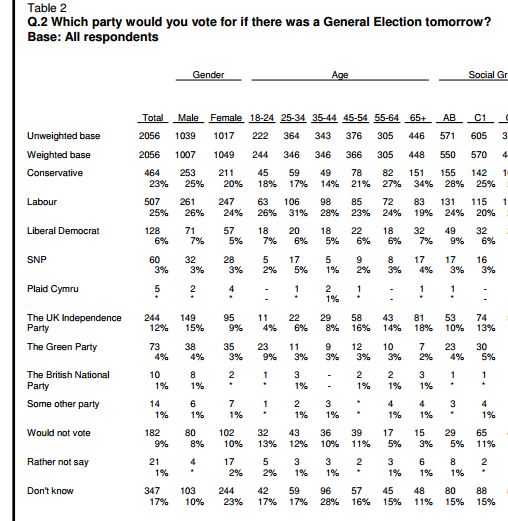
This is an extract from the most recent Populus Voting Intentions Poll:

CaptureOn Friday, Faisal Islam noted the huge difference between the voting preferences of the young: 18-25; 25-34 and 35-44 (all of whom show a strong preference for Labour) and the old: 65+ being the only group showing a strong preference for Conservatives.

The Conservatives responded, today, by announcing that they would extend the Pensioner Bonds scheme of which, as I put it:

So which came first? The chicken or the egg?

In an idle moment – ha! – I trawled back through the Budgets and Autumn Statements of this Parliament to look for measures targeted specifically at the young and old. How have those groups borne the burden of those public spending decisions?

Such an exercise quickly runs aground because many of such measures are not specifically costed. Either you include measures only if specifically costed – which leads to one kind of distortion – or you confine yourself to looking at changes to tax and benefits (which are always costed) but ignoring age-specific non-tax or benefit changes (pensioner bonds, student tuition fees, Public sector pensions, etc). I chose the latter.

Sometimes, the costs change between when the measures are announced and when they are implemented. Again, for the sake of consistency, I have given the costings for the first period for which full costings are given. If no full costings have been given, I have given the latest provided. I can’t promise to have done this exercise perfectly – tracing through the full costings of measures announced with prospective effect is complex – but what I have done follows.

2010 Budget:

  • introduced the following measures benefiting +65s: introduced the pensions triple lock (£5,730m), pension credit minimum income guarantee (£3,170m)
  • introduced the following measures hitting -21s: restriction to Sure Start Maternity Grant (£375m), abolition of health in pregnancy grant (£640m), abolition of Child Trust Fund (£2,530m), abolition of Savings Gateway (£410m), conditionality for lone parent benefits (£1,390m), second income threshold for family tax credits (£660m), child tax credit remove baby element (£1,395m), child tax credit reverse supplement (£900m), freeze child benefit (£5,185m)
  • introduced the following measures benefiting -21s: increase child tax credit plus above indexation (£8,910m)

Net Effect: Over 65s gain £8,900m; under 21s lose £4,575m

2010 Comprehensive Spending Review:

  • introduced the following measures benefiting +65s: Cold weather payments (£200m)
  • introduced the following measures hitting -21s: withdrawal of child benefits to higher rate taxpayers (£10,110m), changes to working tax credit for families (£4,290m), child tax credits – use RTI (£1,010m)
  • introduced the following measures benefiting -21s: increase in child tax credit (£1,805m)

Net Effect: Over 65s gain £200m; under 21s lose £13,605m

2011 Budget:

  • introduced the following measures hitting -21s: abolition of Employment and Support Allowance NICs concession £35m

Net Effect: under 21s lose £35m

2011 Autumn Statement:

  • introduced the following measures hitting -21s: reversal of changes to child tax credit (£4,940m), freeze working tax credit (£1,385m)

Net Effect: under 21s lose £6,325m

2012 Budget:

  • introduced the following measures hitting +65s: freezing of age-related allowances (£3,290m)
  • introduced the following measures hitting -21s: threshold and tapering of child benefit (£1,505m)

Net Effect: under 21s lose £1,505m, over 65s lose £3,290m

2012 Autumn Statement:

  • introduced the following measures benefiting +21s: increase child benefit (£175m)

Net Effect: under 21s gain £175m

2013 Budget:

Nothing

2013 Autumn Statement:

  • introduced the following measures hitting +65s: limiting foreign winter fuel payments (£20m)
  • introduced the following measures benefiting +21s: abolition of Employers’ NICs for under 21s (£1,945m)

Net Effect: under 21s gain £1,945m, over 65s lose £20m

2014 Budget:

As I have discussed here the 2014 Budget showed a yield from the introduction of pensions flexibility. That yield flows from the assumption that pensioners will choose to draw money from their pension pots earlier than they would otherwise have done, with a consequential acceleration of income tax receipts. The fact of this projected yield – of £3,045m – does not seem to me to justify the introduction of pensions flexibility as a measure “hitting” pensioners. I have also not included – as the expenditure thereon constitutes neither tax nor benefit expenditure – the initially (i.e. before today’s extension) projected £215m cost of pensioner bonds.

2014 Autumn Statement:

  • introduced the following measures benefiting +21s: exempting children from air passenger duty (£390m)

Net Effect: over 21s gain £390m.

If one nets off all of these figures over 65s have gained in changes in tax and benefits during the life of this Parliament £5,790m and under 21s have lost £23,535m.

Chicken or egg? I don’t really care whether the Tories have fed the demographic that keeps them in power; or pensioners vote for Tories because of their policies. And I’ll leave others to consider the question of fairness. But I will say this: my assessment of the answer to that question will be the decisive factor in how I vote come May.

Note: Updated on 8 February at 17.45 to correct a double counting error.

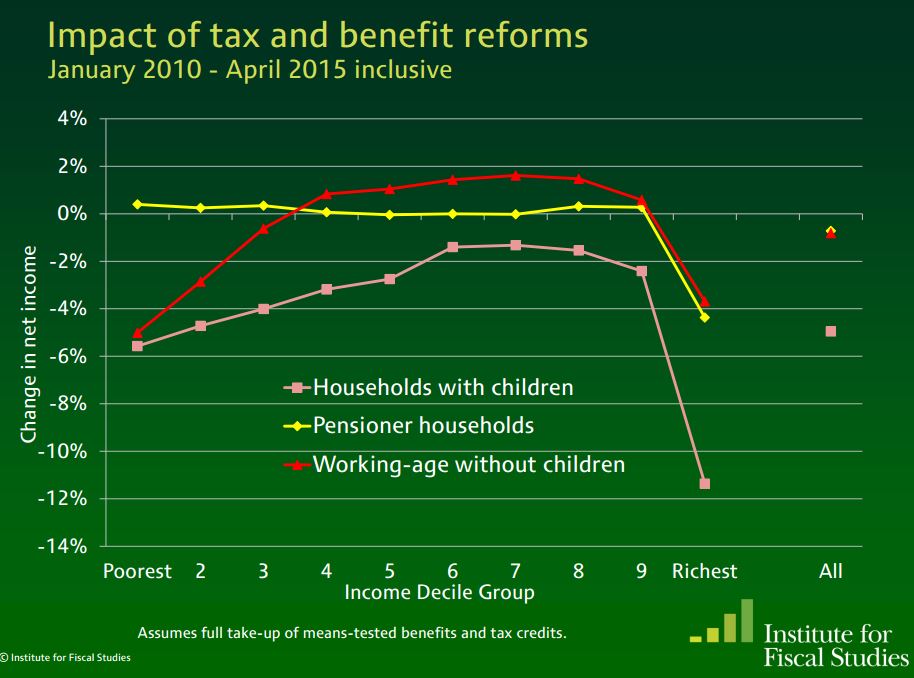
Further Note: the knowledgeable and helpful Heather Self – @hselftax (and well worth a follow) – has pointed out that the IFS has done a similar exercise showing the effects of tax and benefit reforms on household income. Here’s one of several relevant slides.

Capture

The social construction of multinational firms’ tax behaviour. Guest post by @MartinHearson

This week I am trying to help the undergraduate students that I teach to understand a range of scholarship that uses social constructivism to study the political economy. When you go back to first principles to teach something you often see some of your own work in a new light, and that is what I am going to write about today. I’m briefly going to sketch out some social constructivist thoughts about multinational firms’ tax behaviour.

For a side project I’ve been reading some of the academic literature on tax compliance. There’s a great summary of the different theoretical perspectives on tax compliance in this working paper by Odd-Helge Fjeldstad and colleagues. The authors divide them into five:

  1. Economic deterrance. This is the classic rational choice framework, in which taxpayers weigh up the incentives, essentially the tax rate versus the penalty and the probability of being caught.
  2. Fiscal exchange. This is where the notion of ‘quasi-voluntary compliance’ comes in. If taxpayers think they will receive something in return – public services, in other words – they are more likely to pay. Although the evidence for this, according to the ICTD paper, is weak.
  3. Social influences. The final three positions, which I am going to appropriate into the social constructivist field, have stronger evidence to support them than fiscal exchange. The first is that tax compliance relates to perceived social norms: if they think their neighbours are honest, people are more likely to be honest themselves.
  4. Comparative treatment. From this perspective, people are more likely to comply with tax rules if they think the system treats them fairly relative to their compatriots.
  5. Political legitimacy. The final constructivist view is that if people trust the government and the tax authority, they are more likely to comply.

There are loads of empirical studies looking into the determinants of tax compliance behaviour among individuals and small businesses. It’s fascinating, but I think I found a big gap: I didn’t find a single study explaining the attitude to compliance among large businesses (or, to clarify, I found studies about staff compliance with management decisions, but not about compliance with externally-derived rules and regulations).

What do I mean by compliance? Trying to define this could easily veer into a discussion about tax morality, but that’s not where I want to go. We know that multinational businesses have a degree of choice over how aggressive their tax position is, and I want to ask, empirically, “what determines this?” Most of the existing work examining multinational firms’ decisions about their tax affairs tends, I think, to be situated in the rational choice, economic deterrance framework. According to that view, the first theoretical position listed above just needs to be adjusted to reflect the additional risks faced by businesses, in particular the reputation risk attached to aggressive tax planning (here is a paper that tries to do this empirically). Current discourse suggests that this risk is increasing, andbusinesses are revising their positions in response.

John Maynard Keynes

It all starts with Keynes…

This is where my undergraduate class comes in. We could argue that large business decision-making is more likely to be rational than that by small companies and individuals, because a successful large organisation has to create systems that obtain the right information and use it effectively. But a growing trend of political economy work, especially since the financial crisis, has focused very much on the fact that behaviour in financial markets (often by actors who are part of very large companies) can’t be explained solely through rational choices. My students are reading Andre Broome’s excellent introduction to constructivist international political economy, which refers to work in this vein on capital account liberalisation, european monetary union, and behaviour within financial markets.

Economic constructivist thought is often traced back to John Maynard Keynes’ analysis of how actors in financial markets deal with their inherent uncertainty. According to another useful book chapter by Rawi Abdelal and colleagues [pdf]:

Keynes lists “three techniques” economic agents have devised for dealing with this situation, all of which are inherently constructivist. First, “we assume that the present is a much more serviceable guide to the future than a candid examination of the past would show it to have been hitherto.” Second, “we assume that the existing state of opinion … is based on a correct summing up of future prospects.” Third, “knowing that our own judgment is worthless, we endeavor to fall back on the judgment of the rest of the world … that is, we endeavor to conform with the behavior of the majority or average…to copy the others … [to follow] … a conventional judgment.” In short, Keynes’ macro-economy rests upon conventions, that is, shared ideas about how the economy should work.

As the works cited by Broome show, this insight has been applied beyond financial markets to many other processes involving decision-makers and market actors. So why not multinational taxation? If we decide to do so, we can come back round to the theoretical perspectives I set out at the start. Perhaps the calculation about how much uncertainty to build into a company’s tax position is subject to the kinds of conventions identified by Keynes. And perhaps, beyond just uncertainty, the social conventions that influence business decision-making about taxation incorporate perceptions of social norms among decision-makers’ peers, as well as notions of comparative treatment and political legitimacy.

Here is one example, a quote from a survey of corporate tax directors [pdf] conducted by Judith Freedman and colleagues back in 2007 (and which it would be interesting to repeat now). There are remarks here that might support the fiscal exchange, social influence and political legitimacy theories:

One respondent said that his firm’s CSR policy does not extend to paying more tax than is due under the law; they are not interested in ‘making donations to Government’. Others echoed this view, arguing that they could spend their tax savings more wisely than the Government could. At least two firms suggested that there would be a greater social aspect to taxpaying if the amounts collected were earmarked for particular public services, rather than going into general revenue.

Social constructivists devote a lot of time to identifying and analysing the different groups among which social conventions form. There will be overlapping communities within and across companies, including for example the Davos elite, the tax function, social classes, nationality, and so on. I’ve written previously about a paper that touches on transfer pricing practitioners as a social group.

Corporate decisionmakers will have different information depending on their membership of different communities, but they may also be influenced by different social norms within their communities. This morning, for example, Chris Lenon suggests that corporate tax advisers are frustrated by what they see as a lack of rationality on the part of their boards, reporting “a gap between [tax advisers’] perception of the direction of travel in this debate and the denial of this at Board level because of the impact on earnings.”

I understand the normative case against using social norms to make up for deficiencies in the law, as well as the populist argument to the contrary. But I wonder if that debate might be seen in a different light if we begin from a constructivist ontology, in which, like it or not, social norms of one kind or another have always conditioned corporate tax behaviour.

[Ed’s note. Martin published this on his own blog yesterday. I am a big fan of Martin’s: he brings some academic rigour and by golly, I need it. You might do too.]

In which I ramble on, and on, about Inheritance Tax

It’s a strange tax, the Inheritance Tax. It raises, in relative terms, a vanishingly small amount of money – some £3bn of an aggregate tax take of almost £500bn. It is paid by a tiny number of people – some 16,000 per annum (3% of all estates). And yet it possesses a unique status as a kind of fiscal shibboleth, separating a ‘them’ and ‘us.’

Unique, unless of course we make the heroic assumption of a Labour victory in May, where it will be joined by a further shibboleth – someone out there will point out the plural, assuming also heroically, that a shibboleth is a notion such as can possess a plural – namely the Mansion Tax. That tax, too, will be paid by a tiny number of taxpayers. And as with the Inheritance Tax (remember Gordon Brown backing off a snap election when the Tories announced proposals to extend the nil rate band? It’s tempting to speculate on how different the political and economic landscape might now look had he held his nerve, fought and lost, leaving the Tories in control during the credit crunch. Tempting, but…) it’s a feature that dilutes not at all its potency.

I will allow myself this speculation though: one reason why they share this political potency might be that they are both wealth taxes. They get the newspaper barons up and out. For those, like me, who would like to see income taxes on productive strivers reduced in favour of wealth taxes on (in particular) economically fallow assets, it would be nice to think of the political success of the Mansion Tax – hugely popular with the electorate – as emboldening a future Labour Government or Opposition. Sadly, or so it seems to me, this Opposition has largely taken as its motto Matthew 5:5 – that the meek shall inherit the earth. But I’m yet young. I can wait.

You, on the other hand, might be less so. Where is he going, you might quite reasonably ask? I suppose it’s here: why is it that the Inheritance Tax – a tax paid by the donee on wealth she has not earned – is a political liability for Labour but the Mansion Tax a success? And the answer, I’d like to venture, is a matter of design. The Inheritance Tax is badly designed. It’s badly designed in technical terms. And it lacks popular legitimacy: it’ll only ever be a vote loser for Labour. The Mansion Tax, on the other hand, whatever its technical failings, is popular.

Poor technical design first. The cost of reliefs from Inheritance Tax is huge. The tax itself raises, as I have said, £3.1bn but the cost of the reliefs is more than seven times this at £22.4bn. Indeed, the real figure will be higher: the £22.4bn is the aggregate cost only of the 13 (of 88) reliefs from inheritance tax that HMRC publishes costs for.

True it is that much of that cost reflects a modelling decision. The joint nil rate band of £650,000 accounts for all but £4bn of the £22.4bn. And the level of the nil rate band reflects a political choice. The purpose and design of other reliefs is less clearly comprehensible.

Particularly difficult to understand is the privileged treatment given to agricultural property – holdings of farmland together with a ‘farmhouse’ on that land. The need to ensure food security might once have been advanced as a rationale for the relief. But if so, it is difficult to understand: the rationale is achieved by planning controls which limit the uses to which land can be put. However you tax the land, it cannot be used otherwise than to generate income through farming. Also ventured is the need to protect farms from being broken up on death: but I can understand neither why farmland should benefit from such privileged treatment nor how agricultural property relief achieves this goal.

As things stand, agricultural property relief is merely the latest and safest iteration of a kind of fiscal polo – the game played exclusively by the wealthy of ‘mitigating’ inheritance tax bills. Put your money into agricultural property and you can safely escape liability to inheritance tax. Indeed, with other mechanics for avoiding liability to the tax having slowly disappeared, farmland’s privileged status has seen its value – and indeed the cost of agricultural property relief – escalate sharply. The cost of agricultural property relief has tripled since 1999/00 whereas revenues from inheritance tax have remained broadly flat. This increase in the cost of the relief will partly reflect the increase in the values of farmland which have roughly quadrupled over that period (an increase itself likely to be a function of the slow loss of alternative inheritance tax avoidance mechanics). And it will also reflect the growing frequency of use of agricultural property as a token for avoiding inheritance tax – one that you buy old so that it sits, economically underproductive, in your estate for only a short period of time – and which changes hands frequently, forever being sold by younger to older hands.

I pause to note that, taxed as such, agricultural property does not derive its value from its capacity to generate income; this is likely to contribute to it being utilised less than optimally; and these effects are likely to be amplified by frequent changes of ownership. Anyway.

But what of popular legitimacy? The Tories, it has been widely speculated, plan to add to their raft of questionably funded tax cuts (in particular the increase in the income tax personal allowance to £12,500 and the raising of the point at which the 40p rate kicks in) by raising the Inheritance Tax joint nil rate band to a satisfyingly round £1m. Estates of a value below this figure will pay nothing, estates of a value above it may (because of the 36,000 estates valued at above the threshold, 20,000 did not have to pay inheritance tax because of the reliefs for which they qualified) pay 40% on values over it. This, they anticipate, and no doubt rightly, will be hugely popular.

A confession. Like Margaret Thatcher I am not a fan of shrinking the tax base. It might be politically expedient – everyone’s favourite tax is one that someone else has to pay – but it represents bad policy, rendering the yield ever more volatile and susceptible to economic and political shocks. I believe we should all pay something: an amount both reasonable and according to our means.

And the big problem with the current design of Inheritance Tax is that it fails on both scores. Why should those with estates less than the predicted £1m pay nothing? And why should those with estates above suffer a reduction in wealth of a number as high as 40%?

I’m not aware of any polling on the issue but I would hazard that the reason why changes to IHT are such a potent political weapon for the Tories is that the rate is so widely perceived to be too high. A 40% wealth tax on death is a tax set at a level as to lack legitimacy – and so to generate fiscal rebellion in the form of avoidance mechanisms. Gandhi’s Salt March is our fiscal polo.

Cut the confiscatory rate from 40% to 20%, lower the joint threshold to £500,000 (or lower) and fund the difference by abolishing agricultural property relief. And take a long hard look at the 87 other reliefs. There’s a truly radical reform. One which will reduce avoidance, be as close to tax neutral as matters, and be hugely popular.

[NB: for those interested, the distributional impacts of such changes would create a big loser of estates at £500,000 (which would see an increase in tax of £30,000). This increase would reduce until the estate hit £725,000 (at which point the changes would be tax neutral). Above this, and leaving aside the effects of abolishing APR and any other reliefs likely to fall hardest on the largest and hence best advised estates, it would generate winners.]

The diminishing authority of the Tax Bar?

Last week, the Solicitors’ Regulatory Authority (“SRA”) published a Regulatory Settlement Agreement (“RSA”) – effectively the result of a plea bargain between solicitor and regulator – in which LZW Law Limited accepted it had failed to act in its clients’ best interests and had acted in transactions in which there was a significant risk of conflict between the interests of two or more clients.

The RSA arose from an investigation into LZW’s participation in certain schemes – once commonplace, now less so – which had as their intention the avoidance of stamp duty land tax on certain (typically residential) purchases. LZW’s financial interest in those schemes was modest: it charged each (and there were 203) client between £250 and £500 for the extra work involved in effecting the scheme. The lion’s share of the profits on those schemes – typically calculated by reference to the purported stamp duty land tax saving – would have been enjoyed by the promoters.

As others have observed, the fine paid by LZW was a relatively modest £2,000 plus costs of £6,965. The aggregate of these sums is, as can immediately be seen, substantially less than the fees earned by LZW. Others have found this difference remarkable; for what little it’s worth, I do not.

What interests me is the role of Counsel in the scheme.

The conflict of interest referred to in the RSA was between LZW’s borrower clients (those purchasing the properties in question) and its lender clients (providing the monies by which the purchases were to be effected on the strength of the security in the property). It is a common feature of stamp duty land tax avoidance arrangements that they can impair the quality of the lender’s security. Although there is no explicit finding that these arrangements had that effect, the RSA does state that LZW had failed to disclose “material” information to its lender clients (being the borrowers’ participation in the schemes).

In mitigation, LZW pointed out that it had taken advice from Counsel as to whether it was obliged to disclose to lenders the fact of its putative borrower clients having entered into SDLT schemes. To this the RSA observed:

Capture

That “However” is rather troubling. It is not said that the barrister (who, sadly, goes unnamed) is not competent to give that advice. Nor is there any finding that the barrister – instructed by LZW and owing a duty to LZW – has a conflict of interest. Indeed, one might consider that, if the SRA regarded the barrister as having had a conflict of interest, that would have mitigated LZW’s breach because the fault would have been the barrister’s rather than LZW’s.

However, if one proceeds, cautiously, from the assumption that the barrister had no conflict of interest one is left in a rather uncomfortable position. The SRA has held, in effect, that the degree to which a solicitor can rely on a barrister’s advice is dependent on whether the barrister has advised on a related tax avoidance scheme.

If this is right, we have two tiers of specialist tax barrister: those the SRA recognises the bar’s clients can fully rely on and those they cannot.

Why do we persist with the high VAT registration threshold? Guest post by Graham Elliott

You would have to have been living in a bubble in early December not to have noticed the outpouring of anguish by a mighty handful of micro-businesses upon discovering, somewhat late in the day, that the new arrangements for VAT on electronically delivered services (AKA ‘Mini One Stop Shop – MOSS’) would interrupt their VAT-free way of life forever.  These very small businesses, often run by one or two entrepreneurs, do not account for VAT because their turnover is below the UK mandatory annual threshold for VAT registration which, at the time of writing, sits at £81,000.  The new regime, which applies from 1 January 2015, requires businesses of any size to register for and pay VAT in member states of the EU where electronically delivered services have been sold to their residents on a B2C basis.  The threshold for this is ‘nil’.  It requires all suppliers to register for MOSS and complete quarterly returns.

Micro-businesses were astonished that they would be caught in this VAT requirement despite trading below the domestic thresholds.  Whilst they managed to negotiate with HMRC a side-step of certain rules, to allow them not to have to pay UK VAT simply in order to be registered for MOSS, nothing could be done to absolve them from the requirement to account for VAT on minimal levels of sales in other EU countries.  We were told that some of these businesses would accordingly close, having been strangled to death by red tape. Some would ensure that people from outside the UK were unable to buy their products, and others would intervene manually so that their services were not electronically delivered, in order to continue with a clunkier version of the status quo.  Meanwhile, there is no discernable reaction from micro-businesses of any other EU state, where, perhaps coincidentally, the average domestic VAT threshold is much lower.

The uproar this caused was the first time in ages that anybody focused attention on the UK having a VAT registration threshold which is several times average employee earnings.  It seems almost to be accepted that this is a normal state of affairs and that micro-businesses should be able to operate in a VAT-free environment in order to shelter them from the crushing potential competition of larger operators and the general turbulence of commercial life.  But if we gaze across the channel we see a distinctly mixed picture which, nonetheless, shows how extreme our threshold has become in comparison.  France for instance has a threshold of just over €30,000.  The threshold in Germany in less than €20,000.  Austria and Belgium have a threshold of between €25,000 and €30,000.  Spain is not the only one to have a general threshold of ‘nil’.  Even Ireland, which has decided to use two different thresholds, has a services provision threshold of less than €40,000.  Why is the UK so different that it should have a threshold of around €100,000?

Specious reasons?

It is oft stated that the main reason is to protect embryonic businesses until they are large enough to bear the cost of VAT.  If that were true, then the threshold would not be based on taxable supplies alone, but would incorporate a test for overall size.  The current rules allow a significant exempt business to make minor levels of taxable supplies but still remain unregistered.  It also seems fairly obvious that a business does not magically grow the muscles to compete with genuine medium sized and large operations once it exceeds £81,000 turnover.  On the contrary, so significant is the potential difference in tax liability for any B2C operator in the UK, that the main impact of micro-businesses not having to be registered for VAT is that they can run an inherently uncommercial business model on a footing which is just about commercial, but which, if scaled up enough to incur the VAT costs, would simply not be a business proposition.  That might be a charming idea where a genuine hobby business is concerned, but one can run an activity far removed from a true hobby at a figure under £81,000.  So it appears that the VAT threshold does not so much nurture small businesses until they grow up, but creates an artificial environment where certain kinds of activity, as long as they always remain small, will survive.  It is a bonsai environment.  And it undercuts and thus weakens genuine growing businesses.

No-one mentions whether the real reason is that it costs more for government to administer and collect from micro-businesses than justifies the revenues that might arise from them.  I speculate that no-one mentions this because it would immediately spotlight an unfair comparative burden on those businesses which seek to grow their bonsai into something rather more impressive, and which are having to pay for the government’s wish not to become involved in uneconomic tax collection.  But, for the tax system to work properly, it must work relatively even-handedly, so that tax does not become a determinate of success or failure.  If we were to assume that the threshold had been set simply to save government money, the government would not be fulfilling its duty to provide a balanced tax system.  This incentivises government to allow us to think that the threshold is a ‘pro-business’ policy.

Business infantilism

The problem which this creates is significant.  Businesses that mainly work for private consumers are then faced with a major disincentive to grow beyond their infantilised state.  One or perhaps two people can make a living without ever having to charge VAT.  But if they decide to take on one or two employees, with all the attendant risks of trying to scale up, they immediately nudge into VAT territory.  Since VAT registration works rather like residential SDLT used to do before the Autumn Statement reform, namely that once you have crossed the threshold you pay tax on every penny of taxable turnover, rather than merely the excess over the threshold, the person who makes a penny more than the threshold finds himself facing an enormous tax charge.  The marginal rate on that penny is colossal.  The cost of being a penny over the line can easily be £10,000 per year (or more) and this means that the business makes a loss out of joining the VAT club until it adds more than £10,000 to the turnover it reached when it joined the club.  That is an enormous increase in percentage terms and one cannot see any reason why an organisation would wish to do it unless it had an extremely strong conviction of its ability to grow far beyond that scale.  For many businesses only a much bigger scale will ever be viable, but there are businesses where that is not true.

So, the policy of having a high registration threshold ensures that certain businesses are locked into an infantile state and that the talents of their entrepreneurs can never be tested beyond the foothills of what they might have achieved.

Furthermore, a set-up of that kind encourages the fragmentation of a business into several different legal entities in order to escape VAT registration.  If you set the threshold low enough, the threshold at which businesses have to be split in two, three, or more sections, in order to try to avoid the VAT registration requirement, becomes so low as to not be worth the effort in doing so.  Set the threshold as high as we have, and much less fragmentation is needed in order to remain below the threshold.  Whilst HMRC has weapons against fragmentation, the conditions have to be in place and it has to have noticed the issue.  The position would be more clear-cut if the threshold were lower, since it would be harder to defend a position of there being several businesses operating over such a small aggregate economic value.

Taking this point further, it is perfectly, and legally, possible for a B2C trader not to charge VAT because he can run his business below the threshold.  That means he is not regularly distinguishable from the evader – the cash-in-hand operator whose failure to account for VAT is dishonest.  If you bring the threshold down to the extent that it is almost inconceivable that an honest tradesman need not charge VAT, then the general public can have no excuse for accepting a situation where VAT is not charged.  Indeed, in that situation the minuscule businesses that might still theoretically operate below the threshold would find it worth their while to register for VAT sooner rather than later in order to avoid the stigma of appearing to be on the wrong side of the law.

Administrative burden?

Having said that, what level of administrative burden this would create?  First, I postulated that the government perhaps thought that collecting VAT from micro-businesses was not cost-effective.  That certainly might have been the case up until the inception of mandatory electronic filing of VAT returns.  We are now in a situation where the postal costs are eliminated.  It could once have been said that there were no techniques for controlling the compliance of very small traders.  Now the greater sophistication of data analysis open to HMRC must surely make that viable.  Furthermore, there is simply more of the national economy tied up in micro-businesses now than there was in the bad old days when entrepreneurialism was not thought to be a good thing.  The threshold is probably omitting a great proportion of the economy.

As for the administrative burden on the micro-businesses, of course nobody running their own business from head to toe wants another piece of red tape.  But let’s face it, business has been incurring more and more red tape over the years, and there is no logic under which an important aspect such as paying sales taxes should be regarded as being some kind of ‘last straw’ for small business.  Annual accounting reduces VAT return submission to once per year (though not under MOSS).  A flat rate scheme is available to all traders up to £150,000 which means they do not even have to keep purchase records (though, again, MOSS is different).  The most basic bookkeeping would in any case furnish the relevant information, and good book keeping is something we would want to encourage in any size of business.  It is difficult to see how the bureaucratic burden of operating VAT is of such importance that we should continue with a fiscal distortion which is so far adrift from that of most of our EU counterparts.

Even if we were to bring our figure down to £30,000, we would still be broadly speaking at a higher level then is average across the EU.  Of course, there would be a blaze of objections from micro-businesses.  They have so much to lose.  The approval of those businesses which have struggled northwards of the threshold against the odds would probably be more muted, but they would be silently grateful for the unfair fiscal competition being addressed.  But it takes a government of conviction to consider what is best for the country rather than what is best for their next stint at the ballot box.  It needs politicians who are prepared to think the unthinkable, to shed some ingrained ideas as to what is good for business, and take the bold course of action.

Or, if all of the above appears to be too self-assured, and too uncompromising, then let the economists and the politicians step forward to explain why the UK is uniquely sensible in maintaining such a high registration threshold and what it really brings to our economy and our British way of life.

Graham Elliott – Withers LLP

You can, and indeed should, follow Graham on twitter @VatDaddy

The Uses of Morality in Tax

Walk down the street today and eight people out of every ten you ask will tell you that, at the moment, it’s all too easy for multinationals in the UK to avoid paying tax. That’s what a recent ComRes Poll for Christian Aid says. The poll goes on to observe that eight and a half out of ten individuals regard it as unfair that they have to pay their taxes whilst multinationals seem to avoid having to pay theirs. But only one and a half would agree that the fact multinationals are acting within the law means there’s no moral issue at stake.

What use can we make of these data, those of us who work in the tax arena? Is it enough to adopt the position that, as for example Prof Judith Freedman has argued, tax is uniquely an arena in which there is no place for morality. As she puts it: “how much tax should be paid is not a question of moral intuition but a question of what is imposed by law.”

To find the answer to this question, it seems to me, one must start with the “we”. Different groups of people – advisers, businesses, investors, consumers, voters, policy makers – all consider the moral aspect of taxation. But all in different ways.

But before turning to consider the uses made of morality by these different participants in the debate around the relationship between tax and morality, it might just be useful to start with a truism: that which is legal isn’t always moral. Discrimination on the grounds of “colour” (to use the language of the Act) did not become immoral only on 8 December 1965 when the first Race Relations Act received Royal Assent.

I start with that truism because it is only if we lose sight of it that we can regard the question ‘Does XCo wrongly avoid tax?’ as properly addressed by the response ‘XCo complies with all relevant tax laws in all the jurisdictions in which it operates’. It is only if one loses sight of it, too, that one can conclude (against the evidence – which I shall go on to discuss) that there is no use to which morality can be put.

What of us, the advisers? What part does morality play when we exercise that function?  No one, you may well say, comes to a tax adviser for a homily. We lack – most of us, anyway (Mike Truman ‘Emeritus’ Editor of ‘Taxation’ is a Licensed Lay Minister) – the qualifications. What we provide is a pure technical view: the tax result produced by a transaction.

However, even this, the apparently easiest of statements elides a number of difficulties. Advising a client as to his prospects of succeeding in litigation, I would be heavily influenced by my assessment of whether his use of a particular relief was pro- or anti-purposive. That technical assessment of prospects would map closely to my view of the morality of a transaction that accesses a relief provided for by Parliament. And not only mine: as I have observed elsewhere, “Judges do occasionally articulate their instinct to fairness against the grain of legislation”. Or as Graham Aaronson QC put the matter in his Report of the GAAR Study Group: “Judges inevitably are faced with the temptation to stretch the interpretation, so far as possible, to achieve a sensible result.”

As a litigator, I try to assess whether the way in which a judge might be persuaded to view the tax effect of a particular transaction will be regarded by her as “sensible”. That assessment, too, often maps closely to my assessment of the morality of that effect. And the task before me if I am advising pre-transaction is an identical task. It is only if I assess a judge as likely to agree with my view as to how the law applies to particular set of facts that I can advise a client that my view is ‘right’.

However, to focus on the narrowest and most technical aspect of an adviser’s function is to risk ignoring the broader reality. Most of my clients want more than a mere technical assessment. They also want assistance in assessing reputational risks. But I can more easily address that facet of the debate around tax and morality if I wear another hat: that of the CEO.

It is a commonplace that reputational issues are of increasing concern to businesses. Three quarters of CEOs surveyed by PWC agreed it was important that their company was seen to be paying its ‘fair share’ of tax. And four-fifths said that tax was moving up the corporate agenda.  What is particularly revealing about this analysis is that CEOs, like individuals surveyed by ComRes for Christian Aid, understand that the debate about good tax practice has moved beyond achieving mere compliance with rules which no longer work as they should. In that PWC survey, 65% of CEOs recognised that “the international tax system hasn’t changed to reflect the way multinationals do business today.” That sophisticated participants such as CEOs, too, hold these perceptions should stand as counterweight to any temptation to disregard the results of the ComRes survey as merely the product of public ignorance.

Why should businesses hold these views? There is a variety of, on analysis, discrete concerns. Not all will be present for all types of businesses. But they all tend in the same direction.

Businesses – and especially those doing or hoping to do business with Government – often regard the retention of a Low Risk rating with HMRC as of value. I am aware of instances where clients have chosen not to litigate cases, even cases entirely outside the avoidance sphere, because of a perception that to litigate would jeopardise that rating. And in the avoidance sphere Government has, of course, explicitly encouraged this tendency through its procurement policy.

But there are far from the only points at which tax and morality intersect for those running businesses. The effects of the rise and rise of the Corporate Social Responsibility agenda on tax behaviour have been magnified by an increasing public interest in tax.  These two distinct features have created obvious challenges for, in particular, consumer facing businesses.

But what of B2B operations? These are, of course, less susceptible of consumer boycotts and, it is fair to say, can enjoy aquiet the fiscal fruits of that type of planning the merits of which can be expressed simply as ‘lawful’. But not too fast. We can all think of a particular professional services firm which has become the unwitting – and many would say undeserved – poster-child for particular types of tax planning involving one of the smaller members of the European family.

Moreover, management’s stance on tax is plainly a matter of concern to institutional investors. On 4 November 2014 the Financial Times carried a terrific piece ‘Aggressive Tax Avoidance Troubles Large Investors’ revealing the tax concerns of institutional investors. These funds are concerned at the reputational impact for them of investing in companies with “aggressive” tax policies and they are concerned at the sustainability of the post-tax profits those policies deliver. The conjoint effect of those concerns is that certain fund managers regard a disclosed low tax rate as an investment red flag.

If, as the Financial Times argues, we do reach a point where the post-tax income gains of certain types of tax planning come to be appreciated by business owners as delivering a negative hit to the capital value of their businesses then us advisers really are going to need to expand our skill-sets

For the consumer, the equation is a simple one. The ComRes poll reveals that a quarter of consumers are currently boycotting a company because they perceive it not to be paying its fair share of tax in the UK. And two fifths of consumers are considering doing so. And we don’t need to take the commercial effects of these actions on trust. A recent study for the Oxford Centre for Business Taxation found that:

The evidence suggests that the public scrutiny sufficiently changed the costs and benefits of tax avoidance such that tax expense increased for scrutinized firms. The results suggest that public pressure from outside activist groups can exert a significant influence on the behavior of large publicly-traded firms.

As to voters, there is no doubt that it is the perception of politicians that tax policy is a voting issue. Labour has sought to place public perceptions of Tory tax policy at the heart of the pre-election debate. The Conservatives have responded with measures to tackle tax avoidance by multinationals that have those (remarkably) right across the political spectrum crying that they go too far. Someone has got this political assessment wrong: either the tax commentariat or George Osborne. I know who my money’s on.

Standing back, what does all of this tell us about the question I started by posing? What are the uses of morality in tax? There is, of course, much truth in the notion that morality cannot fix one’s legal liability to pay tax. However, as I have sought to show, that truth is not an absolute one: morality is not irrelevant to the determination of one’s legal liability. And perhaps more important still: it is clearly the case that morality cannot be ignored in determining how much tax it is in one’s self-interest to pay.

The consequences of this discovery pose particular challenges to advisers. We can expect increasingly to be asked the question, ‘what tax should I pay’? This will take many of us into unfamiliar territory.

Morality has its uses. (Forgive me if I interrupt the argument to note that is an assertion you are unlikely to encounter outside the pages of this post.) But as a tool for delivering tax outcomes it is highly imperfect: subjective, imprecise, and enforceable indirectly at best. We should be able to do better.

At the Second Reading of the Race Relations Bill Peter, later Baron, Thorneycroft, argued that one should not legislate against discrimination on the grounds of “colour”; it was too soon. As he put it, “The British people can be led, but they cannot be driven.”

He was right albeit only in the narrowest sense. That there be a relationship between law and morality is a basic requirement of the law. The law becomes difficult to enforce if it is too advanced of morality: this was the Baron’s contention. However, the law falls into disrepair where it fails to keep pace with changing mores. And that, Dear Reader, is what we have here.