Is Article 50 reversible? A primer on the Dublin case.

The so-called Dublin Case seeks to establish whether we can unilaterally – ie without the consent of the other 27 member states – withdraw our Article 50 notification.

What follows is a list of frequently asked questions, which I reserve the right to add to over time.

Why is the case important?

Once Theresa May has triggered Article 50 – likely to be in March of this year – we will leave the EU unless we change our mind about the wisdom of that course.

If we do change our mind, there is no doubt that, if the other 27 Member States agree, we could withdraw our Article 50 notification. But it is also possible that we have a unilateral right, which we could exercise without needing to seek their agreement. And it is obviously preferable that we have control over such a decision.

How far has the case progressed?

Because the question whether a member state can unilaterally reverse its Article 50 notification is one of European Union law, it can only be answered by the Court of Justice. And obtaining an answer involves two stages. First a national court needs to refer the question to the Court of Justice. And, second, the Court of Justice needs to answer it.

On or before 27 January we will issue proceedings in the High Court in Dublin. We are targeting a hearing in early April on the question whether it should make a reference to the Court of Justice.

If it does, we know from past experience that the Court of Justice can give a decision within three months of a question being referred to it.

Of course, these timescales will depend, in particular, on the attitude that the Irish courts takes towards the question of a reference. And the speed with which the Court of Justice is prepared to hear the case.

You can read the most recent press release here.

Is this an attempt to block Brexit?

The question seeks an answer to a legal question ‘can a state that has triggered Article 50 later unilaterally withdraw its notification?’

If the Court of Justice answers that question ‘yes’ it leaves the question ‘does Parliament want to withdraw its notification’ for our democractically elected Parliament.

So the case does not enter the political sphere – it leaves the political questions, rightly, for the politicians.

I should add that I did vote to Remain in the Referendum and, were we hypothetically to have another referendum tomorrow, I would vote the same way.

Who is funding the case?

The £70,000 anticipated cost of the proceedings before the Irish High Court was crowd-funded from small donations. There were almost 1,300 donations of £25 or less and over 1,700 donations of £50 or less.

It is possible there will need to be further monies raised to fund the Irish litigation. And if a reference is obtained to the Court of Justice in Luxembourg there will certainly need to be a further fundraising.

You can read what I said at the time of the first fundraising here.

It should be noted that the lawyers are acting at below market rates. And that I will publish as much of the material as I can. You can read our Letter to the Irish Advocate General here: ireland-letter-before-action

What is the Government’s stance on revocability?

The Government’s stance is a political one: it says that it does not intend to revoke Article 50 and David Davis claims not to know whether it could if it wanted to:

one of the virtues of the article 50 process is that it sets you on way. It is very difficult to see it being revoked. We do not intend to revoke it. It may not be revocable—I don’t know. That is the route we are going down. I expect, at least at that point, that people’s calculation will change from, “How can we make them change their minds?” to, “How can we best deal with this?”

However, it is at the very least highly surprising that it has not sought legal advice on the question (although it is possible that David Davis is not aware of that advice). And the fact that the Government does not say that Article 50 can’t be unilaterally revoked is telling.

It is also worth saying this. No one, acting rationally, chooses to make a momentous decision earlier than they need to and before they have the fullest possible evidential picture before them. A Government driven by the interests of the country should want to preserve its optionality until the last possible minute. Moreover, it is hard to understand why the United Kingdom Government might argue for an outcome that denuded itself of a unilateral right and left it instead at the mercy of the agreement of the other 27 member states.

If a reference is made to the Court of Justice, what will the Court say?

Of course, nobody knows.

If we did there would be no need for a reference. But the clear preponderance of legal opinion is that a member state could revoke a notification if it had a real change of mind.

There are many examples but:

  • here’s Donald Tusk (then President of the Council) expressing a view (at 24.55);
  • here’s Lord Kerr who is credited with having drafted Article 50;
  • here’s the former Director of the Council’s Legal Service;
  • here’s Sir David Edward, former Judge of the Court of Justice; and
  • here’s a good academic law treatment.

Of course, when the country is making what Theresa May has rightly described as “momentous” decisions we ought to know – not merely think we know – the legal framework within which those decisions are being made.

Why is the case being taken in Dublin?

Whoever makes the reference to the Court of Justice in Luxembourg the answer will be the same. The same court will hear the case and the United Kingdom will have the same opportunities to advance written and oral arguments.

That having been said, the case rests on alleged breaches of the Treaties by the other member states; those breaches can only be asserted in the courts of those other member states; and the Irish courts are the natural choice because Ireland shares an operating language with the UK, has a very similar legal system, and is profoundly affected by Brexit.

What is the position of the Irish court likely to be?

I have taken this case with the benefit of advice from specialist Senior Counsel – the Irish equivalent to our own Queen’s Counsel – and solicitors experienced in obtaining references to the Court of Justice. I am confident it is the right course for me to be taking.

However, I cannot disclose their advice. That having been said, the widely respected Fellow and Associate Professor at the School of Law, Trinity College Dublin Eoin O’Dell has written:

the balance of the argument is that a referral to the CJUE is likely if a case does indeed get off the ground.

What happens if Article 50 is found to be revocable?

In her Brexit speech of 17 January 2017 Theresa May promised:

the Government will put the final deal that is agreed between the UK and the EU to a vote in both Houses of Parliament, before it comes into force.

Michel Barnier has said that the negotiations with the UK will need to be concluded within 18 months of the trigger date to allow time to ratify the deal. And David Davis agrees this is achieveable. So there will be ample time after the deal is concluded for Parliament to consider whether it wishes to accept the deal and act accordingly.

Parliament is supreme and sovereign. Should MPs or the House of Lords reject the deal they would have the (theoretical) so-called ‘cliff-edge’ option of leaving the EU without a deal. But they will also have the (viable) option of remaining in the EU. Or (more likely) putting the question back to the electorate in the form of a Referendum on the Final Deal.

A ‘Final Deal’ referendum has previously commended itself to a number of prominent Brexiters, including Dominic Cummings.

Whether one is likely to happen will be a function of the prevailing popular mood at the time Parliament is required to consider the question. As I explained here, it would be a mistake to assume that the mood today (which is broadly static since the referendum) remains static over time. We have not, after all, at the time of writing, even triggered Article 50 and many things can and will change.

Finally

You can see an interview with me discussing the case here.
Dublin Case – Press Release

BREXIT LITIGATION TO COMMENCE IN THE IRISH COURTS

A letter before action, the precursor step to proceedings in the Irish High Court, will tomorrow (13 January 2017) be issued to clarify EU citizenship rights in the event of the UK’s departure from the European Union.

The proceedings seek a referral to the Court of Justice of the EU of the question whether Article 50, once triggered, can unilaterally be revoked by the British government without requiring consent from all other 27 EU member states.  

If the CJEU were to rule that Article 50 is revocable, it would give the UK power to reject the outcome of Article 50 negotiations and remain in the EU should the Brexit negotiations being led by Brexit Secretary David Davis MP yield a deal that was not acceptable to the UK Parliament or British voters. 

Without this ruling, Britain will be forced to take whatever deal Mr Davis emerges with, or leave with no deal on a range of crucial economic and social issues, including access for British firms to the single market, and the rights of British citizens living, travelling or wishing to retire in Europe.

The Letter Before Action will be made available to recipients of this press release at 5.30pm. The proceedings consequential on that letter before action will be issued on or before 27 January. The claim will target a hearing date of the application for a reference as soon as possible after March.

The Letter Before Action will name Jolyon Maugham QC as the Claimant, however, Mr Maugham holds unconditional written confirmations from several elected United Kingdom politicians that they will act as Plaintiffs. Their names will be made available no later than 27 January.

There are continuing discussions with other elected representatives of whether they will issue parallel proceedings.

Specifically, the Plaintiffs will seek clarification of what rights as EU citizens will be lost (by triggering Article 50 will the UK automatically also leave the single market); whether it is certain that their rights as European citizens will be lost (can Article 50 unilaterally be revoked by the UK); and when they will lose their rights as European citizens (might Article 50 already have been triggered).

The £70,000 costs of the litigation were crowd-funded by Jolyon Maugham QC largely from small donations. There were almost 1,300 donations of £25 or less and over 1,700 donations of £50 or less.

Andrew Marr has said of the litigation: “This is the single biggest problem for May. Potentially… gives Commons its moment.”

Jolyon Maugham QC said: “The United Kingdom must retain sovereignty over the shape of its future relationship with the EU.  If we change our minds we must be able to withdraw the notice without needing the consent of the other 27 Member States. I want to establish clarity for British voters and deliver sovereignty to the British Parliament over the question of its future relationship with its biggest trading partner.”

[The Letter Before Action can be read here ireland-letter-before-action].

On Theresa May’s call for unity

You can watch Theresa May’s New Year’s message here. And what she says is:

“We all want to see a Britain that is stronger than it is today.

“We all want a country that is fairer so that everyone has the chance to succeed. We all want a nation that is safe and secure for our children and grandchildren. These ambitions unite us, so that we are no longer the 52% who voted leave and the 48% who voted remain, but one great union of people and nations with a proud history and a bright future. So when I sit around the negotiating table in Europe this year, it will be with that in mind – the knowledge that I am there to get the right deal not just for those who voted to leave, but for every single person in this country.”

Those who love our country will join her in wanting unity. And, back in November, I tweeted how this might be achieved (see the tweet-storm that begins here).

But trust and respect are no-one’s to command. They must be earned – and by actions. And Theresa May’s give no comfort to those who voted for, or now believe the country’s interests are better served by, our continuing membership of the EU.

Where, as here, a process is divisive it can only be healed with a better one. And that process must look like allowing our sovereign Parliament – for which we took back control – a meaningful role in negotiations. Yet Theresa May has fought tooth and nail to deny Parliament any say.

Her opposition to Gina Miller’s case is because she wishes to deny Parliament the ability to set negotiating priorities for the Government.

And if she loses she will have no option but to ask Parliament to enact legislation to authorise the triggering of Article 50. The Supreme Court will have said there is a constitutional role for Parliament to play. But she has already indicated that she will put a “bombproof” three line Bill before Parliament. She will be compelled to respect the form of the Supreme Court’s ruling but – even before it rules – she has said that she will ignore the substance of that constitutional role.

So, nothing but a formal role for Parliament when Article 50 is triggered. And what about when her negotiating team returns with the deal they strike with the r27? Surely Parliament will then have a say?


Here is what her spokesman said in October:

Downing Street has said it is “very likely” MPs will be able to vote on the final Brexit agreement reached between the UK and the European Union.

Number 10 confirmed the comment by a government lawyer in the High Court represented the “government’s view”.

But, when the Supreme Court hearing was over, she played a different tune.

So, no voice for Parliament before we trigger Article 50. And no voice for Parliament when we return. And misleading the Courts along the way.

This attempt to reserve to herself – and deny to our democratically elected Parliament – its proper role is difficult to swallow given that she has never been offered to the country as Prime Minister.

It is bizarre given that Parliament chose to enact an advisory rather than a binding referendum

And it is staggering in circumstances where the decision she seeks to reserve to herself – the shape of the deal – is a momentous one for which she has no mandate at all: not in the referendum result or in her Party’s Manifesto or in anything else.

And she has taken many other steps that appear almost calculated to drive the country apart rather than bring it together. Let me mention just two.

Why has she appointed three enthusiastic Brexiters to negotiate the shape of our deal with the EU?

Why will she not attempt to negotiate bespoke deals for Scotland and Ireland – respecting the wishes of their electorates?

For many of the 48%, the Referendum result is hard to take. For all who care about our country the divisions that it generated are a tragedy. But the ongoing actions of Theresa May’s Government, which drive the country apart rather than bringing it together, are simply inexplicable.

You can hear me discuss some of the issues I addressed in this post here.


The problem with experts

Among my New Year’s Eve companions was a bow-tied academic sociologist specialising in game theory.

The fun we had.

He told me about his use of the Monty Hall problem with his students. You probably know it but (from wikipedia):

Suppose you’re on a game show, and you’re given the choice of three doors: Behind one door is a car; behind the others, goats. You pick a door, say No. 1, and the host, who knows what’s behind the doors, opens another door, say No. 3, which has a goat. He then says to you, “Do you want to pick door No. 2?” Is it to your advantage to switch your choice?

The answer, for those who don’t know the problem, is that by switching you double your chances of winning the car. And you can prove it mathematically.

When Marilyn vos Savant, who originally publicised the problem, gave that answer she was beseiged by thousands of readers – almost a thousand with PhDs – telling her she was wrong. Professor Bow Tie’s own experience mimicked this: so powerfully counter-intuitive is the answer that, even after giving the proof, he was routinely challenged by students after class.

“What do you say to them,” I asked, “How do you address this conflict between the instinctive and scientific minds?”

“I send them away to do an experiment using playing cards and checking the result.”

I didn’t find this terribly useful. I was, as you will by now have gathered, interested in what insights he might have into how we should engage with those who no longer trust experts and their facts.

But I was grateful for the question.

I don’t write, especially, to defend experts. Their misplaced confidence in the regulation of our banking system may have imperilled the achievements of the Enlightenment more than what Jonathan Swift described as the “free thinking” of:

the worst part of the Soldiery made up of Pages, younger brothers of obscure Families, and others of desperate Fortunes; or else among idle Town Fops; and now and then a drunken ‘Squire of the Country.

But facts are blameless – and cannot be thrown out with the bathwater. And liberal society must, if it is to survive, wrestle with the question how to engage with a population that has so lost faith in the establishment that it will buy from those it suspects to be selling it snake oil.

I went back to Swift because, in 1721, he posed the same dilemma as that I put to Professor Bow Tie:

Reasoning well never make a man correct an ill Opinion, which by reasoning he never acquired (sic.).

And I wondered what he had offered as a solution. And what he said was this:

If you could once convince the Town or Country profligate, by Topicks drawn from the View of their own Quiet, Reputation, Health and Advantage, their Infidelity would soon drop off: This I confess is no easy Task, because it is almost in a literal Sense, to fight with Beasts.

Much that is right – and wrong – with Swift generally is to be found in these quotes. And we can learn from both.

If we speak to those who no longer believe in the establishment as “Beasts,” we do a number of disservices: to ourselves – we become beasts; to those we address – who deserve respect and courtesy; and to the cause for which we argue – which we undermine.

But there is insight too.

What much of liberal society has forgotten – sometimes even lost interest in – is meeting people where they are. Engaging very directly with people’s fears and their aspirations. This doesn’t mean throwing out the facts. It doesn’t mean accepting propositions that we know to be wrong or self-defeating. It doesn’t mean negating our own values. But it does mean accepting the limits of what we know. Recognising that the facts establish there to be profound limits to what the scientific mind can know. Accepting that there is value, too, in the instinctive mind. With grace and dignity. And, with the legitimacy this brings, pressing what we do know.

That’s one Uber VAT problem.

Remember the Employment Tribunal’s Uber decision?

I wrote about it here. It defined Uber drivers as “workers” for employment law purposes, giving them certain employment law rights. As I pointed out, if those drivers were also ’employees’ (a somewhat narrower status than ‘worker’ and a question not before the Employment Tribunal), Uber would accrue a UK National Insurance Contributions bill of around £13m per month.

But it also has a further – and rather more fundamental – tax problem.

Let me explain. And for clarity I’ll reduce the argument to its essentials:

(1) before the Employment Tribunal, Uber contended that it simply acted as a booking agent for drivers. The Tribunal disagreed. It found, applying a normal contractual analysis, that Uber engaged drivers and supplied transportation services to passengers;

(2) what does this mean in terms of VAT? Well, for VAT, you start with the normal contractual analysis. But national tax authorities can also go beyond that analysis to discern the underlying “economic and commercial reality of the transactions” (as the case law puts it). I don’t, for the purposes of my argument, need to take that extra step. If the VAT analysis follows the contractual analysis then the following points apply. But the VAT test is wider than the contractual one – and even if Uber’s appeal against the Employment Tribunal decision succeeded it could still have a VAT problem;

(3) as things stand, and applying the reasoning of the Employment Tribunal decision, Uber seems to be making VATable supplies to passengers of transportation services. And those services are standard rated. In practice, this means that, of every £100 charged to an Uber customer, Uber would have a so-called ‘output’ tax liability of £16.67 (being the VAT on such sum net of VAT as, when VAT is added, gives you £100). And it would need to hand that sum over – less any ‘input’ tax – to HMRC;

(4)  output tax is the VAT you charge your customers. And input tax is the tax you are charged by your suppliers. It’s the difference – the tax on the value that you add – that you hand over to HMRC. But does Uber have any input tax? Your employees don’t charge you input tax. Uber might have some external costs on which VAT has been charged – but not many. On the assumption (see (1) and (2) above) that the VAT reality of Uber’s business is that it is engaging drivers and supplying transport services to passengers, the vast majority of its expenditure will be the money it pays to drivers. But (with perhaps a tiny number of exceptions) drivers don’t charge Uber VAT on their fares. Indeed, they are incentivised to earn less than the VAT registration threshold. If they earned more, they would have to hand over 16.67% of their profits to HMRC in VAT;

(5)  if you assume that Uber has no material input tax to set against its output tax, that would mean that, of every £100 of fares Uber has collected, it has a liability to pay VAT to HMRC of £16.67. It seems as though Uber racked up about £115m in fares last calendar year. This would mean it had a VAT liability of just under £20m for London for that year. But HMRC can go back four years or, sometimes, more. There is no suggestion in the accounts of the relevant Uber entity – Uber London Limited – that it was aware it had this risk;

(6) but Uber’s problems don’t end there. It appears that the structure Uber uses in London is replicated across the EU. VAT should operate identically across the EU. And so, if the same structure is used, the VAT treatment of Uber’s services for every other City in the EU should be identical to that in London. Different member states have different rates of VAT – and different rules for claiming unpaid VAT. But that £20m per annum for London just got an awful lot bigger;

(7) nor are Uber’s problems merely historical. They don’t end with it coughing up to HMRC any unpaid VAT which is due. Going forward, absent material change in its operating model, Uber’s revenues in the UK net of VAT will fall by 16.67%. And by equivalent percentages across the rest of the United Kingdom and EU;

(8) there is a basic difficulty in changing Uber’s operating model to avoid this consequence. The Uber commercial proposition is based on Uber’s brand value to actual and would be consumers. But there is a tension between the notion (a) that the brand name ‘Uber’ will encourage customers to book rides and (b) that the service provided by Uber is not provided to customers and is not the provision of rides. Indeed, it is this tension that gives Uber both a commercial advantage over its competitors but also a fiscal difficulty;

(9) we should watch with care what actions, if any, HMRC take. I should have absolute confidence that HMRC will properly investigate the potential NIC and VAT liabilities of the Uber structure. I don’t.

A few concluding observations.

The Uber Employment Tribunal decision is being appealed – and it could be overturned. However, I have spoken to a number of specialist Employment QCs and few expect it to succeed. Uber has declined to comment on its VAT position pending its appeal.

It is possible that Uber could change its structure to avoid a VAT liability going forward – but any resolution will have to overcome the basic tension I identified at (9) above. It is also possible that my analysis is simply wrong.

There are a number of pieces of litigation currently before the Court of Justice of the European Union – including this one – which may affect the analysis set out above.

Why Dublin is Right

You can read, here, why I believe it is the right thing for both the UK and Ireland that there be legal certainty on whether Article 50, once triggered, can be reversed. I will not repeat my reasoning but I do invite you to re-read that piece.

The greatest possible compliment has been paid to that argument by those who would leave whatever the cost to our nation: they have refused to engage with it. Instead they have attacked me. Occasional distraction though they are, I do not mind the personal attacks. They reveal more about my opponents’ paucity of thinking on the substance of my argument than they do about me. Everything I have put in the public domain about myself (and my tax practice) is true.

Alongside these personal attacks, there has been some considered focus on whether this is the right step to take or at this time. Including, in private, from Guy Verhofstadt. Let me explain why, as much as I can in this forum, it is.

The first thing to note is that the case is about obtaining legal certainty as to how Article 50 works. It is surprising to me – unprecedented so far as I can recall – that one or two lawyers should argue that this is somehow a bad thing. That we should know what the law is is a basic and fundamental principle of the rule of law. 

But even putting aside – a remarkable sentence to find myself writing – basic principles of the rule of law, obtaining legal certainty is politically desirable. 

When the Court of Justice hands down its decision about what Article 50 of the Lisbon Treaty means (a question of EU law which must have the same meaning across all the EU member states and so one which can only be answered by it) the question what to do with that answer will be one for our democratically elected politicians. They will be able to act knowing what the law is. Their actions, wielding their democratic mandate, will be informed. And that is all.

Some have said that the wrong thing about this action is that it is too soon.

But that argument is the very opposite of right: if anything, it is too late. In a rational world the Prime Minister would not ask our sovereign Parliament to vote on an Article 50 Bill before it knew whether it could reverse Article 50 should the public it serves later so demand. But even with a reasonable tail-wind we can only reasonably hope to have a decision from the Court of Justice in Summer 2017. Meantime, in March next year, our Parliament will be asked to take an incredibly important step in the life of our nation without fully understanding the consequences.

But better late than never.

If the Brexiters make good on their promises to the electorate that they can have their cake and eat it; and our European neighbours do in fact fall over themselves to do trading deals with the UK; and people do not suffer in terms of jobs and living standards and the sustainability of our public finances on which our children’s futures depend; if the NHS gets the extra funding it deseparately needs and which people were induced to vote to Leave to secure; then we will Leave.

But if these assurances, examined under the bare swinging lightbulb of reality, prove to be lies; and the lives of working people living in communities too long abandoned by our governing class become harder still, it would be a desperate tragedy if we said to them, because we had not bothered to establish whether the UK had of unilateral right an alternative: “it is too late to turn back. Whatever the cost, we have now to go.”

And those who say some ‘diplomatic solution’ will be found must contemplate this.

What happens if the diplomatic skills of Boris Johnson and Liam Fox and David Davis, strained further by the disinclination of our EU partners to ignore national and collective interests and bow to UK exceptionalism, so alienate our partners that they are unable unanimously to welcome Britain back into the fold?
The people must know that they can choose – but only if they want to – again, and this time to Remain. And if we fail to work to offer them that choice then we are but paper-democrats.

No democrat can oppose delivering more power to the people; or prefer to trust to the unanimous goodwill of the remaining 27 rather than take unilateral control over the Article 50 process; or demand of the people that they make an irreversible decision based on what the estate agent has told them rather than what they see with their very own eyes.

New Brexit Challenge in the Irish High Court

The following press release was sent to a small number of journalists this afternoon.

PRESS RELEASE. EMBARGOED UNTIL 10PM GMT on 9 DECEMBER 2016

Brexit litigation to commence in the Irish Courts.

This evening at 10pm, leading barrister and campaigner on tax and politics Jolyon Maugham QC will launch a bid to crowdfund £70,000 in grassroots donations to cover the costs of an action in the Irish High Court which will aim to establish whether an Article 50 notification sent by the UK would be revocable at a future date.

The Defendants will be the Irish State, the Council and the Commission and the anticipated plaintiffs will be UK MEPs. The claim alleges that Article 50 may, in fact, already have been triggered. If it has been triggered then the Commission is in breach of its Treaty duties through wrongly refusing to commence negotiations with the UK. But if it has not, the Council and Irish State are in breach of their Treaty duties in wrongly excluding the United Kingdom from Council meetings.

The plaintiffs will say that they suffer a prospective deprivation of their rights associated with these breaches. And that to resolve these disputes it will be necessary to refer certain questions to the Court of Justice of the European Union.

Jolyon Maugham QC said:

“Put aside the legal niceties, what no one can dispute is that there are incredibly important questions to answer.

“Should Parliament control the terms on which we Brexit? Could we have a referendum on the final deal – or is the consequence of triggering Article 50 that we will leave the EU whatever the terms? By triggering Article 50, does the UK also leave the EEA, or is there a separate decision to make about whether we remain in the European Economic Area and Single Market?

“Everyone – those who voted Leave and Remain; the people and Government of Ireland – deserves to know the answer to these questions. People must plan their lives. Businesses need certainty to invest. The people of Ireland are entitled to a Government that can work for the best possible future for Ireland. It’s right that we all have the maximum certainty that the law can give. And referring these questions to the Court of Justice of the European Union is the only way to deliver that certainty.”

These steps have been taken following advice from the leading Dublin firm, McGarr Solicitors, and Senior Counsel – equivalent to UK QCs – at the Irish Bar.

You can read here a copy of a Statement of Claim – the operative part of the formal document that will commence the claim – settled by Joseph Dalby SC.

mep-v-eu-ireland

You can read the Crowd Justice bid – which outlines in greater detail the case for taking these steps – here.

For Background Detail you may wish to read this piece on the revocability of Article 50 and this on our future relationship with the EEA.

Scottish Devolution and Brexit: my piece for The Times.

(The following was published in Saturday’s Times. I reproduce it here, several days late, for those without subscriptions.)

What an ugly aftermath. Leave or Remain, we cannot ignore the Referendum drove wedges into our communities. And hammered deeper ones still between them. Between old and young. Between the glittering cities and the boarded-up market towns. Between globalisation’s winners and its losers. And, most starkly, between the vocal demands of populous England and the stifled voices of Scotland and Northern Ireland.

On Monday, and for the three days following, the Supreme Court sitting in London will hear the Westminster Government’s Article 50 appeal. And, unlike at first instance, the Scottish Government will be heard through the Lord Advocate.

And this is what he will say.

Triggering Article 50 is like firing a bullet. It cannot be recalled to the chamber. Its destination is the United Kingdom’s departure from the European Union. And leaving the European Union will ineradicably reshape the devolution settlement. Certain devolved powers will be lost. Others will be enlarged. Fresh financial burdens will fall upon Scotland. The funding settlement will change. All of this, he will say, cannot be done by Theresa May. It must be authorised by the Westminster Parliament.

In a narrow legal sense, the First Minister, who speaks through the Lord Advocate, is in a weaker position than the individual respondents. She relies on the Sewell Convention, which allocates power between Westminster and Scotland. It goes on to provide that Westminster shall not legislate to change that allocation without the consent of the Scottish Government. But it contains a vital legal proviso: it only applies in normal times. In abnormal times, Westminster can do what it likes. And what times, you may ask, are more abnormal than these?

But to focus on that legal weakness is to ignore its political strength.

One cannot overstate Nicola Sturgeon’s frustration with the choice to pull the trigger on Article 50 before meaningful consultation. There’s been barely a postcard. The much feted Brexit hotline, I was told by one senior adviser to the Scottish Government, doesn’t actually work. If you dial the number no one picks up. And although the Lord Advocate’s written case runs to 58 pages of close legal argument you can take any one, crumple it up, wring it out and extract the same political essence. ‘Please,’ it says, ‘you must hear Scotland’s voice. Do not leave us unheard.’

Ignore that plea and the slight will be hard felt by the SNP’s political constituency – but not by it alone. It will be felt, too, by all who voted Remain, and by others in Scotland wrestling with the right balance between self-determination and a sense that the Union has served them well. The political scales may weigh, today, against a further referendum on Scottish independence. But there is no world in which Theresa May, ignoring the First Minister’s plea, does not add weight for a generation to the argument for independence.

There is a cynical reading of the Scottish Government’s case: it seeks to confront Theresa May with an ugly choice. Either she says, boldly and clearly, that she may legislate without regard to the Scottish Government. Or she gives to Scotland a right to Remain, whatever the impact on the rest of the United Kingdom. The former delivers a major boost to Scottish Nationalism. And the latter is impossible: it leaves Theresa May unable to fulfil her promise that Brexit means Brexit.

If that reading is right, and I do not think it is, it has not yet worked. The reply from David Davis’ lawyers is unedifying in tone – at one point it comes close to calling the Lord Advocate’s arguments not only wrong but stupid to boot – but it does manage to tiptoe around the central dilemma that the Lord Advocate poses. Whether that stance will survive Monday’s hearing remains to be seen. In oral argument the Supreme Court may well put the question squarely to the Government. And then we will see.

For the disinterested observer, of course, this is fascinating. I know from my hours spent wrestling with the ontological question ‘what will Brexit mean’ how the crisp, knowable drama of the law flows as fresh breeze. But, of course, few of us are disinterested. The stakes – for Scotland, for democracy, for our economic wellbeing, for our children – could hardly be higher.

And ultimately, it is not the law that will resolve these issues. Even if Theresa May loses – even if the Supreme Court says that only Parliament can alter the constitutional settlement between Scotland and the rest of the UK – she has signalled she will not respond in good faith. Her telegraphed solution – an immediate single clause bill might respect the form of the constitutional requirement for a Parliamentary mandate – but it will ignore the substance.

The right way forward is this.

There must be a proper consultation with the Scottish Government. There must be a genuine attempt to find solutions that respect the devolution settlement and that protect the wishes of a Scotland that voted overwhelmingly to Remain. The democratic mandate of the Westminster Parliament, too, must be harnessed and cherished. That Parliament must be allowed to shape the terms upon which we exit the European Union, if exit there is to be.

This is the only way that all voices can be heard. It is the only way for us together to overcome the failings of an extraordinarily divisive referendum – and an aftermath more damaging still. It carries risks for the victors – they may not get all of what they want. But the consequences of acting otherwise – a fractured nation, a shattered union, permanent social division – do not bear contemplation.

What those with power always want.

What follows is a guest post from John Halford of Bindmans LLP who acts for the People’s Challenge.


Suppose the Government is right about the legal arguments it makes in support of its appeal. Then, unless there is some significant, but completely unforeseen, political development between now and 31 March 2017, a simple letter will be sent giving notification of the UK’s  intention to leave the EU. 


The wording will not be elegant. No regret will be expressed.  And two years later, unless other EU states agree to a different outcome, UK citizens will lose their EU citizenship rights.  Parliament may, by then, have passed a Great Repeal Bill that mimics some of those rights in UK law,  but it cannot do so  comprehensively  or perfectly.  The rights that many UK nationals  depend on abroad to work, study, trade,  receive and provide services,  live with family members,  receive healthcare, retire and much besides will be gone in their current form. 


In the Divisional Court,  the Government argued that these concerns were exaggerated. Its third QC, Jason Coppel, submitted that the People’s Challenge had:

“seriously overstated the effect of the decision to withdraw from the EU and the notification of that decision on the rights which are conferred on individuals by UK domestic law…. The proposition that I want to put to you first of all is that UK citizens have very few rights as EU citizens which are enjoyed as a result of the 1972 Act. Of those rights, none are directly affected by notification and as a matter of law, all could be preserved upon withdrawal, should Parliament so choose.” 


Our view is that this is simply wrong.  That is partly why the EU law specialists in our team, Gerry Facenna QC and David Gregory, produced the Annex to our Written Case cataloguing EU citizenship rights and explaining their  fundamental and irreplaceable nature. 


That document serves an even more important purpose, however, which is to show the Court  just how deep-rooted EU citizenship rights have become, thanks to the series of Acts of Parliament passed so they could grow in the soil of England,  Scotland, Wales and Northern Ireland and UK territories overseas, like Gibraltar. 


The consequences of the Government being right do not stop at a Brexit without Parliamentary control, oversight  or authority, however. To establish the Royal Prerogative can lawfully be used to invoke Article 50 means that the Government has to go much further than arguing it can be used for that purpose. Paragraph 16 of its written case makes this clear:

“… the true  position is that acts of the Government in the exercise of the prerogative can alter domestic law”. 


In other words, the law of the land is only as durable as the executive decides it should be.


The Government says this is not absolute: Parliament can always protect against the law being changed by “expressly or (possibly) by necessary implication” saying this cannot be done in an Act – see paragraph 64. But this  is hardly comforting. Very few Acts of Parliament expressly protect the rights they create from interference by the executive,  probably because few parliamentarians would have thought ‘express protection’ was necessary, given our constitutional arrangements. Protection that is ‘possibly by necessary implication’ is only as good as the legal arguments that can be presented in favour of it.


Worse still, many of the rights UK citizens enjoy are not contained in statutes at all,  but in the common law. These include the right to procedurally fair decision-making, access to lawyers, protection for confidential legal advice, access to the courts generally and in specific contexts such as individual liberty, protection from torture, privacy, freedom of religion, freedom of speech and assembly to protest and property rights. 


If the Government is right each and every one of these rights only survives as long as it choses not to reach an international agreement to do away with them.


Laid bare, the Government’s case is not that it should enjoy prerogative power to implement the result of the EU Referendum. It is that it should, and does, enjoy prerogative power to change any law unless  prohibited by an Act. That is a remarkable thing for a Government that includes MPs who once argued for cutting back, and strictly regulating, what was left of the Royal Prerogative so that citizens could have more confidence in Parliament’s role.


But maybe this should not be all that surprising. Those with power always want the same thing – more power. That is why Parliamentary democracy,  which balances  the exercise of power with checks and accountability, however imperfectly,  is something well worth fighting for in the Supreme Court next week.

The Northern Ireland Appellants’ Case

The Written Case to the Supreme Court for the Northern Ireland Applicants is – to the best of my knowledge – not available elsewhere. I have been given permission to publish it here.

agnew-and-others-uksc-written-case

There are two points, in particular, to note.

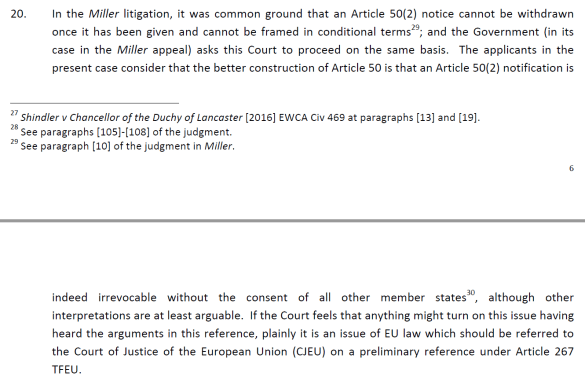
First, the Applicants are (to the best of my knowledge) the only parties gently to moot the possibility of a reference to the Court of Justice of the European Union on the question of the revocability of a notification under Article 50. Even occasional readers of mine will know that I believe that establishing the revocability of a notification to be the key to changing the political dynamics of the Brexit debate. So I regard this as a significant development.

The relevant extract reads as follows:

capture

Second, the Applicants are Crowd Funded (and look to be operating on a shoestring). It seems to me to be a brave and commendable stance to seek a better balance (at least as I see it – others do differ) between long term strategic goals (opening the door to a better or no Brexit) and short term goals (winning the case).

I have made a donation to the Crowd Justice bid – and I would encourage other readers (who are able) to do so too.