Labour’s Brexit tactics

Any attempt to analyse Labour’s position on Brexit faces a difficult initial hurdle: understanding what that position is.

It has a number of different iterations. But let me take the most coherent: that fleshed out by Labour’s Shadow Secretary of State for Exiting the European Union, Keir Starmer.

Here’s what Sir Keir said in Parliament:

The majority of those voting voted to leave. That result has to be accepted and respected, notwithstanding the fact that many of us, including myself, campaigned for remain. However, that is not the end of the matter. The next question, and one that is increasingly pressing, is: on what terms should we leave the EU? That question was not on the ballot paper.

So far so good (For what it’s worth, I’ve explained why I think those statements are true here.  If you remain unpersuaded, this blog post is probably not for you).

But what are the terms on which we should leave the EU – and how does Labour plan to control them? (Making the traditional assumption for this sort of thought piece on the stance of the Opposition: that it can deliver its strategy in Parliament.)

Speaking outside Parliament Sir Keir proposed this:

We are clear that we need the fullest possible access to the single market, that we should be in the customs union, and that there should be special arrangements for Northern Ireland, Wales and Scotland.


(And let’s call this a “Good Brexit”). So far so good.

But what happens if the Government doesn’t secure them? Not a modest failure of the type described by Sir Keir:

Of course the starting position may not be the end position. We all accept that; we are all grown up.

but a wholesale failure. What then? How does Parliament react?

Logically it has three options.

  • First, it waves the deal through anyway. In that world Parliament would have failed to control the terms on which we Brexit.
  • Second, Parliament blocks the deal whilst respecting the result of the Referendum. Assume as is inevitable that the other 27 members of the EU won’t allow us to reopen negotiations. We would then leave the EU without any deal. Again Parliament would have failed to control the terms.
  • Third, Parliament asserts a residual right to block the deal because the Government only has a mandate to Leave on the terms dictated by Parliament. It would say, in effect: ‘Unless you the Government do what Parliament has demanded MPs will either reject the deal and Remain or put the deal to the electorate in a Second Referendum.

Here’s the thing.

The first two don’t achieve Parliamentary control. Only the third does. And so long as Article 50 is legally revocable – a matter which will need to be ascertained from the Supreme Court A50 or other proceedings – it is a meaningful threat. Indeed, it is the only meaningful threat. Unless Parliament issues it, Labour demands for Parliamentary control are mere sound and fury. They signify nothing.

So what consequences – procedural and substantive – follow from Labour adopting this third position?

(1) It makes a ‘Good’ Brexit more likely. 

The Labour Party collectively – if reality permits such a phrase – seems to be cohering around the line that, if it opposes Brexit it loses the ability to influence a ‘Good Brexit’. But, as I have shown, that is near to the exact opposite of the truth. It is a refusal to contemplate a world in which Labour might oppose Brexit that delivers that loss of influence.

(2) It has the advantage of being right.

Writing in the Financial Times, I said (of the possibility of a Parliamentary vote on the final deal or second referendum) this:

capture

That last sentence is unanswerable. If the evidence – as opposed to the cheap speculation of unaccountable politicians – demonstrated that prosperity has deserted the country in anticipation of Brexit we would be mad to ignore it.

Only someone scared of what the evidence will show tomorrow chooses to make a decision based on assumptions today.

(3) The question of legal revocability must be resolved.

This Commons Library paper, released yesterday, addresses the possibility of the question being resolved in the Supreme Court proceedings. If it is not, there are various mechanics, which I will write on shortly, whereby it can be put and promptly in other proceedings.

(4) Timetabling.

Unless agreement can be reached with our neighbours – and Donald Tusk has signalled it would be (see his answer from 24’55”) – the timetable for Article 50 negotiations should recognise the need for Parliamentary approval or a referendum before the expiry of the two year term.

Standing well back, the logic of this line of reasoning is compelling.

If the Referendum result gave no mandate for any particular type of Brexit then Parliament must provide one. Faced with Brexit terms that do not deliver on what Parliament has mandated, Parliament is entitled to reject them. But, in any event, as I have explained above, there is no alternative.

Sadly, speaking yesterday, and without mention of any alternative, John McDonnell appeared to reject this possibility:

we must not try to re-fight the referendum or push for a second vote and if Article 50 needs to be triggered in parliament Labour will not seek to block or delay it.

Frustrating, short-sighted and logically incoherent. How has Labour found itself here?

Germany’s Social Democratic Party has accused Labour of a misplaced need to follow where the electorate leads. As The Times reported:

Along with other centre-left parties in Europe, the SPD is bitterly disappointed that Labour appears to be going along with Brexit. “It is a big mistake of Corbyn to say the majority of the people were in favour, therefore the Labour Party supports Brexit,” Mr Schäfer, 64, deputy head of the SPD in the Bundestag, told The Times.

“Of course they have to vote against Brexit. If the majority of people are in favour of this, Labour should say, ‘OK, we are sorry but we cannot follow always the majority’. Otherwise this is the end of different parties.”

Mr Schäfer warned that Labour would not get any credit for the successes of Brexit but it would share blame for failures if it did not oppose it, as the Liberal Democrats plan to do.

The Libs Dems are leading a campaign supported by some Scottish Nationalist and a few Labour MPs to vote against Article 50 unless the government guarantees a second referendum on the result of the Brexit talks.

The German politician urged Labour to think strategically about the next decade rather than worrying about losing seats at the next election for opposing Brexit. “Labour should vote against Article 50 to make clear they were in the campaign for Remain, because otherwise they are also responsible for the worst outcome of the negotiations,” Mr Schäfer said.

For information, I have set out, at the end, of this post some illustrative charts showing what a 15% loss of votes in ‘Leave’ seats or gain of votes in ‘Remain’ seats would mean for Labour.

But this still does not account for quite how far Labour has moved from the position held by its 2015 Voters (65% or 63% of whom voted Remain) and its MPs (218 for Remain versus only 10 for Leave) in light of polling showing limited support for a Brexit without strings.

In the face of that heavy Remain position, John McDonnell has nevertheless managed to spin 180 degrees from a pre-referendum ‘Brexit will help the corporate elites‘ to a full-blooded post-referendum ‘Brexit will hurt them‘.

Even the thoughtful members of the Labour Party have engaged in repeated attempts to burnish the quality of the democratic mandate. Writing in Prospect, Ed Miliband, for example, argued: “There is a clear mandate for Brexit from the referendum. I am not seeking to reverse the result. We are leaving the EU.” I do not find it easy to understand the impulse to airbrush away the lies of a campaign rich with them or the fact that a 2% swing would have delivered a different result. These facts might not change the mandate but it defies reality to pretend they are irrelevant to is quality.

The answer is that the Party is cowed.

Face with a vigorous and scornful media it seems determined to repeat its mistakes from the last Parliament. Then MPs bowed their heads regretfully to ‘overspending’ allegations and the need for austerity. Now they genuflect to demands for a Brexit that ignores the limitations of the mandate.

They do so because they understand it to be what the electorate wants. They do so because they are frit. But they ignore that they will take the blame when things go wrong. And they ignore that no one wants a Party that follows where others lead.

****

Illustrative charts

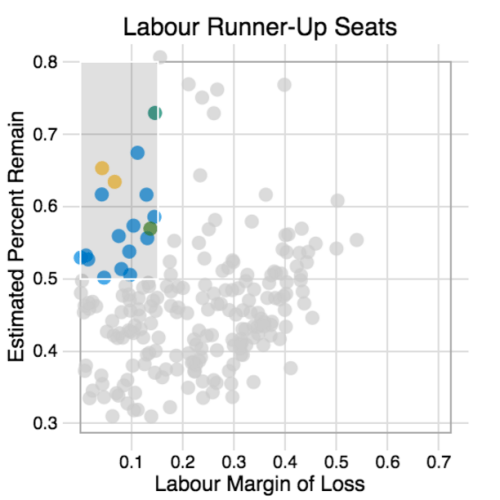
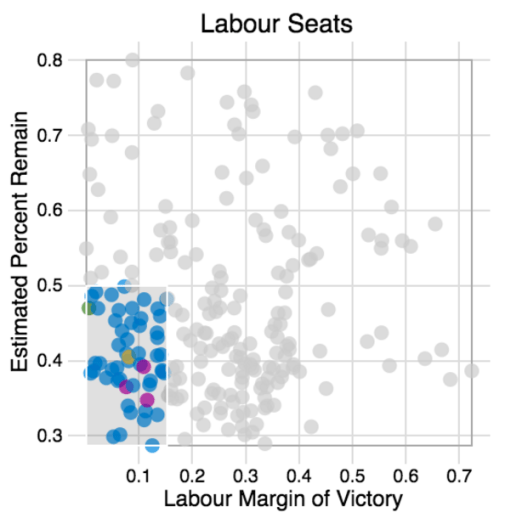
The following two charts show Labour seats in England and Wales by margin of victory, support for Brexit and (by colour, Runner Up).

The first shows all Labour seats.

The second highlights those Brexit supporting seats where Labour’s margin of victory was less than 15% (they total 44: 39 Conservative, 3 UKIP, 1 Lib Dem and 1 Plaid Cymru).

capture

capture

The following two charts show seats in England and Wales where Labour was Runner Up by margin of victory, support for Brexit and (by colour, Winner).

The first shows all seats where Labour was Runner Up.

The second highlights those Remain supporting seats where the winner’s margin over Labour was less than 15% (they total 18: 14 Conservative, 2 Lib Dem, 1 Plaid Cymru and 1 Green).

capturecapture

I’ll leave others to do the editorialising.



How should we respond to attacks on judicial independence?

​[This is a republication of my article in this week’s New European].

It wasn’t Brexit that invented attacks on the judiciary. 

Ten years ago Prime Minister Blair said of a High Court Judge that he had “taken leave of his senses”. The Express also weighed in, describing the Judge’s decision as “tantamount to a judicial coup against Parliament.” That same year The Sun criticised “the arrogance of judges in their mink-lined ivory towers” – I assume time has been unkind to that metaphor – over the sentencing of the child molester Craig Sweeney. And the then Lord Chancellor, Charlie Falconer, was widely criticised for his slow and feeble defence of the judiciary. More recently Theresa May herself – as Home Secretary – criticised Judges for, as she put it, “ignor[ing] parliament when they think it came to the wrong conclusion.”

But we didn’t feel imperilled by it then. So why do we now?

Brexit, of course, bears upon our lives more directly than the Secretary of State’s immigration policy – or a paedophile’s jail term. But there is something more. 

Our times upset the applecart. The thoughtful pluralism of the broadsheet Fourth Estate feels no match for the vigour of the Red Tops. In Parliament, the Burkean ideal of representative democracy has up and gone, capitulated. And Her Majesty’s Opposition is only so in name. 

The consequence is that to have voted Remain is to feel yourself cast as unwitting participant in a Brexiteerian psychodrama. Who will restore us our agency? 

We find our unlikely heroes in what Lord Devlin, giving a lecture to the LSE in 1975, described as a “body of elderly man who have lived on the whole unadventurous lives… old-fashioned in their ideas.” And we throw ourselves in the path of their attackers who take, today as since time immemorial, the form of the Executive and the Press. But what are we to make of the allegation that they failed to respect the will of the people? 

I leave to others an analysis of whether that is true of the Article 50 case. Let me tackle, instead, the predicate. It is right judges should be more responsive or accountable? 

Fortunately this question was considered by a grand Committee of Lords back in 2007. The case for was put by, among others, the Daily Mail’s Editor, Paul Dacre. Our times, he no doubt rightly observed, are characterised by a lack of reverence. He observed a public that has “great faith in the judiciary but there are worries that it is not reflecting their values and their instincts” and judges making political judgments.

He wanted a strong judiciary: “the free press needs an independent judiciary in the extreme. If I may be so bold, the judiciary needs a free press to support it against an over-powerful executive. The two can help each other.” But his suggestion was that judges become a little less Olympian and a little more responsive to public concerns, a little more media savy.

There are profound dangers in this course – but also opportunities too.

Judges are not democratically elected. Their legitimacy derives not from their responsiveness to democratic demands but, in a sense, their irresponsiveness. Parliament makes the law. The Government applies the law. The role of judges is to ensure that they do. And the closer they bind to this narrow role the greater their legitimacy; the further they leave it behind the greater the deficit. 

Giving evidence to that same Committee, Sir Igor Judge pointed out that:

“The independence of the judiciary is something which is precious to every single member of the community. You must be able to go into court and know that the person sitting in judgment is neutral – not on one side or the other – coldly applying the law that applies to your case.” 

For judges to become more responsive to public instincts would mean them giving up that neutrality. And it would also deliver more power to those who channel – or create – those public demands, both the media and the Government. And if judges bend to those instincts who is to police their limits?

It’s apposite, writing on a day when America elected a new President to remember the words of an earlier one, often referred to as the Father of the Constitution, James Madison. 

“The accumulation of all powers, legislative, executive, and judiciary, in the same hands… may justly be pronounced the very definition of tyranny.” 

But there is something to take from what Dacre suggests. 

Judges are, usually at least, keenly aware of the impact of their decisions on public perceptions of themselves and the law. Certainly those who heard the Article 50 case went to almost painful lengths to avoid controversy. The very first paragraph of their summary states: “The court is not concerned with and does not express any view about the merits of leaving the European Union: that is a political decision.” They could sensibly do no more. 

But there is no good reason why Judges should not appoint a spokesman to perform that job for them the function of explaining to the media their decisions. This is an age of democratic irreverence. Those who have held power have failed equably to distribute its fruits. It is right that the establishment is held vigorously to account. And it ignores its duty to be responsive at its, and sadly our, peril.

Encouraging Cycling through the Tax System

Yesterday, alongside Chris Boardman and British Cycling, I launched three proposed tax reliefs, drafted at the invitation of the Department for Transport, to increase the numbers of people cycling to work.

You can read the press release here; and the tax reliefs, their design, purpose and illustrative costings here.

Please do pile in; let me know in the comments section below what you think of the proposals – their design, purpose, intention, costings.

The Uber decision: a straw in the wind

You can read the decision of the Employment Tribunal in Uber here. What I want to flesh out is what, at least as it seems to me, the Decision does and doesn’t do.

The Decision will not fix our malfunctioning labour market (see here for my primer). That malfunction stems from two systemic flaws in our law. First, in our tax law – which imposes on relationships that are economically equivalent substantially different burdens to tax. Second, in our employment law – which imposes on relationships that deliver to the engager of labour the same end result substantially different employee protection burdens.

As I’ve written elsewhere, we should be concerned about these flaws. Businesses worth billions of dollars are constructed to exploit the arbitrage opportunities they create. These arbitrageurs can drive out ‘good’ business actors. And the arbitrages can deliver to shareholders and customers unearned subsidies borne by taxpayers and workers. These are very material failures in capitalism, they’re not news to Government, and it’s pretty abysmal that Government has failed to respond.

The flaws cannot be resolved separately. They must be resolved together. Government is constantly (albeit tentatively) reviewing the tax flaw. Separately it is currently reviewing the employment law flaw. But there is no review that examines them together. And whatever the quality of those separate reviews their separate outcomes will not, because they cannot, resolve the malfunction. Wearing a monocle will address certain consequences of myopia but you’ll still be lousy at football.

The Uber Decision demonstrates a muscular judicial response to the employment law flaw. Such a response will be familiar to those of you who have read me on how judges have responded to tax avoidance. It should be applauded. But the Uber decision is fact specific – it has no direct read across to any other engager of labour. And, unlike in the tax avoidance sphere, rule arbitrage in the employment sphere has yet to draw any meaningful response from our legislators.

As to Uber itself, the consequences of the Decision must be examined through two lenses. One which looks backwards: what does the decision mean for the past? And one which looks forward: what does it mean for the future?

As to the past, the Decision is fact heavy and this, to a lawyer, makes a successful appeal unlikely. It’s not perfect: it majors, and compellingly, on the true factual characterisation of the relationship between Uber’s UK entity and drivers. But its analysis of the legal consequences of that factual characterisation is thin. (Indeed, it is largely to be found in a single paragraph, 94). However, this on its own is unlikely to enable the Employment Appeal Tribunal to overturn the finding that the driver is a worker. The Decision could, however, be more vulnerable on the question when the driver is a worker – at all moments when the Uber app is turned on, or only when the driver has a passenger?

If you assume the Decision survives the inevitable appeals, it will (at least until Uber changes its arrangements) deliver some employment law benefits to the affected workers. The most meaningful of these is likely, in practice, to be holiday pay. But it could also land Uber with a very substantial bill for unpaid NICs.

“Could” because the Decision only concludes that drivers are ‘workers.’ It does not examine whether they are also ’employees’, a subset of workers. If they are found, in what would have to be separate proceedings before a specialist tax tribunal, to be employees then, assuming the 40,000 drivers engaged by Uber earned an average of £600 per week, Uber would accrue a NICs bill of over £13m for every month it has operated – or continues to operate – these arrangements.

Will HMRC take the case? There’s ample reason to think it should: watch this space.

As to the future, even the Employment Tribunal recognises that Uber may adapt its arrangements to seek to avoid these tax and employment law consequences going forward.

capture

I would expect these adaptations to look, in practice, like Uber reducing the control that it exercises over drivers. I do not understand Uber to be contemplating engaging drivers as “workers” going forward. So the gain for drivers is likely only to be temporary.

Of modest and temporary effect, and Uber specific. The Decision is little more than straw in the wind.

Pulling down the shutters at HMRC

How should the ‘elites’ address mistrust? And the Government Departments thought soft on them? Pull down the shutters – or let the light shine in?

Nowhere are these question raised nowhere more sharply than in the sphere of tax dodging – avoidance and evasion – by wealthy individuals and powerful corporates.  We are worried – and we are right to be worried. The best that can be said about our tax system is that it does not function as it should. But the worst is that HMRC fails to apply the law in an even handed fashion: it is, to borrow Ed Miliband’s compelling phrase, strong with the weak but weak with the strong.

Many of us can understand that responsibility for the misfiring international tax system does not lie entirely with our own Government. But the idea HMRC pushes hard against small businesses struggling to turn a profit whilst failing to collect tax from the likes of Google and Facebook is deeply corrosive. And only yesterday the National Audit Office reported that, over the last five years, HMRC had closed 72 fraud investigations into high net worth individuals with only two prosecutions and one conviction.

It’s a brave Government that ignores the question ‘why should I pay more taxes when he doesn’t pay his?’ Brave or – given that we check less than 2% of personal self-assessment returns – stupid. And greater transparency is an important – and perhaps the only – way to answer it; greater transparency alongside meaningful scrutiny.

Last month the Supreme Court handed down a decision in the Ingenious case. The case concerned a briefing given in 2012 by the then Head of HMRC, Dave Hartnett, to Alexi Mostrous, a journalist at the Times. During the course of it, Mr Hartnett made some corruscating remarks about Patrick McKenna, a then high profile promoter of tax avoidance schemes. And those observations drew upon confidential material held by HMRC.

You can read the remarks at paragraph 10 and 11 of the decision. They disclose nothing about the tax affairs of Mr McKenna. Or, indeed, of anyone else. They merely signalled that HMRC disapproved of the arrangements promoted by Mr McKenna; that very, very substantial sums of money were at stake; and that HMRC anticipated that it would establish that those arrangements did not work.

The Supreme Court found that, in making those remarks, HMRC had breached its duty of confidence owed to Mr McKenna. Even though, only weeks earlier, the specialist Tax Tribunal had found that Mr McKenna had promoted tax avoidance arrangements; that very, very substantial sums of money were at stake; and that the arrangements did not work.

In practice, such arrangements can be difficult even for highly skilled professionals to differentiate from ‘good’ tax mitigation. Individuals without professional expertise have little choice but to rely on the advice given to them by their advisers. And their advisers are usually or often financially incentivised to encourage their clients to invest.

The consequences can be disastrous. We know from numerous media reports (see, for example, this) that a number of hugely successful footballers face bankruptcy as a result of participating in Ingenious schemes.

Even in the tax field, some stuff is beyond sensible argument.

HMRC must be able in the public interest to communicate with those it serves.

It must be able to warn taxpayers off avoidance schemes that it considers dangerous, as it sought to do with Ingenious and film schemes more generally.

It must be able to address public concern about possible sweetheart deals – for example, this story that Bernie Ecclestone was able to settle a £2bn tax bill for £10m. It must be both free to engage with and forced to confront legitimate Parliament scrutiny of sweetheart deals.

It must be able to address misrepresentations by powerful individuals or corporates. Tax conduct is reputational and wealthy taxpayers and corporates do publicly misrepresent their tax behaviour. Where these representations damage public trust in HMRC, HMRC must be free to counteract them.

I intend no criticism of the Supreme Court – it addressed a narrower question – when I say it is a mistake to conceive of taxpayer confidentiality as an absolute value to which the public interest must genuflect. Like all values it must be balanced, here with the importance of maintaining public confidence in HMRC. Should this remark be thought controversial I would invite putative critics to grapple with the rule that compels the full public disclosure of the relevant personal financial affairs of individuals of anyone seeking to appeal against a decision  of HMRC.

To strike that balance, it is now clear that Parliament must legislate. It must explicitly authorise disclosures of confidential information to protect HMRC’s assessment of the public interest. Parliament can, should it wishes, make that assessment justiciable before the courts by listing a range of factors to which HMRC is to have regard in reaching that assessment. Those factors could include the obligation to have regard to the objectives listed above – and also the desire, where consistent with their achievement, to preserve taxpayer confidentiality.

But the status quo, after the Supreme Court’s decision in Ingenious, is unsustainable. It will damage HMRC’s ability to raise tax, it will foster public distrust in the institutions of Government, and it will inhibit Parliament’s already poor scrutiny of a field of proper public concern.

A whine made from sour grapes

It is true that, unlike (for example) our referendum on the alternative vote, Parliament chose not to make the EU referendum legally binding. This point, along with many similar, is available to be made.

But it is a whine made from sour grapes.

It is available but it fails to address head on the democratic imperative of the Referendum result. The fact that the result was not technically binding does not have as its consequence that it can be ignored.

So where does this leave the court challenge, that seeks as a precondition for triggering Article 50 the passing of an Act of Parliament?

It has been, and will be, said, and often, that the challenge is about thwarting the will of the people. That’s an expedient line to take but it does suffer from this defect: it’s just not true.

Here’s what David Pannick QC, who argued the case, for the lead claimant said:

If we are correct in our legal submissions, and if the government were then to place a bill before Parliament, it would be entirely a matter for Parliament whether to enact legislation and in what terms. Parliament may decide to approve such a bill, authorising notification. Parliament may reject such a bill, or it may approve it with amendments which may impose limits on the powers of the defendant. For example, as to the date of notification; for example, in relation to parliamentary approval of negotiating terms; for example, as to the need for the minister to report back to Parliament at defined times. All of those would be matters for Parliament to consider and decide.

There is (and I think, rightly) little or no enthusiasm in Parliament for rejecting a Bill authorising the triggering of Article 50. But there is for imposing conditions.

The referendum left important questions unanswered – and it denies reality to pretend otherwise. It was silent, to pick up Lord Pannick’s point, on the date of notification. MPs did think to table an amendment (see NC4) that required Parliament to trigger Article 50 by a certain date but that amendment was not adopted. But, more importantly, the referendum left unanswered the fundamental question of what Brexit means.

Some Leavers say it was about immigration. For others it was Taking Back Control. Many say it was about the £350m. Who is to pick between these sometimes competing objectives? And on what basis do they assert the right to do so?

And, when we come to consider the consequences of the vote, we must also have regard to the wishes of those who voted to Remain. The Referendum asked whether we should leave the EU. It did not ask whether those who voted Remain – some 48% – should lose all opportunity to help shape a country that belongs to them too.

These choices, their consequences, are enormous questions. Fundamental to the life of our nation. The referendum result delivers a democratic imperative but it also creates a democratic deficit.

So let me ask this question, and non-rhetorically: how it can be wrong to require that the Government confront that deficit?

And if it is said, as seems to be the Prime Minister’s position, that Parliament cannot know before the event what we will negotiate for, the logical consequence is that the democratic deficit must be filled after the event.

And what filling the deficit after the event looks like is this.

The deal must be put in a meaningful way to Parliament or the country. And what ‘a meaningful way’ means is ‘with a genuine alternative’.

For the mutual convenience of the parties, the Article 50 litigation has been conducted on the footing that a notification under Article 50 is a bullet that, once fired, cannot be recalled to the chamber. Here is what James Eadie QC, who acted for the Government, said:

We say that a notice of a decision cannot be given on a conditional basis… We also say that an Article 50(2) notice is irrevocable, and once given, it will inevitably lead to withdrawal from the EU on a date which is subject to negotiation, but cannot be any later than two years from the point of notice, unless extended unanimously.

The consequence is that the opportunity the Government means to offer to Parliament to ratify the deal is, as even Jacob Rees-Mogg MP recognises, no opportunity at all. Quoted in The Times he said:

It is quite possible parliament will vote down a deal — but that just means we leave the EU without any deal at all, leave the single market and trade on WTO terms.

But there is another way to look at the consequences of triggering Article 50.

Speaking here (at 24.55), Donald Tusk says, unequivocally and contrary to the footing on which the litigation has been conducted, that the Article 50 notification, once given, can unilaterally be reversed. And he added here:

In my opinion, the only real alternative to a “hard Brexit” is “no Brexit”…Of course it is and can only be for the UK to assess the outcome of the negotiations and determine if Brexit is really in their interest.

And he is right.

It is for us to assess the outcome and for us to determine whether it is in our interests. That is the real choice. It can be made by the electorate in the form of a referendum on the outcome or, should Parliament prefer, by Parliament. But it must be made by the UK. It cannot be made by an Executive that holds no democratic mandate to do so.

And here is where the Article 50 case comes in.

If the Claimants succeed then the Government will need to put before Parliament an Article 50 Notification Bill. And Parliament will have the opportunity to impose one or more conditions on the triggering of Article 50. And the one condition it should impose is the one that addresses that deficit.

If not offered by the Government in the Bill, Parliament should table and uphold amendments. Those amendments should require that there is put before the people or Parliament a sharp and focused choice. ‘Here is the deal that we have negotiated. It is what we, your Government, think reflects the will of the people in voting to Leave. It delivers an exit from the EU in a way that balances the hopes and wishes of all the citizens of the United Kingdom. But the choice is yours. Take this or stick with what we have as members of the EU.’

If asked, I will draft those amendments.

Brexit: the important role of the Court of Justice

It attracted surprisingly little press attention but, in a speech of late last week, Donald Tusk offered up a tantalising possibility. Negotiations might take place between the UK and the EU. And when they had concluded, we could choose between the outcome of those negotiations (which he said would be a ‘Hard Brexit’) and the status quo of our remaining in the EU.

Tusk was gently floating a political possibility. He didn’t address the underlying legal question – one of construction of European law – which is whether, having made a notification under Article 50, we can later and unilaterally reverse it.

But it is no exaggeration to say that the legal question is of enormous political importance.

If the answer is ‘no’, the triggering of Article 50 will commit us to leaving the EU. The effective consequence of the answer being ‘yes’, on the other hand, may be to compel the Government to offer Parliament or the electorate at large a vote on the terms of the deal. Parliament may require a second mandate as the price of passing an Act to trigger Article 50 – or passing the Government’s proposed ‘Great’ Repeal Act. Even if Parliament does not, should during the course of negotiations the popular mood turn against Brexit (likely if economic conditions continue to deteriorate) the public may demand it.

What makes this question especially topical is that the same legal question as is embedded in Tusk’s political offer also lurks just below the surface of the Article 50 litigation that is presently taking place in the High Court.

The Claimants’ case – that triggering Article 50 can only be done by Act of Parliament – rests upon a contention that removing rights from individuals cannot be done by the Executive. It is something only Parliament can do. But if Article 50 is reversible, the central assertion in the Claimants’ case may not arise. If Article 50 is reversible we can’t know that the consequence of Theresa May triggering Article 50 will be to remove those rights.

Until Friday, this legal question looked likely to remain below the surface.

For political reasons – as I predicted back in June – the Government was loathe to argue that Article 50, once triggered, could nevertheless be reversed. Arguing this would leave our membership of the EU an open book and infect the remainder of the Conservatives’ term in office. The reversibility of the Article 50 case suited the Claimants too. As I have explained above, their legal case that only Parliament could trigger Article 50 is weakened (perhaps fatally) if Article 50 is reversible.

So it seemed as though the question might pass unresolved.

But on Thursday the High Court upset this expedient consensus. The Lord Chief Justice indicated he was not prepared to proceed on a mutual assumption that Article 50 was irreversible. He wanted to decide the point.

So what happens now?

(I should say for the record that, although I was the original client for the purposes of obtaining advice and writing to the Government, for legal reasons I now have only a limited and informal involvement in what became the so-called People’s Challenge. Specifically I do not know what it intends to submit.)

What we know is that, before the litigation, Government considered the matter carefully and decided not to assert that Article 50 can be reversed. It seems to me very unlikely that the Government will now form a different view. I expect that it will decide to keep its powder dry and perhaps take the point in the Supreme Court if it loses in the High Court. It will want to hedge its bets.

The Lead Claimant – Gina Miller, represented by David Pannick QC – has advanced what she coyly describes as an “assertion of law” that Article 50 is irreversible. This, too, is a form of bet-hedging to see what the other side does. Only if the Government asserts that Article 50 can be reversed will Lord Pannick feel compelled to move beyond assertion.

Counsel for the People’s Challenge – Helen Mountfield QC – had sought to invite the High Court to proceed on an assumption that it is irreversible. She came – and will come again tomorrow – under pressure to firm up her position. But what is clear (to me at least) is that she cannot be forced to advance submissions in relation to a point that is not in issue. I expect her to adopt David’s Pannick QC’s formulation.

So where does this leave the High Court – which obviously does consider that it needs to decide the question?

You won’t have noticed but I observed (above) that the question whether an Article 50 notification is reversible is a question of European law. And that has a striking consequence. Our courts may need to refer the matter to the Court of Justice of the European Union.

If it is (1) necessary for our courts to decide on the reversibility of Article 50 to answer the question before it (on whether Theresa May can trigger Article 50) and (2) the matter is not clear beyond sensible doubt, then the High Court may (indeed, the Supreme Court must) refer the matter to the Court of Justice of the European Union for an answer.

It cannot reasonably be suggested that the matter is clear beyond sensible doubt. And the High Court plainly seems to consider the matter highly relevant (although it is not yet clear that it is ‘necessary’). So a reference by the High Court must be a real live possibility (although it may be reasonable to expect a reference from the Supreme Court rather than the High Court).

Such a reference would have some important consequences.

First, there would be a very real delay in the determination of the Article 50 claim. The Rules of Procedure of the Court of Justice do contain provision for the President of the Court to direct an expedited procedure. But even were he to do so, it might be reasonable to expect (taking this as an example) a delay of three months. There would then need to be a further hearing before the High Court or Supreme Court to determine the outcome of the Article 50 claim once the Court of Justice had ruled. Theresa May’s deadline for triggering Article 50 of March 2017 would inevitably be breached.

Second, there will be some media excitement. Imagine the delight of our Fourth Estate at the prospect of the Court of Justice playing a part in determining the mechanics of our decision to leave the European Union.

Each of these consequences will be viewed with some caution by the parties to the Article 50 litigation. But, if the High Court or Supreme Court is determined to decide the question of the reversibility of the notification we must prepare ourselves for them.

Standing back from all of this, and although I can certainly see the downsides to a reference to Luxembourg, there is an important upside too.

Each of Parliament, the Government, and the public too needs to understand the consequences of notifying under Article 50. If it is irreversible, the public should understand before notification that there can be no second referendum or Parliamentary mandate for the Brexit deal. If, on the other hand, it is reversible, Parliament and the Government should acknowledge the consequence of the lack of clarity as to what the Referendum mandate meant. That consequence is a need for a fresh mandate from Parliament or the electorate on the terms of the negotiated deal.

The Dependent Worker

The thrill of the new, of progress, the advance of technology, can cause us to misascribe to modernity that caused by quite something else. We can, for fear of appearing Canute, accept as inevitable that which can and should be resisted.

Care should be taken.

Many of these problems are evidenced in our analysis of the growth of self-employment.

It is true that technology puts the buyers and sellers of labour together with an efficiency that benefits both – indeed us all. It is true that this has made possible – and desirable – patterns of working that could not previously have existed. But it is not true that it is this alone, or even primarily, that has caused the rise in self-employment. And it is not true that the negative consequences – the creation of a class of worker living precariously on the margins – are inevitable.

Care must be taken.

Put aside those who progress crowns winners. Focus instead on those without bargaining power: the warehouse workers, secretaries, drivers, call-centre workers, the marginal trades. Those who are dependent, very often, on a single relationship. Their status as self-employed stems often not from technology but the law. The law, which creates two compelling disincentives against their employment.

The first is the tax system. As I explain here, putting £100 into the pocket of an employed worker can cost an employer £26 more than putting that same £100 into the pocket of her self-employed equivalent. This difference is profoundly important to the economics of the low margin, high volume businesses in which the precariat are engaged. If you employ a worker you cannot compete.

The second is employment law. We ask employers to provide a safety net for their employees. We ask them, very often, to bear a cost which would otherwise fall on the worker or on the state. But we impose no equivalent burden on engagers of the self-employed.

Think about that.

We use our tax system to incentivise employers to avoid providing a safety net. This – I hardly need say – makes no sense. The incentive should be exactly the other way: not to shirk a safety net. We should not through the tax system subsidise those who transfer costs to others.

But addressing it is not impossible. It requires only political will. The Conservative Party has at least two terms of Government before it. It is insulated from political risk. It should act. And here is how.

First, it must remove the tax incentive for employers to shirk the provision of the safety net. This could be done in a revenue generative fashion – by raising the tax costs of engaging the self-employed to the level of the employed. Or a revenue neutral fashion – by spending some of the tax raised from self-employment on cutting taxes for the employed. It matters not. But the playing field must be leveled.

Second, we must address when that safety net should be provided.

Presently the answer is given by a judge made test – employment or self-employment – that dates back a century or more. The test relies on a range of factors, many of which have no logical relationship to the question when we should place responsibilities on the employer. We must replace it with a statutory test that Parliament can trim to the conditions of the day.

To ask what that test should look like we need to recognise its purpose. That purpose is not to ask of a worker whether he should have a safety net: it is not a substitute for a welfare system. It is, instead, to ask of an employer whether his relationship with his workers is such that it is reasonable for him to provide one. Is the worker ‘dependent’ on the employer?

This is, it seems to me, a function of two factors: first whether the worker has the power to set his own prices and second whether the worker really is in business on his own account.

When I, as a barrister, set my prices I can include within those prices a margin to enable me to provide my own safety net: sick pay, holiday pay, a pension and so on. In those circumstances the law should not compel any other to, for example, make contributions towards my pension. But where an employer dictates the prices at which a worker works, she cannot create that margin. Indeed the logic is to ask: what minimum amount does a worker need to pay for her own safety net. Pay below this rate and the burden of providing the safety net falls upon you.

The other important factor is whether the worker is dependent upon the employer. Our law already knows of the concept of a ‘subordinate’ worker. We could replace it with a simple test based on the number of hours worked for an employer. Use a worker for that number of hours and they become dependent on you; you acquire a commensurate obligation to provide a safety net for them.

These steps would not stem the rising tide of the gig economy. They do not seek to; they recognise the benefits it brings. But they would ensure a level playing field for employers. They would ensure the less generous do not drive out the more. And they would remove the bizarre encouragement our tax system provides for business to transfer costs to the state or the individual. 

Theresa May’s mighty throw of the Dice

(A version of this piece appeared yesterday in Prospect magazine).

It is mere machinery, the proposed ‘Great’ Repeal Act. 

It moves the debate on, as Faisal Islam wittily quipped, only from ‘Brexit means Brexit’ to ‘How Brexit means Brexit’. But it leaves unanswered the What: it tells us nothing about the shape our relationship with our European neighbours will come to take.

One might, warming to this theme, come to see it as a purely technocratic exercise in advancing to today a step that would otherwise be taken tomorrow. The European Communities Act 1972 – which translates into our domestic law the rights and responsibilities we derive from the United Kingdom’s membership of the EU – would need to be repealed anyway. And the Repeal Act won’t take effect until we leave the EU. It does nothing now.

All of this is right. And yet it misses the true import of what Theresa May announced.

Writing on the Friday following the Referendum I expressed the view – one from which I have not shifted – that hopes for our remaining in the EU rest largely on how events are sequenced. 

Voters, when they entered the booth on the 23rd of June, and in their unwritten ledgers of Leaving and Staying, priced up present resentments and discounted future costs. The passing of time, ran the argument, would cause them to re-mark their concerns to reflect the reality of life outside the EU. When investment stalled, and jobs were lost, and public finances were hit, and the promised NHS savings were reversed, voters would revisit their ledgers. Public opinion would turn.

This may yet happen. And those who have fought and won the fight to Leave know it. It is this that spurs their sense of urgency. That is why we must Leave now and the consequences of acting precipitately be damned.

Only when you see the battle to Brexit in these terms can you begin to understand why Leavers have argued for exactly this solution: a Repeal Act, adopted by Parliament now, authorising a repeal of the European Communities Act later, with that later being a point in time to be determined by Executive Order. Now the result of the Referendum provides an impetus for Parliament to act. Now a narrative around the damage that would be done to democracy by ignoring the expressed will of the people might cause Parliamentarians to decontextualize the result from the circumstances in which it was obtained and the opacity of what it means. But later? Later, who knows.

So repeal now, prospectively, and place the means of delivering that repeal beyond Parliament, in the hands of the First Lord of the Treasury: the Prime Minister. Parliamentarians are amenable to the pressure of the electorate. But with her moderate flank left unprotected by an opposition party shamefully absent from the most important event in the life of our nation, the Prime Minister is accountable only to her own Conservative MPs. A future change in the tides of democratic opinion could not rescue her from the demands of her own Party.

And yet, and yet, all is not lost. The Great Repeal Act is also a mighty throw of the dice by Leavers.

There is a world – a world that at the end of last week seemed possible or even likely – in which MPs had no opportunity to vote on Brexit until it was too late. Article 50 would be triggered, negotiations would ensue, we would agree terms of separation with our EU partners, our membership of the EU would cease and then, and only as a tidying up exercise, would MPs formally be asked to repeal what had already become the empty vessel of the European Communities Act. The array of rights that it had conferred upon citizens of the United Kingdom would have dissipated already. It was this world that the Article 50 challenge – which will be heard in the High Court later this month and the Supreme Court in December – was designed to head off. Triggering Article 50 amounted to a functional repeal of the European Communities Act, ran the argument, and a member of the Executive can’t repeal an act of Parliament.

But to deliver her Great Repeal Act Theresa May will have to persuade MPs to support it. To vote for an Act they cannot know the effect of. 

It is true that the Great Repeal Act is a leap into the unknown. But to say this is to fail to do justice to quite how big a leap it is. There can hardly be an aspect of our national life that the EU does not touch upon. It is this that caused Theresa May to announce that alongside the repeal there will be a separate measure adopting as domestic law everything we currently derive from the Treaties. But even this does not do: for there is much of our law that must change when we leave: our membership of the Customs Union, our system of Value Added Tax from which we derive almost a quarter of all tax receipts, reciprocal healthcare and pension arrangements, and so on. What is to happen to all this?

So she will have to persuade MPs to support this leap into the unknown – and Peers too. If the Act takes the shape I understand it to, I believe the Salisbury Convention, which prevents the House of Lords from withholding consent to a measure promised in an election Manifesto, would not apply. And, although they are not a representative set, the members of the House of Lords I have spoken to are adamant that such an Act would not pass the Upper Chamber.

Most importantly of all is the opportunity the Great Repeal Act gives to an MP to table what a responsible Government would offer us anyway. 

The binary formulation put to the electorate in the Referendum: “Should the United Kingdom remain a member of the European Union or leave the European Union?” skated over the many parallel universes offered up during the campaign: lower and not lower immigration, inside and not inside the single market, money spent and not spent on the NHS, retained and not retained regional investment and agricultural subsidies, and so on. Without clarity as to what the question we put to the electorate meant, how can we interpret the answer they gave us?

Even if, at this early stage, MPs and Peers feel unable to resist a prospective repeal of the European Communities Act, they may be persuaded to adopt a measure that gave the electorate the chance to choose between the relationship we have with the EU, and that which our Three Brexiteers manage to negotiate for us. A referendum on that deal: that would be what taking back control from an unelected Executive really looked like.

Article 50 Challenge: the Government’s Defence

Following an application made to the High Court by Bindmans on behalf of the People’s Challenge which you can read here, the High Court has allowed publication of the Government’s Grounds for Resisting the Article 50 challenge.

You can read, following, those Grounds and the Skeleton prepared by Bindmans.

You can contribute to the costs of the People’s Challenge here.


Government’s Grounds for Resisting the Article 50 challenge

The People’s Challenge Skeleton