How did your constituency vote in the Referendum?

This is the Leave vote for England and Wales (by constituency and political party)Capture

And this is the Remain vote

Capture.PNG

If you click here you’ll be taken to an interactive and enlarged version of these maps. Click on your constituency and you’ll see its Estimated (and if available Actual) Remain and Leave Votes; a sense check against another similar exercise (this carried out by Chris Hanretty); and the 2015 General Election results for your constituency.

The Leave/Remain data was not, or not often, collected by constituency and so you’ll need an explanation of how these maps were constructed. Click here for that explanation (by the brilliant @ZackKorman). He also explains why the map does not extend to Northern Ireland and Scotland.

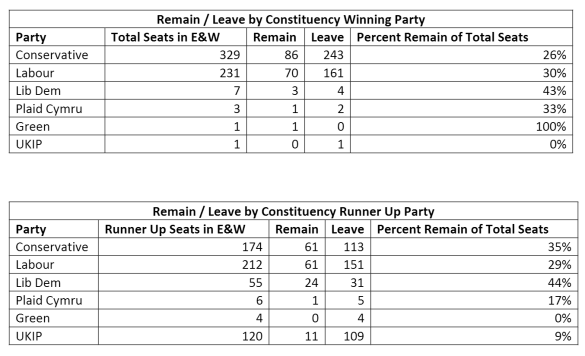
Especially interesting are these tables which show, for England and Wales, how many constituencies of each political party voted Remain and Leave and how many constituencies of each runner up political party voted remain and leave. CaptureI’m not going to do the editorialising. I’ll leave that to others.

Enormous thanks to Zachary Korman who you should certainly follow on twitter: .

Jolyon Maugham QC


How to beat Corbyn

It’s not difficult. It just requires clear-sightedness and a little courage.

We voted for Brexit. But 48% of us who voted in that referendum – more if recent polling is right – have a result we don’t want. And many of us are now profoundly worried about what the future holds.

No political party speaks for us or for our concerns. Even though we number over 16m – a hundred times or more what will separate Corbyn and his leadership challenger, whoever that be.

If you’re not a member you can vote in Labour’s leadership election as a registered supporter. A £3 voter. Engage us – or even 1% of us – and Corbyn will return to obscurity.

Promise us that a Labour Party you lead will campaign to return to the nation once the outline of a deal on Brexit is known. Another referendum on that deal. That promise is a good promise to make. There was no known Leave proposition. No world we could weigh on the scales against the one we have. When that world is known, the electorate should get to choose which it wants.

A political party that speaks for you, on an issue that dominates your thoughts. For only £3.

That’s a proposition with a lot of buyers.


Conservative Party Leadership Rules

If you thought Labour Rules for selecting leaders were bad, you’re going to love these

Capture

They really are dreadfully drafted but here’s what I think they mean.

The key is Rule 3.

It’s the duty of the 1922 to present a choice of candidates to the Party. The Party is defined (clause 1) as the Conservative and Unionist Party. And it shall consist of its members (clause 3). So, read naturally, the duty of the 1922 Committee is to give a choice of candidates to its members. This interpretation is rather supported by clause 10 (and the reference to “elected by the Party Members and Scottish Party Members”).

Capture.PNG

And also the following words in Rule 3 (“selects candidates for submission for election”). And Rule 5 which makes it clear that the final choice rests with members.

The Rule 3 duty arises: “Upon the initiation of an election for the Leader.” This language most naturally refers to the point at which a vacancy for party leader arises and the process for selecting a new leader starts. Read as such, the 1922 Committee has a duty to put two candidates before the Members. In a world in which there was only one nomination – or only one valid nomination – for Leader then rules 4 and 7 make clear you don’t need an election. But we are not in that world. There were a number of nominations – and it was not suggested they were not valid.

Does the 1922 Committee (by Schedule 1 a Committee comprising all Conservative Members of Parliament) have power to change the Rules? Only if the Rules enable it to – and they don’t (see Rule 90). The 1922 Committee has a limited power to set out the procedure for choosing candidates to submit for election to the members (see Rule 3). But it’s pretty punchy to suggest this gives it power to ignore valid nominations given it has a duty to present to members a choice of candidates.

So what happens next? The safe thing to do would be to call for nominations again. It feels to me rather risky just opting for Michael Gove: who knows who Andrea Leadsom’s supporters would have voted for without her in the contest?  And if there are no nominations then we may well be able to enthrone Theresa May. But if there are, a choice would have to be put to members.

These are my thoughts. But do treat them with care. It’s early days. If I change my view I’ll say so here.

Postscript. I understand that the Chairman of the 1922 Committee has stated that the leadership contest is over. He may have had in mind Rule 35 of the 1922 Committee procedure for Conservative leadership elections which provides:

Capture.PNG

but, if my analysis above is correct and I have seen nothing to cause me to change my view, this Rule is beyond such powers as are available to the 1922 Committee. But in practical terms it is, of course, a moot point whether anyone will challenge the Chairman’s decision.

Article 50. Our Letter to the Government.

Earlier today I tweeted out the text of an email I’d sent to those who had helped fund this Crowd Justice campaign.

I promised to name the legal team you had funded and reproduce a copy of our letter to the Government.

Our legal team (in alphabetical order) is as follows (with further names to be added).

Paul Bowen QCGerry Facenna QCBen Jaffey, John HalfordTim JohnstonHelen Mountfield QC and Jack Williams.

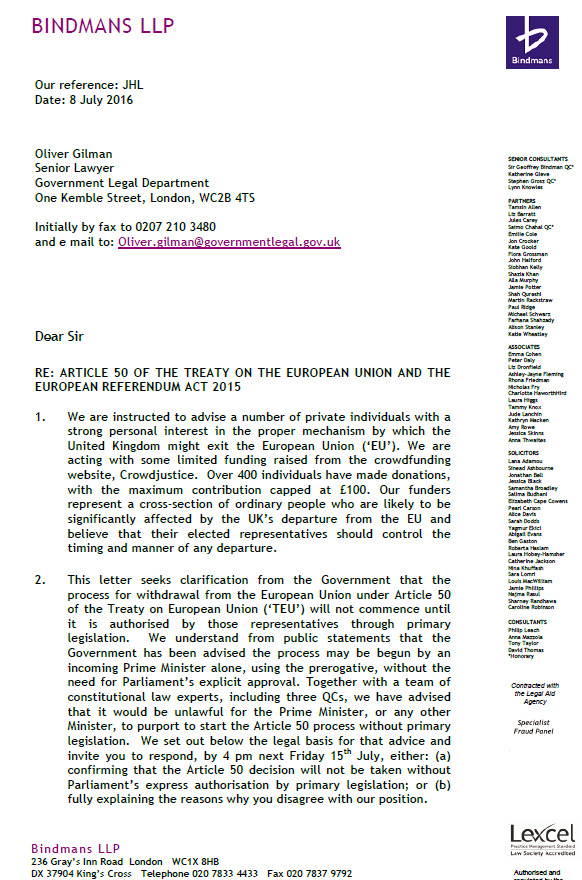
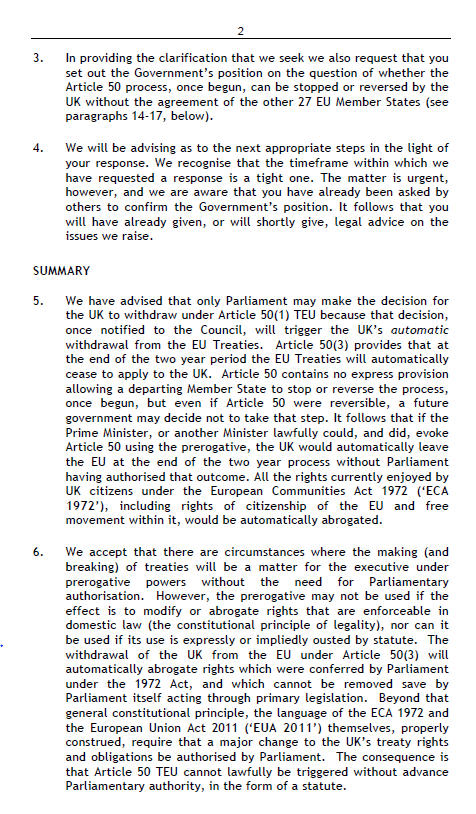
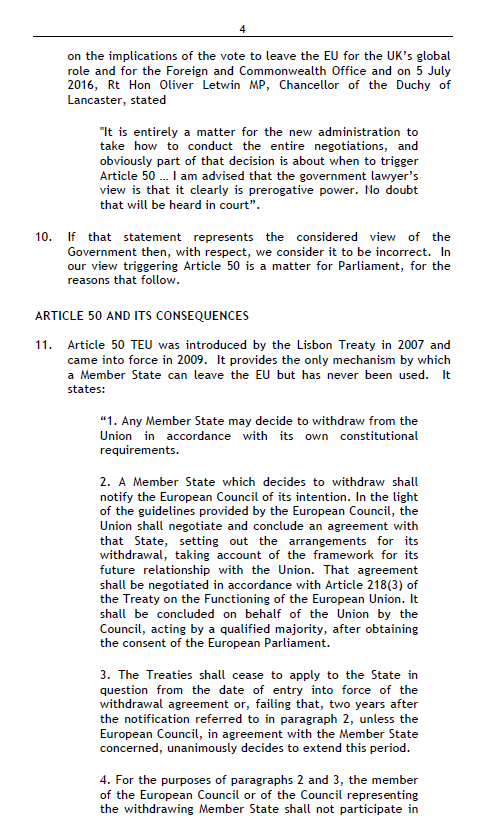
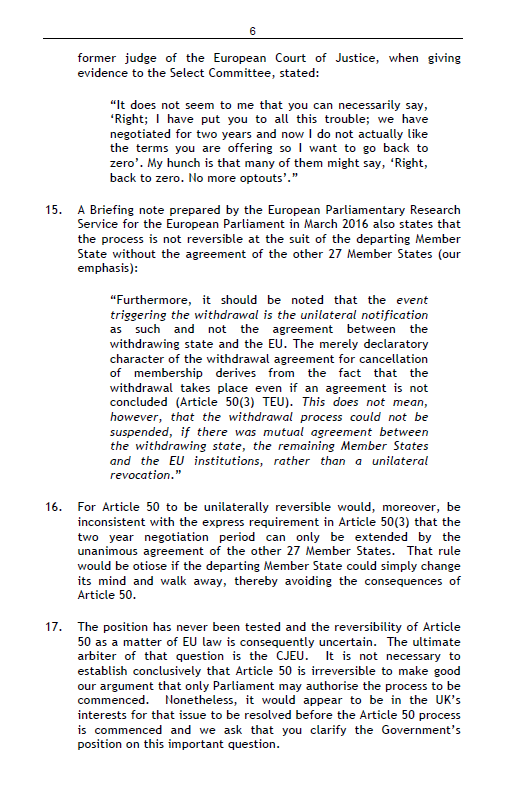
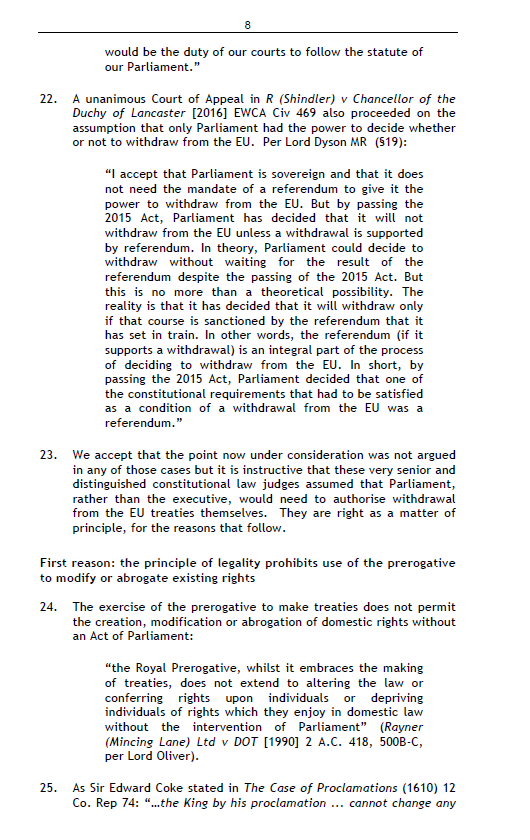
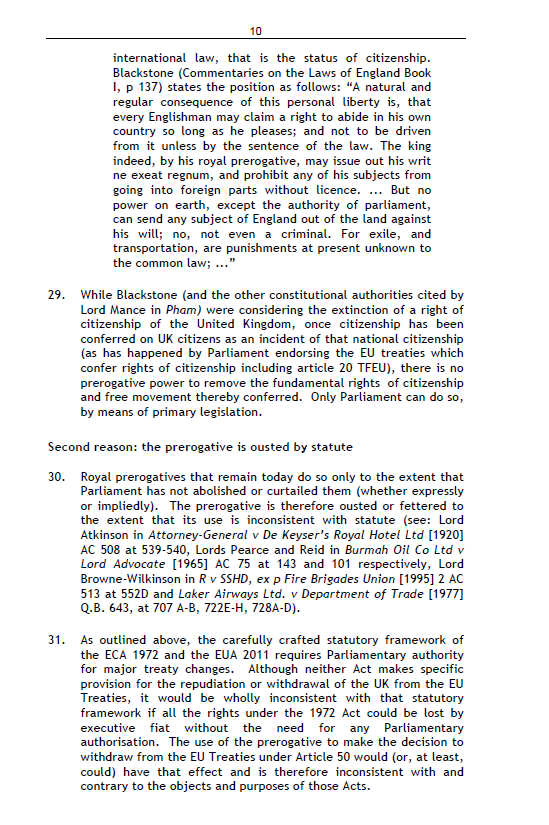
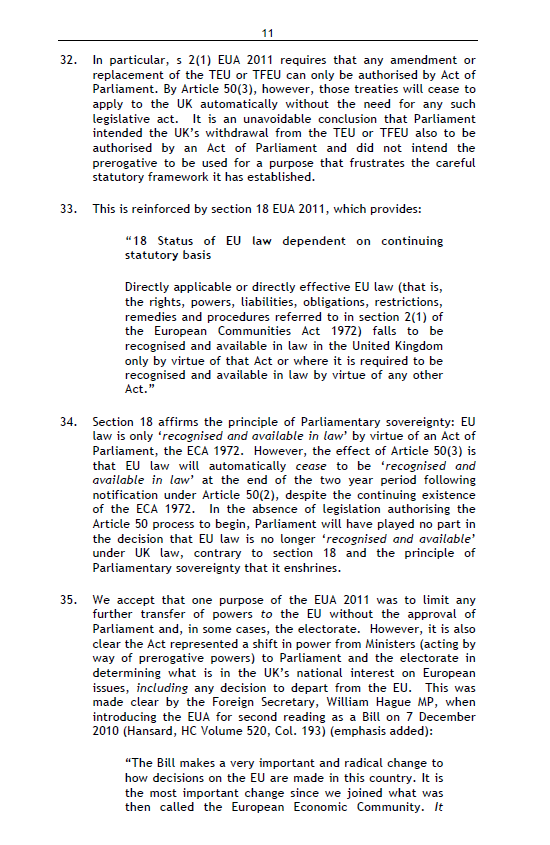
The letter reads as follows.

Capture1Capture2Capture3Capture4Capture5Capture6Capture7Capture8Capture9Capture10Capture11Capture12

Referendum untruths and overspending

What follows is a blog post written by leading public law solicitor, John Halford of Bindmans LLP. John is one of the large team instructed from this piece of crowd-funding (from which the blog emerged). The post is written primarily for members of the public but I hope it contains sufficient legal analysis to enable lawyers, too, to engage with its content. If you’re a lawyer and you think it’s wrong, please do say so and why. I asked John to write it because I think it is important that, where at all possible, this exercise be conducted with maximum transparency and engagement with the public.

We are a small team, most of us working for a small fraction of what we usually charge. (I, of course, am working for nothing.) If there are people out there who are capable of researching links between Vote Leave and other campaigning groups – and there is certainly strong evidence that Vote Leave intended to break spending limits – we would be grateful to receive the fruits of that research. If there are people out there who would like to fund that research I would be grateful to hear from you.

As to the remainder of the crowd-funding work, we will write to the Government later this week putting the legal case for Article 50 to be triggered by Parliament and we will publish the letter on this site.

Jolyon Maugham

Uncovering the smoking cannon:  can anyone be held accountable for untruths told and overspending during the EU Referendum campaign?

In the aftermath of the EU Referendum, many have expressed the view that the outcome would, or at least could,  have been different had the Leave campaign being conducted differently.  It has also been suggested that there may have been overspending in breach of the strict rules for Designated Organisations, which receive a public subsidy for their campaigns, and by other campaigners.  What, if any, remedies does the law provide? There will be few lawyers have not been asked this question over the last week but the answer is not straightforward.

The starting point is the European Union Referendum Act 2015 which lays down the framework within which the Referendum was conducted.   In contrast to election statutes, it includes a petition mechanism for the result to be set aside. The Act briefly mentions that judicial review claims in respect of the Referendum have to be brought within a truncated six-week time period, but says nothing about the basis of such a claim.   The fact judicial review is recognised on the face of the Act as a possibility must mean Parliament contemplated such a claim being brought in certain circumstances. What might they be?

Judicial review claims are essentially concerned with the legality or procedural fairness of the decisions or actions of public authorities.  Plainly, members of the public cannot be challenged in this way regardless of how they vote or why. Democracy allows an irrational vote to be cast and values equally to one cast by the voter who has conscientiously taken account of all relevant considerations. It is also clear that some significant procedural irregularity on the part of  returning officers or other public officials that would have made a difference to the outcome could be the subject of judicial review claim.   But as regards this referendum,   a sufficiently egregious and large scale error by officials would almost certainly have come to light by now.

Campaigning on the basis of false or misleading statements is nowhere mentioned. That suggests, in the face of things, that however unethical it may be, it is not prohibited. That might be thought surprising, particularly when at least one Leave campaign assertion – the £350 million per week savings to be made as a result of Brexit – was identified as  misleading by public and private organisations,  but nevertheless sustained.

There is no real prospect of the courts reading in a duty not to knowingly or recklessly make such statements during a referendum campaign into the Act,  less still to enforce it by making a ruling that would force a second referendum  to answer the same question put to voters.  That is primarily because Parliament has fashioned a limited and narrow obligation to tell the truth to the electorate in the context of general elections, but did not  choose to impose a similar obligation during referendum campaigns. The election duty is found in section 106 of the 1983 Representation of the People Act which provides:

“A person who, or any director of any body or association corporate which—

(a) before or during an election,

(b) for the purpose of affecting the return of any candidate at the election,

makes or publishes any false statement of fact in relation to the candidate’s personal character or conduct shall be guilty of an illegal practice, unless he can show that he had reasonable grounds for believing, and did believe, the statement to be true.”

Even had this appeared in the 2015 Act, and it does not, the obligation does not extend to statements about policies or consequences  and indeed the courts have expressly recognised  that there is no accountability at law  for such statements: see Gibson J in The North Division of the County of Louth (1911) 6 O’M and H 103  at page 163 (approved of in what is now the leading case, R (Woolas) v The Speaker of the House of Commons [2010] EWHC 3169 (Admin)).  The European Convention on Human Rights provides no help either. Free and fair elections are guaranteed, not so  free and fair referenda.

Other legal and regulatory remedies would not affect the outcome of the referendum.  If, for example, a campaigner were successfully prosecuted for incitement to racial hatred or some other public order offence, the referendum result would be unaffected.  The same is true of complaints that might be made relying on the codes which regulate the conduct of Ministers, Members of Parliament and MEPs.  Political speech is specifically excluded from the regulatory regime for advertising.

The position on overspending might be different, however. If there were compelling evidence of the spending limits set down in the 2015 Act being contravened, either by a Designated Organisation, or  one or more other campaigners,  the Electoral Commission would be able to investigate and even has powers to hold an inquiry.  But the deadline for reporting campaign expenditure expires in December, many months after a direct challenge to the outcome of the referendum would be possible based on the findings of a Commission investigation. In theory then, if there was  the most egregious breach of the referendum expenditure rules that could be shown to have  materially influenced the outcome,   the courts just might be persuaded to intervene now by way of judicial review.  At present, there is no real evidence the rules were breached in that way. If there is a smoking cannon, it remains hidden.

It follows that the remedy for concerns about the outcome of the referendum having been distorted is almost certainly a political, rather than a legal, one.  Political because the referendum advises Parliament of the views of those who voted in it, but does not oblige Parliament to withdraw the UK from the EU at all costs.  And when deciding what to do next, MPs and peers can certainly take into account the extent to which those  they represent, whether Leave or Remain voters, were misled if there is compelling evidence of that having happened. Similarly, if members of the public have evidence of expenditure irregularities, that should be brought to the Election Commission’s attention urgently as it may be able to investigate and advise parliamentarians before a decision to evoke Article 50 of the Lisbon Treaty is made.


John Halford

Bindmans LLP

Those who fear democracy

Picture this.

Two candidates left in the Conservative leadership race. The first is a recent convert to a vigorously pro-Brexit position. The second has a more cautious and nuanced position.

80% of the 150,000 odd members of the Conservative Party cast valid votes. It’s close but the first leadership candidate wins with 63,000 votes. She pushes the button straight away. And we Leave.

Now, assume a different world. The second wins. And she takes the view it’s important we think through where we want to be before we enter the one way street to Brexit. In the meantime, the economy deteriorates, there are factory closures and lay-offs, the NHS struggles to cope with the exodus of thousands of foreign doctors and nurses, and public pressure builds for us to Remain. She never pushes the button.


Which of these two worlds – the UK remaining in the EU or leaving it – happens has nothing to do with what the electorate thinks. The electorate never gets to vote on who becomes Leader of the Conservative Party. The decision is made by those who happen to be members of the Conservative Party. And perhaps they’re there, but I can’t find in the Constitution of the Conservative Party a requirement that you be old enough to vote, or resident in the UK, or on the electoral register to become a member of the Conservative Party.

How’s that democracy? Better, surely, that the decision when, and indeed if, to press the button be one for our elected Parliament.

Leave aside, for a second, the legal argument. It’s a narrow point, outlined here, important in its consequences but one for lawyers. There are other arguments, too, that Parliament should decide.

Parliament is supreme. It, as someone may once have said, should have control. And it chose to enact a referendum that doesn’t take us out of the European Union. Could have. Didn’t. Instead it chose a referendum that advises. Advises someone. But who? Our unelected Prime Minister or our elected Parliament? That’s a question with only one sensible answer.

And the critical question of what our relationship with our European partners looks like post-Brexit? What if a deal on free movement were struck behind the scenes before the Article 50 button was pressed. There’s no public mandate for any particular deal; could an unelected PM choose on a personal whim to reject such a deal on the part of the citizens of the United Kingdom? Or does our elected Parliament get to decide whether, in that world, we leave?

Ultimately, the question a Divisional Court and Supreme Court will have to decide – PM or Parliament – rests on a legal argument. And that’s a good thing too. Without the rule of law we have dictatorship.

But the idea there’s something undemocratic about our elected Parliament rather than our unelected Prime Minister deciding whether to push the button? It struggles to raise itself from the swamp of nonsense. And those who argue Parliament has no role are not the friends of democracy. They fear it.


Unscrambling eggs

The Referendum was an instruction to make an omelette. Eggs were cracked. More will be. And scrambled. And when they are, they are.

Since the result became known I’ve written twice: this on how we might avoid leaving the EU and this on whether the decision to leave is one for our elected Parliament or an unelected Prime Minister. Those posts have been widely read. I have been asked by different groups to help them think through what happens next.

Perhaps unsurprisingly, much of their thinking – and some of my own – has focused on whether the electorate’s decision to Leave might be reversed. I have, since Friday, said that I think it between very possible and probable that, in some form or other, we will not Leave. That remains my view. But in working to achieve that goal it is important to keep ahold of what it is that we really seek.

The City is concerned about the impact of Leaving upon its health. The thoughtful among us should be concerned about that concern. Although many of us would agree that the City should not be so important to the public finances of the United Kingdom, still it is important. Reducing our exposure by generating other strengths is a gradual exercise which, properly conducted, would take decades. To reduce it by Leaving is like losing weight by severing a leg. And alongside the economic impact of Leaving on the City – and at least as important – will be the impact on the so-called ‘real’ economy.

Some worry about what Leaving means for an apparently – the data is unclear – growing class of people living economically marginal lives. On all objective analyses, Leaving will generate meaningful pain for those least well-placed to bear it. I’ve written elsewhere about what shape that pain takes. I shan’t repeat it here.

Others are concerned about what Leaving means for our cultural fabric. I spoke earlier this week to a Government minister who compared the campaign fought by members of the Leave team – and the subsequent upsurge in racial violence – to the ascension of Hitler in Nazi Germany. Some will say this is scare-mongering – but for others it is a profound worry.

Still others fear for the future of our democracy. What will happen when the truth about what Leaving means is revealed to those who were persuaded to vote for it?

There will be other concerns too. But in thinking about how to address them they must be separated out because they are different. And although their solutions overlap they are different too. And, and this is important to grasp, some eggs are scrambled already.

A reversal of the decision to Leave the EU might suture back on the leg. Not as good as it was – true – but much less bad than it could come to be. We might then ask seriously – not merely rhetorically as so often we hitherto have – what an industrial policy that generated growth in the real economy looked like.

A reversal should also help those living economically marginal lives. But the experience of many since the global financial crisis of 2008 is that there is a big difference between that “should” and “will.” Remaining might create the conditions within which more can be done. But Remaining won’t do it.

And if this is your concern your focus should be, alongside working to Remain, supporting those politicians whose commitment to the lives of working people is otherwise than synthetic. I am, for the moment, a member of the Labour Party so let me say this very clearly. Those politicians are to be found in all political parties: Labour is far from having a monopoly on morality or concern for the dispossessed. But the key point is this: even were we to step back from the precipice, Remaining will not automatically improve things for the poor.

As to the effects on the cultural fabric of our nation, this, egg is, I am afraid, already broken. Already, as Paul Lewis observed, the small minority of our country that is racist believes itself to have the express or tacit support of 52%. No doubt this was not the intention of those like Michael Gove who say, now, that they “shuddered” at the rhetoric of hate employed by their allies but said, then, nothing in case to do so cost a few votes. But even if the enormous upsurge in racial hatred was not Gove’s intention it was a predictable consequence and one he did nothing to stem. For him, it was a price worth paying to achieve the result he wanted. If you value our tolerance, you should oppose those prepared to sacrifice it to win a few votes.

Alongside opposing such politicians you should support the major public voices for pluralism in our society. You may find it hard to give money to the Guardian – there are personal reasons why it is extremely difficult for me – but without it a powerful, and positive, voice for tolerance is lost. Support it.

If you believe that fascism thrives when people feel ignored by ‘normal’ politics then the prospect of failing to deliver the result of the Referendum will rightly concern you. But lies were told about immigration and the NHS and jobs and public finances, and the lies will be discovered. Do we, do our politicians, wait until the victims discover that we knew of the lies all along and did nothing to tell them – do we kick the can down the road? Or do we confront the truth now for an environment where the underlying issues can better be addressed? The fight against what looked to that Government minister like fascism is only beginning. It is no time to opt for easy choices.

The concerns you may have about Leaving? Do not think that Remaining solves them. It is a necessary precondition. It is necessary but not sufficient.

The Big Green Button Bill

“There’ll be rioting in the streets,” I’ve been told over and again, “if the result of the Referendum is ignored.”

But here’s the thing.

There’s no good outcome from this. There are only more and less bad ones.

The promises the Leave camp made to voters – that immigration would (in some sense) stop or that £350m per week would be available to spend on the NHS – have already been jettisoned. But these are only small things. The Leavers had no plan. David Cameron has resigned and no one is running the country. Day by day our economy is bleeding out. When these things eventually come to sound in a huge hit to investment and economic growth and public finances; when Project Fear is revealed to be Actual Reality, and benefit spending is slashed, and hard working voters find they’ve lost their jobs, and there is less public money available to spend on the NHS, and class sizes grow because there is less money to spend on schools… what then?

How will disenfranchised voters then feel about the promises that were made about how their lives would improve? Promises that were not merely broken but were revealed to be exactly the opposite of the truth? What then? Could there then be rioting on the streets?

These are not my fears alone. Speaking before the Referendum – and in lines I quoted repeatedly before its outcome was known – Donald Tusk, President of the European Council, said this:

As a historian I fear Brexit could be the beginning of the destruction of not only the EU but also Western political civilisation in its entirety.

Of course, it is not for me, or anyone else acting alone, to choose where we now go. That is a choice to be made by whatever our democratically elected Government comes to be. Acting consistently with the rule of law. But I write these lines in order to explain that my conscience is clear in acting, so far as I can, to reverse the result of a referendum, and as soon as possible.

One important idea emerged yesterday on the blog of the UK Constitutional Law Association (and I do encourage you to read the important blog post to which this post is indebted). And it is this.

The process of leaving the European Union begins with us formally notifying the European Council of our intention to leave the European Union. But who is it – exactly – that does that notifying? Who gets to press the Big Green Button?

Among the powers held by the Prime Minister are a collection of powers left over as a relic from medieval times when they were exercised by the King or Queen. Constitutional lawyers call them the Royal Prerogative. The Royal Prerogative is used to conclude – and relevantly end – treaties with foreign states.

But there is a funny thing about the EU Treaties that make up the legal framework of the European Union. They are given effect to in the United Kingdom by an Act of Parliament: the European Communities Act 1972. And whoever presses the Big Green Button will, in effect, denude that Act of content. They will render it, by commencing a process that concludes with our withdrawal from the European Union, an empty vessel. A dead parrot. And the idea that the Prime Minister, by her or his action, might be able to destroy an Act of Parliament is one that suggests we are less democracy and more dictatorship. As it was put in The Case of Proclamations of 1610 :

  …the King by his proclamation… cannot change any part of the common law, or statute law, or the customs of the realm…

So what does all of this mean?

It means that pushing the Big Green Button might not be something that the Prime Minister can do. It might instead require a new Act of Parliament – a Big Green Button Act. And if we do need a Big Green Button Act, Parliament would need to choose to have it. MPs would need positively to choose to have it. MPs including your MP.

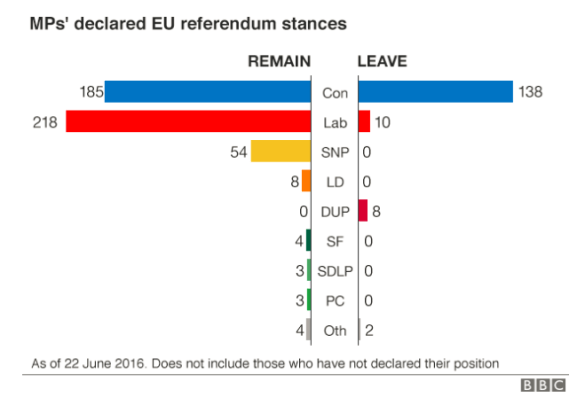
This image taken from here shows the declared positions of our MPs on the 22nd of June.

Capture

As you can see a huge majority backed ‘Remaining’. Of course, there is a difference between, first, the outcome that an MP might have preferred before the outcome of the Referendum vote was known and, second, how an MP would choose to vote on a Big Green Button Bill after the Referendum vote was known.

You may think that the outcome of the Referendum should dictate how your MP should vote.But (wrote Edmund Burke, the political theorist) what your MP owes you is:

not his industry only, but his judgment; and he betrays, instead of serving you, if he sacrifices it to your opinion

And Parliament is a place:

where, not local purposes, not local prejudices, ought to guide, but the general good, resulting from the general reason of the whole.

So how, in practical terms, would your MP vote in a Big Green Button Bill?

MPs inclined before the Referendum result to vote Remain and who live in areas – in particular Scotland and London – which supported Remaining may feel little difficulty in voting against a Big Green Button Bill now. The (relatively small) number of MPs inclined to vote Leave and in areas that support Leaving will feel no difficulty in voting in favour of such a Bill now. But, at least I would say, an MP in a Leave area whose judgment told her or him that Leaving would be bad for the United Kingdom – bad for its economy; bad for the the Union; bad for jobs and the NHS and education; bad for its place in the world; bad as heralding the arrival of racial intolerance; and, yes, bad for the long term future of democracy – should vote against that Bill.

And, whatever the outcome in the House of Commons, to pass, a Big Green Button Bill would also need to be approved by the House of Lords.

And if the Big Green Button Bill did not pass then we could not begin the process that concluded with us leaving the European Union. Absent further action, we would Remain.

In the coming days I will take legal advice from our leading constitutional lawyers. I have already begun that process. If the advice is that pressing the Big Green Button may or does require new legislation, I will then consider what to do. Should we seek a declaration in the High Court, and then (by way of leapfrog appeal) the Supreme Court that a Big Green Button Act is required?

Can the Scottish Parliament block Brexit?

Section 29(2)(d) of the Scotland Act 1998 provides, somewhat inelegantly, that a provision of an Act of the Scottish Parliament is not law if it is incompatible with EU law.

To similar effect, section 57(2) of that Act provides:

“A member of the Scottish Government has no power to make any subordinate legislation, or to do any other act, so far as the legislation or act is incompatible with any of the Convention rights or with EU law.”

These provisions caused Sir David Edward, a former judge of the European Court of Justice and a very serious lawyer indeed (as well as being an exceptionally nice man), to suggest to the House of Lords Select Committee on the European Union that you would need legislative consent from the Scottish Parliament to withdraw from the EU (see paragraph 70 here and question 17 here).

The easiest way to understand his point – or the easiest way I can find to explain it – is this.

The sections of the Scotland Act I have set out above would, if unamended, leave the Scottish Parliament and Scottish Government bound to act consistently with EU law. That would be a nonsense if we were no longer ‘in’ the EU. Moreover, there is a constitutional convention – the so-called Sewel convention – that (with one proviso) the Westminster Parliament needs the consent of the Scottish Parliament to legislate on matters that have been passed to the Scottish Parliament (so-called “devolved matters”). So, the argument runs, in order to amend the Scotland Act 1998 to enable the Scottish Parliament and Government to act inconsistently with EU law, the Westminster Parliament would need the consent of the Scottish Parliament. And (given that, in the Referendum, Scotland voted ‘Remain’) the Scottish Parliament would not give it.

The problem with the argument, at least as I see it, is the so-called proviso. The Sewel convention has now been enacted in section 28(8) of the Scotland Act 1998. You can see it here but what it says in context is:

(7)     This section does not affect the power of the Parliament of the United Kingdom to make laws for Scotland.

(8)     But it is recognised that the Parliament of the United Kingdom will not normally legislate with regard to devolved matters without the consent of the Scottish Parliament.

You remember that proviso I mentioned? The Westminster Parliament retained a residual right to legislate without the consent of the Scottish Parliament in non-normal circumstances.

And if a decision in a UK-wide referendum to depart from the European Union is not a non-normal circumstance I don’t know what is.

The Scottish Government website also makes reference to a Devolution Guidance Note 10 which you can read here. That note provides, relevantly:

Capture

And were I arguing in court for the Westminster Parliament, I would certainly be saying that the need to amend legislation to enable the Scottish Parliament to act inconsistently with a law that no longer applied was incidental to or consequential upon the decision to remove the United Kingdom from the European Union.

It follows that, with real deference and respect, I disagree with Sir David.

I am grateful to Jim Fitzpatrick (@jimfitzbiz) for the information that led to this post.

How to deliver a second Referendum

Here’s what Boris Johnson wrote back in February:

There is only one way to get the change we need, and that is to vote to go, because all EU history shows that they only really listen to a population when it says No.

He may have had in mind the second Irish referendum on the Lisbon treaty which followed after the Irish voted ‘no’ in the first – and secured further concessions from the other Member States.

“Say ‘no’ for a better ‘yes'” isn’t bad as a negotiating ploy. But it’s not much of a campaigning slogan. The Leave camp ditched it for ‘Take Back Control’.

And the rest is recent history.

It wasn’t only Boris who saw the attractions of a second referendum. So did Nigel Farage. Speaking to the Mirror he said this:

“In a 52-48 referendum this would be unfinished business by a long way. If the remain campaign win two-thirds to one-third that ends it.”

It’s fair to say he meant a 52-48 win for Remain rather than that very vote for Leave. But, you may think, what’s sauce for the Goose…

But could we have a second referendum after a Leave vote? And what might it take to bring such a thing about?

Let me begin my task by clearing away a little undergrowth.

The referendum result creates a democratic imperative for the UK to depart but, as the great legal blogger David Allen Green has set out here, it doesn’t create a legal one. The legal one follows not from the referendum result but from our decision to trigger the exit procedure in Article 50 (which I turn to below). Some have mooted that our Parliament could simply ignore the referendum result. Although that may be right in legal theory I don’t, myself, consider it a practical likelihood. But, what democracy has commanded shall be done it can also command to be undone. Or, to put the matter less grandly, a second vote, this time for Remain, would undo the democratic imperative of the first.

So I see a refreshed democratic mandate as key.

How might such a thing be delivered?

I can see two routes.

First, were we to have an early General Election fought by one party on an explicit Remain platform and were that party to prevail it would, I think, amount to a ‘refreshed democratic mandate’. The electorate would have spoken such that the result of the Referendum would be superseded.

Second, even without such a General Election, Parliament might decide that circumstances had changed sufficiently, as in Ireland, to put the proposition to the electorate again.

What would make these routes more or less likely?

The General Election route requires that three things happen.

First, there would need to be a General Election. The Fixed Term Parliament Act 2011 requires that (absent a no-confidence motion in the Government) the motion for an early general election achieve a two-thirds majority in the House of Commons. But if the Government took the view that such was desirable – and several Brexiteers have already mooted such a thing – it is unlikely that the Labour Party would stand in its way.

Second, one or other side would have to stand on an explicit Remain platform. That would not be the Conservative Party. And such also seems inconceivable under Labour’s present leadership. Writing to Labour members on the 24th of June Jeremy Corbyn said this:

After yesterday’s European referendum, politicians of all parties must listen to and respect the vote. Millions of voters have rejected a political establishment that has left them behind. Communities that have been hardest hit by government cuts and economic failure have voted against the status quo.

This is not the language of a Leader who wishes to Remain. But Jeremy Corbyn is to face a leadership challenge and the overwhelming majority of the Parliamentary Labour Party – and indeed its voters – support Remaining. Were a new Labour leader to be selected, Tim Farron’s pitch for a pro-EU social democratic coalition might fall on fertile ground. And, of course, Nicola Sturgeon has made plain her intention to keep Scotland in the EU.

And, third, that Remain platform would need to win. You will have your own views about the likelihood of that prospect. But Luke Baker has referred to the possibility of Buyers’ Remorse about Leaving. Not even a day in there is much anecdotal evidence of this. And if the Project Fear predictions of the poor, derided “experts” come to pass it is possible that the population might come to welcome an opportunity to Remain.

The other possible route to a second Referendum is much simpler. Again, it has three steps.

First, it would require a recognition on the part of the EU that the concerns of the local electorate be met with concessions. The public could, I think, only sensibly be confronted with the In/Out question afresh if the circumstances had changed since last it was asked. This was, in effect, Boris Johnson’s “Say ‘no’ for a better ‘yes'” strategy. This has, in fact, happened on three occasions: Ireland (twice: Lisbon and Nice) and Denmark (once: Maastricht).

Second, there must be a desire on the part of the Government of the day to deliver a second referendum. This will in large part be contingent on whether the public’s attitude to the prospect of Leaving sweetens or sours: Buyers’ Remorse again.

An EU contemplating an existential crisis of its own in consequence of the UK’s likely departure – perhaps facing demands from other Member States for referendums of their own – might increase the pressure on our Government by dangling concessions directly in front of the UK public. You might even think that this was Wolfgang Schäuble’s intention when he talked of the UK having “associate member” status. You might also read into Boris Johnson’s comments of Friday morning a desire to keep this door open:

In voting to leave the EU it’s vital to stress that there’s no need for haste, and as the Prime Minister has just said nothing will change in the short term except work will begin on how to extricate this country from the supranational system. As the Prime Minister has said there is no need to invoke Article 50.

Any or all of these circumstances could create huge public pressure for the question to be put afresh. Pressure no sensible Government could ignore.

Third, a renewed Referendum would have to be won. But, as this rather elegant piece by Ece Özlem Atikcan explains, they do tend to be.

Of course, had we left in the meantime, all of this would be academic. And the timing is important. Too soon and we may not have time to see Buyers’ Remorse. Too late and it may be difficult to derail the process. Again, a close reading of Mr Johnson’s comments suggest a sensitivity to the possibility of a golden moment.

If you assume this golden moment arises before we have triggered Article 50 (and, for reasons I don’t want to get sidetracked by why I regard as hollow the threat to treat the Referendum result as triggering Article 50), we can simply ignore such conditions as it imposes. But what if you assume that, under pressure from an EU with problems of its own to resolve, we have already triggered the process?

Were you to read Article 50 as you might a piece of domestic law, you would note it has no reverse gear. Once you start the process, you’re on the way to the exit door. This is a point that David Allen Green has made here. But for myself I have little doubt that the process can be abandoned once started. As a general proposition, in my experience, EU law bends much more to pragmatism than does English law. This was also a point made by Professor Derrick Wyatt QC in his oral evidence to the House of Lords Select Committee on the European Union. And Sir David Edward, former judge of the European Court of Justice, giving oral evidence on the same day said:

It is absolutely clear that you cannot be forced to go through with it if you do not want to.

Perhaps we might all feel differently if Article 50 stated explicitly that a member state, having triggered the Article 50 process, cannot abandon it. But it doesn’t; it’s just silent on the issue.

So. Let me sum up.

Form your own view, but I think Buyers’ remorse is likely. I think the electorate will come quickly to appreciate that the ‘look behind you’ of the Remain campaign did not warn of an approaching pantomime villain. Rather, there is a very real likelihood of a very meaningful deterioration in the lives of a great many people. The fruits of victory may quickly turn to ashes in the mouths of Brexiteers. It is, I think, likely that the EU will seek to engage the UK public directly – and I very much hope they do. And, although here I speculate, I do sense an ongoing ambivalence on the part of Boris Johnson to the creature he has delivered. Where lies his place in history on delivering a disaster to a country he loves? Mix these ingredients together and you have the recipe for a refreshed democratic mandate for Remain.