Towards Business Accountability

This is the third in a series of pieces exploring what the Labour Centre might offer to the electorate. The first, sketching out some of the broader ideas, can be seen here. The second, which advances some specific policies to reshape the labour market to support self-employment and improve competition, can be seen here. I will come back to those ideas. But I want now to set out some thoughts on how the Party might respond to public demand for better business.

We are awash with narratives of bad business: of environmental destruction, tax dodging, exploitative labour practices, unpunished regulatory breaches. And even as the events of 2008 disappear into history their effects remain political centre stage. Writing here I described the need to reforge the relationship between society and business as “the defining political question of our time” and “perhaps the one great opportunity open to the Left.”

We’re not short of diagnosis. But we need to move to specific prescription. Not a command and control prescription that positions Labour at war with the forces of capital. But one that looks for inflection points and uses them to influence the shape that markets take.

***

Do you own an Apple iPhone? Or search with Google? Or drink at Starbucks? Or run in Nike?

What responsibility do you have for their environmental damage or poor supply chain management or abusive tax practices?

When you choose their products do you own their policies?

Their commercial performance suggests not. Decry the behaviour though we might, we do not deny them our custom.

What if you own their shares?

By investing, you lower their cost of capital. You reward their management’s assessment of the ‘right’ balance of profit maximising/cost externalising.

Still not convinced? But what if you ran those companies?

What if it were you who, as the Archbishop of Canterbury put it, turned a blind eye to your wild lending, knowing that Government stood back-stop; or who targeted an effective tax rate that compelled abusive tax behaviour; or who chose a supplier on the basis of cost alone, ignoring how they achieved it; or who opted for cheaper, unsustainable energy?

And what if you were only doing what your shareholders were rewarding you for?

If you spread responsibility widely enough no one need bear it. But it’s the law that has done this and what it has shared out it can gather together again.

***

Once upon a time ‘who bears responsibility’ was not a question we had to answer.

Until the mid-19th Century we did not have limited companies, not as we now know them. The creation of a ‘legal’ person, separate from its owners, was a rare act effected almost exclusively by Royal Charter.

So there was always a man to carry the can. The owner, in law, was the business. There was no separate legal entity. He ran the company and the staff he employed executed his will.

But today we have two actors. And there are important consequences. Consequences that troubled commentators in the mid-19th Century – but that we seem to have forgotten today.

Moral responsibility is difficult to site.

And criminal responsibility, too, is lost.

Speaking on the Marr Show on 24 January 2016, Rona Fairhead, a Director of HSBC at the time its Swiss unit facilitated tax evasion, said this:

“What happened in HSBC, behaviour that was criminal, behaviour that was against the practices of the bank, we have said as a bank that we accept responsibility and we have said that we are deeply sorry for any reputational damage in what happened.”

Yet no criminal charges have been brought against the Bank – or against Ms Fairhead who chaired the audit committee at the time. And, remarkably, no regulatory action has been taken either – against HSBC or, as far as I am aware, Ms Fairhead. It is difficult to imagine that an individual – as opposed to a company – who admitted criminal behaviour on this scale would escape sanction.

***

The intense political focus on my own field, taxation, has driven some interesting thinking.

Writing in June last year I argued for “measures – likely outside the tax code – which nudge business to become better fiscal citizens through embracing transparency and improving corporate governance.” Would behaviour change if there was an individual whose reputation was on the line? Or if business was compelled to state publicly whether it would adhere to prescribed baseline standards?

Last Summer Government published a Consultation Document entitled ‘Improving Large Business Tax Compliance‘ which asked whether responsibility for tax strategy should rest with a named individual. And whether businesses should be invited to state whether they might sign up to a voluntary code of good tax conduct (similar to that applying to banks).

But business respondents were overwhelmingly hostile to these proposals. And the Conservatives abandoned them.

A perception that a lack of personal accountability for poor behaviour could engender a corporate tolerance of it drove policy thinking in other areas too.

In July 2014, the Bank of England published ‘Strengthening accountability in banking: a new regulatory framework for individuals’ which identified as a contributing cause to the financial crisis the fact that “individual accountability was often unclear or confused.” That framework went on to observe that: “Both the Financial Conduct Authority (FCA) and Prudential Regulation Authority (PRA) (the regulators) believe that holding individuals to account is a key component of effective regulation.”

Companies cannot carry the can. This should not encourage in those who run them any diminution in the care with which they attend to the moral and legal mores society sets down. But history tells us it does.

***

Companies are creations of law. Through our laws we make them, and through those same laws we regulate their uses. There is no need for companies to become a means for the doing of that which a natural person could not. The privilege of limited liability and separate personality is ours to grant. And there is nothing radical in the notion that we should carefully and in our collective interests dictate the terms upon which that privilege is extended.

The law is not a mechanism for regulating morality. As I observed here (writing about the relationship between tax law and morality):

Discrimination on the grounds of “colour” (to use the language of the Act) did not become immoral only on 8 December 1965 when the first Race Relations Act received Royal Assent.

I start with that truism because it is only if we lose sight of it that we can regard the question ‘Does XCo wrongly avoid tax?’ as properly addressed by the response ‘XCo complies with all relevant tax laws in all the jurisdictions in which it operates’. It is only if one loses sight of it, too, that one can conclude… that there is no use to which morality can be put.

The law of corporate personality need not be used to allow to mask moral responsibility.

We should identify the spheres of corporate behaviour which we consider contain a moral element – environmental standards, a tax strategy, labour standards and others – and ask large companies to publish their policy on it and name the individual responsible for achieving that policy. By taking that step we re-establish clear moral linkage between action and actor.

And separate corporate personality should never act as a shield against criminal responsibility.

If we care enough to attach criminal sanction to types of behaviour we should impose upon directors a positive obligation to take reasonable steps to secure that such behaviour does not occur. The converse – that they need not take reasonable steps to prevent criminality – invites directors to regard that behaviour less seriously than society by deeming it criminal dictates.

Let the law join together what it split asunder.

Once might be unfortunate. But twice?

As I’ve made the point on twitter:

let me spell it out here.

I’ve traced Google UK Limited’s accounts back to 2008. The first sign of trouble comes in 2012 where we see for the first time a provision for underpaid corporation tax:

Capture


in respect of employee share based compensation. We can reasonably assume a deduction had wrongly been taken for tax purposes. Call this the First Dispute. And there is a corresponding interest charge to reflect the fact that at least some of this additional tax has been owed for some time:

Capture

In 2013, there’s then a new and separate provision “in respect of additional corporation taxes”:

Capture

You’ll notice that it occupies a separate line in the accounts to the £24,069,879 figure carried over from 2012 and has a separate description. Call this the Second Dispute.

And there’s also a further interest charge.

Capture

which is said to relate to the First Dispute.

Now roll the clock forward to the (as yet unpublished – but I have a copy) accounts for the period ending 30 June 2015. You can see a substantial additional provision to that recorded in the accounts for the period ending 31.12.13:

Capture

Although the accounts for the period ending 30 June 2015 don’t explicitly record that the provision is for the Second Dispute, the fact that it is compared with the prior period £1,153,785 (which obviously was for the Second Dispute) strongly suggests that some or all of it relates to that dispute.

As I indicated here, there is also in the accounts for the period ending 30.6.15 a further provision for interest of £13.6m. If you assume that some or all of the £69m related to the Second Dispute the amount of this interest charge would suggest that the Second Dispute, too, is of venerable age. And from the timing of the provision you can see that either HMRC uncovered – or Google conceded – the point late in the day.

So. Two longstanding disputes as to Google UK Limited’s UK corporation tax bill. Both involving tens of millions of pounds of underpaid tax.

One might be unfortunate. But, two?

Google’s £130m: what is it and when is it from?

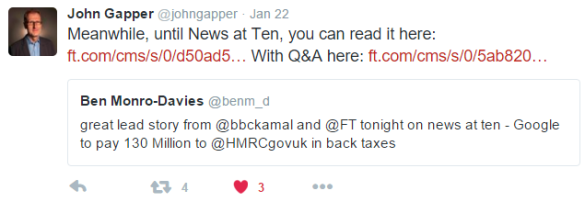
First out of the blocks on Friday the 22nd was John Gapper of the Financial Times:

Capture

Capture

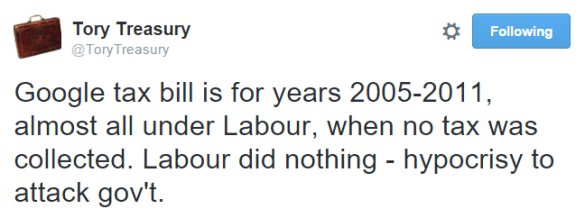
At 10am on Saturday 23rd, this is what the “Official CCHQ voice for all things Treasury” said:

Capture

And here’s what the Financial Secretary to the Treasury, David Gauke, said later that day at 1.47pm:

Capture


Labour quite properly wanted to understand whether these allegations were true.

And there were also wider public concerns around whether the deal struck with Google represented a good one for the UK taxpayer. John McDonnell, Shadow Chancellor, was given permission to ask an urgent question in the Commons:

Capture

But David Gauke said he could not give further details because of the duty of taxpayer confidentiality.

But what is the £130m actually from? And to what does it relate?

It has been widely quoted that it is from tax, interest and penalties. The source of that belief appears to lie in an interview HMRC’s head of business tax, Jim Harra, gave to the BBC’s the World at One.

Capture

Following a tax investigation, a taxpayer will pay any additional tax that has been found to be due, plus the interest consequential on paying that tax late.

The penalties are particularly important.

There can be modest fixed sum administrative penalties for technical slips. But penalties can also signal that a taxpayer has behaved ‘badly’ – negligently or fraudulently. They can send a message that a taxpayer has been held to account.

So does Google have a liability to penalties? Not according to its accounts. Only tax and interest:

Capture

I think it likely that Jim Harra was responding to a specific question with a general answer – that would be my expectation given the deep (perhaps too deep) privileging of taxpayer confidentiality in HMRC – and the press failed to grasp the context of his answer.

So, Google was not penalised.

But what is the composition of that £130m figure?

Capture

First, £69m for periods prior to 30 June 2015.

Second, an existing provision of £33m:

Capture

That provision first appeared in Google UK Limited’s accounts to 31.12.12 as £24m:

Capture

and grew over the year to 31.12.13 to £33m.

Third, interest of £14m:

Capture

And fourth £14m of extra tax liability for the current year:

Capture

Making £130m.

And to what periods does it relate?

Here’s what Google UK Limited’s accounts for the period ended 30 June 2015 report:

Capture

You’ll note those words “for prior accounting periods and the current accounting period”. On 30 June 2015, Labour had been out of office for fully five years.

So the highly political allegations tweeted above appear to be untrue.


The £130m liability does not cover the period 2005-20111. Instead it covers a period dating back to 2005 and ending on 30 June 2015. It’s 2005-2015. Including over five years of Conservative Government.


Do companies have a duty to avoid taxes?

Here’s a transaction that did the rounds some years ago.

If I wanted some foreign exchange in the future I could enter into a contract with a bank by which it would sell me some. Assume that, in order to get a bank to promise to give me $2bn in twelve months, I had to promise to give it £1.5bn in twelve months.

But here was the trick.

What about if, instead, I agreed to pay the bank £300m now and the other £1.2bn twelve months down the line in return for that $2bn. The bank would be pleased because it would get that £300m now. And I would be pleased too. Because I would – or at least this is what folks were told – get to treat that £300m as wiping out £300m of taxable profits. I would (assuming a 20% tax rate) be £60m better off for doing nothing. I might want that £60m enough that I’d buy $2bn of foreign exchange even if I had no need for it. And some did.

I tell you this story because of what Boris Johnson wrote in the Telegraph yesterday. He said this:

“It is absurd to blame the company for “not paying their taxes”. You might as well blame a shark for eating seals. It is the nature of the beast; and not only is it the nature of the beast – it is the law. It is the fiduciary duty of their finance directors to minimise tax exposure. They have a legal obligation to their shareholders.”

But it’s not true, of course. Not remotely. It’s completely baseless. Boris Johnson can’t point to a single authority for that proposition – because there isn’t one.

A director’s duties are to promote the success of the Company. You can see that yourself here in the Companies Act. The Act says – and I’m quoting it – that directors must have regard to the following factors in particular:

“(a)        the likely consequences of any decision in the long term,

(b)          the interests of the company’s employees,

(c)           the need to foster the company’s business relationships with suppliers, customers and others,

(d)          the impact of the company’s operations on the community and the environment,

(e)          the desirability of the company maintaining a reputation for high standards of business conduct, and

(f)           the need to act fairly as between members of the company.”

There’s nothing at all in the Companies Act about a duty to minimise your tax bill. And I’ve highlighted the bits that are flatly inconsistent with it. It’s like asserting that the duty to consider the environment imposes an obligation on John Lewis to deliver sofas by horse and cart. Worse, in fact, because although it mentions the environment the Companies Act is silent on the subject of tax avoidance. True, you would be in breach if you ignored tax – although the language above suggests it’s not in the first tier of matters to which you should have regard. But that’s an age away from the proposition that directors have a positive mandatory legal obligation to seek out opportunities to minimise tax.

The words of the Act mean what they say. But if they aren’t clear enough for you, here’s a legal opinion and here’s some further analysis. But you don’t need them.

Why does this matter? If The Staggers ran a detailed rebuttal every time a politician got it wrong you’d soon stop reading The Staggers. Why did I describe it yesterday as “extraordinarily irresponsible”? And “encouraging abusive tax behaviour”?

This is why.

The words uttered by a senior politician – the Mayor of London and likely future Prime Minister – carry weight. People listen. Directors will consider themselves obliged to seek out tax avoidance schemes.

And tax avoidance schemes are bad for society.

But you don’t need to take my word for that. Here’s what the Financial Secretary to the Treasury, David Gauke said:

“While we want a tax system that is competitive for businesses, we also want a tax system where businesses pay their taxes. It is clear that attitudes to aggressive tax planning are changing – and that the public, investors and stakeholders now expect higher standards of tax compliance and more transparency from large businesses about the way they approach taxation.”

The behaviour that Gauke is talking about is perfectly legal, if aggressive, tax planning. He’s explicitly saying that businesses should not do that which Boris Johnson says they are obliged to.

So it’s bad for society and it’s also often bad for business.

That scheme I mentioned at the start?

It failed. Leading QCs advised it worked. It was entered into by Blue Chip companies. It was sold by one of the Big Four firms of accountants. It looked as good as a tax scheme can look. And it failed.

And the companies who entered into it lost the substantial fees they paid to the promoter and their advisers, they suffered the cost and distraction of litigating the matter through the courts, they suffered reputational damage, they were exposed to interest rate liabilities and the risk of penalties and they suffered the economic cost (in some cases) of being lumped with huge amounts of foreign exchange they didn’t want.

You see, these schemes can fail. And do fail – HMRC claim to win 80% of all tax avoidance disputes. And very often businesses are driven into bankruptcy by the consequences of this failure.

So Johnson is wrong. He’s telling businesses they must act contrary to the signals sent by the rest of Government; in ways that damage civil society; and, very often, directly damage business too.

But he also damages the relationship between business and society.

Businesses aren’t “sharks”. They are not hard-wired to sniff out and exploit weaknesses in broader society. There is no need to excuse moral recidivism. Public confidence in business – low since 2008, and not only on the left – isn’t nurtured with blind celebration. What we need instead is a defence that celebrates what business can enable. But also that searches out the ways in which business can better deliver on the only metric that matters: the health of our society.

Starting with, to borrow Osborne’s words on Friday, paying their fair share of taxes.

Guest Blog: “We’ve got Google to pay taxes”: Famous last words for independence.

A significant amount of (electronic) ink has been spilled since Friday on Google’s tax arrangements. It was revealed that the multinational had arrived at a tax settlement with HMRC for £130m. Lawyers, academics, economists, civil servants, politicians, accountants and tax advisers have (enthusiastically) discussed the intricacies of the deal, although the paucity of details has meant that arguments on all sides have been forced to rely upon assumptions, hypotheticals and even guesswork. Whether this is cause for greater transparency is a matter for another day however. The catalyst for this post is the interjection by George Osborne. At the World Economic Forum in Davos on Saturday, Osborne lauded the deal:

This is a major success of our tax policy.

We’ve got Google to pay taxes and I think that is a huge step forward and addresses that perfectly legitimate public anger that large corporations have not been paying tax. I think it’s a really positive step.

I hope to see more firms follow suit and of course I’ve introduced a diverted profits tax which will require this going forward. So I think it’s a big step forward and a victory for the government”

The reason that this is concerning relates to the fact that HMRC is a non-ministerial governmental department. In the words of HMRC:

“this makes it different from most other government departments, which work under the direct day-to-day control of a minister. The Queen appoints Commissioners of HMRC who have responsibility for handling individual taxpayers’ affairs impartially. This means that ministers have no involvement in taxpayers’ cases.

This is worth emphasising. A minister does not control HMRC’s day-to-day collection and enforcement activities and there is no political involvement in taxpayers’ cases. During a reading of the Bill creating HMRC in 2005, former Attorney General Lord Goldsmith remarked that it was:

“an important principle that the administration of revenues should be conducted at arm’s length from Ministers”.

Osborne’s intervention calls into question the independence of HMRC collection and enforcement activities and undermines this “important principle”. In making its claims, the tone and tenor of the speech imply political involvement in the settlement. Although he did introduce the Diverted Profits Tax, that affects tax liability going forward from April 2015, not retrospectively to which the deal largely relates (it settles the tax dispute up to June 2015). By publically praising the deal at Davos, there is an uncomfortable implication that HMRC were under political pressure to arrive at the deal in time for his speech. The fact that it was Google itself that initially announced and endorsed the deal has the effect, not of detracting, but rather of supporting this assessment. It gives the appearance of a prior agreement on both sides to publicise the deal. Furthermore, this is not the first time political involvement by Mr Osborne has called into question the independence of HMRC operations (see: UK Uncut, especially para 22).

In and of itself, undermining the arm’s length relationship between politicians and non-ministerial departments is problematic. It has further implications however for the mechanisms for accountability. As a non-ministerial department, the traditional elements of individual ministerial responsibility are eschewed. No cabinet minister bears ultimate responsibility for actions taken by HMRC. Rather, that rests in the hands of civil servants, who cannot be voted out by the ballot box, forced to resign or sacked by the Prime Minister. Accountability must be sought through alternate avenues. To this end, select committees exercise Parliamentary control. In the case of HMRC, that is the Public Accounts Committee and the Treasury Select Committee, and these bodies regularly interrogate the Commissioners of HMRC over the performance of the body.

Osborne’s inference however blurs the line between policies for which he is accountable and actions for which HMRC is accountable. In so doing he attempts to take the fruits of a PR opportunity but without being held responsible for its minutiae. He holds no duty to Parliament if in time it turns out to be a poor deal for the exchequer. Further, by encroaching upon the territory of the Commissioners, he has placed them in the unenviable position of being forced inevitably to defend the deal before the select committees without divulging its details, restricted by reason taxpayer confidentiality. This invites another NAO report!

This idea of having one’s cake and eating it too ultimately calls into question the appropriateness of an arm’s length relationship between ministers and HMRC. In principle, I would disagree with the notion that HMRC should have direct political oversight. But Osborne’s actions mean that this objection in principle could be outweighed by the practical reality. Other common law countries, such as Canada, do have an element of political involvement in overseeing the actions of revenue-collecting bodies, and their worlds have not caved in. Perhaps it is time to interrogate the received wisdom that HMRC must be independent.

Stephen Daly is a PhD candidate at the University of Oxford and blogs regularly at http://taxatlincolnox.wordpress.com/

Follow him on twitter at @SteveLincolnOx

The Google Deal: A Response to My Critics

On Saturday evening I published a short post on what Google’s tax liability in the UK might look like. You can read it here. It made a number of points, but one in particular has proven controversial.

My post took the revenues that Google Inc, a US entity, reported to its US shareholders as having been made in the UK (£4bn), applied to them the margin that Google Inc makes on its revenues (25%) and to the notional result (£1bn) applied the UK rate of corporation tax 20% to arrive at a notional UK corporation tax liability of £200m. And it compared this figure to the £30m of tax actually paid in the UK, hailed by George Osborne from Davos with more than a little hubris as a “major success”.

Critics have said this analysis is wrong. A number of substantially similar examples have been given in the comments section of that post to illustrate just how wrong it is. But let me take the analogous example given by the Financial Secretary to the Treasury in the House of Commons yesterday. He talked of a manufacturer in the UK which makes cars here, ships half of them to Detroit and sells them there. The point I made above, he says, has as a consequence that the sales are taxed in Detroit. And it is wrong, he said, because:

corporation tax is not calculated on the basis of profits attributed to sales in the United Kingdom, but to economic activity and assets located in the United Kingdom.

But this analogy is less to do with the question whether profits are made in Michigan than the conceptually discrete question ‘to which territory does the corporation tax system choose to attribute profits’. It does not have as its necessary logical consequence a rebuttal of the argument that profits are made in (in David Gauke’s example) Michigan.

We might, in a textbook, predicate a manufacturer in the UK who makes 1,000 widgets here at a cost of 60 each, ships them to Detroit and and sells 300 of them (incurring sales expenses of on average 5) at a cost of 100 per unit. The remainder being sold in the UK. We can hypothesis what his accounts might look like and can construct a sensible argument for attributing different proportions of his profit to the UK and Michigan.

Is his profit in Michigan 300 x 35 (my example above) or 300 x some smaller sum to reflect the fact that we should deem some part of that profit to be attributable to the manufacturing in the UK? An accounting textbook could construct sensible arguments for both.

So I can see the conceptual argument. But what I have more difficulty with its application. Specifically to Google.

Is Google analogous to a car manufacturer?

Not really, it doesn’t make stuff and move it and sell it. You might better think of it as an engine that generates money. Is it situated in the US? I don’t know, but why should that matter – you could put the machine anywhere. Perhaps the better question is where the machine is built and maintained? But that is to attribute profits to where the costs are rather than where the revenues are from. Why is that logically superior to looking at revenues? Few of us would think of a calculation of profits as starting with costs and applying some uplift. Most – if not all – of us would start with the revenues.

But let’s dig a little deeper.

Let’s treat the various Google entities as what they are – part of a single economic monolith – and ask what the Google monolith does in the UK?

We know that revenues are generated here.

That is what my notional profit calculation starts from. But the process of generating those revenues is constructed to look like this: finding and warming up sales leads and then passing them to Ireland for signing. If the signing took place in the United Kingdom the tax consequences would be different – and less attractive to Google. To avoid that Google introduces some artifice.

And obviously costs are incurred in generating and warming up those revenues. But not, apparently, costs of a type that entitle the UK to attribute revenue to it. Costs of a different type: costs to which we accept, apparently, that we should apply only a small uplift on which uplift modest tax is charged here.

But generating revenues here is not the only thing Google does here.

Many of the men and women who build and maintain the Google machine live and work here. And they work on building and maintaining the machine. You can see this in the accounts of Google’s UK entity. Its activities include the provision of research and development services to Google Inc. Surely these are the ‘right’ types of costs? The type that entitle us to attribute to the UK a proportion of Google’s worldwide revenues?

No.

We apparently accept that they are not that type of cost either. They are also the ‘wrong’ type of cost. To them, too, we can only apply a modest uplift to generate a modest UK taxable profit.

So. Revenues less margin is wrong, my critics tell me: we should look to where the work is done, to where the cars are made.

But,  in the case of Google, looking at the costs takes us no further. Profits are not taxed where the revenues are earned. Nor on where the costs are incurred. So, where?

To which territory does Google attribute its non US profits?

Not to Ireland. Here’s what the Irish Times reported yesterday:

Capture

That’s a profit on a margin of revenues of less than 1%.

And not to the US either.

Although I cannot corroborate it, it is widely understood that Google Inc has no US tax liability on foreign profits until it repatriates them to the US. And it doesn’t.

So although my critics might argue that my calculation of Saturday night fails to respect the textbook norms of international taxation, that argument avails Google only if its affairs do. And they don’t.

So I say to my critics, try again. I’m not throwing in the towel yet.

That Google Deal

Here’s what Google Inc (the Company then at the top of the Google Group) reports to its investors about UK revenues.

Capture

That’s $6.5bn. Assume an exchange rate of £1:$1.60. That’s around £4bn (plus £62m of loose change).

We know it makes a margin of about 26%. Here’s what one analyst says:

Capture

Others give about the same.

And that’s a margin for all revenues – you’d expect it to be higher in the markets in which Google is already established, but leave that aside. And assume a rather lower 25%. That gives you a notional UK profit of £1bn.

We have a corporation tax rate – the equal lowest in the G20, alongside Saudi Arabia; Russia and Turkey – of 20%. But it would be nice if companies actually paid it. And on that notional UK profit figure Google’s tax liability would be £200m. In a logical world that’s what we’d get from Google in tax revenues.

John Gapper, writing in the Financial Times, said this about Google’s tax settlement yesterday:

Capture

Annualised, that £46.2m represents £30m per annum. That’s an effective tax rate on that notional £1bn of UK profits of 3%. (And for scale, that £30m is only half the amount of the “loose change” I ignored above.)

Here’s what Osborne said about that deal (quoted by the BBC here):

Capture

I’m perfectly prepared to believe it vindicates something. But you might wonder what.

And hang on a second. What happened to that £1bn of UK profits I mentioned at the start? What’s this £106m for 18 months (or about £70m a year) that John Gapper mentions?

The answer is that it has nothing at all to do with the revenues Google Inc tells its investors have been made in the UK. Nothing to do with them at all.

It has come from Google UK Limited’s new accounts – which have been shown to selected journalists but not to me. Never mind. We can look at their last filed accounts.

Capture

Yep, about £70m of profit. More or less the same figure as that annualised for the 12 months to June 2015. But what is that profit actually on?

Well, here’s what Google UK Limited does.


Capture

Now, that doesn’t sound much like selling advertising. And it isn’t. Its business is selling services to other Google companies. And it will charge a modest uplift on its costs – and that modest uplift will comprise its profits.

A consequence of this is that Google UK Limited’s accounting profits will never bear any relationship to the profits Google Inc chooses to report to its shareholders as having been generated in the UK. Those profits generated in the UK will never show up in Google UK Limited’s accounts and be subject to UK tax. Google UK Limited is never going to be hugely profitable.

Indeed if Google Ireland Limited and Google Inc were to choose to buy those services from some other jurisdiction, Google wouldn’t generate any accounting profits here at all.

The accounting profits they generate here they generate because they choose to buy services from here. They choose to make profits here.

But what about the Diverted Profits Tax? It was introduced with some fanfare just before the General Election. I was a rare enthusiast. The tax community hated it and the business community hated it but I thought it was a brave measure. I wrote about it on a number of occasions – but you might start here. Will it make a meaningful difference to Google UK Limited’s tax liability?

Well, the evidence suggests not.

The Diverted Profits Tax came into force on 5 April 2015. And the settlement with HMRC squares off Google UK Limited’s tax liability until June 2015 – or three months after the Diverted Profits Tax was introduced. And it increases Google UK Limited’s tax liability by £13.8m. Even if you assume all of that is attributable to the Diverted Profits Tax – an impossible assumption given that we know Google UK Limited also has back taxes to pay for other periods pre-dating the Diverted Profits Tax – and you annualise it, you still only get £55m.

Even with the tax already payable, still significantly short of the £200m that in a logical world Google UK Limited would be paying.

Speaking in Davos, Osborne also described the deal between Google and HMRC as a “major success”.

Well, clearly it was in publicity terms.

For a third of the annual price to Barclays of sponsoring the Premiership, that £13.8m of additional tax has generated a blizzard of favourable publicity for George Osborne, Google and HMRC.

But for the UK taxpayer? Not so much, I think.


Why ‘Will it encourage saving?’ is the wrong question.

It’s heating up, again, pension tax reform.

The Conservatives seem to have ditched plans first proposed by the Centre for Policy Studies to remove up front tax relief for pension savings and replace it with back-end relief – when those savings are expended. And quite rightly too, because that otherwise fascinating CPS paper neglected the key question: whether such a change would encourage those who need to to save. It’s difficult to make the case that it will.

What has been mooted instead is replacing the iniquitous current system – which gives 40 of tax relief to a higher rate tax payer contributing 100 but only 20 to a basic rate payer making that same contribution – with a flat rate. Assume for the sake of argument, 33.

Such a change would provide further encouragement to basic rate payers to save – but diminish that for higher rate payers. And this has, in turn, sparked a row about whether the Financial Secretary to the Treasury, David Gauke MP, was right to tell the BBC:

“We need to ensure it is effective in terms of encouraging saving, and it is going in the right place”

And the arguments as to why a flat rate would or wouldn’t encourage saving are rehearsed in this typically thorough piece by Jim Pickard of the Financial Times.

Sadly, not surprisingly, it’s a typical political argument: under-evidenced, riven with sectarian division – and about completely the wrong thing.

The right thing is ‘what is the purpose of pension tax relief?’

If you proceed from the assumption – as I do – that its purpose is to encourage people to save for their old age so that they won’t become a burden on the State, you should really provide the greatest incentive to those otherwise most likely to become that burden. And that’s those on lower incomes.

The higher your income, the more likely you are to have surplus income – which, it being surplus, you will accumulate as savings even absent a tax incentive. And there is the closely related point – the higher your income the more likely you are to accumulate assets over your lifetime which you can liquidate during your retirement to provide for your then needs.

Putting the matter more acutely, what we shouldn’t be interested in is whether a flat rate pension tax relief would encourage aggregate savings. What we should be interested in is the change (relative to the present system) to the distribution of savings that a flat rate relief would effect. Will people more likely to be a burden on the state save more?

And the answer to that question, in the case of a flat rate pension tax relief, is indubitably yes.

Why are we rowing about the Oxfam statistics?

On Monday, Oxfam published a report entitled ‘An Economy for the 1%: how privilege and power in the economy drive extreme inequality and how this can be stopped.’ And, as you’ll know, the statistical foundation of that report was rather roughly handled by a number of commentators, often those on the right of the political spectrum.

I don’t write to throw my Casio calculator into that ring. But to make the point I want to I need to start with a few short observations about what those criticisms identified and ignored.

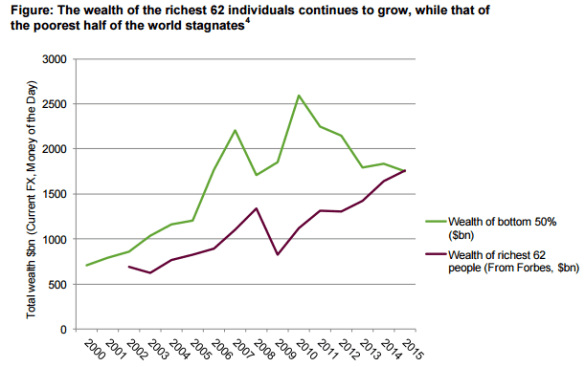
They focused on the green line in the Oxfam chart below. And often on the number of high consuming but indebted individuals in the West who you might not readily identify as poor. As Tim Harford put it:

here’s a surreal image of my own: my toddler controls more wealth than the poorest one and a half billion people on the planet.

Does he have a rich uncle?

No, but he has no debts. That puts his wealth at zero.

But why should an increase in the number of net indebted individuals contributing to the shrinking wealth of the bottom 50% not be a cause for concern?

Capture

Little or no exception was taken by commentators to Oxfam’s purple line – which shows a more than doubling of the wealth of the world’s 62 richest people in the last six years. And most of us will shift uneasily in our chairs at this, too.

So the rough handling – although usually accurate in its own terms – often obscured, and sometimes seemed wilfully to obscure, matters that on any view we should be concerned about.

But perhaps hostility to the Report was rather predictable?

Many appear to have read it as an attack on capitalism. And the belief that capitalism possesses a unique ability to rescue people from poverty is a sacred tenet for many. Sacred – and not without evidential support as Fraser Nelson has pointed out here.

(A short aside. There important limitations to Fraser’s charts too: a steep decline in the number of people with an income of less than $1.90 a day certainly tells us something about poverty – but the ‘what’ is rather context specific. Do you live in Malawi or Monaco? Certainly the suggestion made by the graph that the “Share of the world’s population living in poverty” has declined is not made out by the data given. And, similarly, an increase in resource flows tell us nothing about who receives them. You might well expect the ‘Private’ flows that Fraser champions to fill different pockets to those of the ‘Official Development Assistance’ flows.)

Even so. Let’s make an assumption I readily make: that capitalism is a powerful force for good. And look at where it should and shouldn’t lead us.

It should lead us to protect capitalism – and celebrate its successes. But it shouldn’t lead us to conclude that capitalism cannot function better. If any of us are sanguine about environmental change, or inequality, or abuses of the tax system, or poverty, or air pollution – if any of us are, we shouldn’t be.

In fact, Oxfam’s report doesn’t attack capitalism. What it does do is call for changes to the way capitalism functions. A good defence of capitalism involves championing the successes but also searching out the ways that will cause it to succeed better at the only metric that matters: the health of our society. A bad defence focuses exclusively on the successes; ignores the failures; and attacks those who point them out.

That bad defence does not seek to persuade the undecideds. It has no broader ambition than preaching to those already in the choir seats. But it needs to do more. Because capitalism’s friends – amongst whose number I count myself – mustn’t be complacent.

There is hunger for political and economic change. In the US a fight for the Presidency between Donald Trump and Bernie Sanders is now a live possibility. And in the UK, today’s complacency might quickly fall away were Labour to choose a more adept leader from its Left – especially if the public were to be exposed to another 2008 style market failure. By failing to agitate for its better functioning, capitalism’s champions jeopardise that which they seek to protect.

And, perhaps even more importantly, they eschew the opportunity to advance the better world we would all like to see.

Labour and the World of Work

It won’t have escaped your attention that the way in which we work is changing. A number of narratives have sprung up around those changes.

There is an optimistic narrative that celebrates the opportunities for self-actualisation that a more fluid work environment delivers. There is a narrative around how everyone can benefit from the chance to tailor the supply of our labour as we choose. There is a narrative that identifies the negative impact of less secure models on working on individuals whose skills leave them with low bargaining power. And there is a corresponding narrative that decries the exploitation of those individuals.

Each is true – and none is universal.

What I’d like to do is identify some regulatory levers a Labour Government might pull to bring more of us within those positive narratives. But to do that, I need to start by identifying a less common narrative.

The arbitrage advantage

The line between employment and self-employment describes the difference between a contract whereby you provide services to another and a contract of service. Are you in business on your own – or are you in the service of another?

If you are in the service of another, that other must provide you with a safety net, one which corresponds to your service. There are regulatory obligations of minimum pay, of security, to treat you fairly and share risks with you. If you are in business on your own, those burdens fall on you.

So for the employer, an important consequence of employing someone is that you carry the cost of providing that safety net. Contracts for services do not carry those costs.

This same line in the sand – between employment and self-employment – that dictates availability of this safety net also carries profound tax consequences. Putting £100 of pay in the pocket of a basic rate employee can cost an employer (after tax and National Insurance) £167. Putting that same £100 in the pocket of a self-employed worker costs her engager £141.

In a competitive, labour intensive, high volume, low value added industry that £26 represents a saving far more profound than any that might be delivered by a real-life competitive edge. When taken together with additional costs imposed on employers of providing the safety net it is overwhelming.

Disruptive new technologies that enable different modes of working are creating new opportunities for businesses to compete. Sometimes they deliver pure efficiency advantages. But they also create opportunities to arbitrage regulatory weaknesses.

And the successes we celebrate as victories for new technology are very often – usually I would say – the product, in whole or in part, of regulatory arbitrage. Our narratives might ignore it but we live in a world where, as Stephen Sondheim crisply put it, the Princes are Lawyers.

This is an indubitable fact. And it is true not merely of labour intensive businesses – although it is upon those that I focus here.

And arbitraging these advantages channels vast amounts of money – tens of billions of pounds – into the pockets of the arbitrageurs. And it channels that money from the rest of us. From businesses that don’t enjoy those arbitrages and are outcompeted. From individuals denied that safety net who faces lives of financial uncertainty and breadline pay. And from taxpayers and those who rely on public services who together fund that lost £26.

A properly functioning regulatory environment fosters and rewards real innovation. Ours acts actively to reward poor labour practices and burden shifting. By creating market distortions it rewards the very behaviour it should discourage.

How should Labour respond?

The problem of outdated regulatory frameworks extends beyond the workplace. But it is the workplace I want to focus on here.

Sometimes it will be appropriate to impose the burden of providing a safety net on those who use labour. And there are good reasons to encourage entrepreneurial behaviour through the tax system: real entrepreneurs – unlike arbitrageurs – deliver wealth to us all. I start from these principles.

The history of the dividing line – employment or self-employment – is measured in centuries rather than decades. The quality of the safety net that is its consequence ebbs and flows with different Governments. But the line that dictates whether or not it is available has in recent times remained broadly static. It has not moved as the ways in which we work have changed. It derives from the (wrong) question ‘are you in service?’ rather than the (right) question ‘should we impose upon your engager the obligation to provide a safety net?’ It looks to a formal question ‘does this contract look like a contract of employment?’ rather than a functional one ‘how does this relationship actually function?’ And it is found in judge-made law, which Government cannot adjust as circumstances change.

It is not the right line.

If there are circumstances where the burden of providing a safety net should fall on employers those circumstances must be dictated by a principled analysis of when it is appropriate to impose it. You can only conduct that principled analysis by replacing the present test with a statutory test; a statutory test that looks to functional questions rather than legal ones. And which, unlike the ‘in or not in service question’, you can adjust as the world adjusts.

A sensible functional test looks in particular to whether there is an ongoing relationship between an individual and an other. And to the intensity of that relationship (hours a week). And imposes the burden on the counterparty whose business it is financially to profit from that individual’s labour.

Such a test would, of course, disrupt some business models – but it would protect others and create more. Labour should not be afraid of these consequences.

This would not merely be right. It would also enable the manifesto promise that under Labour people who are employees will have a safety net. The class of individuals who continued not to benefit from that safety would shrink. And it would also be composed of individuals whose mode of working was more akin to being, in reality, in business on their own account. The sorts of individuals less in need a safety net.

And there may also be a good case for the State to step in where the test fails to identify a functional employment relationship. In his Conference speech Corbyn indicated Labour might venture down this road. He was right to do so
– indeed Labour might travel further.

I turn next to consider how we use the tax system to encourage entrepreneurial behaviour.

Remember that £26? As things stand, the dividing line between those who pay it and those who do not is, again, the question whether the individual is legally ‘in service’. And we collectively give a multi-billion subsidy – officially around £3bn per annum – to the self-employed and those who engage them.

If you think it odd that we today encourage entrepreneurship by reference to a line drawn in a long ago world; if you are surprised that the engagers we subsidise are those who do not provide safety nets; if you find it a remarkable coincidence that the line we use to encourage entrepreneurship is the same as the line we use to dictate whether there is a safety net then… well, you are in good company.

Labour should abolish the subsidy.

It is poorly targeted and damages legitimate competition. The saving would fund the modest costs of improving the safety net for the self-employed. And a better safety net would itself enable more risk taking. But the saving would also fund the cost of a tax relief, targeted at basic rate taxpayers, and that encouraged entrepreneurs and not arbitrageurs.

I shall not write here about the mechanics of abolition: that is a discussion for another place. Nor shall I further outline what that tax relief might look like. The question how to encourage entrepreneurship through the tax system is a broader conversation but I may later write on the principles which might guide that conversation.

Note: this is the second of the series of pieces stemming from this Manifesto.