Brexit: the important role of the Court of Justice

It attracted surprisingly little press attention but, in a speech of late last week, Donald Tusk offered up a tantalising possibility. Negotiations might take place between the UK and the EU. And when they had concluded, we could choose between the outcome of those negotiations (which he said would be a ‘Hard Brexit’) and the status quo of our remaining in the EU.

Tusk was gently floating a political possibility. He didn’t address the underlying legal question – one of construction of European law – which is whether, having made a notification under Article 50, we can later and unilaterally reverse it.

But it is no exaggeration to say that the legal question is of enormous political importance.

If the answer is ‘no’, the triggering of Article 50 will commit us to leaving the EU. The effective consequence of the answer being ‘yes’, on the other hand, may be to compel the Government to offer Parliament or the electorate at large a vote on the terms of the deal. Parliament may require a second mandate as the price of passing an Act to trigger Article 50 – or passing the Government’s proposed ‘Great’ Repeal Act. Even if Parliament does not, should during the course of negotiations the popular mood turn against Brexit (likely if economic conditions continue to deteriorate) the public may demand it.

What makes this question especially topical is that the same legal question as is embedded in Tusk’s political offer also lurks just below the surface of the Article 50 litigation that is presently taking place in the High Court.

The Claimants’ case – that triggering Article 50 can only be done by Act of Parliament – rests upon a contention that removing rights from individuals cannot be done by the Executive. It is something only Parliament can do. But if Article 50 is reversible, the central assertion in the Claimants’ case may not arise. If Article 50 is reversible we can’t know that the consequence of Theresa May triggering Article 50 will be to remove those rights.

Until Friday, this legal question looked likely to remain below the surface.

For political reasons – as I predicted back in June – the Government was loathe to argue that Article 50, once triggered, could nevertheless be reversed. Arguing this would leave our membership of the EU an open book and infect the remainder of the Conservatives’ term in office. The reversibility of the Article 50 case suited the Claimants too. As I have explained above, their legal case that only Parliament could trigger Article 50 is weakened (perhaps fatally) if Article 50 is reversible.

So it seemed as though the question might pass unresolved.

But on Thursday the High Court upset this expedient consensus. The Lord Chief Justice indicated he was not prepared to proceed on a mutual assumption that Article 50 was irreversible. He wanted to decide the point.

So what happens now?

(I should say for the record that, although I was the original client for the purposes of obtaining advice and writing to the Government, for legal reasons I now have only a limited and informal involvement in what became the so-called People’s Challenge. Specifically I do not know what it intends to submit.)

What we know is that, before the litigation, Government considered the matter carefully and decided not to assert that Article 50 can be reversed. It seems to me very unlikely that the Government will now form a different view. I expect that it will decide to keep its powder dry and perhaps take the point in the Supreme Court if it loses in the High Court. It will want to hedge its bets.

The Lead Claimant – Gina Miller, represented by David Pannick QC – has advanced what she coyly describes as an “assertion of law” that Article 50 is irreversible. This, too, is a form of bet-hedging to see what the other side does. Only if the Government asserts that Article 50 can be reversed will Lord Pannick feel compelled to move beyond assertion.

Counsel for the People’s Challenge – Helen Mountfield QC – had sought to invite the High Court to proceed on an assumption that it is irreversible. She came – and will come again tomorrow – under pressure to firm up her position. But what is clear (to me at least) is that she cannot be forced to advance submissions in relation to a point that is not in issue. I expect her to adopt David’s Pannick QC’s formulation.

So where does this leave the High Court – which obviously does consider that it needs to decide the question?

You won’t have noticed but I observed (above) that the question whether an Article 50 notification is reversible is a question of European law. And that has a striking consequence. Our courts may need to refer the matter to the Court of Justice of the European Union.

If it is (1) necessary for our courts to decide on the reversibility of Article 50 to answer the question before it (on whether Theresa May can trigger Article 50) and (2) the matter is not clear beyond sensible doubt, then the High Court may (indeed, the Supreme Court must) refer the matter to the Court of Justice of the European Union for an answer.

It cannot reasonably be suggested that the matter is clear beyond sensible doubt. And the High Court plainly seems to consider the matter highly relevant (although it is not yet clear that it is ‘necessary’). So a reference by the High Court must be a real live possibility (although it may be reasonable to expect a reference from the Supreme Court rather than the High Court).

Such a reference would have some important consequences.

First, there would be a very real delay in the determination of the Article 50 claim. The Rules of Procedure of the Court of Justice do contain provision for the President of the Court to direct an expedited procedure. But even were he to do so, it might be reasonable to expect (taking this as an example) a delay of three months. There would then need to be a further hearing before the High Court or Supreme Court to determine the outcome of the Article 50 claim once the Court of Justice had ruled. Theresa May’s deadline for triggering Article 50 of March 2017 would inevitably be breached.

Second, there will be some media excitement. Imagine the delight of our Fourth Estate at the prospect of the Court of Justice playing a part in determining the mechanics of our decision to leave the European Union.

Each of these consequences will be viewed with some caution by the parties to the Article 50 litigation. But, if the High Court or Supreme Court is determined to decide the question of the reversibility of the notification we must prepare ourselves for them.

Standing back from all of this, and although I can certainly see the downsides to a reference to Luxembourg, there is an important upside too.

Each of Parliament, the Government, and the public too needs to understand the consequences of notifying under Article 50. If it is irreversible, the public should understand before notification that there can be no second referendum or Parliamentary mandate for the Brexit deal. If, on the other hand, it is reversible, Parliament and the Government should acknowledge the consequence of the lack of clarity as to what the Referendum mandate meant. That consequence is a need for a fresh mandate from Parliament or the electorate on the terms of the negotiated deal.

The Dependent Worker

The thrill of the new, of progress, the advance of technology, can cause us to misascribe to modernity that caused by quite something else. We can, for fear of appearing Canute, accept as inevitable that which can and should be resisted.

Care should be taken.

Many of these problems are evidenced in our analysis of the growth of self-employment.

It is true that technology puts the buyers and sellers of labour together with an efficiency that benefits both – indeed us all. It is true that this has made possible – and desirable – patterns of working that could not previously have existed. But it is not true that it is this alone, or even primarily, that has caused the rise in self-employment. And it is not true that the negative consequences – the creation of a class of worker living precariously on the margins – are inevitable.

Care must be taken.

Put aside those who progress crowns winners. Focus instead on those without bargaining power: the warehouse workers, secretaries, drivers, call-centre workers, the marginal trades. Those who are dependent, very often, on a single relationship. Their status as self-employed stems often not from technology but the law. The law, which creates two compelling disincentives against their employment.

The first is the tax system. As I explain here, putting £100 into the pocket of an employed worker can cost an employer £26 more than putting that same £100 into the pocket of her self-employed equivalent. This difference is profoundly important to the economics of the low margin, high volume businesses in which the precariat are engaged. If you employ a worker you cannot compete.

The second is employment law. We ask employers to provide a safety net for their employees. We ask them, very often, to bear a cost which would otherwise fall on the worker or on the state. But we impose no equivalent burden on engagers of the self-employed.

Think about that.

We use our tax system to incentivise employers to avoid providing a safety net. This – I hardly need say – makes no sense. The incentive should be exactly the other way: not to shirk a safety net. We should not through the tax system subsidise those who transfer costs to others.

But addressing it is not impossible. It requires only political will. The Conservative Party has at least two terms of Government before it. It is insulated from political risk. It should act. And here is how.

First, it must remove the tax incentive for employers to shirk the provision of the safety net. This could be done in a revenue generative fashion – by raising the tax costs of engaging the self-employed to the level of the employed. Or a revenue neutral fashion – by spending some of the tax raised from self-employment on cutting taxes for the employed. It matters not. But the playing field must be leveled.

Second, we must address when that safety net should be provided.

Presently the answer is given by a judge made test – employment or self-employment – that dates back a century or more. The test relies on a range of factors, many of which have no logical relationship to the question when we should place responsibilities on the employer. We must replace it with a statutory test that Parliament can trim to the conditions of the day.

To ask what that test should look like we need to recognise its purpose. That purpose is not to ask of a worker whether he should have a safety net: it is not a substitute for a welfare system. It is, instead, to ask of an employer whether his relationship with his workers is such that it is reasonable for him to provide one. Is the worker ‘dependent’ on the employer?

This is, it seems to me, a function of two factors: first whether the worker has the power to set his own prices and second whether the worker really is in business on his own account.

When I, as a barrister, set my prices I can include within those prices a margin to enable me to provide my own safety net: sick pay, holiday pay, a pension and so on. In those circumstances the law should not compel any other to, for example, make contributions towards my pension. But where an employer dictates the prices at which a worker works, she cannot create that margin. Indeed the logic is to ask: what minimum amount does a worker need to pay for her own safety net. Pay below this rate and the burden of providing the safety net falls upon you.

The other important factor is whether the worker is dependent upon the employer. Our law already knows of the concept of a ‘subordinate’ worker. We could replace it with a simple test based on the number of hours worked for an employer. Use a worker for that number of hours and they become dependent on you; you acquire a commensurate obligation to provide a safety net for them.

These steps would not stem the rising tide of the gig economy. They do not seek to; they recognise the benefits it brings. But they would ensure a level playing field for employers. They would ensure the less generous do not drive out the more. And they would remove the bizarre encouragement our tax system provides for business to transfer costs to the state or the individual. 

Theresa May’s mighty throw of the Dice

(A version of this piece appeared yesterday in Prospect magazine).

It is mere machinery, the proposed ‘Great’ Repeal Act. 

It moves the debate on, as Faisal Islam wittily quipped, only from ‘Brexit means Brexit’ to ‘How Brexit means Brexit’. But it leaves unanswered the What: it tells us nothing about the shape our relationship with our European neighbours will come to take.

One might, warming to this theme, come to see it as a purely technocratic exercise in advancing to today a step that would otherwise be taken tomorrow. The European Communities Act 1972 – which translates into our domestic law the rights and responsibilities we derive from the United Kingdom’s membership of the EU – would need to be repealed anyway. And the Repeal Act won’t take effect until we leave the EU. It does nothing now.

All of this is right. And yet it misses the true import of what Theresa May announced.

Writing on the Friday following the Referendum I expressed the view – one from which I have not shifted – that hopes for our remaining in the EU rest largely on how events are sequenced. 

Voters, when they entered the booth on the 23rd of June, and in their unwritten ledgers of Leaving and Staying, priced up present resentments and discounted future costs. The passing of time, ran the argument, would cause them to re-mark their concerns to reflect the reality of life outside the EU. When investment stalled, and jobs were lost, and public finances were hit, and the promised NHS savings were reversed, voters would revisit their ledgers. Public opinion would turn.

This may yet happen. And those who have fought and won the fight to Leave know it. It is this that spurs their sense of urgency. That is why we must Leave now and the consequences of acting precipitately be damned.

Only when you see the battle to Brexit in these terms can you begin to understand why Leavers have argued for exactly this solution: a Repeal Act, adopted by Parliament now, authorising a repeal of the European Communities Act later, with that later being a point in time to be determined by Executive Order. Now the result of the Referendum provides an impetus for Parliament to act. Now a narrative around the damage that would be done to democracy by ignoring the expressed will of the people might cause Parliamentarians to decontextualize the result from the circumstances in which it was obtained and the opacity of what it means. But later? Later, who knows.

So repeal now, prospectively, and place the means of delivering that repeal beyond Parliament, in the hands of the First Lord of the Treasury: the Prime Minister. Parliamentarians are amenable to the pressure of the electorate. But with her moderate flank left unprotected by an opposition party shamefully absent from the most important event in the life of our nation, the Prime Minister is accountable only to her own Conservative MPs. A future change in the tides of democratic opinion could not rescue her from the demands of her own Party.

And yet, and yet, all is not lost. The Great Repeal Act is also a mighty throw of the dice by Leavers.

There is a world – a world that at the end of last week seemed possible or even likely – in which MPs had no opportunity to vote on Brexit until it was too late. Article 50 would be triggered, negotiations would ensue, we would agree terms of separation with our EU partners, our membership of the EU would cease and then, and only as a tidying up exercise, would MPs formally be asked to repeal what had already become the empty vessel of the European Communities Act. The array of rights that it had conferred upon citizens of the United Kingdom would have dissipated already. It was this world that the Article 50 challenge – which will be heard in the High Court later this month and the Supreme Court in December – was designed to head off. Triggering Article 50 amounted to a functional repeal of the European Communities Act, ran the argument, and a member of the Executive can’t repeal an act of Parliament.

But to deliver her Great Repeal Act Theresa May will have to persuade MPs to support it. To vote for an Act they cannot know the effect of. 

It is true that the Great Repeal Act is a leap into the unknown. But to say this is to fail to do justice to quite how big a leap it is. There can hardly be an aspect of our national life that the EU does not touch upon. It is this that caused Theresa May to announce that alongside the repeal there will be a separate measure adopting as domestic law everything we currently derive from the Treaties. But even this does not do: for there is much of our law that must change when we leave: our membership of the Customs Union, our system of Value Added Tax from which we derive almost a quarter of all tax receipts, reciprocal healthcare and pension arrangements, and so on. What is to happen to all this?

So she will have to persuade MPs to support this leap into the unknown – and Peers too. If the Act takes the shape I understand it to, I believe the Salisbury Convention, which prevents the House of Lords from withholding consent to a measure promised in an election Manifesto, would not apply. And, although they are not a representative set, the members of the House of Lords I have spoken to are adamant that such an Act would not pass the Upper Chamber.

Most importantly of all is the opportunity the Great Repeal Act gives to an MP to table what a responsible Government would offer us anyway. 

The binary formulation put to the electorate in the Referendum: “Should the United Kingdom remain a member of the European Union or leave the European Union?” skated over the many parallel universes offered up during the campaign: lower and not lower immigration, inside and not inside the single market, money spent and not spent on the NHS, retained and not retained regional investment and agricultural subsidies, and so on. Without clarity as to what the question we put to the electorate meant, how can we interpret the answer they gave us?

Even if, at this early stage, MPs and Peers feel unable to resist a prospective repeal of the European Communities Act, they may be persuaded to adopt a measure that gave the electorate the chance to choose between the relationship we have with the EU, and that which our Three Brexiteers manage to negotiate for us. A referendum on that deal: that would be what taking back control from an unelected Executive really looked like.

Article 50 Challenge: the Government’s Defence

Following an application made to the High Court by Bindmans on behalf of the People’s Challenge which you can read here, the High Court has allowed publication of the Government’s Grounds for Resisting the Article 50 challenge.

You can read, following, those Grounds and the Skeleton prepared by Bindmans.

You can contribute to the costs of the People’s Challenge here.


Government’s Grounds for Resisting the Article 50 challenge

The People’s Challenge Skeleton

Article 50: Your right to know

Back in late July, I tweeted this Order of the High Court in the legal challenge to the Government’s position that no Act of Parliament is needed to trigger Article 50:

I think that is a pretty remarkable Order for Government to have procured in an action of enormous and legitimate public interest.

Today, John Halford at Bindmans LLP has applied to the High Court to amend the effects of that Order. I have reproduced, following, that application.

Should you want to fund the legal challenge you can do so here. And I have also, today, in a separate blog post, reproduced one of the Skeletons produced by those bringing the challenge.

a1

a2a3

a4

Article 50 challenge: the Skeleton

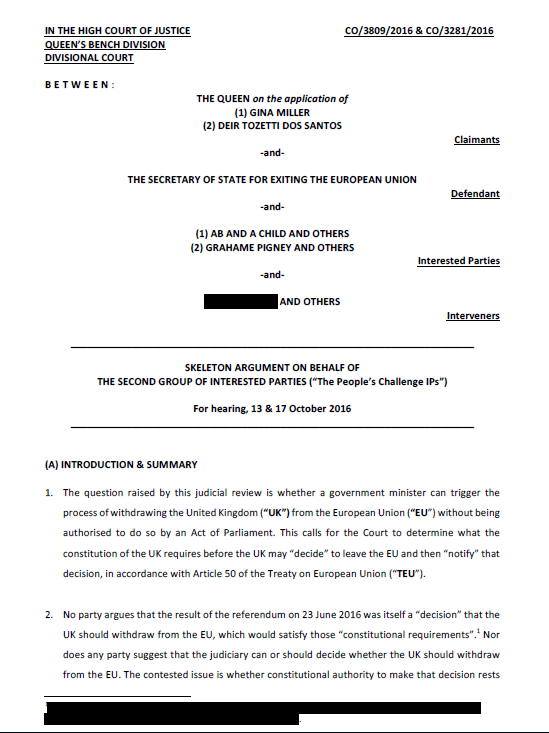
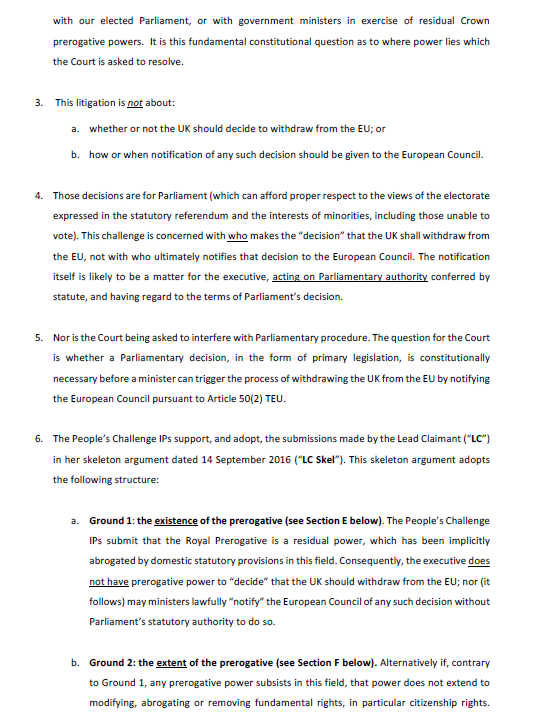
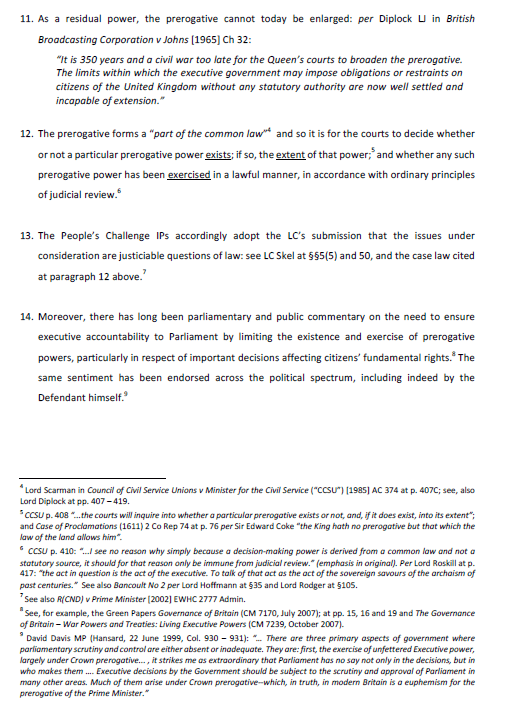
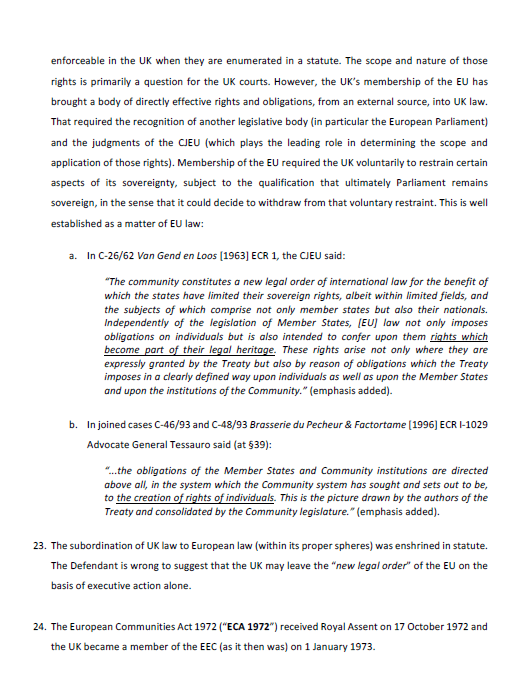
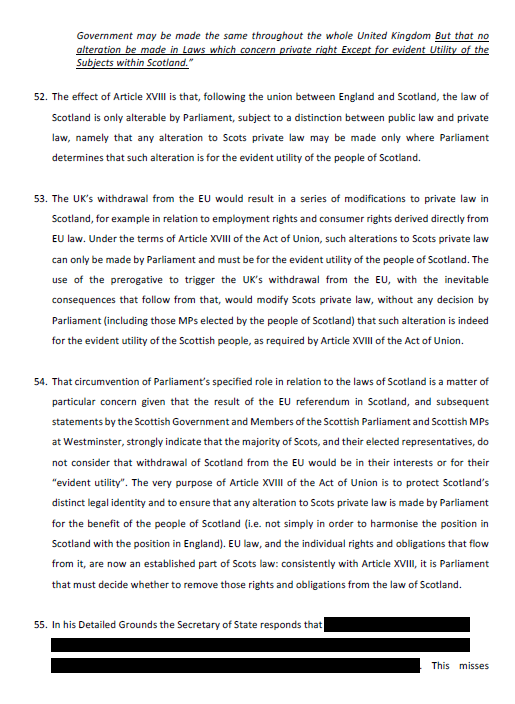
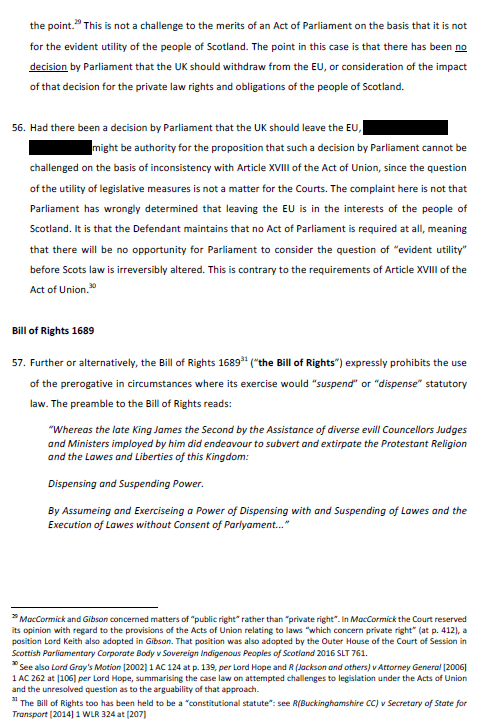
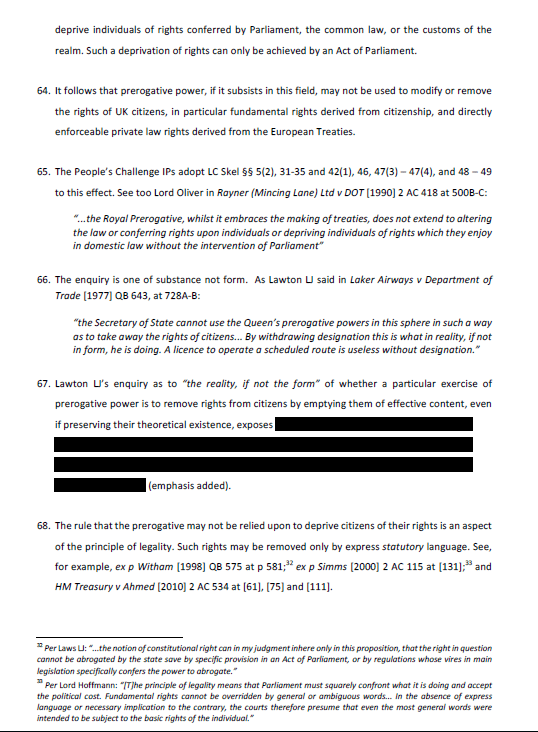
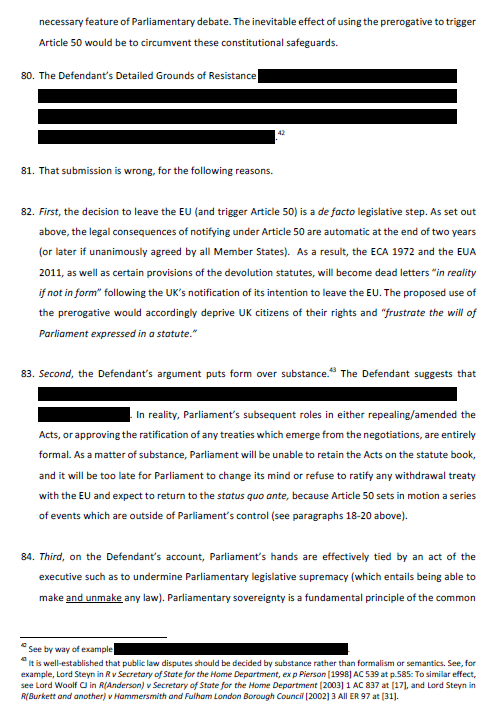
What follows is a copy of the Skeleton served by the ‘Interested Parties’ in the action before the High Court to establish whether an Act of Parliament is needed to trigger Article 50.

You can fund the action here. And you can read more about why I think democracy demands that Parliament decides here.

You will note that, in consequence of an order made by the High Court, certain sections of this Skeleton have been blacked out (or ‘redacted’ if you want to Talk Like a Lawyer). I am publishing, separately, a copy of the Interested Parties’ application to overturn that order of the High Court.

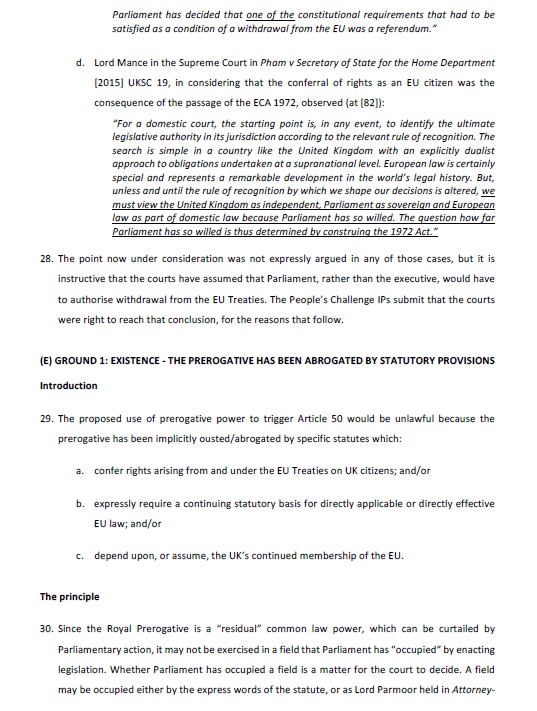
page1

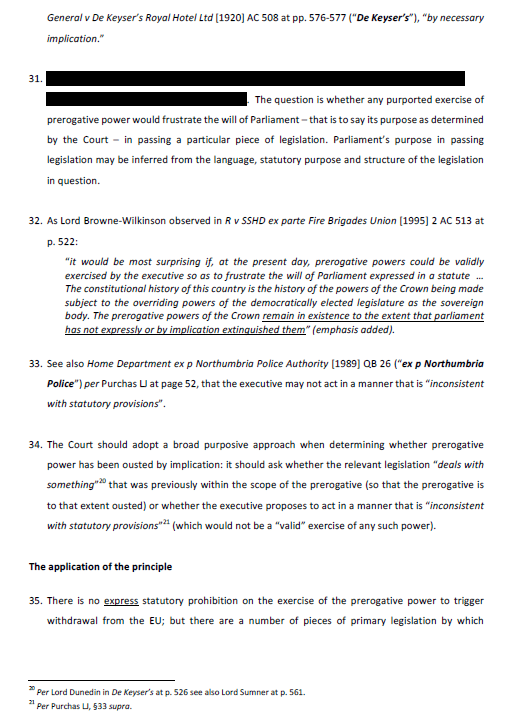
page2

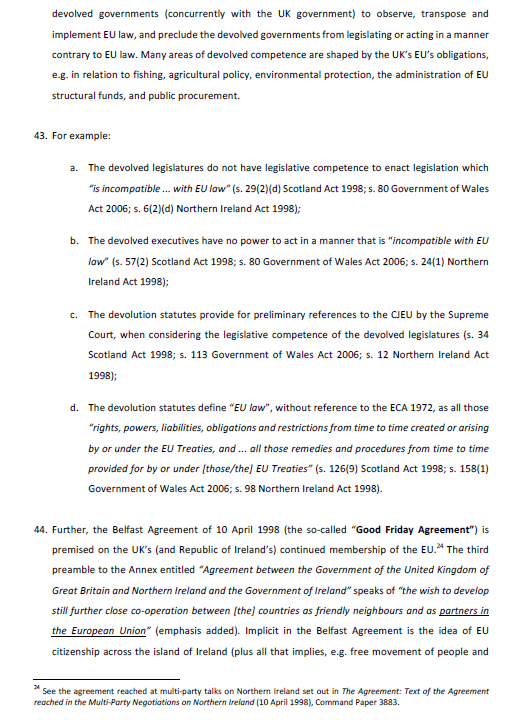
page3

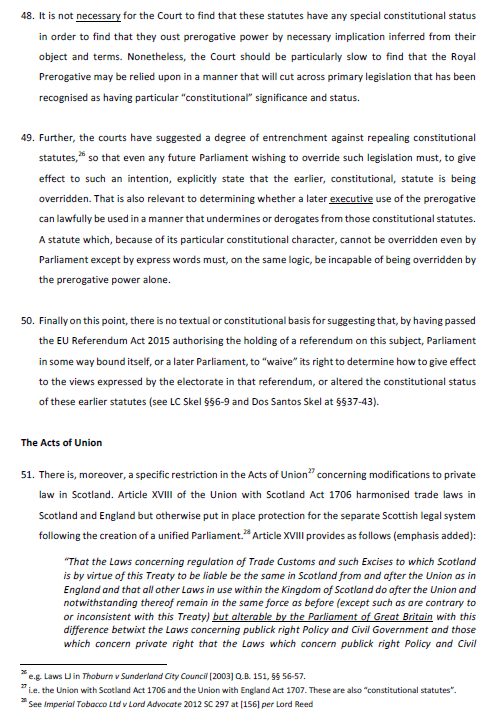
page4

page5

page6

page7

page8

page9

page10

page11

page12

page13

page14

page15

page16

page17

page18

page19

page20

page21

page22

page23

page24

page25

page26

A footnote

A political party is a machine for turning values into actions. In viable Opposition it’s powerful and in Government there is none better. But, like every machine, it can break beyond repair. If it does, it’s not merely useless. It actually gets in the way of achieving those values. Keep it and you can’t get a better machine. One that works.

Under the first past the post system there’s only room for one party on the Left. If that party is Labour there can be no other. That’s great if Labour is, or reasonably hopes to be, in Government. But, if you want to turn your values into actions, and Labour can’t, you need a machine that can. 

So the question you should be asking yourself is whether Labour is broken. Be honest: is there a realistic route back to Government for it? Is it still a powerful machine for turning values into actions? Or is it just a space where people go to talk to one another about what they want?

Those questions aren’t easy to answer.

For many, your attachment to the Labour Party goes beyond the rational. Your narrative of who you are, your relationships, your career and status, all are bound up with the Labour Party. But if you believe it is broken and you stay with it just the same you should be honest with yourself that it’s not about the values. You’re not achieving change in society, indeed, you might even be impeding it.

Leaving isn’t about letting ‘them’ win, or it being ‘our’ Party, or us being a ‘family’,  or whether we still have values in common. Those questions face inwards to the Party rather than outwards to the country. If your focus is on making the country a better place the only question is whether Labour can function as a powerful Opposition or is viable as a party of prospective Government. 

I’m not going to help you answer it. I’m not even going to tell you why I’ve answered it ‘no’. I just want to pose what I think is the right question.

Many of us are wondering, if we leave, where do we go?

At the moment, because there is Labour, there is no new machine.

But at the moment that doesn’t matter. 

Fewer than 1 in 50 of us is a member of a political party. But the votes of the other 49 count just the same. Indeed, they may even count for more. Don’t be taken for granted. Let them come to you – Labour and the Lib Dems and the Tories and the SNP. Let them try and persuade you that they can deliver what you want to see. On competence, on Brexit, on employment, on welfare, on immigration, on the economy, on defence, on our place in the world.

And when something new rises – and if Labour fails it will – join it. But by propping Labour up you make that impossible.


Sweetheart deals and meaningful accountability at HMRC

Buried in the EU Commission’s State Aid Press Release was this invitation to other Member States to share in Ireland’s prospective €13bn (plus interest) tax bonanza from Apple.

capture

Italy already has. Apple handed over €318m last year, it would seem. Spain, Austria and France have now signalled that they will look again at whether Apple has paid the right amount of tax. This is no surprise. Even without the Commission’s prompt, given how Apple’s operations are structured, if it owes hundreds of millions in Italy, you would expect it to owe equivalent sums to member states across the EU, including here.

But there’s been no public signal we will look again. This will – and should – give rise afresh to the question whether HMRC is acting in the public interest.

I ask this question now because later this month we will hear how HMRC proposes to answer it.

Back in February 2012, following widespread concerns that HMRC was doing sweetheart deals, the Public Accounts Committee noted:

Governance procedures have lacked the independence and transparency needed to provide sufficient assurance to Parliament. Tax settlements with large companies are inevitably complex and involve the exercise of judgement. Parliament needs assurance that these settlements are appropriate and good value for the taxpayer. The Committee welcomes the Department’s proposals to introduce an independent assessor, or assessors, to sit alongside Commissioners, who would carry out independent review of settlement proposals.

Because we treat taxpayer confidentiality as sacrosanct, Parliament lacks the ability to scrutinise whether HMRC is acting in the public interest.

What was then proposed was that we would appoint a “Tax Assurance Commissioner” who would act independently of HMRC. A People’s – to use the nomenclature du jour – Champion who would zealously guard over the public interest and fearlessly disclose naughtinesses at HMRC.

The appointee was Edward Troup, and here’s what he said in his Tax Assurance Commissioners’ report published just a couple of months ago.

capture

That’s all reassuring. Until you remember it was written five months after he was also given the job of Executive Chair and Permanent Secretary of HMRC. For the last few months he has, in effect, been scrutinising himself. And prior to that – at least it might be seen in this way – he spent several years as gamekeeper whilst auditioning for the job as Chief Poacher.

I’m not advancing an assertion that Edward has done those jobs otherwise than well. But when it comes to appearances? It’s quite fantastically unattractive.

In an age of enfeebled nation states and mighty corporates – remember “the tax treatment in Ireland enabled Apple to avoid taxation on almost all profits generated by sales of Apple products in the entire EU Single Market” – democracy demands meaningful scrutiny of these hugely valuable deals done behind locked doors.

I’ve addressed this problem before.

I wrote:

We can generate a dozen different layers of assurance. But if we populate them with individuals with a cookie cutter outlook the result will neither look like – nor represent – good scrutiny. The reality is that few people move into HMRC from the outside world – the traffic is almost all the other way – and the pool of Tax Commissioners is drawn almost exclusively from HMRC and the tax profession. I am aware of no-one who occupies a role of strategic importance in the process of approving deals whose background is such as to reassure the public that they are likely to provide independently minded challenge.

Let’s hope we end up with real scrutiny. Scrutiny that’s meaningful. That the public can have confidence in. That’s in everyone’s interests. Because if we can’t have confidence that big taxpayers are being made to pay the tax they owe, we’re bound to wonder whether we should bother.

Brexit: the Case for a Parliamentary Vote

[The following was commissioned by Counsel Magazine and is also published here.]

I’ll take some things as read.

You’ll know there’s a legal challenge to the Government’s position that it is for it and not Parliament to decide what action to take following the result of the Referendum. And that the challenge will be heard in the Divisional Court in October with a likely leapfrog appeal to the Supreme Court in December.

You’ll be aware that the challenge raises a question about the nature of the limits to the Royal Prerogative. Will triggering Article 50 denude the European Communities Act 1972 of content? Will it deprive UK nationals of their rights as an EU citizen? Is it Theresa May’s finger on the trigger? Or is must it be by Act of Parliament?

Published alongside this piece is another arguing that these are political questions – and that the courts should not get involved. I disagree. That there are political ramifications to the answers doesn’t change the nature of the questions from legal.

Few of us would baulk at the suggestion that the courts have an important role to play in regulating the relationship between the citizen and the Executive. Or in circumscribing when the Royal Prerogative can and cannot be used. Baulkers, if there are any, should read the words of Lord Oliver in Rayner (Mincing Lane) v DTI [1990] 2 AC 418, 462:

as a matter of the constitutional law of the United Kingdom… the Royal Prerogative, whilst it embraces the making of treaties, does not extend to altering the law or conferring rights upon individuals or depriving individuals of rights which they enjoy in domestic law without the intervention of Parliament.

Indeed, publicly at least, even the Government says that the challenge raises a justiciable question. I can’t tell you what the Government’s pleaded position is because, remarkably, the Divisional Court has ordered that all documents produced by the Government be kept confidential.

But, as far as we are aware, the issue is not a live one. So let me turn to the question why the proper functioning of democracy requires that Parliament decide. There are at least four overlapping reasons.

First, Parliament is supreme. It chose to enact a referendum that doesn’t mandate our departure from the European Union. It chose one that the then Foreign Secretary recognised in Parliament as merely “advisory”. Mr Hammond went on to say that the Government would regard itself as bound by the result – but that political commitment does not alter the legal character of the European Union Referendum Act 2015 as advisory. To treat it as binding is to undermine the Supremacy of Parliament. It is to replace its intention, as enacted in the Referendum, with the intention of the Executive.

Second, the United Kingdom’s membership of the European Union gives us rights as individuals: to live abroad, healthcare cover on temporary travels, to accrue pension rights working in other Member States, and so on. Parliament has not acted to modify or abrogate those rights. It cannot be right that the Executive can. To say this is to do no more than articulate a specific instance of an important general rule about the limits of Prerogative Power. To ignore it is to put citizens at the mercy of the Government.

Third, the fact that it is advisory inevitably gives rise to the question: who does it advise?

We know Theresa May opposes a second vote on the outcome of our negotiations with our EU partners. We also know that others in the Conservative Party feel differently. Nicky Morgan, who as Education Secretary also publicly contemplated standing for the leadership, says that Parliament must have a say on the final deal. There are wide open spaces between these two positions. One will lead to us leaving the EU: Brexit, after all, means Brexit. The other might not. The difference between them reflects the personal approaches of those two politicians to the outcome of the Referendum. But the electorate has had no chance to speak on which position should prevail. The only choice was one made by Conservative MPs pursuing considerations which included (and I mean no criticism when I say this) parochial ones. To deny Parliament any say on the choice between these positions cannot be right.

Finally, alongside the question, ‘who did the referendum advise’ is the related one, ‘what did it advise’? The binary formulation put to the electorate “Should the United Kingdom remain a member of the European Union or leave the European Union?” skates over the many parallel universes offered up during the campaign: lower and not lower immigration, inside and not inside the single market, money spent and not spent on the NHS, retained and not retained regional investment and agricultural subsidies, and so on. These, and the trade-offs between them, are profoundly important questions. But they were not put in the Referendum; they figured in no election manifesto; no politician can claim a democratic mandate to answer them. I say they cannot be for an unelected Prime Minister.

Let me acknowledge this.

Although the argument I am putting forward is a procedural one – should Parliament or the Prime Minister make the decision about triggering Article 50 – I am interested in it because I believe the sovereignty of Parliament is substantively engaged. And I can only say that if I am prepared to contemplate that Parliament might take a different view to the Prime Minister.

But to contemplate this is not to urge Parliament to ignore the outcome of the Referendum. It is to urge Parliament to consider it in the context in which it arose. That context includes a number of assurances – of a points-based immigration system, of £350m extra to spend on the NHS, of VAT cuts on fuel – each of which has already been disavowed by the Prime Minister. Is the falsity of a representation relevant to the quality of the consent it induces? For legal readers of Counsel, there is only one answer. It includes the imprecision of the Referendum question and the competing accounts of Brexit that were given. It includes the fact that Parliament enacted only an advisory Referendum. It includes the enormous importance to our life as a nation of whether we are inside or outside the EU. And it includes the small margin of victory. Each of these factors must be weighed in the balance, alongside the democratic importance of adhering to the outcome of a hard-fought referendum campaign.

This weighing exercise is not one for an unelected Prime Minister. Parliament, with the roving democratic mandate given to its Members, must find a resolution. It should decide what to do with the result of the Referendum. And those who value democracy should hope that the Divisional, and then the Supreme Court, will direct that it does.

Other people’s money: the Apple story

It really does have it all, yesterday’s Apple story. But you don’t want to read 5,000 words and I don’t want to write them. So let me focus on the bits I think are interesting or important.

First, the political dimension.

Students of the history of the European Union will know that the European institutions have often acted to protect and enhance the functioning of the single market. As I’ve argued on these pages before, we can’t really have the level playing field on which a functioning single market depends with aggressive tax competition between member states. And the institutions obviously know that.

But the power to make tax law rests by and large with member states.

The inevitable result is a tension between those member states who would seek to tilt the playing field towards them through aggressive tax competition and the institutions who are interested in preserving and advancing the functioning of the single market by keeping it level.

I said a year ago that I believed the Commission had decided to use State Aid law to explore the limits of member states’ power to engage in ‘field tilting’ through the tax code. It had decided, to put it bluntly, to be a little more activist. Whether you think that’s a good thing rather depends on what you think about tax competition. And whether you think the single market’s important. But – and I bear in mind the old saw that you shouldn’t make up your mind until you’ve heard both sides of the argument – I have to say I’m surprised at the emergent consensus that the Commission’s decision amounts to overreaching.

Second, the importance of the Apple decision.

I think it’s really important. Indeed, I think it could be a game changer. If you’re contemplating setting up an unnatural structure for tax avoidance reasons, there’s a number of things you weigh in the balance. There are financial costs to setting up and maintaining that structure; there are reputational costs; the structure can be a green flag for investors attracted by the higher post-tax returns but it can also be a red flag for investors worried about the sustainability of higher post-tax returns that can be wiped out with a stroke of a legislator’s pen; and it can negatively affect your relationship with Government in the jurisdictions those structures are designed to denude of tax revenues.

What the Commission decision does is add a really important factor to that list.

The assumption you might once have made – that you will get those higher post-tax returns – you now can’t make. You might incur all the costs – all the negatives – and only discover years later that you didn’t get what you were banking on. The mere fact of the decision – irrespective of whether it is successfully appealed against – adds risk. And there will be many cases in which that will tilt the scales against unnatural avoidance.

Third, looked at in the round, the sort of practice imperiled by this decision is bad and so challenging it is good.

If you read the Irish press you’ll see the debate about whether to appeal against the decision couched in purely parochial terms: should we keep the windfall? or should we act to protect the advantages that come from tilting the playing field in our direction?

But if you look beyond those parochial concerns you’ll see that what Ireland has been doing is giving a subsidy to Apple’s shareholders with other people’s money – and keeping a touch for itself.

The subsidy to the shareholders comes in the form of higher post-tax returns than they would otherwise have enjoyed. As the Commission Press Release noted:

In fact, the tax treatment in Ireland enabled Apple to avoid taxation on almost all profits generated by sales of Apple products in the entire EU Single Market.

The ‘other people’s money’ is the taxes that would have been paid elsewhere in the single market – including in the UK – and in the US too if Ireland hadn’t issued the rulings the subject of the complaint.

The ‘touch for itself’ is Ireland’s tiny slice – from 1 per cent falling to 0.005 per cent – of tax on Apple’s European profits together with the economic activity in Ireland associated with diverting those European wide taxable profits to Ireland.

If you look at the question whether to appeal or keep the cash purely through an Irish lens I’m perfectly content to accept there are sensible arguments both ways. But this shouldn’t blind us to the reality that Ireland’s modest benefit are at the expense of its European partners. And that the real winner is Apple which ends up paying materially no tax at all on its European profits. Not in the US, and not in the EU either.

Finally, the EU dimension.

If you agree with the proposition that it’s a good thing for big multinational companies to pay tax on their profits then you should be interested in how this result came about.

It wasn’t Ireland, or Germany, or France, or the UK that delivered it. It was the European Commission. The reality is that the smaller you are, the more difficult it is for you to generate tax receipts. You’re less important a market. And you’re less able to absorb the risks attached to widening your tax base or increasing your tax rates. Or to face down threats of retaliation. On the other hand, the bigger the market you are, the greater the heft you have.

As I argued before the referendum, writing then about State Aid rules, leaving weakens our bargaining position on tax matters. It puts us on the road to tax haven UK. And if you want an NHS, or free education, or decent pensions, or a social safety net, that’s not a good thing.