That Google Deal

Here’s what Google Inc (the Company then at the top of the Google Group) reports to its investors about UK revenues.

Capture

That’s $6.5bn. Assume an exchange rate of £1:$1.60. That’s around £4bn (plus £62m of loose change).

We know it makes a margin of about 26%. Here’s what one analyst says:

Capture

Others give about the same.

And that’s a margin for all revenues – you’d expect it to be higher in the markets in which Google is already established, but leave that aside. And assume a rather lower 25%. That gives you a notional UK profit of £1bn.

We have a corporation tax rate – the equal lowest in the G20, alongside Saudi Arabia; Russia and Turkey – of 20%. But it would be nice if companies actually paid it. And on that notional UK profit figure Google’s tax liability would be £200m. In a logical world that’s what we’d get from Google in tax revenues.

John Gapper, writing in the Financial Times, said this about Google’s tax settlement yesterday:

Capture

Annualised, that £46.2m represents £30m per annum. That’s an effective tax rate on that notional £1bn of UK profits of 3%. (And for scale, that £30m is only half the amount of the “loose change” I ignored above.)

Here’s what Osborne said about that deal (quoted by the BBC here):

Capture

I’m perfectly prepared to believe it vindicates something. But you might wonder what.

And hang on a second. What happened to that £1bn of UK profits I mentioned at the start? What’s this £106m for 18 months (or about £70m a year) that John Gapper mentions?

The answer is that it has nothing at all to do with the revenues Google Inc tells its investors have been made in the UK. Nothing to do with them at all.

It has come from Google UK Limited’s new accounts – which have been shown to selected journalists but not to me. Never mind. We can look at their last filed accounts.

Capture

Yep, about £70m of profit. More or less the same figure as that annualised for the 12 months to June 2015. But what is that profit actually on?

Well, here’s what Google UK Limited does.


Capture

Now, that doesn’t sound much like selling advertising. And it isn’t. Its business is selling services to other Google companies. And it will charge a modest uplift on its costs – and that modest uplift will comprise its profits.

A consequence of this is that Google UK Limited’s accounting profits will never bear any relationship to the profits Google Inc chooses to report to its shareholders as having been generated in the UK. Those profits generated in the UK will never show up in Google UK Limited’s accounts and be subject to UK tax. Google UK Limited is never going to be hugely profitable.

Indeed if Google Ireland Limited and Google Inc were to choose to buy those services from some other jurisdiction, Google wouldn’t generate any accounting profits here at all.

The accounting profits they generate here they generate because they choose to buy services from here. They choose to make profits here.

But what about the Diverted Profits Tax? It was introduced with some fanfare just before the General Election. I was a rare enthusiast. The tax community hated it and the business community hated it but I thought it was a brave measure. I wrote about it on a number of occasions – but you might start here. Will it make a meaningful difference to Google UK Limited’s tax liability?

Well, the evidence suggests not.

The Diverted Profits Tax came into force on 5 April 2015. And the settlement with HMRC squares off Google UK Limited’s tax liability until June 2015 – or three months after the Diverted Profits Tax was introduced. And it increases Google UK Limited’s tax liability by £13.8m. Even if you assume all of that is attributable to the Diverted Profits Tax – an impossible assumption given that we know Google UK Limited also has back taxes to pay for other periods pre-dating the Diverted Profits Tax – and you annualise it, you still only get £55m.

Even with the tax already payable, still significantly short of the £200m that in a logical world Google UK Limited would be paying.

Speaking in Davos, Osborne also described the deal between Google and HMRC as a “major success”.

Well, clearly it was in publicity terms.

For a third of the annual price to Barclays of sponsoring the Premiership, that £13.8m of additional tax has generated a blizzard of favourable publicity for George Osborne, Google and HMRC.

But for the UK taxpayer? Not so much, I think.


Why ‘Will it encourage saving?’ is the wrong question.

It’s heating up, again, pension tax reform.

The Conservatives seem to have ditched plans first proposed by the Centre for Policy Studies to remove up front tax relief for pension savings and replace it with back-end relief – when those savings are expended. And quite rightly too, because that otherwise fascinating CPS paper neglected the key question: whether such a change would encourage those who need to to save. It’s difficult to make the case that it will.

What has been mooted instead is replacing the iniquitous current system – which gives 40 of tax relief to a higher rate tax payer contributing 100 but only 20 to a basic rate payer making that same contribution – with a flat rate. Assume for the sake of argument, 33.

Such a change would provide further encouragement to basic rate payers to save – but diminish that for higher rate payers. And this has, in turn, sparked a row about whether the Financial Secretary to the Treasury, David Gauke MP, was right to tell the BBC:

“We need to ensure it is effective in terms of encouraging saving, and it is going in the right place”

And the arguments as to why a flat rate would or wouldn’t encourage saving are rehearsed in this typically thorough piece by Jim Pickard of the Financial Times.

Sadly, not surprisingly, it’s a typical political argument: under-evidenced, riven with sectarian division – and about completely the wrong thing.

The right thing is ‘what is the purpose of pension tax relief?’

If you proceed from the assumption – as I do – that its purpose is to encourage people to save for their old age so that they won’t become a burden on the State, you should really provide the greatest incentive to those otherwise most likely to become that burden. And that’s those on lower incomes.

The higher your income, the more likely you are to have surplus income – which, it being surplus, you will accumulate as savings even absent a tax incentive. And there is the closely related point – the higher your income the more likely you are to accumulate assets over your lifetime which you can liquidate during your retirement to provide for your then needs.

Putting the matter more acutely, what we shouldn’t be interested in is whether a flat rate pension tax relief would encourage aggregate savings. What we should be interested in is the change (relative to the present system) to the distribution of savings that a flat rate relief would effect. Will people more likely to be a burden on the state save more?

And the answer to that question, in the case of a flat rate pension tax relief, is indubitably yes.

Why are we rowing about the Oxfam statistics?

On Monday, Oxfam published a report entitled ‘An Economy for the 1%: how privilege and power in the economy drive extreme inequality and how this can be stopped.’ And, as you’ll know, the statistical foundation of that report was rather roughly handled by a number of commentators, often those on the right of the political spectrum.

I don’t write to throw my Casio calculator into that ring. But to make the point I want to I need to start with a few short observations about what those criticisms identified and ignored.

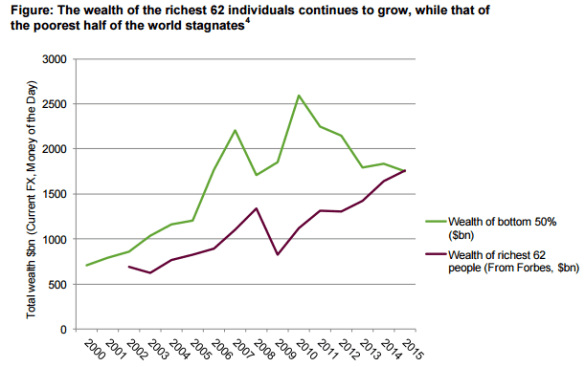
They focused on the green line in the Oxfam chart below. And often on the number of high consuming but indebted individuals in the West who you might not readily identify as poor. As Tim Harford put it:

here’s a surreal image of my own: my toddler controls more wealth than the poorest one and a half billion people on the planet.

Does he have a rich uncle?

No, but he has no debts. That puts his wealth at zero.

But why should an increase in the number of net indebted individuals contributing to the shrinking wealth of the bottom 50% not be a cause for concern?

Capture

Little or no exception was taken by commentators to Oxfam’s purple line – which shows a more than doubling of the wealth of the world’s 62 richest people in the last six years. And most of us will shift uneasily in our chairs at this, too.

So the rough handling – although usually accurate in its own terms – often obscured, and sometimes seemed wilfully to obscure, matters that on any view we should be concerned about.

But perhaps hostility to the Report was rather predictable?

Many appear to have read it as an attack on capitalism. And the belief that capitalism possesses a unique ability to rescue people from poverty is a sacred tenet for many. Sacred – and not without evidential support as Fraser Nelson has pointed out here.

(A short aside. There important limitations to Fraser’s charts too: a steep decline in the number of people with an income of less than $1.90 a day certainly tells us something about poverty – but the ‘what’ is rather context specific. Do you live in Malawi or Monaco? Certainly the suggestion made by the graph that the “Share of the world’s population living in poverty” has declined is not made out by the data given. And, similarly, an increase in resource flows tell us nothing about who receives them. You might well expect the ‘Private’ flows that Fraser champions to fill different pockets to those of the ‘Official Development Assistance’ flows.)

Even so. Let’s make an assumption I readily make: that capitalism is a powerful force for good. And look at where it should and shouldn’t lead us.

It should lead us to protect capitalism – and celebrate its successes. But it shouldn’t lead us to conclude that capitalism cannot function better. If any of us are sanguine about environmental change, or inequality, or abuses of the tax system, or poverty, or air pollution – if any of us are, we shouldn’t be.

In fact, Oxfam’s report doesn’t attack capitalism. What it does do is call for changes to the way capitalism functions. A good defence of capitalism involves championing the successes but also searching out the ways that will cause it to succeed better at the only metric that matters: the health of our society. A bad defence focuses exclusively on the successes; ignores the failures; and attacks those who point them out.

That bad defence does not seek to persuade the undecideds. It has no broader ambition than preaching to those already in the choir seats. But it needs to do more. Because capitalism’s friends – amongst whose number I count myself – mustn’t be complacent.

There is hunger for political and economic change. In the US a fight for the Presidency between Donald Trump and Bernie Sanders is now a live possibility. And in the UK, today’s complacency might quickly fall away were Labour to choose a more adept leader from its Left – especially if the public were to be exposed to another 2008 style market failure. By failing to agitate for its better functioning, capitalism’s champions jeopardise that which they seek to protect.

And, perhaps even more importantly, they eschew the opportunity to advance the better world we would all like to see.

Labour and the World of Work

It won’t have escaped your attention that the way in which we work is changing. A number of narratives have sprung up around those changes.

There is an optimistic narrative that celebrates the opportunities for self-actualisation that a more fluid work environment delivers. There is a narrative around how everyone can benefit from the chance to tailor the supply of our labour as we choose. There is a narrative that identifies the negative impact of less secure models on working on individuals whose skills leave them with low bargaining power. And there is a corresponding narrative that decries the exploitation of those individuals.

Each is true – and none is universal.

What I’d like to do is identify some regulatory levers a Labour Government might pull to bring more of us within those positive narratives. But to do that, I need to start by identifying a less common narrative.

The arbitrage advantage

The line between employment and self-employment describes the difference between a contract whereby you provide services to another and a contract of service. Are you in business on your own – or are you in the service of another?

If you are in the service of another, that other must provide you with a safety net, one which corresponds to your service. There are regulatory obligations of minimum pay, of security, to treat you fairly and share risks with you. If you are in business on your own, those burdens fall on you.

So for the employer, an important consequence of employing someone is that you carry the cost of providing that safety net. Contracts for services do not carry those costs.

This same line in the sand – between employment and self-employment – that dictates availability of this safety net also carries profound tax consequences. Putting £100 of pay in the pocket of a basic rate employee can cost an employer (after tax and National Insurance) £167. Putting that same £100 in the pocket of a self-employed worker costs her engager £141.

In a competitive, labour intensive, high volume, low value added industry that £26 represents a saving far more profound than any that might be delivered by a real-life competitive edge. When taken together with additional costs imposed on employers of providing the safety net it is overwhelming.

Disruptive new technologies that enable different modes of working are creating new opportunities for businesses to compete. Sometimes they deliver pure efficiency advantages. But they also create opportunities to arbitrage regulatory weaknesses.

And the successes we celebrate as victories for new technology are very often – usually I would say – the product, in whole or in part, of regulatory arbitrage. Our narratives might ignore it but we live in a world where, as Stephen Sondheim crisply put it, the Princes are Lawyers.

This is an indubitable fact. And it is true not merely of labour intensive businesses – although it is upon those that I focus here.

And arbitraging these advantages channels vast amounts of money – tens of billions of pounds – into the pockets of the arbitrageurs. And it channels that money from the rest of us. From businesses that don’t enjoy those arbitrages and are outcompeted. From individuals denied that safety net who faces lives of financial uncertainty and breadline pay. And from taxpayers and those who rely on public services who together fund that lost £26.

A properly functioning regulatory environment fosters and rewards real innovation. Ours acts actively to reward poor labour practices and burden shifting. By creating market distortions it rewards the very behaviour it should discourage.

How should Labour respond?

The problem of outdated regulatory frameworks extends beyond the workplace. But it is the workplace I want to focus on here.

Sometimes it will be appropriate to impose the burden of providing a safety net on those who use labour. And there are good reasons to encourage entrepreneurial behaviour through the tax system: real entrepreneurs – unlike arbitrageurs – deliver wealth to us all. I start from these principles.

The history of the dividing line – employment or self-employment – is measured in centuries rather than decades. The quality of the safety net that is its consequence ebbs and flows with different Governments. But the line that dictates whether or not it is available has in recent times remained broadly static. It has not moved as the ways in which we work have changed. It derives from the (wrong) question ‘are you in service?’ rather than the (right) question ‘should we impose upon your engager the obligation to provide a safety net?’ It looks to a formal question ‘does this contract look like a contract of employment?’ rather than a functional one ‘how does this relationship actually function?’ And it is found in judge-made law, which Government cannot adjust as circumstances change.

It is not the right line.

If there are circumstances where the burden of providing a safety net should fall on employers those circumstances must be dictated by a principled analysis of when it is appropriate to impose it. You can only conduct that principled analysis by replacing the present test with a statutory test; a statutory test that looks to functional questions rather than legal ones. And which, unlike the ‘in or not in service question’, you can adjust as the world adjusts.

A sensible functional test looks in particular to whether there is an ongoing relationship between an individual and an other. And to the intensity of that relationship (hours a week). And imposes the burden on the counterparty whose business it is financially to profit from that individual’s labour.

Such a test would, of course, disrupt some business models – but it would protect others and create more. Labour should not be afraid of these consequences.

This would not merely be right. It would also enable the manifesto promise that under Labour people who are employees will have a safety net. The class of individuals who continued not to benefit from that safety would shrink. And it would also be composed of individuals whose mode of working was more akin to being, in reality, in business on their own account. The sorts of individuals less in need a safety net.

And there may also be a good case for the State to step in where the test fails to identify a functional employment relationship. In his Conference speech Corbyn indicated Labour might venture down this road. He was right to do so
– indeed Labour might travel further.

I turn next to consider how we use the tax system to encourage entrepreneurial behaviour.

Remember that £26? As things stand, the dividing line between those who pay it and those who do not is, again, the question whether the individual is legally ‘in service’. And we collectively give a multi-billion subsidy – officially around £3bn per annum – to the self-employed and those who engage them.

If you think it odd that we today encourage entrepreneurship by reference to a line drawn in a long ago world; if you are surprised that the engagers we subsidise are those who do not provide safety nets; if you find it a remarkable coincidence that the line we use to encourage entrepreneurship is the same as the line we use to dictate whether there is a safety net then… well, you are in good company.

Labour should abolish the subsidy.

It is poorly targeted and damages legitimate competition. The saving would fund the modest costs of improving the safety net for the self-employed. And a better safety net would itself enable more risk taking. But the saving would also fund the cost of a tax relief, targeted at basic rate taxpayers, and that encouraged entrepreneurs and not arbitrageurs.

I shall not write here about the mechanics of abolition: that is a discussion for another place. Nor shall I further outline what that tax relief might look like. The question how to encourage entrepreneurship through the tax system is a broader conversation but I may later write on the principles which might guide that conversation.

Note: this is the second of the series of pieces stemming from this Manifesto.

The year ahead – some personal reflections

Along with so many other members – and former members – of the Labour Party my thoughts in the second half of 2015 have been much absorbed with how to respond to the new direction it has chosen to take.

I have never pretended to be tribally Labour. My affinity is more to an idea of social justice than to a Party which once manifested its delivery and contains elements which hope to do so again. So I do not have to pretend, now, that I have not asked whether Labour remains the Party for me. My analysis – right or wrong – is that the path the Party is set upon may well lead – indeed without change is likely to lead – to permanent electoral oblivion. I also believe I could have more influence on Government policy were I not a member of the Labour Party. And the choice between working to save the Labour Party and working to better my country seems to me no choice at all.

What has kept me in the Party is the hope that Labour might again choose to manifest itself as a machine for delivering social justice. That, and a dogged attachment to the idea of good governance. Challenge, transparency, accountability, honesty, representation, diversity: it is a (rather lawyerly) adherence to an idea of how good policy is formed and implemented and overseen that has kept me in the Party. Not because I think Labour has any monopoly over those qualities – it absolutely does not – but because good Government depends upon good governance and good governance demands good opposition.  And, enfeebled though its capacity to fulfil this role presently is, Labour is the only opposition the country has.

So I remain to try and cause it to so manifest itself again.

It has been said, and often, that candidates other than Corbyn offered little in Labour’s leadership elections. I think this is broadly true. But it is much less damning than might at first be thought.

Cooper, Kendall and Burnham thought they were competing against each other – and would have time after victory to put together a policy offer. This is, of course, exactly how good ideas are made. They do not spring fully formed from the mind of some mythical leader. They emerge from a process of deep and iterative thought. As I listened to the early leadership hustings what I most wanted was to hear someone with the courage to admit that they were still embarked on the journey of finding out what the solutions were.

And Cooper, Kendall and Burnham did not see until it was upon them the Corbyn steamroller. And then it was too late to respond. And in this, of course, they were mistaken – but they were far from alone.

And although I do not know what they were for I have little sense of what Corbyn’s Labour is for either. His appeal in the leadership campaign was primarily to higher spending and a largely unarticulated notion of change. Since his victory his more lavish policy offerings – for example, closing the so-said £120bn so-called tax gap or ditching the so-called £93bn of so-called corporate welfare – have (rightly) been shelved.  And the gruel that has been replaced them has largely been drawn from Labour’s 2015 Election Manifesto – that and the policy platform of Stop the War.

But whether or not you think this analysis fair, what certainly is fair is the challenge laid down by those who remain supporters of Corbyn’s brand of politics: what is Labour’s rump for?

I have tried to engage with others in the rump to formulate a mode of responding to this challenge – and I will continue to. I hope something emerges soon – because I believe time is short. But for the meantime I will write personally, offering some tentative thoughts here and elsewhere. I should say, in particular, that I am very grateful to the New Statesman’s political blog for giving me the space to write. I hope they will continue to – especially as I wander further from my area of professional expertise.

So in the coming months – at least as time allows, because my workload in the coming months is especially heavy – I will write on some of conversations I believe the Party should be having. I hope to write on the following themes.

What do we want from our State?

Whilst ‘anti-austerity’ may unify us internally – although I sometimes wonder whether this is only because the expression is so open textured that we can march in uneasy step behind it – I think it is (and rightly) electoral poison. To the public at large, it neatly articulates their fear that Labour would deliver more spendthrift Government. To the taxpayers of today and tomorrow who must fund it, it is an undifferentiated appeal for a bigger state. Its appeal to that part of the electorate might be compared to the appeal to those who must suffer it of (some amongst) the Conservatives’ desire for a smaller state. Both are unprincipled and both are wrong-headed. But the difference is that the Conservatives realise this and do not campaign on it.

Instead, we must start by identifying what we want the State to be. We must make the case for it to exercise those functions. And what delivering them properly would cost. And if the result is spending more then we will at least have a principled basis for explaining why that is the right thing for us to do as a society.

What should be the relationship between business and society?

If I rub my crystal ball, this emerges as the defining political question of our time. As our lives fall into ever greater and more uneasy thrall to the power of money, what as a society can and should we ask of those who have it? How can we ensure business works for all of us? It is this question – and its answer – that represents perhaps the one great opportunity open to the Left. It is space that the Right is politically unable and financially unwilling to occupy. Scepticism of whether business has our interests at heart is both deep-rooted and widespread. We all sense – even if we find it difficult to articulate them – the ways in which money has come to corrode values that all of us hold dear.

But there are yet further levers open to sophisticated Government for ensuring that business behaves in all our interests. And a carefully modulated argument – challenging but not oppositional – for developing and wielding those levers would, I believe, deliver real electoral gains. Only Labour can persuade voters that it is on their side – but it still has to do so.

What should our tax system look like?

As the world changes, as wealth continues to cascade up, adhering to fewer and fewer hands, the Left must plan for more than accretive changes to rates and bands of taxation. The case for examining whether we get value for money from the very substantial sums of revenue foregone through tax reliefs – handsomely in excess of one hundred billion pounds per annum – makes itself. Inheritance tax must be replaced by a system which is both fairer and more fiscally meaningful. And Labour cannot forever turn a blind eye to the possibilities of taxing wealth rather than squeezing ever more from income. Unless the pattern of wealth accretion changes – and I do not think it will – there will come a time when this question is no longer the right question to ask, but instead is the only question. Labour must be ahead of the curve. The starting point, it seems to me, is to ask whether wealth taxes might give us greater fiscal autonomy: is capital more or less inclined than income to flee our borders.

But Labour’s narrative around redistribution has wrongly fixated on tax alone.

The housing market, too, increasingly functions as a system for redistributing wealth, regressively, from renters and other non-owners to those who have property.

The planning system creates scarcity – less than 10% of our environment is built on with half of that ‘built on’ as subordinate garden – and thereby preserves and enhances the wealth of those who own property to the cost of those who do not. The consequences for those who cannot hope ever to own a house in our Cities – and for the economies of those Cities – and for the money we have left for productive investment – do not need to be spelled out here. But a bold reform of the planning system should not be a mechanism for delivering further wealth to those who own the land upon which new houses might be built. Labour must ensure that the bounty that planning reforms occasion is shared with the State. So that the State can deliver the infrastructure investment that those reforms necessitate – and which will deliver prosperity to other regions too. This can be achieved by taxing planning gains.

The labour market might also be seen as a redistributive mechanic.

If you erode the pay and protections offered to employees you make it easier and cheaper for business to engage them. The result (as we have seen) is an increase in employment of marginal quality to the cost of those who lose bargaining power and the benefit of those protections. On the other hand, where you drive up the price of labour – for example by increasing the statutory minimum wage – you can reduce the propensity of business to employ, distributing from it and those not in employment to those who are. This should not, either, be what Labour is for.

Labour needs to have a honest conversation about these effects. I do not ignore apple pie truisms about the need to create a highly skilled and productive labour force. But we must also have a conversation around where to draw a line in the sand. How can we ensure dignity in the labour market for the low skilled? As a society what is the baseline quality of employment that we will permit business to offer to workers? The right answer will be the familiar product of a marriage between principle and pragmatism. But it must come from these questions – not a wilfully myopic outbidding of the Conservatives on the level of the minimum wage.

So these are the themes that interest me. I will write more on them.

But I am only a lawyer – and a tax lawyer at that. There are others more suited than me to develop these – or further or better ideas. My modest goal in the coming year is to contribute to or precipitate a conversation. If your vision of the Labour Party is that it is a machine for delivering social justice I would like to issue to you an invitation. Please respond, here or elsewhere. It really doesn’t matter where. If the ideas are good, and well expressed, people will find them.

All of this means I will do less in the way of scrutiny of the Conservatives’ tax policy.

It is easy to stand on the sidelines and criticise – and after all we have so many targets to choose from. But although vigorous opposing may serve the purpose of making us feel better about the ugly reality of not being in Government, we should not fool ourselves into thinking that it is any replacement for the process of articulating our own, positive, vision of the society we would like to see and create. It is only by presenting that electorate with a better vision than that the Conservatives’ offer that we can hope to bring about the change we would like to see.

Guest Blog: Tax Competition and the Diverted Profits Tax

The Chancellor of the Exchequer is a busy man. Given George Osborne’s broad hegemony over almost all government policy, he could be forgiven if some aspects of government policy were working against others. However, this appears to be happening within the Treasury itself, with respect to corporate taxation policy.

We have seen the Chancellor promise further cuts to the headline rate of Corporation Tax, firmly establishing Britain as having the lowest corporate tax rate of all of the world’s major economies.

‘A new 18 per cent rate of corporation tax – sending out the loud and clear the message around the world: Britain is open for business.’

While it may be folly to pay too much regard to the headline rate (capital allowances, for example, remain comparatively low by international standards) it remains a very clear statement of intent: to bolster Britain’s tax competitiveness by further lowering tax rates. But can we square the Chancellor’s fondness for inter-state tax competition where Britain benefits with his efforts to shut down tax competition for others through the Diverted Profits Tax (DPT)?.

Tax competition: as bad as it seems?

Tax competition is entirely compatible with, if not encouraged by, the free-trading economic model to which the UK has subscribed for the entirety of its modern history. The free market capitalism to which the Chancellor is undoubtedly an adherent sees the market allocating its resources to the locations and functions that are most profitable. Taxation is every bit a factor in this allocation, in the same way as regulatory environment, national infrastructure, labour costs, access to materials, and market-provision. How states compete is a political choice, with differing approaches easily being attributable to the left and right of the political spectrum. While Germany may well have higher corporate tax rates, an enterprise that locates there clearly values the infrastructure and skilled workforce which that higher tax environment provides.

However, George Osborne clearly sees Britain’s competitive edge as coming, increasingly, from its fiscal policy.

The patent box has no purpose other than to encourage enterprises to locate their research and development arms in the UK. The ongoing cuts to Corporation Tax can only be construed as intended to have a similar, but much broader, effect. And  it is arguable that the Chancellor is right to do so. Tax competition is intrinsically linked to the conservative free market ideology to which the Chancellor is sworn.

This is not simply a Tory ideology, however. It is the ideology that permeates the entire free market economy in which the UK sits. In the EU, the role of tax competition in the free market economy has been repeatedly recognised by the ECJ as being an essential element of the EU’s internal market. In Commission v. France the Court held that the fact that a company gains a tax advantage by establishing in a Member State cannot of itself justify the imposition of disadvantageous tax treatment by another Member State. In Barbier the court held that measures that deprive residents of a Member State from benefitting from more favourable tax treatment in another Member State constitute an obstacle to the movement of capital within the meaning of Article 63 TFEU.

If the very purpose of free movement is to ensure the allocation of resources to their most efficient location, it logically follows that measures which inhibit shopping around for the most favourable environment for those resources must surely be unlawful. It certainly follows that such prohibitions run contrary to the free market principles at the very core of the EU Internal Market.

Pulling in two directions at once

George Osborne clearly sees value in confounding opponents by working in two, sometimes ideologically opposite, directions simultaneously (a kind of political ‘hedge’). Take for example the Chancellor’s substantial reductions in public expenditure while, at the same time, increasing the tax burden on the highest earners. This allows him to defend himself against complaints about the former by drawing people’s attention to the latter. The Chancellor appears to have sought to establish a hedge for his Corporation Tax policies by seeking to appear to clamp-down on lawful tax avoidance.

The Diverted Profits Tax (dubbed the ‘Google Tax’) seeks to shut down not simply those arrangements that are artificial or abusive, but effectively any lawful arrangement that results in an enterprise paying significantly less tax than it would have done in the UK. It provides that arrangements which lawfully bring take profits outside UK tax are brought back within UK tax where the amount of tax that is payable elsewhere on those profits is less than 80% of that which would otherwise have been taxable in the UK. Read in these terms, the DPT appears to provide that any arrangement that takes advantage of more favourable tax conditions in another jurisdiction is prohibited, regardless of whether it is artificial or abusive or not.

In essence, the DPT seeks to bring to an end lawful tax competition between states.

There is an obvious ideological and political contradiction between, on the one hand, seeking to enhance Britain’s competitiveness by slashing away at the UK’s corporation tax rate; while, on the other, seeking to shut down all lawful tax competition between states.

At first glance this might appear to be a clever strategy on the part of the Chancellor: attract businesses in with a low rate of tax, and then prevent anyone else from undercutting the UK further by locking them in using the DPT. However, if you look beyond the abstract conceptual difficulty in resolving these two positions, there are two potential risks attached to the Chancellor’s approach. First, successful implementation of the DPT could result in swift duplication by other states. Second, the success of one approach highlights the failings of the other.

A risky strategy?

The DPT is a unilateral act, and history has taught us that states do not take kindly to unilateral action with respect to corporate taxation.

While the UK may be a lone actor at present, other states are watching closely how the UK implements the DPT. The OECD has also tacitly endorsed such measures in its recent BEPS recommendations. If the UK succeeds in curtailing base erosion through the DPT, it is highly likely that other states will implement similar measures. And the likelihood of such those counter-measures being implemented in other states is exacerbated by the fact that the UK is perceived to be seeking to erode those other states’ tax bases through its low rate of corporation tax.

This exposes the practical inconsistency in the Chancellor’s approach. If the DPT is a success, leading other states to follow the UK in implementing such a tax, and lawful tax competition between states is severely curtailed, what’s the point in slashing the UK’s corporate tax rate? Conversely, if it fails, and tax competition remains despite the DPT, what was the point of the DPT in the first place?

Stuart MacLennan (@SensibleStu) is an Assistant Professor at the China-EU School of Law.

Tax loss, business and personal service companies

Reform of the taxation of personal service companies was top of everyone’s list of tips for the Autumn Statement. Reform was widely briefed. But “not yet” was the message. Although it remains on the cards it was not delivered by the Autumn Statement.

Most of what follows I wrote on the morning before the Autumn Statement. I had intended it to be a piece congratulating David Gauke, Financial Secretary to the Treasury, on delivering a much needed policy reform. Obviously I can’t publish that piece. But instead of adding ‘wasted my morning’ to (the bottom of) my (long) list of complaints about the Conservative Government I offer it, mildly revised, as an argument for the reform we need.

***

To understand why personal service companies are used you need to start with two important facts about the tax system and one about the nature of the employment relationship.

Tax Fact One

First, liability to operate PAYE – to deduct income tax and NICs from payments made to employees – rests with the employer. If the employer (call it ‘XCo’) doesn’t operate PAYE properly, XCo (almost always) carries the can. Even if the consequence of that failure is that the employee (MrY) is better off.

This has the important consequence that every time XCo engages MrY on a ‘freelance’ or self-employed basis XCo takes on risk that HMRC will, later, say that MrY was an employee, leaving XCo with a substantial bill for failing to operate PAYE.

Tax Fact Two

Second, there are lots of advantages for both XCo and MrY to MrY being self-employed.

Above a certain threshold (currently, annualised, £8,112), all income paid by XCo to an employed MrY attracts a 13.8% surcharge. Payments made to a self-employed MrY don’t attract that surcharge.

MrY is also – in cash terms at least – better off. On earnings of between £8,060 and £42,380 an employed MrY will pay NICs of 12% but a self-employed MrY will pay 9%. A self-employed MrY also enjoys a cashflow advantage – and a more generous regime for deducting his expenses.

And the advantages for XCo are not merely cash advantages. It gets to engage MrY with fewer (expensive) employment rights.

XCos are often prepared to share with MrYs some of their advantages in the form of higher pay to encourage them to agree to ‘self-employment’. Sometimes, properly understood, these arrangements are abusive and involve MrY undervaluing his employment law rights – and sometimes they don’t.  Indeed, there are many cases where (for this and other reasons) MrY will not work for XCo unless he is engaged on a self-employed basis. There is no hard and fast rule.

Employment Fact

The one fact about employment is this.

If MrY has a direct relationship with XCo, he doesn’t get to choose whether he’s an employee or not. Whether he is or not depends on the proper legal characterisation of what he does and what his contract with XCo says. But if MrY is engaged through a personal service company (PSC) to supply his services to XCo he will almost always be self-employed. So XCo and MrY can transform what would be a relationship of employment into a relationship of self-employment by interposing a PSC between them.

***

The reasons for these tax differences – if there are reasons, and there might be – are poorly understood. I have explored them in some detail here. Many argue forcefully that they should be eradicated. For what it’s worth, for my own part I am not, or not yet, in that camp.

The reasons for the employment differences are also coming under some scrutiny: see Jeremy Corbyn’s speech at Party Conference here and my response here.

***

When in 1999 the then Government announced the introduction of IR35 its stated objective was to tackle the use by both engagers and workers of personal service companies to arbitrage tax differences: my Tax Fact Two above.

It sought to achieve its objective by, in effect, ignoring the interposition of a PSC between XCo and MrY. It asked whether, if XCo employed MrY directly he would be an employee or self-employed?

If the answer was “employed” XCo would have an obligation to operate PAYE (see Tax Fact One). And XCo would bear the risk of getting it wrong. At least, that was what was originally proposed.

But XCos didn’t like that risk and they lobbied Government furiously. And the then Government caved and put the liability on the PSC instead.

And that turned out to be a fatal error.

Because, instead of looking at a (relatively small) number of XCos, an overstretched and under-resourced HMRC had to undertake extensive and complex investigations into a (relatively large: tens or hundreds of thousands) number of PSCs.

And if they found a relationship that, ignoring the interposition of the PSC, looked like employment they had to challenge it in the courts.

And each of those cases would have no formal read-across to other PSCs: so HMRC had to litigate them case by case.

And very often, even when HMRC won, it couldn’t collect the tax. The PSC would simply wind itself up and MrY would start a new one. So common was this practice that it acquired a name: ‘Phoenixism’.

Meanwhile, XCo carried merrily on. It continued to have an incentive to engage MrY as self-employed. And so long as a PSC was involved – which the XCo insisted on – XCo enjoyed the benefit of the arrangement and took none of the risk.

And, so far as MrY was concerned, he too could carry on enjoying his share of the rewards. There was only a modest risk of HMRC enquiring – and if it did only a modest risk of any consequences.

***

The solution to this is remarkably simple. We need to revert to plan A.

The liability needs to rest on XCo. XCo will then show an interest in whether MrY really is an employee. And if he is, XCo will operate PAYE – and MrY will gain employment rights. As the system stands it fails to incentivise anyone to be interested in whether the right tax is paid. It really is as simple as that.

***

We are talking very substantial sums of money.

The best recent estimates suggest a population of 200,000 personal service companies (see paras 18 and 19 here) used particularly by workers engaged in the oil and gas and IT sectors.

If you assumed (a) average weekly earnings of £800 for those 200,000 and (b) all workers were self-employed, the difference between between Class 1 NICs (paid by the employed) and Class 2 and 4 NICs (paid by the self-employed) would be in the order of  £1.2bn.

HMRC have provided an estimate of the difference between all Class 1 NICs (paid by the employed) and Class 2 and 4 NICs (paid by the self-employed) of £2.56bn.

And these figures are before the cashflow advantage and the benefit of the more generous deductibility regime.

Against that the population of MrYs who would be taxed under PAYE if engaged directly by XCos would be much smaller than 200,000. It may well be that a figure of around £500m would be of the right order.

However, it should also be noted that the creation of a new £5,000 tax free band for dividends could open up further and much more substantial opportunities for avoidance which exceed this £500m in scale.

Guest Blog: Asset Sales and Future Revenues

Asset sales have become a bit of a feature under the current Chancellor in his attempt to meet debt reduction targets.

In the Spending Review, it was announced that Government will explore selling its 49% stake in NATS (National Air Traffic Services) and look at options for privatising the Land Registry. Government also has a more general long-term ambition to sell Government-owned assets, and set up UK Government Investments to deliver a £23 billion programme of asset sales – including bank shares and its stake in Eurostar – earlier this year.

A key question, however, is whether this makes sense for the taxpayer.

There are a number of non-financial reasons why Government should sell such assets. In some cases, the private sector might run such assets more efficiently. In other cases, privatisation could be a route to creating a more competitive market with more than one provider.

But if the fundamental reason behind selling an asset is to improve the public finances, then it is clear that part of the criteria must involve balancing the money received by selling the asset today against the revenues that would have carried on flowing to Government if the asset had remained in Government hands.  NATS, for example, generated £450 million in turnover and £82 million in operating profit in 2013-14.

But how should sales proceeds today be balanced against further income tomorrow?  Ignoring inflation for the moment, suppose you had an asset that you could sell for £100 to pay down your debt. But this asset gives you a 10% annual return. To decide whether to sell or not, you would need to compare this 10% annual return against the interest rate you pay on your debt. If that debt interest rate is, say 15%, then you are probably better off selling the asset and repaying debt. If it is, say 5%, then you would make more money in the long-term by keeping the asset and not paying down your debt straight away. So the asset return needs to be compared to your cost of borrowing to work out how valuable it is.

For Government, the cost of borrowing has been falling over recent years and has recently been at all-time lows. One might, therefore, think that this should change the costs and benefits of selling assets to pay down debt. In fact, there was a sign in this week’s Spending Review that Government does indeed think that the relative value of its assets has changed because its cost of borrowing has fallen (Paragraph 2.76 of the Spending Review).

Or at least on one asset – student loans –the Government’s Spending Review effectively said that it now values the further income (comprising future interest and principle repayments) from its portfolio more highly than it used to – because its cost of borrowing has fallen. As pointed out by an IFS paper when the changes were first mooted, this makes the student loan system look cheaper.

But it also begs the question of why the same would not apply to revenues generated by other assets Government holds, and why we are embarking on more asset sales now, when borrowing costs are so low. Perhaps the answer is that asset sales help reduce debt in the short-term, which nicely fits with the Government’s targets. But the end result – as often pointed out by the OBR – is that debt simply goes up again later.

Nida Broughton (@fiveminuteecon) is Chief Economist at the Social Market Foundation (@smfthinktank), an independent public policy think tank, where she leads research on public spending, employment and economic growth.

On that OBR Forecasting

As of yesterday, the OBR’s expected deficit (or Public Sector Net Borrowing) for the year ending April 2015 was £90bn: see OBR table 1.3.

Here’s a chronology of some earlier forecasts.

22 June 2010: George Osborne delivers his Budget forecasting a deficit for 2014-15 of £17bn (table C.6). He fell short by £73bn.
12 October 2010: George Osborne confirms his aim of eliminating the deficit by 2015. He fell short by £90bn.
23 March 2011: George Osborne delivers his Budget forecasting a deficit for 2014-15 of £46bn (table C.8). He fell short by £44bn.
29 November 2011: George Osborne delivers his Autumn Statement forecasting a deficit for 2014-15 of £57bn (table C.7). He fell short by£33bn.
21 March 2012: George Osborne delivers his Budget forecasting a deficit for 2014-15 of £52bn (table D.6). He fell short by £38bn.
29 November 2012: George Osborne delivers his Autumn Statement forecasting a deficit for 2014-15 of £62bn (table B.6). He fell short by £28bn.
20 March 2013: George Osborne delivers his Budget forecasting a deficit for 2014-15 of £71bn (table B.6). He fell short by £19bn.
5 December 2013: George Osborne delivers his Autumn Statement forecasting a deficit for 2014-15 of £84bn (table B.6). He fell short by £6bn.
20 March 2014: George Osborne delivers his Budget forecasting a deficit for 2014-15 of £95bn (table D.5). He overshot by £5bn.
3 December 2014: George Osborne delivers his Autumn Statement forecasting a deficit for 2014-15 of £91bn (table B.5). He overshot by £1bn.
18 March 2015: George Osborne delivers his Budget forecasting a deficit for 2014-15 of £90bn (table C.5). He gets it right.
8 July 2015: George Osborne delivers his Budget forecasting a deficit for 2014-15 of £89bn (table 1.2). He falls short by £1bn.

The purpose of this exercise is not to be rude about George Osborne’s – or the Office for Budget Responsibility’s – forecasting skills.

Forecasting is a tricky business. However well run, and independent, the OBR is.

So why does any of this matter?

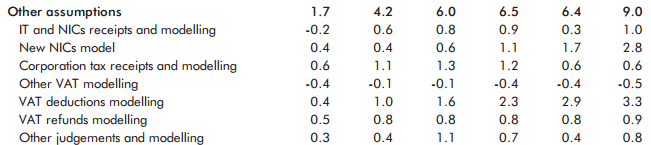
Well, as is now well understood, yesterday the Chancellor got a £33.8bn windfall, mostly from modelling changes but also some modestly improved forecasts of receipts (see Table 4.8).

Capture

And that’s a £33.8bn change in OBR forecasts since July.

And he’s already spent two-thirds of it, according to the Resolution Foundation.

Capture


Spending it is bold, given the OBR’s forecasting record. You have to really want to believe – really want to – that all of those earlier forecasting errors were anomalous. And that now, at last, the OBR’s going to get it right.

I’m not saying Osborne was wrong to slow the pace of spending cuts (as those on the left put it) or spend more (as those on the right do). I’d be ejected from the Labour Party if I said that.

It’s more that all of this bouncing around from Osborne feels a touch… unstrategic. An opportunistic, rather than a long term, economic plan?


The Social Care Precept: hitting the poorest hardest

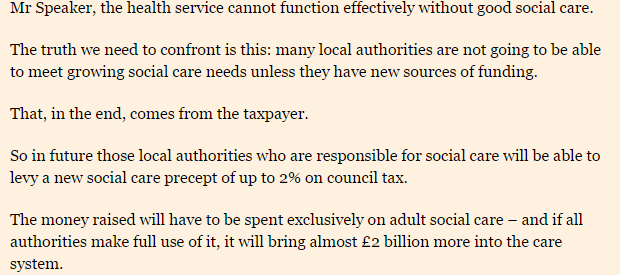
Here’s George Osborne delivering his Autumn Statement:

Capture

But, assuming it is taken up, who will be the real winners and losers from the Social Care precept?

Arguing in the New Statesman back in July against rises in the Personal Allowance I noted this:

Council tax is highly regressive. In 2013/14, even net of Council Tax Support, it represented a staggering 13.5 per cent of the earnings of the poorest 20 per cent of households and only 1.9 per cent of the richest (source ONS) (6.4 per cent/4.3 per cent/3.1 per cent for intermediate quintiles).

Increasing Council tax bills to fund social care obligations will make this situation even worse. The proportion of earnings of the poorest quintile of households consumed by Council tax, including the precept, will rise to 13.9%.

And that poorest quintile will bear 13.7% of the £2bn cost of the social care precept (16.1%/19.7%/23.1%/27.5% for the remaining quintiles). Had the rise been funded through income tax, by way of comparison, the burden on the lowest quintile would have been 1.7% (5.1%/11.6%/21.9%/59.7% for the remaining quintiles). (Both calculations from Table 14A here).

So the precept will fall heavily upon the poorest households. I genuinely struggle to think of another tax raising measure, consistent with our direction of fiscal travel, which could place a heavier burden on the poorest.

But who benefits?

In March 2014, the National Audit Office published a report into Adult Social Care. It revealed, unsurprisingly, that 68% of users were adults over 65 (Figure 4) and that adults over 65 consumed 50.8% of all Adult Social Care spending (Figure 12).

Median pensioner incomes are, of course, higher than those for the rest of the population (say the IFS). And only a tiny fraction of those incomes are comprised of earned income – so the diminution in income consequential on a pensioner requiring care is modest.

Means testing for local authority provision (helpfully summarised here) should mean that the poorest pensioners benefit the most from the precept. But the lifetime cap on care costs – of £72,000 – will only benefit wealthy users of Adult Social Care.

So the social care precept clearly involves a transfer from the poorer. I do not have the evidence to say it is to the richer. But it may well be.