Spending Tomorrow’s Money Today

I haven’t written a blog post for a while. The project I set myself – of educating the interested public in tax matters – ran aground on the banks of a disinterested public. However, I was so irritated at a piece of chicanery in yesterday’s budget that I was moved to pick up the metaphorical pen.

The biggest tax raising measure in the budget is the extension of the so-called Accelerated Payments Regime pursuant to which those engaged in particular types of alleged tax avoidance transaction stump up the disputed tax upfront rather than waiting for the courts to declare it payable. Just hold on, it gets interesting I promise.

The so-called ‘yield’ from this measure over the five year term for which HM Treasury forecasts is about £4bn give or take. That makes it the biggest single revenue raising measure in yesterday’s budget. It pays – or is said to pay – for 1p off a pint, a freeze in cider duty and a halving of bingo tax five times over.

Except it doesn’t.

The measure merely accelerates payments which would have been received in later years to earlier years. Tomorrow’s money today. So over, say, a ten year time-scale the measure would be yield neutral.* But over a five year time-scale, which is the only time-scale HM Treasury (publicly) looks at, it has a £4bn yield. So manipulate the time-scales and shazzam! you’ve manufactured a four billion quid budget give away. Much of it going to wealthy savers and the elderly.

Of course, if HM Treasury’s time-scales were wrong, such that, for example, the tax collected today would otherwise have been paid in year two or five rather than in year six or after as the forecasting anticipates, the measure would be revenue neutral even over a five year term.

Which makes this line in the Budget 2014 Policy Costings Document: “The main uncertainties in this costing relate to the… payment profile” (see page 37) really rather telling. Translated it means, we think we’ve magicked up £4bn but there’s a real risk about that.

*Actually, on one view it’s even worse than that. Once you factor in that the failed tax avoider who gets his fiscal come-uppance in year six has also to bear interest at a rate which substantially exceeds the Government’s borrowing rate, and that interest is foregone by Government if it gets the disputed tax now, the measure may be argued to be revenue net negative for Government.

What might tax transparency bring?

Today I turn to look at the second call in Progress’ Tackle Tax Avoidance Charter:

Open up the tax affairs of large quoted companies, starting with the FTSE 100. We should require companies to be much more transparent about their businesses and profits in the accounts they file with Companies House.

Let’s start by putting the issue in context. According to HMRC, the total ‘tax gap’ for all corporates amounts to some £4.1bn, or 8.8% of the tax gap. This £4.1bn figure includes SMEs as well as larger corporates and the tax gap attributable to the 800 or so largest businesses is only £1.4bn (of which 75% is due to “avoidance”). So the tax gap attributable to avoidance for those 800 businesses is £1.05bn (or about £13m each). That’s not an especially significant amount of money – by way of comparison the tax gap for VAT (the overwhelming majority of which is attributable to household spending) is almost £10bn.

(Important but lengthy side note. One must be cautious when using tax gap figures. They reflect HMRC’s estimates of the tax which is caught by the letter or spirit of the law. But they don’t reflect the tax which many would think should be paid but which is not caught. To take an obvious example, if important intellectual property is held offshore and rented to the UK operation at a market rent, the fact that those arrangements significantly reduce the profits of the UK operation will not be reflected in the tax gap.

There is a perception that there is widespread use of this and similar arrangements such that the tax gap is hugely understated. That perception may very well be right. However, the evidence for this is not clear. Over a ten year period there has been no real decline in corporation tax receipts – a surprising fact if one’s perception of avoidance by large corporates is that it is enabled by the internet age.)

So, using HMRC’s measure of the tax gap, the problem is not substantial in scale. And, although it might be reasonable to expect that increasing transparency would have some effect on corporate behaviour, the strength of this causal relationship is (to the best of my knowledge) unexplored. Anecdotally, there is conflicting evidence on the point: on the one hand, the growing consensus that being a good corporate citizenship involves paying your fair share is (undoubtedly) leading to changes in behaviour; on the other hand, there is an, I think, quite genuine concern on the part of corporates that a falling tide grounds all boats. In other words if they are to be pilloried regardless of whether their behaviour can sensibly be described as tax avoidance they may as well take the financial benefits available to them.

So, where does all of this get us? Some suggestions:

1. Transparency is a side-show. What we really need is a just tax system.

2. Legislation is not the answer. The fruits do not justify it. And – because we cannot legislate beyond our shores – it would not be effective.

3. However, a corporate citizenry kite-mark would be a good idea. It would usefully harness the self-interest that corporates have in being seen to behave properly. However, to achieve corporate take up, the methodology for qualifying must be fair and sensible. In other words, it must be drawn up by representatives of the business community – and not just tax campaigners.

Naming and Shaming Tax Avoiders: a How to Guide

Today I mean to look at the first of the proposals in Progress’ Tackling Tax Avoidance Charter which is to:

‘Name and shame’ companies and individuals engaged in tax avoidance. This would both have a powerful deterrent effect and help to change the culture among those people who see tax avoidance as legitimate and desirable rather than the abrogation of civic duty that it really is.

The attractions of this course are manifest.

  • Few people, today, would agree with Lord Oliver, speaking as a Law Lord, in Craven v White that:

the fact that the purpose of a scheme is tax avoidance does not carry any implication that it is in any way reprehensible or other than perfectly honest and respectable.

  • The specialist tax tribunal is often confronted with applications for appeals to be held in private and – these days – almost never accedes to them. One can, thus, say that the notion that one has the right to privacy in relation to ones, controversial, tax affairs is already in heavy retreat.
  • Naming in shaming is bound to have a powerful deterrent effect. As US Supreme Court Judge Louis Brandeis observed, “Sunlight is the best disinfectant”. And so it is in this field – as anyone who has picked up a newspaper recently will tell you.

The attractiveness of the outcome ought not, however, cause you to close your eyes to the difficulties of getting to it. These problems might best be explained by comparing what is proposed to that which already exists.

Section 94 of the Finance Act 2009 enables HMRC to publish the names of “deliberate” defaulters. The operation of the provision was considered by HMRC in October 2010 in a well argued paper which revealed that naming and shaming deliberate defaulters was a powerful tool which would work and which raised the stakes for would be tax evaders.

So far so good. However, the operation of section 94 is subject to two (relevant) limitations. First, it applies to those who engage, broadly, in evasion (rather than avoidance). And, second, names are published only once the subject (in effect) accepts that s/he or it is a deliberate defaulter.

So what do these limitations tell us about the call to name and shame tax avoiders?

First, whilst there is a settled understanding of what constitutes tax evasion, there is no equivalent for tax avoidance. This is no mere matter of semantics.

Amongst commentators there is profound and genuine disagreement as to what avoidance actually is (a matter I have explored in several of my previous blog posts – see in particular that of 11 June 2013). And this is not (or not just) a question of how you describe tax avoidance; there’s an even more important (prior) question about what avoidance actually is.

The consultation group which considered and devised the General Anti Abuse Rule wrested at some length with these questions. And the concepts and language they ultimately adopted to resolve them (which can be found here) are so complex as to be described as unworkable by many. I disagree; I think the GAAR will prove highly effective but the fact remains that tax avoidance is conceptually and definitionally extremely complex.

Second, unlike “deliberate” default, “tax avoidance” is not a term of legal art. So, again unlike “deliberate” defaulter, there is no ‘other’ legal conclusion to which the label “tax avoider” might be attached.

What are the consequences of this?

You would need not merely to work out what tax avoidance is and then define it (my first limitation) but you would also have to create, and fund, a mechanism to determine whether a particular transaction satisfied that description.

And basic considerations of fairness would dictate that if you were to be ‘named and shamed’ by HMRC you would  need an opportunity to contend before an independent tribunal that you had not engaged in tax avoidance. And HMRC would have to spend money defending their decision. And that money, because expended only upon pinning a label to someone, could not lead directly to the recovery of tax. It might, in other words, fairly be considered ill-spent.

It is not easy to see a wholesale solution to these difficulties. But there is a limited one.

Tax law does, from time to time, badge transactions as “abusive” (the GAAR) or as having a main tax avoidance object (any number of targeted anti avoidance rules (“TAARs”)). Legislation could, relatively easily, be introduced that those engaging in transactions caught by the GAAR or a TAAR should be named and shamed. Such a measure would not go quite as far as Progress propose – it would not catch all tax avoiders – but it would catch a fair number and achieve much of the deterrent effect that Progress seeks.

Compass’ Alternative Spending Review

A short diversion from yesterday’s plotted course.

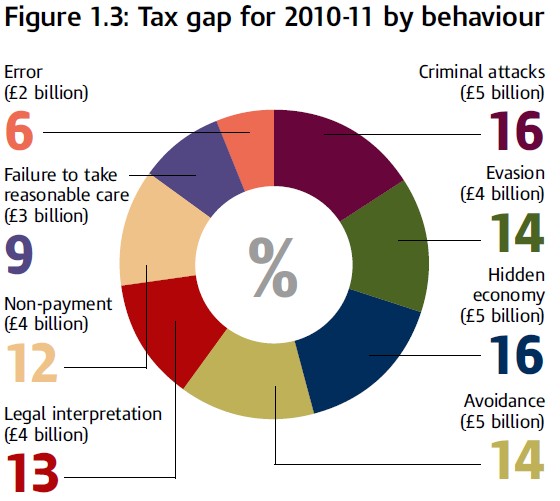
Compass today released its alternative spending review. The plan includes closing the structural deficit by raising £85bn in extra tax including £32.5bn from “Clamping down on tax avoidance” (see page 8). This figure is borrowed from HMRC’s calculations of the tax gap (see “Further Details on Eliminating the Structural Deficit” in the Compass Plan). But a perusal of HMRC’s own calculations show that only £5bn of the tax gap is attributable to avoidance. The vast majority is linked to various types of criminality – under or non reporting, criminal frauds, the black market – or simple non-payment. In these areas the tax gap is wide and persistent. There is no magic wand to be waved.

As I argued in my blog post of yesterday:

“A (completely wrong-headed) belief has grown up that £32bn per annum of prospective income – i.e. the so-called tax gap – is just lying around waiting for the Labour Party to come back into power and pick it up.”

I went on to argue that perpetuating this belief was damaging because it undermined the party’s inclination seriously to address the lingering public perception that the Labour Party can’t be trusted with the economy.

Compass rightly recognises the need to tackle that perception:

Earning the trust to spend money wisely in the future is paramount for any progressive party or coalition, including the Labour Party who have a particular problem in that many voters think it was not careful enough with the public finances when in Government.

Unfortunately its alternative spending review is a rather retrograde step.

The Progress Charter? Should do better

Recent internal debate in the Labour Party around its spending plans has helped to move the party back into the centre-ground from the tax-and-spend hinterlands. However, that debate has focused on the “spend” bit; there has been no real soul-searching in relation to the party’s position on the “tax” bit.

This absence is both surprising and damaging.

It’s surprising, because, unlike spending, where the Tories have a natural head-start, fairness in the tax system is much more obviously Labour territory.

It’s damaging, because a (completely wrong-headed) belief has grown up that £32bn per annum of prospective income – i.e. the so-called tax gap – is just lying around waiting for the Labour Party to come back into power and pick it up. And this belief undermines the commitment of many of the party faithful to tackling the “spend” bit.

But perhaps worse still, the absence of a sensible debate – or perhaps more accurately the focus on insensible debate – is a missed opportunity to articulate a set of effective and actionable principles for a sensible approach to taxation around which the Party, the electorate and even the business community might cohere.

The most recent attempt to galvanise the party into action is Progress’ ‘Tackling Tax Avoidance Charter‘. But as I have observed before, it has both the strengths and the weaknesses of Margaret Hodge: it’s a powerful call but to unworkable action.

Over the coming days, I will look at each of the Charter calls. But I start with its introduction:

“This month the G8 will be discussing international action against tax avoidance. While this is hugely important, it is not an excuse for inaction at home, where HMRC estimates  a ‘tax gap’ of at least £32bn exists. At a time of squeezed incomes and public spending cuts, it’s simply unfair a group of global corporations and wealthy individuals are avoiding paying their fair share.”

This introduction – an otherwise sensible call for fairness – perpetuates a number of unhelpful fictions. In fact, of the £32bn tax gap, “only” £5bn is attributed by HMRC to tax avoidance. And I am aware of no evidence at all that global corporations are disproportionately responsible for this £5bn of “avoidance” – indeed I am not even aware of any suggestion that they are. And, although I know other commentators disagree, I argue tax avoidance transactions before the specialist tax tribunals day in and day out and I have no doubt that the General Anti-Avoidance Rule (the “GAAR”) will have an enormous effect in shrinking that part of the tax gap attributable to tax avoidance.

I don’t make these points (and those I will make in the days to come) because I think there’s no need for action on tax avoidance. I don’t make them because I don’t think £5bn matters. I don’t make them because I mean to defend global corporations. I make them because I would like to see Progress as a useful participator in the debate around closing the tax gap. And I think it ought to set it sights higher than making noise.


How do you solve a problem like tax avoidance: what’s the scale of the problem

In the last stop on my whistle stop tour of the tax gap, I address how much of the tax gap is made up of tax avoidance.

HMRC publish data in relation to how, their statistics indicate the gap arises. That data is summarised in the following table:

Doc2_page1_image1


HMRC describes ‘avoidance’ (for the above purposes) as that which is ‘operating within the letter but not the spirit of the law’. As such, HMRC say, it does not extend to “legitimate tax planning” which “involves using tax reliefs for the purpose for which they were intended. For example, claiming tax relief on capital investment, saving in a tax-exempt ISA or saving for retirement by making contributions to a pension scheme”.

Two cautionary notes must be sounded in considering these figures. First, some commentators appear to eschew the notion of “legitimate tax planning”. Richard Murphy, for example, the controversial tax campaigner, appears to regard even pro-purposive tax planning as the mere exploitation of “loopholes”. Second, as I have previously noted, the tax gap only refers to tax which is within the letter or spirit of the existing legislation. It does not refer to tax which should be within the letter or spirit of existing legislation.

If pro-purposive tax planning is included, or the gap is defined as including that which should be taxed, then the size of the tax gap will increase and the proportion of that gap attributable to avoidance will increase substantially.

However, as things stand, the proportion of the tax gap attributable to avoidance, whilst large in absolute terms, is relatively small expressed as a percentage of the tax gap. Despite this, it almost entirely dominates the political debate.

I will turn next week to look at the Progress Tackle Tax Avoidance Charter. But, and this has been the point of my quick survey of the tax gap, an efficacious tax policy is one that goes everywhere the tax is uncollected, and does not merely follow the noise.


How do you solve a problem like tax avoidance: where is the problem

In yesterday’s blog post, I looked at the tax gap and what, conceptually, the headline figure of £32bn represented. I noted that it might, in fact, considerably underestimate the tax that you and I might think is due on activities in the United Kingdom.

Today I want to make a short point about where the tax gap arises? Because it’s only once you know where it is that you can begin to formulate practical policy to close it.

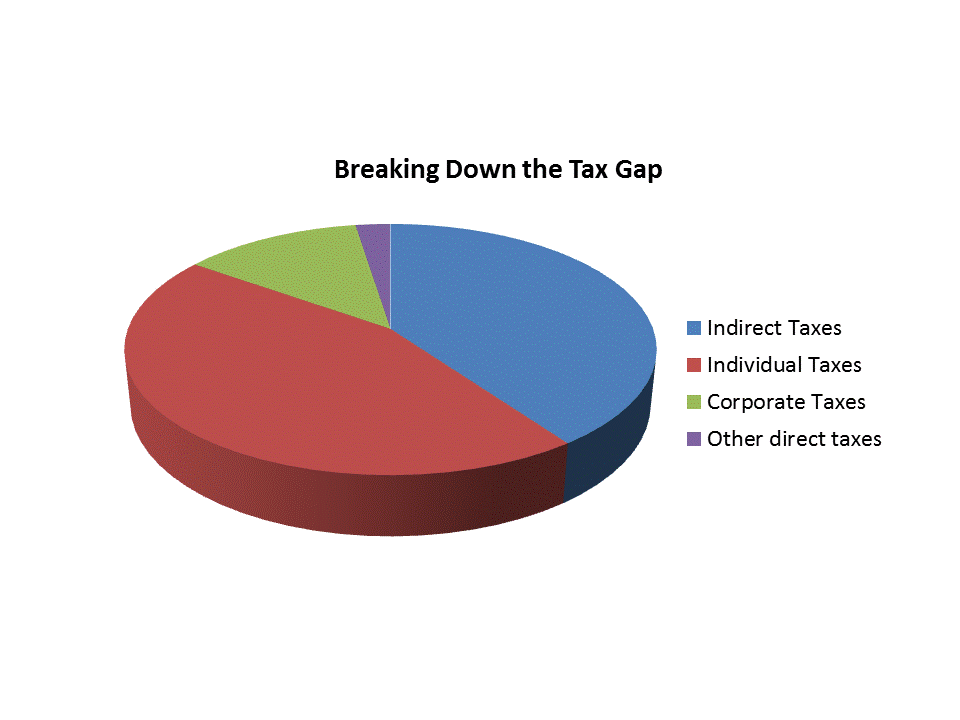
The areas where the tax gap arises are set out at page 4 of this document. I don’t mean to go through them all (they’re summarised in the chart below) but there is one surprising fact which jumps out at you.

By far the single biggest constituent element in the tax gap is VAT, which accounts for £9.6bn of the £32bn. So VAT makes up 30% of the tax gap but only 19% of tax receipts. The VAT tax gap is both huge in absolute terms – and far higher as a percentage of the tax that should be collected than for other types of tax.

Even if one one strips out VAT that’s declared but not paid (about £0.9 bn) and VAT lost to a particular infamous type of VAT fraud (so-called Missing Trader Intra Community Fraud) (£0.5-£1bn) one is still left with £8bn of VAT that’s not even declared. That’s about double the corporation tax tax gap (which is £4.1bn, split fairly evenly between SMEs, Large and Complex Businesses; and Businesses Managed by the Large Business Service (don’t ask)).

This comparison tells us a number of things. First, and most obviously, we ought to be talking more about VAT and less about corporation tax. Second, given that the overwhelming part of the VAT liability falls upon households (over 80% if one strips out exempt transactions) we should be exploring ways in which households might help HMRC collect VAT, for example by requiring households to ask traders with whom they deal for invoices. And, third, once we ‘sense-check’ our understanding of where the gap is against the data about the behaviour to which the gap can be attributable we begin to be able to formulate further ideas about the measures necessary to close the gap. I’ll examine the behaviour question tomorrow.

Presentation1

How do you solve a problem like tax avoidance: is the tax gap too small?

We all know a little about the tax gap. It’s £32bn right? A fairly big number. It’s just under 5% of government spending – or about half the budget of the DfE – or about 50% more than we spend on primary health care. So it’s quite important.

Over the course of this week, I’m going to look at three things connected to the tax gap. First, what is it? It’s probably not what you thought it was. And the Real Tax Gap may, in fact, be a lot bigger than £32bn. Second, where does the tax gap arise? There are real surprises here. It’s only once you know where it arises that you can begin to formulate practical policy to close it. Third, to what behaviour is the tax gap attributable? Again, an appreciation of this last point is critical to identifying the practical measures one must take to close the tax gap.

But first, what is the tax gap?

According to HMRC (see paragraph 1.1):

“The tax gap is defined as the difference between tax collected and the tax that should be collected (the theoretical liability). The theoretical tax liability represents the tax that would be paid if all individuals and companies
complied with both the letter of the law and HMRC’s interpretation of the intention of Parliament in setting law (referred to as the spirit of the law).”

Two points about this explanation.

First, the “tax that should be collected” is not (or not just) the tax that tax legislation says should be collected. That number’s smaller than £32bn. It’s tax satisfying both of two conditions (1) the legislation says it should be collected and (2) HMRC thinks Parliament intended the legislation to collect. This is interesting recognition that the law doesn’t always do what HMRC thinks it should.

Second, the tax gap is a function of the difference between the tax that is collected and the tax that the law (both in letter and in spirit) says should be collected. In other words, it doesn’t include tax that you and I might think should be collected but the law does not presently collect. That’s quite important so let me say it again. If Google’s tax affairs were compliant with the letter and the spirit of the law then the tax that you and I might (sensibly) think they should pay in the UK will not be captured in the tax gap.

So the tax gap on a different measure – i.e. between what the tax law should sensibly collect and what is actually paid – might be a number really quite a lot a bigger than £32bn. Call this number the Real Tax Gap.

Now I am but a mere technician. But occasionally released, blinking at natural light, from the stacks. But if I was campaigning for an effective tax system, I might begin by defining some parameters that would enable me to model the size of the Real Tax Gap.

How do you solve a problem like tax avoidance: where am I going (and why)

Thanks to everyone who took the time to read my blog yesterday. As I seem already to have gathered a number of readers, I thought it might be helpful to say where I hope I’m going, and what I want to do along the way.

My aim is to educate and inform my readers with the hope of improving the quality of debate around tax and tax avoidance. To be effective participants we don’t need to be tax experts. We do need commonsense, clear headedness and a little help.

A little help? Let me propose three golden rules. One: we should understand how the choices we make about our tax system affect the functioning of our economy. Two: the tax system ought to be conceptually fair. Three: it ought to be properly administered.

I start with these golden rules because (although no-one could disagree with them) they’re frequently ignored. They are ignored because they’re inconvenient. And they’re inconvenient because the debate is unnecessarily politicised: the participants all too often sacrifice the chance to propose sensible policy advances at the altar of playing to their constituencies. Bluntly, in order to give their constituencies what they want, they ignore what they know is right.

Let me give examples of each of the golden rules being ignored.

My first. Yesterday I read a prominent (and expert) commentator on the left arguing that we should close the “loophole” of the Enterprise Investment Scheme.

Closing a loophole sounds like a good thing, but what’s actually at stake here? To quote HMRC’s website: “The Enterprise Investment Scheme (EIS) is designed to help smaller higher-risk trading companies to raise finance by offering a range of tax reliefs to investors who purchase new shares in those companies.”

Helping smaller, higher risk trading companies raise finance also sounds like a good idea. So you might have thought that, before arguing for the closure of EIS, there should be an assessment of its efficacy and the consequences of withdrawing it. But there was no assessment.

My second. The ongoing debate around Google’s tax affairs. Eric Schmidt, Google’s Executive Director, has argued that Google is “fully compliant” with the law. He’s ignoring whether the law is conceptually sensible or fair.

My third. Again, the ongoing debate around Google’s tax affairs. And the suggestion from the Public Accounts Committee that it was “extraordinary” that HMRC “did not challenge” Google over its tax affairs.

HMRC might be a convenient scapegoat but take a look at the facts for a second. We have a government department, with expert staff, with full fact finding powers, and under huge political pressure in relation to Google’s tax affairs. We have an enormously well-funded Google which is bound to have taken advice before implementing the arrangements in question which has argued forcefully that it accounts correctly for the tax. We have a Public Accounts Committee which isn’t as expert as either Google or HMRC and is only in possession of the facts it asked for. Against that background, isn’t the more likely explanation that HMRC looked very closely at Google’s tax affairs – but the tax system just doesn’t function as the Public Accounts Committee thinks it should? In other words, it’s the second rather than the third golden rule that’s being breached?

To be an effective participant in this important debate,  you need to be better at diagnosing the (real) disease, better at prescribing the (effective) medicine – and you also need to understand the (economic) side effects of the prescription. I hope my golden rules will help you do this.

So where am I going?

I’m going to continue on my path of seeking to improve the quality of debate: I make no apology for being ambitious. As a member of Progress, I have a particular interest in its Tax Avoidance Charter and I’m going to test its efficacy against my three golden rules. Disappointingly, I will show that, it, too, is often a function of considerations of doctrine rather than efficacy.  And then I’m also going to advance a number of proposals of my own for how we might more effectively tackle ‘bad’ tax avoidance.

Do follow me on @JolyonMaugham

How do you solve a problem like tax avoidance: but I digress

In my blog of yesterday, I noted that tax advisers sometimes “police the line between avoidance and evasion”. When doing this, advisers are not paid out of common funds but by those who activities they police. If this reminds you of the activities of bond ratings agencies of yore, it should. And if you’re wondering whether you should feel comfortable with this state of affairs, you’re right to wonder.

Let’s take a hypothetical. I’ve simplified things a little – but not so that it matters.

X is in the business of developing tax efficient structures to sell to investors. And X has got an idea which it thinks will fly. Let’s call it the Big Idea – and assume that the effect of the Big Idea is to reduce X’s taxable income. And it wants to take it to market: i.e. sell it to corporates or individuals whose particular circumstances match what the Big Idea requires. And let me just say, for those who haven’t read yesterday’s post, there’s not, necessarily, anything wrong with the Big Idea, either legally or morally.

Before anyone will buy X’s Big Idea – before X’s clients will pay for that idea – they will want to see that the idea has been ‘blessed’ by someone external to X. Someone who has both the expertise to advice on it and a sufficient reputation that their blessing carries weight.

That someone external is not always a barrister, but let’s assume it is. The barrister will receive details of the Big Idea from X and be asked (and paid) to advise whether it works. If the barrister advises that the Big Idea does work, X can go out and sell the Big Idea to its clients.

When a client then utilises the Big Idea they fill in the tax return with their (lower) income numbers that flow from implementing the Big Idea.

Now, one of three things can happen: first, the tax return might not get checked; second, the tax return might get checked and HMRC might agree that the Big Idea works; third, the tax return might get checked and HMRC might decide that the Big Idea doesn’t work (and the courts might agree).

What about the first possibility?

You have to remember, when you file your tax return and pay your tax you’re paying the tax you think – or your advisers have told you – you are liable to pay. Not what tax you are actually liable to pay. And if you’ve participated in the Big Idea you’re going to be telling HMRC that you have less income than you would otherwise have and you’re therefore going to be paying less tax. Now, not everyone’s return gets checked. And if your return doesn’t get checked, it doesn’t matter whether the Big Idea works or not, because, either way, you’ve paid less tax.

What about the second possibility?

As as I’ve argued previously, some tax avoidance is good tax avoidance. We should be pleased when HMRC agree that it works. Some tax avoidance is bad tax avoidance and we should be displeased when HMRC agree that it works. But that’s for another day.

What about the third possibility?

I don’t, just for the moment, want to get diverted by a description of the process whereby a court might ultimately find that the Big Idea is also a Bad Idea. Let’s just assume that it has. The effect will be that you have made your return showing income of, say, 70, when, in fact, your income is, say, 170.

So you will have participated in a tax avoidance transaction and you will have under-declared your income. But you still won’t be guilty of tax evasion – you still won’t go to prison –  because, in filling in your tax return, you won’t have deliberately under-declared your income. You will have relied on the advice given by the barrister.

That’s what I mean when I say that tax advisers sometimes police the line between avoidance and evasion. But perhaps the more important question is, do they invariably police it well?

The amounts of tax at stake are vast – sometimes running into billions for a single Big Idea. And the fees that can be generated for X are similarly vast. And if, as a barrister, you are prepared to ‘bless’ a Big Idea you’ll make a great friend of X – who will be very pleased to come back to you again and again for (well paid) advice. And X’s industry also knows the names of the Boys Who Can’t Say No – which in turn can drive further advisory work to your door.

So there are ‘powerful forces’ – to put the matter politely – operating in favour of saying ‘yes’. There are also powerful internal and external controls on saying ‘yes’: not least, your reputation and the inclination of insurers to indemnify you against the consequences of giving poor advice. I think most barristers at the tax bar get the balance right. But several do not.

This aspect of the tax industry has, rightly, exercised Margaret Hodge (although you should not rely on as accurate the particular individuals she has named as offenders under cover of parliamentary privilege). But, more importantly, the account given above should spark further ideas as to how one might tackle tax avoidance. In a quiet, but effective, and pro-growth sort of way. I’ll come on to those another day.