The Out campaign – and the attitude to tax of its funders

If you click here you can see a link to the Electoral Commission list of donations to referendum participants arranged by size.

I have listed below the ten donors of the largest donations, in descending order, to the ‘Out’ campaign and some material in the public domain that might cast light on the attitudes of those donors to tax and tax planning.

There is, of course, much other material in the public domain about those individuals – both positive and negative. It is my intention only to set out what is in the public domain that could reasonably be thought to cast light on their attitudes to tax and tax avoidance. Where I have given other information it is only by way of introduction to individuals about whom little else is known.

1. Peter Hargreaves gave £3.2m to Leave.EU Group Limited.

Here’s what the Daily Mail records him as saying about corporation tax.

I never understood why companies should pay tax. They don’t have a vote. If they didn’t have to pay tax, they would come here in droves and employ millions of people who would pay loads of tax.

This is consistent with other public statements that suggest he believes that lower taxes generate more tax receipts. He took steps to pay an increased dividend before the 50% tax rate came in.

2. Better for the Country Limited – otherwise known as Leave.EU – made a non-cash donation of £1.95m to Grassroots Out Limited. The Guardian has identified that Leave.EU was incorporated by STM Fidecs Nominees Limited, a company based in Gibraltar that “specialises in financial planning…. for high-net-worth individuals… re-locating to, other, frequently lower, tax jurisdictions.”

Its shares were then transferred to Arron Banks who remains, so far as the public record discloses, both a director and 100% shareholder. Arron Banks’ name has appeared in the so-called Panama Papers. The Guardian reports that he has set up “37 different companies using slight variants on his name.” That, you may think, is a tendency associated with a desire to reduce transparency.

The Guardian report also contains this paragraph.

Capture

3. Diana Van Nievelt Price gave £1m in cash to Vote Leave Limited. Little is know of her.

4. International Motors Limited gave £600,000 in cash to Vote Leave Limited. “Lord Robert Norman Edmiston” is a director of International Motors Limited. The shares in that company are held by I.M. Group 1991 Limited, the shares in that company are held by I.M. Group Limited, and the shares in that company are held by “Robert Norman Edmiston”. Lord Edmiston is said by the Mirror to have had his first application for a peerage blocked by HMRC over a tax dispute. He is also reported to have received an “accelerated payment notice”. Accelerated payments notices are given by HMRC to those claimed by it to have used a “tax avoidance scheme”.

5. Patrick Barbour gave £500,000 in cash to Vote Leave Limited. Patrick Barbour was  until 10 April 2013 a trustee of the Politics and Economics Research Trust. I have written here about how over the last five years 79% of its grants have been made to the so-called Taxpayers’ Alliance. And I have described PERT as “channelling money to the Taxpayers’ Alliance.” The Politics and Economics Research Trust is currently in discussions with the Charity Commission “about decision making and monitoring of grant funding.” I hope to write more on this after the Referendum. Patrick Barbour has also written papers for the Taxpayers’ Alliance.

6. Gladys Bramall gave £500,000 in cash to Vote Leave Limited. She is a former member of the BNP but little else is known about her.

7. Jeremy Hosking made two donations to Vote Leave Limited (£500,000) and Brexit Express (£480,000). He operates a hedge fund.

8. Peter Cruddas gave £350,000 in cash to Vote Leave Limited. Peter Cruddas is a one-time resident of the tax haven Monaco and former Co-Treasurer of the Conservative Party who resigned over the ‘cash for access’ scandal.

9. Terence Adams gave £300,000 in cash. He appears to have construction interests in the US.

10.= John Stuart Wheeler gave £250,000 to Vote Leave Limited. The Guardian has written of his £5m donation to the Conservative Party in 2000 which was followed shortly thereafter by Conservative MPs seeking to change the Finance Bill in a manner which would benefit the tax treatment of financial spread-betting, the industry in which Mr Wheeler then operated. Jonathan Wood also gave £250,000 to Vote Leave Limited. There is a Jonathan Wood, hedge fund manager, who has made substantial donations to the Conservative Party. The Evening Standard reports he has lived in Switzerland and Monaco – both might reasonably be described as tax havens.

For reference – and I imply no connection to the matters stated above – I have written here about some highly misleading tax related statements made by leading Vote.Leave figures such as Michael Gove, Boris Johnson and Iain Duncan Smith. I have written here about how leaving the EU will reduce the UK’s ability to combat tax avoidance.

For the sake of transparency, I should say that I will be voting Remain tomorrow.


Statistics, Vote Leave statistics, and lies.

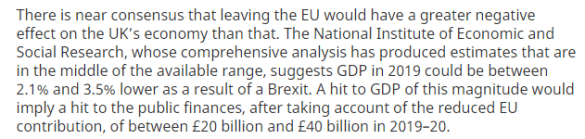
As the Institute for Fiscal Studies has stated, there is “near consensus” that Brexit will damage the economy.

Capture

On any view the mid-case £30bn is a very substantial sum of money. Illustratively, to recover it by way of income tax would require an increase in the basic rate of income tax to in excess of 26.5%. It represents about 25% of all NHS spending in 2019-2020. To recover it, either the budget deficit target would have to be abandoned, or spending cut, or taxes raised or some combination of all three.

In an effort to address this very serious concern about the effects of a ‘Leave’ vote, leading Brexiteers including Michael Gove, Boris Johnson, Priti Patel, Dominic Raab and Iain Duncan Smith this morning wrote a letter making a number of promises about where in a post-Brexit world funding might be found (the “Letter“).

The Letter can be read here and it states (in particular):

For example, the UK is set to pay out between £7 billion and £43 billion by 2021 in tax refunds to big businesses which have successfully used the European Court and EU law to escape taxes lawfully imposed on them in Britain.

It continued:

If we Vote Leave, the Government will pass legislation to prevent these payments being made so that taxpayers are not given these huge bills.

But is this statement true?

The £7.3bn figure comes from Table 4.15 of the OBR’s Economic and Fiscal Outlook from March of this year. It is the sum of this line:

1.PNG

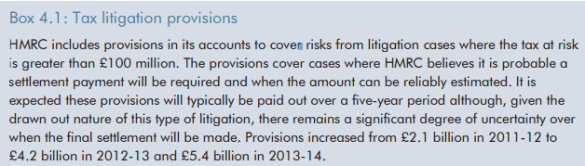
The March 2016 Outlook gives you no further detail of what “tax litigation” relates to but the July 2015 Outlook does and states this:

1

So the £7.3bn covers sums which HMRC expects to pay out from litigation cases when the amount can reliably be estimated.

But contrary to what the Letter states, the £7.3bn figure does not derive from “tax refunds to big businesses”. It covers all tax refunds to individuals, partnerships, trustees, small businesses, and big businesses.

Contrary to what the Letter states, the £7.3bn figure does not derive from businesses “which have successfully used the European Court and EU law”. It derives from all claims in all courts domestic and EU (and conceivably foreign) and based on all law domestic and EU (and conceivably foreign).

Contrary to what the Letter states, the £7.3bn figure does not derive from attempts to “escape taxes lawfully imposed on them in Britain”. It will derive from the recovery of taxes wrongly over collected by HMRC, taxes wrongly levied by HMRC, taxes lawfully collected in advance and which later have to be repaid and interest on those taxes, whether that wrongful levying or overcollecting or repayment derives from HMRC’s mistaken understanding of domestic or EU (or conceivably foreign) law or otherwise.

Finally, contrary to what the Letter states, the £7.3bn figure is not the bottom end of a range with £43bn at the top. The bottom of the range is £0. The £7.3bn figure represents the aggregate of sums which HMRC expects to pay out (but might not do). This is not a hypothetical point: in 2009/10 well over £2bn (a sum larger than is expected to be collected in any year addressed in the “tax litigation” line above) was written back (see page 92)

Let me put the matter in a nutshell.

The Letter – which let us remember has been signed by Michael Gove, Boris Johnson, Priti Patel, Dominic Raab and Iain Duncan Smith – is (in the respects identified above) simply false.

What of the £43bn figure?

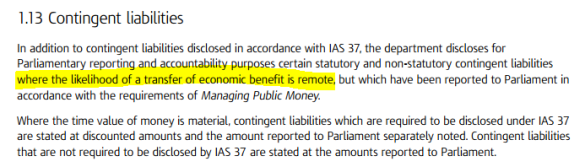
It is the sum total of the £7.3bn above and a further £35.6bn of contingent liabilities or “possible liabilities for cases currently in litigation”: see paragraph 9 of the auditor’s note to HMRC’s annual report for 2014-15 here. Possible, but not very likely as you can see from the highlighted passage earlier in the annual report here:

1

“The likelihood of a transfer of economic benefit is remote.”

This £35.6bn figure, again, does not relate to big business, European law, breaches of Europe law, or a successful use of the European Court. There is simply no basis for these claims. Moreover, to imply it is remotely realistic that £43bn could be paid out, again, simply does not bear analysis.

The Letter very materially misleads the public. Michael Gove, Boris Johnson, Priti Patel, Dominic Raab and Iain Duncan Smith should immediately disavow the baseless claims to which they have, one hopes inadevertently, put their names.


Leave – and become tax haven UK

Last month a hedge fund threatened to move from Connecticut to another state. Its boss, Ray Dalio, earned $1.4bn last year. That’s as much as 34,482 teachers earning the average salary for teachers here of £29,000. But that wasn’t enough for him and he demanded Connecticut help him build new offices. They gave him $22m. You can read about the story here.

That’s $22m that he doesn’t need. It’s about 1.5% of what he earned last year. But it reduces Connecticut’s ability to employ policewomen and firemen; to repair its roads and look after its elderly; to run its schools and operate its healthcare programmes.

That can’t happen in the EU.

We have rules – called ‘State Aid’ rules – which stop powerful corporations playing countries off, one against the another. They know Member States can’t give the money – and this stops them demanding it.

You will have read about the tax shenanigans of Apple. Starbucks. McDonald’s. Amazon. Google. The arrangements of each of those companies is being looked at by EU institutions to see if they comply with European law. If they don’t, State Aid rules mean they will have (in effect) to repay the tax they’ve wrongly underpaid.

Corporate tax avoidance is a huge problem. The European Parliament has estimated it cost the EU €160-190bn last year alone. As the second biggest economy in Europe we will have suffered a substantial share of that loss. Without the protection of State Aid rules we won’t be able to claim it back.

We’ll be weak. And we’ll get weaker.

Here is Jason Collins, Head of Tax at Pinsent Mason – a law firm based in London which is very vocal in calling for measures which help its clients – talking about what will Brexit will mean for the UK tax system.

Capture

Translated, what this means is that those huge multinationals, if we leave the EU, will be free to demand more tax breaks from the UK.

You think we’ll be able to resist?

By the end of this Parliament, we’ll be collecting almost £15bn a year less in corporation tax than we were in 2010 in consequence of huge cuts in tax rates (see paragraph 1.159 here). £15bn is more than we spend on housing (and utilities such as street lighting) and contributions to the EU combined. The present government tried to do even more for these corporations – but turned back in the face of pressure from the EU.

Pretend, if you like, that we’re big enough to go it alone. Pretend we can face these companies down and that corporate tax avoidance won’t get worse. We’ve the fifth largest economy in the world, after all. But bear in mind that the global revenues last year of one company – Apple – were about a third of all the tax paid over to HMRC. And look at the evidence of how we’re already failing.

Alone, things will get worse, and quickly. There will be less tax available to spend on the NHS and schools. There will be less to build better roads for your communities and support more house-building for your children. More libraries will close – and there will be more foodbanks as welfare is cut further.

But together, we’re stronger.

The Taxavoiders’ Alliance

“When I use a word,’ Humpty Dumpty said in rather a scornful tone, ‘it means just what I choose it to mean — neither more nor less.”

Were there a Humpty Dumpty award for imaginative use of language the TaxPayers’ Alliance would be my nominee. Because embedded in its funding machinery is a rather nifty tax avoidance wheeze.

***

We only offer charitable status to those who deliver (broadly speaking) a “public benefit“. We guard that status zealously and the reason why is because the state, through the tax system, provides what you might best think of as a type of ‘matched-funding’ scheme.

Because of the cost to the rest of us of that ‘matched funding’, the Charity Commission won’t register a charity which exists for a political purpose. This is why the Taxpayers’ Alliance isn’t a charity. In principle, this is bad news for high income UK taxpayer backers. It means that every pound they give to the Taxpayers’ Alliance costs them (after tax) £1.82. Were it a charity, that same pound would cost those same backers £1.

Unless there was a wheeze.

What about if those wealthy backers gave money to a charity which passed that money on to the Taxpayers’ Alliance?

***

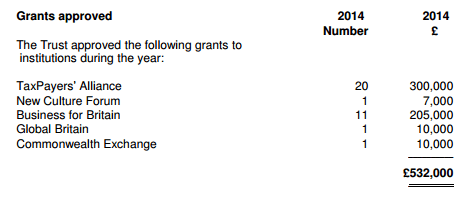
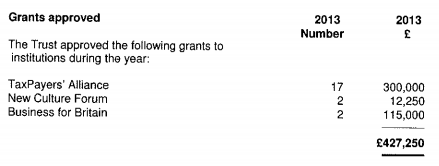
Here are the accounts for the year ending 31 December 2014 for the Politics and Economics Research Trust (“PERT“), which is registered as a charity. They show that it made 20 grants to the Taxpayers’ Alliance in that year:

Capture

Leaving aside £60,000 which was returned to it and £36,752 in Governance Costs this comprised the entirety of its activity for the year.

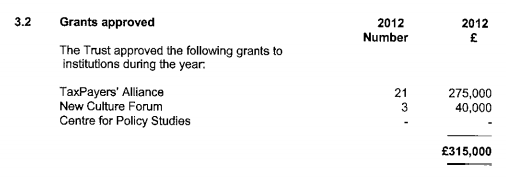
What about for the year ending 31 December 2013?

Capture.PNGAnd 31 December 2012?

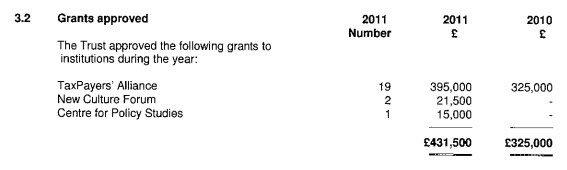
CaptureAnd 31 December 2011 and 2010?

Capture.PNGSo over those five years PERT made 95 grants (including 18 in 2010) to the Taxpayers’ Alliance out of a total of 119 (80%). By value 79% of its grants were to the Taxpayers’ Alliance. An average grant of £319,000 per annum.

Perhaps this is a surprise. And then again, perhaps not. Companies House reveals PERT originally had a different name:

Capture

***

We don’t know who funds PERT. Regrettably its accounts are silent – and so is its website – on the subject. So we can’t know for a fact that they’re wealthy UK taxpayers. But the evidence points to that conclusion.

If you give to PERT you know the bulk of that money – after administrative costs – is going to find its way to the Taxpayers’ Alliance. That is, as I’ve shown, what invariably happens. So if you didn’t intend your money to go to the Taxpayers’ Alliance why would you give the money to PERT?

But, if you know the money is going to the Taxpayers’ Alliance, why do you give it to PERT instead of the Taxpayers’ Alliance? You know that giving it to PERT will cause it to accrue a further layer of administrative charges? And we know how much supporters of the Taxpayers’ Alliance hate ‘waste’.

There’s only one sensible answer to that question. You want the tax relief. If you didn’t you’d give it directly to the Taxpayers’ Alliance – its website does solicit donations after all – and save the administrative charges.

***

You might reasonably ask whether PERT performs any real function over and above simply channelling money to the Taxpayers’ Alliance. You might ask whether the reality of the situation is that the money is simply going to the Taxpayers’ Alliance and the Council is simply a mechanic to help its UK taxpayer backers avoid tax on the donations.

The Charity Commission looked at these questions over five years ago. You can see its report here. It looked at whether money had been channelled from a particular body – the “Midlands Industrial Council” – to the Taxpayers’ Alliance and concluded:

Capture

PERT mentions this on its website. But the website doesn’t mention why. However, the ‘why’ is apparent from paragraphs 19 and 20 of the report.

Paragraph 19 provides:

It was also confirmed to the investigation that the Midlands Industrial Council has not made any donations to the Charity…

And paragraph 20 provides

Capture

If the subject of a complaint to the Charity Commission is that donor x has channelled donations through a charity to obtain tax relief; and the facts show that donor x didn’t make donations and, even if it had, it wouldn’t get tax relief it’s not a great surprise if the complaint is dismissed.

Anyway, you’re bright.

Whatever the Charity Commission’s view as to the merits of a specific complaint about an abuse of the law of charities you can see with your own eyes the evidence that the overwhelming majority of the money given ever year to PERT is passed on every year to the Taxpayers’ Alliance .

***

Of course, this mechanic benefits the Taxpayers’ Alliance too.

Assume its wealthy backers wanted to spend £175,275 per annum supporting the Taxpayers’ Alliance. If they gave that money directly to the Taxpayers’ Alliance – which does collect donations – the Taxpayers’ Alliance would have £175,275. But if they funnelled it through PERT, the Taxpayers’ Alliance would have £319,000.

£319,000 is the average yearly amount the Taxpayers’ Alliance received from PERT over the last five years. The difference between it and the notional £175,275 – some £143,725 – comes from taxes paid by the rest of us.

On the evidence, it seems the Taxpayers’ Alliance is the beneficiary of an abuse of charitable tax reliefs. A willing beneficiary too – it applies to PERT for funding. You might find it odd – unattractive even – that an organisation apparently devoted to “protecting taxpayers” routinely puts itself in this position.


Did George Osborne mislead Parliament?

Here’s an exchange from Hansard between George Osborne and Angela Eagle yesterday:

Capture

Note, in particular, that George Osborne said of Google that it “paid no tax when the Labour party was in office.”

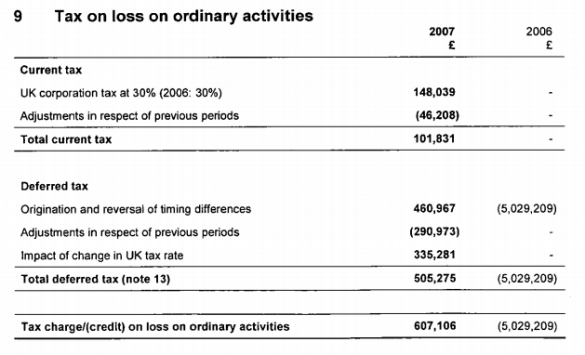
Here is an extract from the accounts of Google UK Limited, Google’s UK subsidiary, for the year ended 31 December 2007:

Capture

You will see that, for the year ending 31 December 2007 there was a total current tax charge of £101,831. Google UK Limited’s deferred tax asset (basically a limited right to reduce your tax bill acquired in past years) does not seem to have absorbed that charge.

All things being equal you would expect that tax charge to be met.

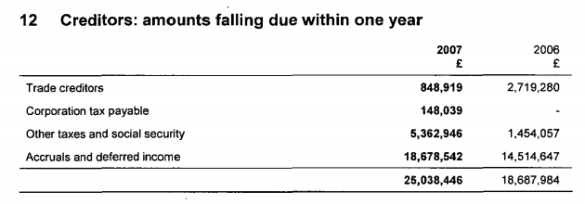
Although Google UK Limited has not provided a cashflow statement it does have a statement of current liabilities which provides:

Capture

So Google UK Limited expected, in 2007, to make a payment of corporation tax within a year.

And at a time when the Labour Party was in office.

Welfare for the Wealthy

This year we’ll collect a little less than £170bn of income tax, roughly a third of all tax receipts. We’ll also forego through reliefs about £30bn of income tax.

Spread evenly amongst the population that £30bn would deliver to every man, woman and child almost £500 a year.

But it isn’t. It goes overwhelmingly to those who need it least. And that’s not mere happenstance. It’s the inevitable consequence of two deliberate policy choices: to distribute that £30bn through the tax system. And to fail to monitor what good it does.

Let me give some specifics.

Last year we spent £480m per annum rewarding those who earn more than £54,000 per annum and make gifts to charities. We spent nothing rewarding those who earn less.

This year we’ll spend £2.6bn per annum encouraging saving in ISAs. But the average ISA holder with annual earnings of more than £150,000 will get – through higher savings relieved from income tax at higher rates – well over 6 times as much tax relief as her equivalent earning between £20,000 and £30,000 per annum.

In 2013/14 the highest earning 1% of taxpayers made almost 13% of all contributions to pension schemes. Pension scheme relief costs £21bn in income tax foregone. But that 1% of taxpayers – roughly 0.5% of adults – will get even more than 13% of that £21bn because we give them a larger tax bonus than those who earn less.

HMRC doesn’t publish much data on how the benefit of these reliefs is distributed between rich and poor. By and large you have to stitch the statistics together.

But HMRC does track one particular sub-set of reliefs: “Allowances given as tax reductions”. It comprises, in particular, Venture Capital Tax Relief, Enterprise Investment Scheme Relief and Seed Enterprise Investment Scheme Relief. Remarkably Additional Rate Payers – those earning over £150,000 – receive 69% by value of those reliefs. That figure has risen every year since 2010/11.

More striking still, the highest earning 15,000 taxpayers – an almost homeopathic 0.05% of all taxpayers – netted 5.5% of total deductions and reliefs. Most will have seen six figure reductions to their income tax bills.

Why is this? Should we be concerned?

It’s hard to find sense in it.

Take pension tax relief as an example.

The more you earn, the more likely you are to have surplus income. Because you have surplus income you’re less in need of incentivises to save for your retirement. But the tax system gives you more.

That’s not sensible policy. It’s a wasteful bung.

We can make the same argument for ISAs. If a couple can afford to save what the median household earns (after direct taxes and benefits) – and that’s what the annual ISA limit for a couple represents – why do we spend money giving them incentives to save? If there’s money to be spent, surely we bolster the position of those who struggle to save rather than those compelled to by surplus income.

We don’t need to reward the wealthy for making donations to charity. The impulse to donate is a civic responsibility. It doesn’t need to be greased. Only the wealthy win, and the causes they prioritise. Good for Opera Houses; Youth Clubs, not so much.

These – I can put it no politer than ‘anomalies’ – have two related causes.

First, we deliver these reliefs through the tax system. It must be this that has led us unthinkingly to give most generously to those who have the highest earnings and so pay the most tax. But to achieve the public ends these tax reliefs serve does not require that we forego the most from those who pay the most.

That brings us to the second. We have no mechanism for assessing what public good we achieve with this £30bn. The absence means our political class need not confront the question. And what they can pretend they don’t know they can pretend they needn’t remedy. This state of affairs is convenient to them. Because the noise made by the losers from tax decisions tends to drown out the applause from those who’ve won.

But there is an answer. And a precedent.

Interest rates decisions were once heavily politicised. Were they still, now, in the hands of the Government the UK would be a more dangerous place. After seven years of near zero interest rates could any Government hold the line between depositor pensioners and the borrower working age population? But, devolved to the Bank of England, the political heat has simply evaporated.

As it was with interest rate decisions, so it could be with tax reliefs. Value for money assessments, decisions around functioning, decisions around shape; all these could be devolved to an independent body such as the Office for Budget Responsibility. Over time, and insulated from political heat, it could reshape tax reliefs to operate in the public interest.

The Tories and the Electoral Commission

Here’s what section 146(1) of the Political Parties, Elections and Referendums Act 2000 (the “Act”) provides:

The Commission may by notice require the relevant person in the case of any supervised organisation…—

(a) to produce, for inspection by the Commission or a person authorised by the Commission, any such books, documents or other records relating to the income and expenditure of the organisation or individual as the Commission may reasonably require for the purposes of the carrying out by them of their functions…

From this Electoral Commission statement it appears that the Commission did make such a request:

The Commission issued the Conservative and Unionist Party with two statutory notices requiring the provision of material relevant to its investigation.

Subsection 146(5) provides:

A person commits an offence if he fails, without reasonable excuse, to comply with any requirement imposed under this section.

From the Electoral Commission statement it appears that the relevant person failed to comply with the request.

However, the Party has…. provided… no material in response to the second notice (issued on 23 March 2016). That follows the Commission granting extensions of time to comply.

Unless there is a “reasonable excuse” – and the Electoral Commission statement mentions none – the “relevant person” will already have committed an offence.

It makes no difference to the analysis if the documents are subsequently handed over – because there has already been a failure to comply with the request.

The “relevant person” is defined by section 146(9) thus

relevant person”, in relation to a supervised organisation…, means… in the case of an organisation, any person who is or has been the treasurer or another officer of the organisation…

The Conservative Party website gives as the Treasurer of the Conservative Party Lord Lupton.

And by Schedule 20 of the Act a failure to comply with section 146(5) is punishable on summary conviction at level 5. Although my specialism lies elsewhere I understand the consequence to be that a fine of unlimited amount may be imposed: see herehere and here.

You may wonder why the Electoral Commission Statement makes no mention of this commission of a criminal offence. But no matter. Tomorrow I shall refer the matter to the Police.

Postscript: 13 May 2016. 

It may be that a different, or further, offence has been committed under Schedule 19B paragraph 13 of the Act. I have, today, reported both prospective offences to the Metropolitan Police who will take a statement from me on Monday.


Waiving the right to privacy

Should I choose, for recreational reasons and shielded from public view by the thick walls of Maugham Towers, to wear a diving mask and snorkel I might reasonably assert a right to privacy in relation to that choice. Should I step, thus dressed, into the formal gardens of Maugham Towers I might maintain it still. But should I fail to de-snorkel before wandering up to the newsagents, my reasonable claim to privacy would vanish.

There is a right to privacy. A good right. One that can be found in most attempts to articulate what basic human rights look like. But this post isn’t an attempt to describe the law of privacy. The questions I want to pose concern the shape the right to privacy should take.

My mooted enjoyment of diving gear may or may not be a matter of public curiosity but for so long as I choose to confine that enjoyment to a private sphere the public has no right to know. But the right is contextual. I can waive it by my actions. I can make choices that alter the balance between my right to privacy and such passing curiosity as the public may possess. By those choices I can denude of value my claim to privacy. We may collectively hold that it is better that we preserve the rights of those who wish to take photographs outside a newsagents than the claims to privacy of those who choose to shop at them.

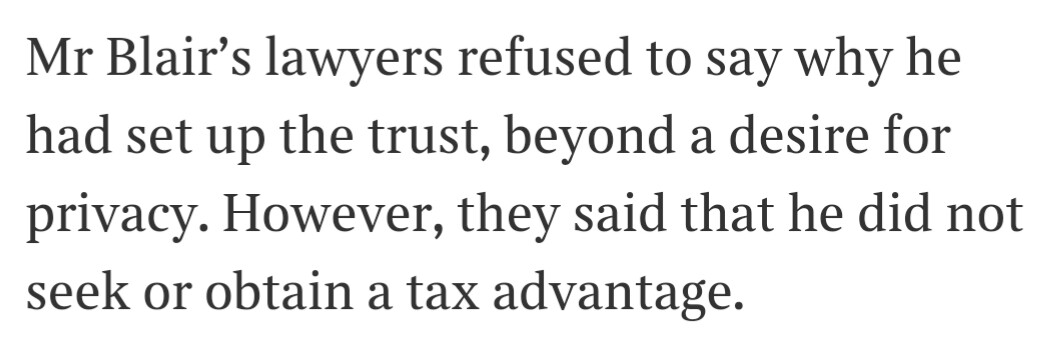
A week or so ago Alexi Mostrous, the Times journalist who has made so many of these stories his own, wrote about Tony Blair’s rather complex personal finances. Those arrangements were said to be set up for reasons of privacy:

image

And yet what is clear is that an arrangement whereby Mr Blair simply chose to receive the money directly – without the interposition of any company, or partnership or trust structure – would have provided the nearest thing the law offers to perfect privacy. So one should approach with scepticism any contention that this arrangement was about privacy. Because the choices Mr Blair made reduced rather than enhanced it.

No tax justice campaigners of which I am aware campaign for the public disclosure of income or gains that individual (lawyer-speak for ‘real’, like you and me) taxpayers enjoy. There is a reason for this. It is because the most natural arrangements – Y provides X with income where Y and X are individuals – is adequately able to be taxed. That arrangement is inimical to avoidance and any sophisticated form of evasion.

It is when we choose to create and interpose legal structures – trusts, partnerships, companies and variants thereon – between X and Y that there arise the conditions within which avoidance and evasion can occur. Of course, often or usually we choose to interpose those structures for good reasons. Trusts provide a mechanism for protecting the assets of the vulnerable. The limited liability attaching to companies encourages us to indulge the animal spirits that cause us to create businesses and generate wealth.

But there is no good reason why we as a society should not attach to the choice of these legal structures a price – an enhanced degree of public scrutiny – for using them. Charging a price does not breach anyone’s right to privacy. It is the choice to use them – to walk to the newsagents – that carries the concomitant loss of privacy.

I would go further.

Where we know that those structures create the conditions within which behaviours inimical to the interests of broader society – such as tax evasion and avoidance and money laundering – can occur, society should charge a price for using them, especially where that price is designed to reduce the risk of those behaviours.

Of course, we should think sentiently about what that price should be. It should reflect the legitimate uses to which those structures are put. And also the risks that they create. And it should be mindful of assertions of privacy that legitimately serve – for many do not – the public interest.

But having made the decision about what that price looks like, it is right that it be paid.

Some of the media coverage of the Panama Papers might suggest that the thinking I have outlined above is heretical. But it is not heretical – it is not even new. Rather, we have just forgotten it.

Let me take one of many examples.

Section 113 of the Companies Act 2006 creates an obligation on the part of companies to maintain a register of shareholders which is available to the public. The entitlement on the part of the public to examine this information can be seen as a price in reduced privacy that attaches to the use of a company structure. Hold assets through a company and the public should know.

Is this price qualitatively different from the apparently contentious proposal that there be public registers of beneficial ownership of companies?

I don’t think so.

There is, it seems to me, only one explanation for a state of affairs that has section 113 on our statute books but rejects the notion of public registers of beneficial ownership of companies. That explanation is that we have lost sight of why we introduced the rule now to be found in section 113. What possible purpose is served by a provision that obliges a transparency that we now allow to be occluded?

Let me sum up.

Many assertions that to do X or Y would breach the privacy of Z misdiagnose the cause of Z’s loss of privacy. On analysis, it is the choices that Z makes not the doing of X or Y that occasion that loss. Society should weigh in the balance its broader interests when it sets the conditions under which Z can choose to use structures that create the conditions within which avoidance and evasion can occur. None of this is heretical – or even new.

A clear eye towards principles that should be uncontroversial. A review of trust law and company law and partnership law with these principles in mind. Measures – easily found – to secure that the purpose of these principles by UK residents is not subverted by the use of non-UK structures.

What could be wrong with this?


‘Tackling Tax Fraud’: the new PAC report

Overnight the Public Accounts Committee published a timely report on ‘Tackling Tax Fraud’. It’s fairly short and you can read it here.

Prospectively the greatest point of interest in the report is when it addresses the ‘perception that HMRC does not tackle tax fraud by the wealthy.’

There are, of course, two questions buried in that phrase.

Is HMRC failing to do enough to tackle tax fraud by the wealthy? And, is HMRC allowing to grow up in the minds of the public a perception that it is failing to do enough to tackle tax fraud by the wealthy?

Only one of the questions raises a matter of fundamental public importance: are rich and poor treated meaningfully equally under the law. The other concerns whether HMRC should sack its press agency.

And I said “prospectively the greatest point of interest” because the report in good part addresses the second question. I don’t think I care – do you? But, anyway, it concludes that HMRC should “publicise this work“. 

Now we’ve got that out of the way, what do we learn about the important question.

We can glean one or two details of interest.

Almost.

See if you can spot where the forensic point slides away from the Committee here:

HMRC told us it investigates around 35 wealthy individuals for tax evasion each year, but did not know how many wealthy individuals it had successfully prosecuted. We welcome the fact that HMRC has sought and received funding to increase the number of investigations it undertakes into corporates and wealthy individuals to 100 a year by 2020, indicating that the current level is insufficient.

Yep. There is apparently going to be an increase in funding to move from 35 to 100 investigations a year. But that increase will not only cover wealthy individuals but will also cover corporates.

I was curious about how this point had been allowed to slip so I went back to the oral evidence session which stood as the basis for this report. That didn’t help so I went back to the National Audit Office report which had been addressed in the oral evidence session. As I read those documents, HMRC has never stated that it investigates 35 wealthy individuals a year or that it is now going to investigate 100. Both of those numbers cover both wealthy individuals and corporates.

But at least there is more resource to tackle a group that includes wealthy individuals. Even if we don’t know how that resource is targeted within that group.

Maybe. Here’s the oral evidence session again.

Q147 Stephen Phillips: In one sense, Ms Granger, you have anticipated my question. You are going to increase the number of prosecutions, or investigations that hopefully lead to prosecutions, to 100 for wealthy individuals and corporates from a figure that is currently around 35. Is that right?

Jennie Granger: I think “wealthy and complex” is what we said—

So that number for evasion investigations – and the increase from 35 to 100 – covers (a) wealthy individuals (b) wealthy corporates (c) complex individuals (d) complex corporates.

Ah.

But forget about investigations for a second. What about prosecutions? How many wealthy individuals face the threat of jail time? Here I go back to the report. And on this it is crisp. HMRC did not know how many prosecutions it had brought of wealthy individuals for tax evasion (see paragraph 10).

What we do know (according to the National Audit Office) is that increasing HMRC’s overall target for criminal prosecutions to 1,000 led it:

to focus on less complex cases, in particular a large number of prosecutions for evading income tax, VAT and tobacco duty, and lower-value cases.

We also know HMRC had estimated that many billions of pounds of tax were being evaded offshore. Many billions were expected to be collected under a number of long-running tax amnesties – but the number of billions actually collected fell very short.

And we know, because the report reminds us, that the 3,600 names on the HSBC Falciani list of those with Swiss Bank accounts led to only one prosecution. And that fact led to widespread public outrage.

Did this shortfall, did this outrage precipitate some change of focus in HMRC’s activities? It’s not easy, on the basis of the Public Accounts Committee report at least, to conclude that it did.

Did it prompt decisive re-resourcing of HMRC to enable that change of focus? We know from the OBR (see paragraph A.23) that HMRC very recently still lacked the resource to chase up an £800m shortfall in expected receipts from tax evasion.

And did it prompt HMRC to gather targeted information to address public concern? HMRC still seems to be (at best) unable to tell us how many investigations into tax evasion by wealthy individuals it is carrying out.

Hang on a second.

Perhaps the question whether HMRC should do more to publicise its work is more interesting than it seemed. But I’m not sure I’d agree with the Public Accounts Committee. I’m not sure HMRC should publicise what it is doing.

People might be cross.

David Cameron and Inheritance Tax

To avoid tax you have to do a thing which cuts your tax bill.

Fail to do that thing and your tax bill is higher. But do it and you’ve avoided tax compared with an alternative world – economists call it a counterfactual but you and I would call it an overdraft – in which your tax bill is higher.

If this all seems a bit, well, metaphysical, it shouldn’t.

When Ian Cameron died, David Cameron received £300,000 in his will. That’s just below the maximum amount you could, at the time, pass on free of inheritance tax. Most or all of the rest went to David’s mother and, because she was Ian’s wife, it went tax free. She promptly gifted the Prime Minister a further £200,000 by way of what Downing Street is describing as an equalisation payment (a payment to ‘equalise’ the money that the children received from their father).

That’s the real world. If she survives the gift by seven years that will save £70,000 compared with an alternative world in which the money went straight from Ian to David.

The mere fact of making gifts whilst you’re alive can – if you’re wealthy at least, because only a very few people are rich enough to pay inheritance tax – avoid inheritance tax. But I wouldn’t describe it, without more, as meaningful tax avoidance. It’s a rule that the statutory draftsman has created and you’re using it as she intended.

But what takes this little two-step into the realm of meaningful tax avoidance is that it would have been known before Ian’s death what sum David needed to get in Ian’s will to ensure he received the same amount from his father as his siblings.

The natural thing to do – and so to me the appropriate ‘counterfactual’ to what actually happened – would have been for Ian to make the gift in his will. But instead Ian gave him a sum of such a size that there would be no inheritance tax to pay. And then David’s mother gave him a little bit more in such a way that, if she outlived the gift by seven years, there would have been no inheritance tax to pay.

Compare that counterfactual to what actually happened and there’s a £70,000 inheritance tax saving.

I think this is, in a meaningful sense, tax avoidance.