The Prime Minister’s Tax Returns

Thanks to several newspapers, I was yesterday given a preview of information provided by David Cameron to the press on his tax returns.

The numbers themselves are relatively unsurprising.

So that my readers can see them I have cut and pasted below an extract from what Downing Street provided to the newspapers:

Capture

If you plug these numbers into your pocket calculator the tax paid is broadly what you would expect it to be. I have one or two observations to make on the numbers – see below – but I can see nothing especially exciting beyond what immediately meets the eye. And what immediately meets the eye is not especially exciting.

But does the exercise succeeded in delivering what is likely to be its objective? To improve our understanding of the Prime Minister’s financial affairs and quell speculation of hypocrisy?

The first and most important point to make is that the Prime Minister has not published his tax returns. He has provided a sort of dance-of-the-seven-veils version. He’s shown you quite a lot of what you might like to see – but not all of it. ‘What else is there?’, you are bound to ask. Why can he not show us his actual tax returns? If the objective really is to improve transparency – you really don’t want me to push my metaphor – he ought to have followed John McDonnell’s example and published his full tax returns.

And you’re not made more comfortable when you come to look at who has provided the information.

It comes from a firm of accountants, called RNS, under cover of a letter, addressed to the Prime Minister, (the “Cameron letter”) which provides:

Capture


The Cameron letter follows very closely the format pioneered by Zac Goldsmith in February (the “Goldsmith letter”):

Capture

But unlike the Goldsmith letter, the Cameron letter has no accompanying Press Release.

Zac’s Press Release made it very clear that the letter was from Zac’s accountants:

Capture

But we are not told, and do not know, whether the accountants that wrote the Cameron letter were his. Reading it, and the notes provided with it which talk about what the authors “understand” about his expenses, I have a sense that it was written by accountants other than Mr Cameron’s. If this sense is justified, if the letter comes from someone who isn’t Mr Cameron’s accountants, it takes us a (difficult to understand) further step away from actual transparency.

A couple of other points about form.

The letter does not pretend that any exercise has been done over and above the mechanical one of extracting information from past self-assessment tax returns. I mean no disrespect when I say it involves no professional judgment by RNS.

But it does come from a professional firm – and that has useful consequences.

The numbers are what the numbers are. The Prime Minister has not invited us to take on trust what he says they are; instead he has delivered them in the form of a letter from a certified professional bound by a code of professional ethics. My view, and the view of most, is that it couldn’t properly be suggested these numbers are false even were they to be given by the Prime Minister himself. But I know that some would and so having a professional say that they represent what is reported in his tax returns might be thought to be a sensible precaution.

The final point to note is that the letter is addressed to the Prime Minister, not to anyone else. The firm of accountants will have the Prime Minister as its client, not anyone else. This tells us something – this is not the place for a detailed analysis of the law – about who the firm intends should rely on the letter and to whom it owes its professional duties. Again, let me be explicit, I do not say any conclusion should or even can be drawn from this, but I might have done it differently.

Turning to the detail of the numbers, it is noteworthy that David Cameron received £6,681 in interest from what we are told is “interest on savings with a UK high street bank”. If you assume a (relatively high) 2% rate of interest and that the interest is before deduction of tax, this implies he had during the course of the year an average of £334,050 sitting in his bank account.

The notes also record that David Cameron has voluntarily overpaid tax on occasion:

Capture

And has donated royalties from his book to charity:

Capture

Some will say that this voluntary largess is a privilege of wealth.

Perhaps it is.

But having myself lived in poverty and now in wealth I very much appreciate that wealth enables me to spend to nurture my self-sense of moral well-being. And I remember, too, the moral humiliations that poverty brings. But whatever your view, mine is that we must recognise that these are careful and responsible acts that many do not undertake.

The capital gains and losses are described by the notes as being from the sale of “units in Blairmore.” But “Blairmore” is not a legal entity – or a description of anything – and all the lawyers I know, and accountants too, would have used its proper name. My sense of slight unease is not diminished when I contrast the clumsy “Blairmore.” with the full technical description elsewhere in the notes of the “Income Tax (Earnings and Pensions) Act 2003”. And it is positively exacerbated when I recall that in his ITV interview, David Cameron starts off by talking about the asset that he sold as a “unit trust” and then several minutes later describes it as “Blairmore Investment Trust.”

The notes also state that:

Capture

This is, perhaps, rather bold of RNS. It cannot know what other sources of income or gains the Prime Minister has. It can only know what it has been told.

But leaving that aside, the substance is consistent with various other statements that the Prime Minister has made about not having any offshore interests himself. These are set out here.

However, the statement does nothing to address the concern that the Prime Minister, his wife or children might benefit in the future from a discretionary trust. (I should say explicitly, to be transparent myself, that earlier in the week I reached a different view but I now regard myself as having been precipitous to do so).

The closest the Prime Minister has come is to say this:

Capture

But an offshore discretionary trust for his children is not one which “the prime minister, Mrs Cameron or their children will benefit from in the future.” It is not a future interest in possession trust in respect of which it could fairly be said that those entitled will benefit. An offshore discretionary trust is one from which they only might benefit, depending on how the trustees choose to exercise their discretion.

There are two points that makes this gap in the Prime Minister’s language interesting to me.

The first is that it has been left.

The Prime Minister could very well have said:

As far as I am aware, there neither is nor has been any non-UK discretionary trust of which the Prime Minister, his wife, or children are or have been potential beneficiaries.

but he did not.

The second is that had you asked me or other tax professionals several weeks ago what arrangements you might have expected Ian Cameron to have made for his family, an offshore discretionary trust would have featured heavily amongst the responses. It’s a perfectly natural arrangement for someone with extensive offshore interests to enter into. It would be surprising if someone who had shown an appetite for complex offshore arrangements involving exotic tax haven locations such as the Bahamas and Panama, and really rather ugly features such as bearer shares, had opted for tax simplicity in the disposal of his estate.

So although it is speculation, and although I do not want to speculate in a destructive way, my own personal judgment is that it is reasonable speculation.

In summary?

The financial acts that I can see, and of course there are many I cannot, and that are acts of the Prime Minister, are by and large decent and responsible. The financial acts that make me uncomfortable are the acts of his father, from which of course David Cameron benefits, but they are not his acts and he did not choose them. And the weaknesses of this exercise, if you regard it as an exercise in enhancing transparency, may perhaps stem from a desire to obscure the latter.


A small homage to Guido Fawkes

Here’s a clip of Guido Fawkes’ exclusive. I’d encourage you to visit the page yourself – he’ll appreciate the advertising revenue.

Capture

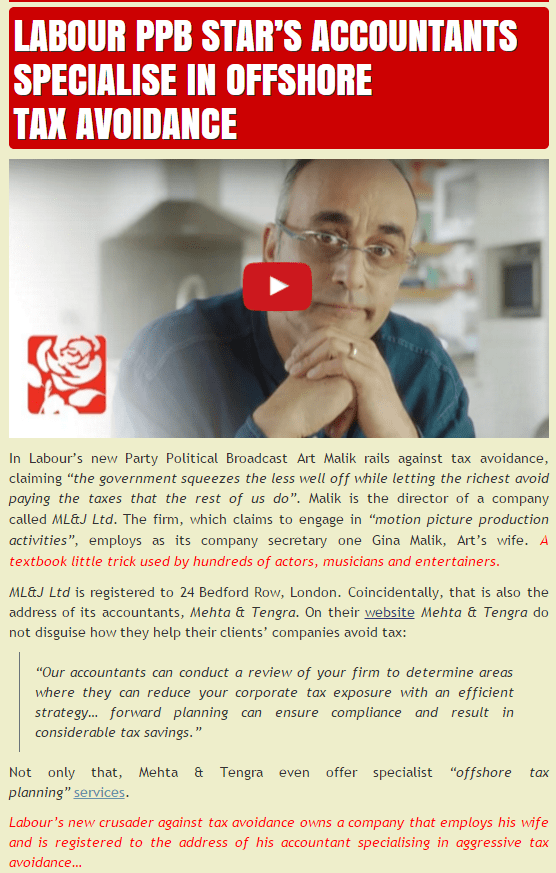
In a nutshell, the ‘story’ is, first, that Art Malik’s company (ML&J Ltd) engages as its company secretary his wife, Gina. And, second, that his accountants offer specialist offshore planning advice.

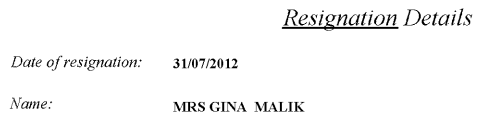
As to the first, it doesn’t. She resigned almost four years ago.

Capture.PNG

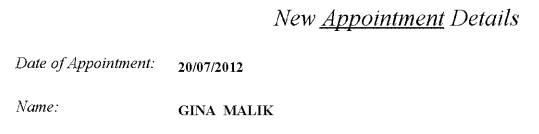
This was just eleven days after her appointment.

Capture.PNG

God knows why: probably an administrative balls-up.

As to the second, it looks as though the Board of the Conservative Party prepares its own accounts. But the Registered Treasurer is Simon Day, who used to work for BDO. And BDO are now also its auditors.

Capture

And here, amongst other services, are those offered by BDO, including offshore tax planning.

Capture

Like it or not, this is pretty standard stuff.

I don’t think it’s much of a story that the Conservative Party’s auditors do it. And I also don’t think it’s much of a story that Art Malik – whoever he is – has accountants that do it. But if you disagree with one you must also disagree with the other.

Panama. Where next?

Two days in. Lots of column inches. But what will it all mean for the future? Some embarrassment, a scalp or two, then business as usual? Or meaningful change?

Corbyn is right. We could, if we wanted to, compel ‘our’ tax havens to deliver transparency. This excellent Global Witness piece gives specific examples of a number of recent instances where we have legislated directly and against the will of British Overseas Territories.

Some writers assert that, somehow, tax is different from those examples. But there’s little to support those assertions. If you accept that you can cross the rubicon for one purpose it’s difficult to sustain an argument you can’t cross it for some other.

So, why don’t we?

It’s neither attractive nor, to me, plausible to suggest that the Conservatives are indifferent to the moral quality of the actions of those who avoid or evade tax – or those who facilitate it, be they professionals or tax havens. It is certainly true that the revelations so far have revealed a preponderance of individuals with some connection to the Conservative Party. But there is a natural and plausible explanation for this.

There is an almost perfect correlation between being an offshore tax avoider or evader and being wealthy. That correlation follows from the considerable costs of establishing and maintaining an offshore structure. There is also a correlation – less close but still – between being wealthy and voting Conservative. Accept the logic of these propositions and you avoid the need to impute anyone with a moral ugliness that experience tells me is a rarity, on any part of the political spectrum.

The explanation, I think, is more likely to be found in the Conservatives’ assessment of what the public interest demands, both here and in those Overseas Territories.

A substantial part of the City is engaged in the servicing of the global wealthy. We have ceased to be the holders of wealth and have instead become their butlers. The City is, when it doesn’t fall over at least, a huge contributor to the financial health of the UK. All of this poses a quandary: how much ugliness should we tolerate to sustain or even increase that contribution?

I don’t want to answer that question, yet at least. I just want to pose it. What price our moral principles?

So far as our tax havens are concerned, the picture is much the same.

Tax havens compete on a variety of criteria.

Some of these carry no moral component: political stability, language, proximity, sophistication of service, legal familiarity, judicial independence.

But some do: transparency (more is less) and opacity (less is more). And a whole variety of soft factors: what quality of information will local financial services professionals  demand for compliance procedures, how quickly and enthusiastically will local tax authorities respond to requests for information from overseas tax authorities, how vigilant will they be when it comes to updating registers, what is their reputation with the tax authorities of real countries and so on.

Sophisticated players in the market will have a keen sense of where the various tax havens rest amidst this competitive ecology.

Disrupt that ecology and – this will be the Conservatives’ fear – you will kill the tax haven. It will cease to enjoy the position it did in the market and whatever wealth that position delivered to the population of the haven will be lost. What is the point of doing this when other tax havens continue?

The net gain to morality will be nil.

This will be the unspoken logic of the Conservative Party which bears the burden – so long as it remains in Government – of having to make hard decisions.

And this logic is, it seems to me, perfect. But also very limited.

Because collectively tax havens serve no useful purpose.

Their aggregate effect on the global economy is huge – and hugely negative. They disrupt the ability of Governments to achieve political ends through diplomatic means. They permit criminals to enjoy the fruits of their crimes. They enable to be hidden from the eyes of the electorate that which it should know. They facilitate the theft of public assets by public figures for private gain. And, of course, they diminish our Governments’ treasuries to the benefit of a wealthy few.

These factors are profoundly compelling.

And their presence – and their effects – has blighted our societies for decades, and will linger. It will linger for so long as Governments fail to demonstrate leadership.

The perfect logic that I described above I also described as limited. It is limited because it prefers the modest short term gains from protecting the contingent revenue streams of small haven economies to the substantial long term gains from tackling these profoundly negative effects.

Let me, against the background of that discursion, return to the question with which I started.

Where is the story going? Will we see meaningful change?

The electorate wants what looks to it like justice. But, or at least this is my view, politicians are apt to underestimate the strength of that desire for ‘justice’. And inclined, also, to underestimate the price the electorate will pay to have it.

The Conservatives are not ignorant of this public desire, of course. And they have a record – not unblemished but nor unimpressive – of tackling personal tax avoidance.

But on tackling evasion, I cannot claim to be optimistic about what the Government will do.

There is incontrovertible evidence of profound under-resourcing of HMRC. And the the appointment of Edward Troup, a civil servant’s civil servant, as Lin Homer’s replacement does not signal a desire to change HMRC’s culture so as to prioritise the signal banging up of one or two upper middle class tax evaders. The rhetoric, of course, thrills. But the evidence is that the reality will fall some way short.

But will we force our tax havens to up their game?

Here, too, I do not expect meaningful change. We will hear, again, the rhetoric designed to quieten the mob outdoors. But I do not believe the Conservatives’ instinct to preserve the status quo will change.

I do not think the mob will swallow what the Government would have it eat. We will continue to see the absence of delivery and not be distracted by the rhetoric. But this, of itself, will not deliver change.

The real value of stories like this is that they raise the political price of inaction. But for so long as Labour is not, electorally speaking, at the races the Conservatives can pay that higher price. The power of the electorate to compel change is dispersed by an absence of threat. The conservative instinct will prevail.

Stand back from all of this. Where are we?

The nature of the revelations – both their huge scale and their intimate detail, the quality of the names, the size of the sums, the ugliness of the conduct – cannot but take us a further step along a long road. But, without viable political challenge, I regret that I do not see meaningful change immediately ahead.

Some thoughts on the Panama Papers

In the coming days you will hear a lot about the difference between tax avoidance and tax evasion.

‘Avoidance’ is – whatever your views of its moral quality – lawful. ‘Evasion’ usually involves deception and is unlawful. You go, theoretically at least, to prison for offshore tax evasion. (‘Theoretically’ because HMRC tend not to bring prosecutions for this type of behaviour. As of November 2015 there had been only 11 prosecutions for offshore tax evasion in the last five years.)

In the coming days professional firms and others whose business it is to service or speak for those amongst the wealthy who prefer not to pay their taxes will be out in force in the newspapers and the media channels. Having assets in, or which have passed through, Panama is consistent with avoidance, they will tell you.

They – and, too, the Government which will want to defend its record in this field – will suggest that the outrage you feel about what you read you are wrong to feel. And that people can perfectly lawfully have assets in Panama. And that you cannot conclude from the fact that name X or name Y has appeared in the Panama Papers that X or Y has done anything wrong.

And you won’t be able to contradict them.

You won’t know whether Mr X or Mrs Y have declared their tax liabilities on those assets in the UK. You have no entitlement to know anything about their UK tax affairs.

HMRC won’t tell you. HMRC is bound by a duty of confidentiality – and that duty is so very strict that if I was Mr X I could stand, smiling, on national news, next to HMRC’s Chief Executive and declare that I had paid every penny I owed and even if HMRC’s Chief Executive knew this an outrageous lie she would still not be able to contradict me.

Journalists won’t be able to tell you either. It is hard to have enough information to exclude every legitimate explanation for a fact pattern such that you can positively assert that Mrs Y is a tax evader. You will have had to tell Mrs Y in advance of what you planned to broadcast and Mrs Y’s lawyers will have issued very serious threats about what will happen if you broadcast – sometimes coupled with an almost comedically implausible explanation for the conduct. But the threats are serious and so you will not broadcast.

You may wonder who this wall of secrecy exists to protect. You may wonder whether the explanations of why it exists fairly balance public and private interests.

You will see something that feels very wrong. Yet no one will call it so. And because no one will call it wrong, no one will promise meaningful change. And this will make you angry.

It is true that tax avoidance is – whatever you think of its moral quality – legal. And it is true that people living in the UK might have assets in or that have passed through Panama for perfectly proper reasons. True, but not very likely.

And here’s why.

For the purposes of UK tax law, most tax havens are the same. There is no magic effective in UK tax terms that can only be performed in Panama. Moreover, Panama is not next door. It is not a British tax haven with the comforting familiarity such brings. It does not enjoy an especial reputation for trust and solidity.

People think of these things when they are choosing where to put their money. They are big disadvantages for Panama.

So there has to be a reason why you go there.

What Panama has offered – its USPs in the competitive world of tax havenry – is an especially strict form of secrecy, a type of opacity of ownership, and (if the reports of backdating are correct) a class of wealth management professionals some of whom have especially compromised ethics.

You go to Panama, in short, because, despite its profound disadvantages, you value these things.

And the question you should be asking is, what is it about this Mr X or that Mrs Y and his or her financial affairs that causes them to prioritise secrecy or opacity or (if the reports are correct) ethically compromised professionals above all else?

Perhaps it is not because the behaviour is criminal: tax evasion or money laundering or public corruption. Perhaps it is not. But – and especially in the case of Panama – very possibly it is.

PS: There’s a nice ITV clip of me talking through some of the issues in this Telegraph piece.

Netting off tax and benefits

On Sunday I wrote about how the tax system, examined as a whole, isn’t nearly as progressive as George Osborne suggests. It’s regressive, in fact.

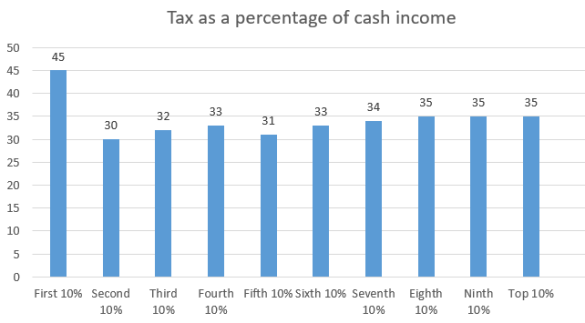
I gave the Office for National Statistics numbers for ‘quintiles’ – the lowest to highest earning fifths – of households. But here’s a chart for deciles which makes the point even more strikingly.

Capture.PNG

These are ONS numbers – taken from here – and they give tax as a percentage of the total of earned income and cash benefits.

The main culprit is Council Tax which – even after ‘Council tax support’ – consumes 9% of the total for the First 10% but only 1.5% of the income for the Top 10%. Every time – as with, for example, the Social Care Precept – Government chooses to fund spending through Council Tax you should be outraged. It is willfully choosing to dump those costs on the poorest because to do so is politically expedient. Collectively we understand but poorly the distributional effects of raising Council Tax. This enables Government to do what it should not without political cost.

But alongside the regressive nature of our tax system there is a related debate to be had about benefits.

Does it matter that the poor are disproportionately taxed if they disproportionately benefit from the benefits taxes fund? Is it the net effect of taxes paid and benefits received that one should analyse?

Of course, this is not what Osborne sought to do. The currency of political debate is ‘who bears the burden of taxation’. That political debate readily assumes, and often in ugly language (see this reference to “scroungers“), that the poor are beneficiaries of a burden borne by others.

But there is also a discrete, economic, debate.

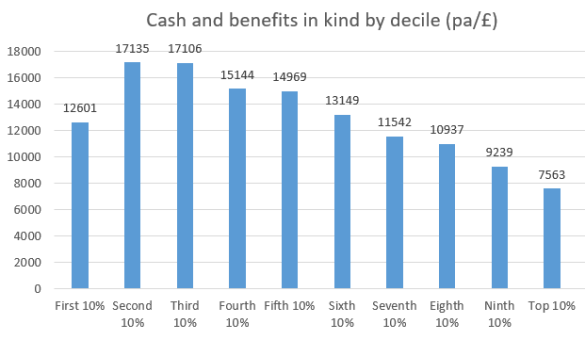
This debate is also informed by ONS figures. Here are their absolute numbers for cash and other benefits in kind received directly from Government (see Table 14).

Capture

The explanation for these numbers lies, in particular, in the universality of the state pension; the fact that all deciles are substantial consumers of education and (in particular) the NHS; and the fact that the rail subsidy is disproportionately enjoyed by the rich.

Of course, looked at as a percentage of income rather than in absolute terms, the poorer deciles benefit more than this chart reveals. But in absolute terms the differences in the extent to which the deciles benefit directly from Government are far less profound than you may expect.

I use this phrase “directly from Government” quite deliberately. The ONS figures capture those benefits we receive directly. But they do not capture those benefits we receive indirectly. They do not capture the extent to which the wealthy benefit from the infrastructure that enables income to be generated and wealth to be protected.

If we analyse who are the big beneficiaries of that infrastructure – of the legal system that enables income to be generated and protects property rights, of the police and army that secure our wealth from confiscation by acquisitive forces, of all the complex systems that Government provides and sustains and which enable us to earn our incomes – it is self-evidently the wealthy and high earners who benefit most.

Is there some argument that requires that we have regard to the direct benefits our tax system funds – but that we ignore the indirect benefits? If there is, I do not see it.

Of course, we should all benefit – as economic agents and as moral beings – from the social compact to which we, willingly or unwillingly, subscribe. We are, as George Osborne observed in the quote with which I began this discussion, “in it together.” True, we benefit differently. But we must each contribute according to our means.

Postscript:

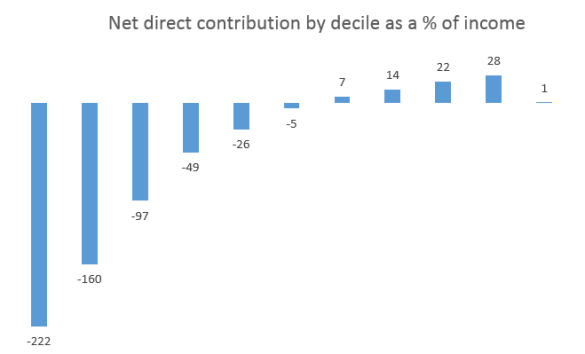
Here’s Andrew Jackson’s chart (see ‘Comments’below) of net direct contributions (I have re-titled his chart but the data is his).

Capture

Andrew adds:

“At first glance it looks very odd that the negative bars are so much bigger than the positive even though the total is 1%, but of course the negatives are percentages of much smaller numbers so this is to be expected.

“The other odd thing is that it comes down to only 1% difference, implying personal tax and benefits are largely breaking even; presumably other taxes cover all other spending.  Although with council tax in there but local services excluded, that is also odd. In fact, the more you look at this the more you realise what is not included, at least in the way of benefits… but it’s a start.”

The wealthy and the tax burden

Here’s what George Osborne said in his Budget speech:

Capture

Income tax represents almost 32% of all the tax we receive so this is a not insignificant statistic. But is it right?

It is, in fact, very wrong indeed. It would be more accurate to say that the highest earning half a percent pay 28% of all the income tax we receive. But it’s important we understand why this is. And what it tells us about whether we really are “all in it together”.

A high proportion of income tax revenue being paid by a small proportion of earners might be because we have a progressive tax system. Or it might be because we have income inequality. Either would deliver this result. But only one of them would be thought a positive political achievement.

Our system for taxing income is not nearly as progressive as you might think.

On income over £10,600, you will pay tax – including National Insurance Contributions – of 32%. On income over £42,385 you pay tax of 42% and on income over £150,000 you pay tax on income of 47%. But tax on income – excluding National Insurance Contributions – is more progressive.

George Osborne gave us the figure for income tax. Because it is our most progressive tax it overstates both the proportion of tax paid by high earners and the proportion of tax on income paid by high earners.

What about the alternative, income inequality?

From 2010-11 to 2015-16, the number of people earning more than £500,000 grew 44% from 32,000 to 46,000. And the number earning more than £2m per annum grew by around 500%. But this (it should be noted) only returned us to roughly pre-financial crisis levels.

And it wasn’t merely the number of high earners who increased – but also the amounts they earned. The amount earned by the average earner in that £500,000 plus bracket increased 16% from £1.122m in 2010-11 to £1.3m in 2015-16. By way of rough comparison, average weekly earnings grew from January 2011 to January 2016 by about 7%.

What about the tax paid by the average earner in that £500,000 plus bracket? It increased too (from £472,000 in 2010/11 to 514,000 in 2015/16) but only by 8.9%, much less than the increase in earnings. This is, of course, because of the cut in the top rate of tax from 50% to 45%.

So both are contributors.

One final point.

If you want to understand how progressive our tax system is, you really should look at it as a whole rather than focusing (as Osborne did) only on its most progressive element (income tax).

Looked at as a whole, the lowest earning 20% of households is the most highly taxed. That 20% pays 38% of its cash income – including benefits – in taxes. The second ‘quintile’ pays 30% then 33% for the third, 33% for the fourth and 35% for the top 20% (see Table 1 here).

This is because pretty much all of our other taxes are regressive. Big shout out to Council Tax which – even after Council Tax Support – consumes 5.8% of the cash income of the lowest earning 20% of households but only 1.8% of that of the highest earning.

If the Conservatives really did want a more progressive tax system they could start with that.

Coming Unstuck

The Chancellor’s plans to eliminate the deficit were always going to come unstuck.

Do not fear. I do not blog to advertise my lack of knowledge of macro-economics. Why would I, when that market is already so crowded?

I do not blog today on the effects of cutting public spending on growth. Nor, although previously I have elsewhere, do I mean to point to the consequences of Osborne’s decision to narrow our tax base. Nor, although I will, his relentless focus on cutting tax for corporations – beyond our G20 peers, beyond that which influences their investment decisions, beyond even that which they ask for. Nor, although it is something the OBR has persistently pointed to, will I point to the fact that Osborne’s deficit reduction plans rely in good part on asset sales rather than balancing income and expenditure.

No, the reason why Osborne’s plans were always going to come unstuck is a function of simple arithmetic.

Assume my spending remains constant at 100. To fund that spending I must have receipts, every year, of 100. Over five years to fund spending of 500 I must have income of 500. That five years is important because it’s the time horizon over which we plan our nation’s spending.

If my income is not 100 a year but 85, I have a problem. You might think, and rightly so, that I am 15 short. This Government has been 15 short.

What it has done, to hide that truth, is accelerate a whole bunch of 15s from later years into earlier years to hide the shortfall. Which is fine in earlier years – your budget looks balanced – but it leaves you in those later years with a shortfall of 30: the 15 you had anyway and the further shortfall consequential on you taking 15 from those later years for use in earlier years. Instead of having 85 you’ll only have 70. It’s not that complicated: if you spend tomorrow’s money today, you won’t have it tomorrow.

For a number of years, this is what we’ve been doing. On an extraordinary scale. Did you see those italics? Good, because I’m going to come back to them. And we’re now looking at a whole bunch of 70s.

You don’t believe me? Let me give you some examples. I don’t need to go back too far to justify those italics.

I’ll start with the Autumn Statement 2013. The Chancellor announced “follower notice” provisions which brought into earlier years £670m of receipts from tax avoidance cases that were expected to be won in later years. In Budget 2014, the Government dramatically extended the scope of the follower notice provisions with some “accelerated payment notice” provisions that moved a further £3.9bn from later into earlier years. A few points about these sums: of course, they moved money from later years into earlier years. But they also treated “possible” wins as certain. And they treated one off sums – resulting from a huge stockpile of tax avoidance litigation – as ongoing income.

But Budget 2014 didn’t pull this trick once. It pulled it twice.

Government knew that if you released pensioners from the obligation to buy an annuity from their pension funds and allowed them instead to withdraw cash lump sums they would. And when they did, income tax that would otherwise have been paid later on that annuity would instead be paid earlier, on the cash lump sum. Government would get the tax in the cash withdrawal year – but it wouldn’t get it in the later annuity years.

What was styled ‘pension freedom’ brought £3.05bn from later years into earlier years.

On to that year’s Autumn Statement. If we make a profit in tax year one but have made earlier losses, we can set those earlier losses against the tax year one profit and avoid paying corporation tax in tax year one. Government decided it wouldn’t let banks deduct their earlier losses against all of their tax year one profits: instead it would only let them deduct earlier losses against half of those tax year one profits. This would increase the Government’s take in tax year one but would also, of course, mean that in future tax years banks would have more losses available – because they wouldn’t have been set against tax year one profits. The result would be to increase the tax paid in earlier years and reduce it in later years.

By this mechanic, the Government brought from later years into earlier years the sum of £3.48bn.

In the March Budget of 2015 Government addressed its mind to those who’d already bought annuities. If we allowed them to sell those annuities, the same thing would happen as those who had yet to buy annuities. Those selling them would be in a position to make cash withdrawals giving rise to a tax liability now – rather than a later tax liability on payments under the annuities. This extension of pension freedom dragged a further £820m from later to earlier years. There was also an extension of the accelerated payments regime dragging in a further £550m from later into earlier years.

This all continued after the election. In the Summer Budget 2015 Government advanced the date at which big corporations had to pay their corporation tax. This brought an extra £7.83bn into earlier years. It wasn’t lost from later years – but it was a one off boost which made it look as though we had an extra £7.83bn of ongoing receipts.

In the Autumn Statement 2015 we repeated the ‘advancing the tax receipts’ mechanic, but this time for capital gains tax on residential properties, bringing into earlier years a one-off boost of £1.16bn.

And in last week’s Budget 2016 Government extended the Autumn Statement 2014 restriction on loss reliefs for banks and other companies, bring from later years into earlier years a further £3.36bn.

This isn’t over – the Making Tax Digital project will create an enormous one off boost – quite possibly in the tens of billions of pounds – to public finances in earlier years. This boost will flatter the real condition of public finances but won’t alter the underlying reality.

Even ignoring the Making Tax Digital boost, and only looking back to the Autumn Statement 2013, this combination of measures has brought £24.82bn into receipt for the five year timescale of earlier years. Much of this sum represents a one off boost; much of it will worsen the state of public finances in later years; none of it is repeatable; and all of it is matched against on-going expenditure.

And those later years? We’re looking at them now.

Be afraid.

Discriminating against the State

One of the odder measures in today’s Budget is this (from George Osborne’s speech)

Capture

In principle, it is welcome.

I explained here that self-employed workers are favourably treated for tax purposes, that a worker’s status as self-employment delivers very valuable benefits to her engager, and that personal service companies are abused to denude the Government of much needed tax revenues and workers of valuable employment law rights.

This measure carries a predicted yield of £555m over the life of the Parliament and appears to be exactly the measure I argued for here.

The curiosity is why it is confined to public sector employers?

George Osborne gives us no clue. Nor does the Office for Budget Responsibility’s Economic and fiscal outlook. The closest we get is in the Red Book:

Capture

But this reasoning is not particular to the public sector. Everyone, surely, has a responsibility to ensure that the people working for them are paying the right tax?

The abuse is far from public-sector specific. Indeed I argued here that the private sector is the environment in which the behaviour has its most destructive impacts – of distorting competition and destroying ‘good’ businesses. And the types of environment in which it is most likely to be seen are in the private sector:

Capture.PNG

This Select Committee report, too, suggests that personal service companies are most often used in the private sector. And Government has already tackled public sector abuse through this Procurement Policy Note.

But of course, everything has a reason.

What we do know is that it will put the public sector at a competitive disadvantage compared with the private sector. It will be difficult for public sector organisations to engage workers on a self-employed basis: they will bear the risk of getting wrong the assessment that a worker is self-employed. They will be driven to engage workers on an employed basis to avoid that risk – and this will increase their wage bill by up to 13.8%. The private sector will continue to be able to transfer that risk to the worker – or his personal service company. The private sector will, in effect, be able to buy the same worker for 13.8% less.

Why might this result be desired?

I can think of only one explanation.

Were you wanting to shrink the State; to force more outsourcing; to pass public money to big outsourcing companies… you might tilt the playing field. You might do this.


The future of tax avoidance

We don’t know much about tax avoidance. Not how much it costs us. Nor how to stop it. We barely know what it is. But we’re pretty sure we don’t like it. And we now know – thanks to Deutsche Bank and UBS – that the Supreme Court doesn’t either.

Last week’s decision concerned a scheme dating back to the early 2000s. Glory days for tax advisers who found, come bonus round, a willing buyer in every board room in City. The Deutsche Bank and UBS arrangements were variants on a scheme that lasted a number of years. You’d line up willing – and few weren’t – participants. To them you would deliver, instead of a cash bonus, shares in a cashbox company. It would declare a dividend in the amount of the cash bonus. Employees would pay a lower rate of tax – or even none at all.  And there’d be a nice little NICs saving for you too.

We barely noticed, prior to 2008, this stuff. And when we did we didn’t care. But true to history – which tells us tax avoidance is the most reliably pro-cyclical industry of all – this all changed with the financial crisis. Who could we find to blame? Whose shoulders might bear the burden? From whose had it, well, slipped a little?

We soon found out.

That our judges sit aloof from the winds of public opinion is an article of public faith. But the faith of tax lawyers quickly lapsed. Points that, before the financial crisis, HMRC lawyers had regarded as so hopeless as not even to bother to argue acquired, a mere few years later, the fixed status of orthodoxy.

The speed of this process caused concern in the legal community. Government appointed a ‘study group’ to help it decide whether to adopt a General Anti Abuse Rule to tackle tax avoidance. That group included, amongst others, a retired Law Lord and a serving High Court judge. It agreed, unanimously, that when confronted with avoidance judges adopted a “stretched interpretation” to the law. And quite how stretched depended on how much her or she disapproved of the transaction before her.

The GAAR was to solve all of this by giving judges an objective legal framework within which they might articulate their instinct to fairness. But it’s now been on the statute books for almost three years and a judge has yet to have the chance to use it. So the judicial activism continues.

Both Deutsche Bank and UBS had enjoyed success in the lower courts. Judges had not been able to find in the language of the legislation an intention that the bonuses should be taxed as HMRC contended.

But you didn’t need to read further than the first paragraph of the Supreme Court decision to know that this time would be different. When judges start the conversation with talk of the “sophisticated attempts of the Houdini taxpayer to escape from the manacles of tax” it’s rarely as a precursor to offering the tax freedom our would-be Houdini desires. It found that the result contended for by the banks would be “positively contrary to rationality, bearing in mind the general aims of income tax statutes” and dismissed their arguments.

A thrilling denouement to the story of tax planning. Few politicians intend that the highly paid should be able to apply the expensive emollient of good tax advice to slip the shackles of taxation. Not least because the British public, unlike those who flocked to Houdini, tend not to applaud when they do.

But is an extra set of judicial leg-irons really a good thing?

Yes – if your mind’s eye sees a judge who wears a blindfold and balances the scales with an invariable thoughtfulness and care. But there are reasons to be cautious too. There are times when we genuinely don’t know whether a transaction is “avoidance”. And if the reality does look like that subscribed to by the GAAR study group – judges applying a personalised sniff test – our tax system could come to deliver a little less than law and, sometimes, only a little more than popular opinion.

The UK’s tax competitiveness

Here’s what the FT reported this morning:

Capture

Ouch. That doesn’t sound so good. More tax cuts for multinationals must be the answer, right?

That’s what you’d think from the responses from Government:

Capture

But is that really what the KPMG ‘league tables’ show? Do we really need “further improvements” (for them, that is. You and I would probably describe it as collecting even less tax from multinationals)?

Here’s the KPMG Survey. It has lots and lots of questions comparing our ‘tax competitiveness’ with that of other nations. And business is asked over and again what would help our ‘tax competitiveness’. And they have lots of suggestions which result, unsurprisingly, in them paying less tax.

But when I take my three daughters into an ice-cream parlour and ask them whether they’d like ice-cream they tend to say yes. There’s not a single question in the KPMG report which seeks to assesses whether those tax breaks are in any way decisive of a decision to invest here or not.

This is close as the reports gets:

Capture

You’ll note the tiny sample size. You’ll also note that “high influence” is counted together with “some influence (and is not disaggregated). It could perfectly well be – indeed I would guess – that the number saying it has “high influence” is lower than the number saying it has “no influence.”

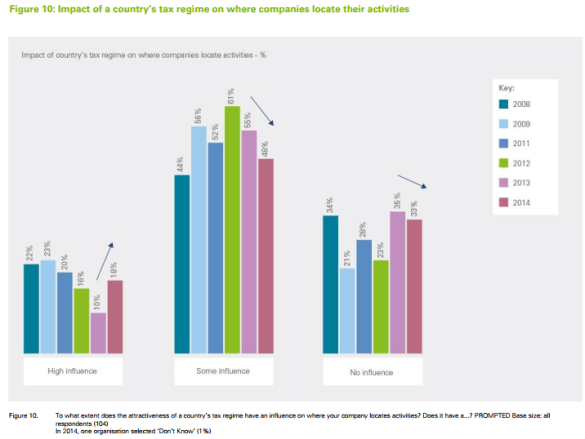
You don’t believe me? Well, here’s what the selfsame KPMG survey showed in 2014 (where they did disaggregate ‘high’ and ‘some’):

Capture

In 2013, the number saying the tax regime has “no influence” on where they located their activities was a staggering 350% of the number saying “high influence”.

And the report contains no analysis at all of the costs and the benefits for us as a nation of cutting the tax burden on business.

You see, at 20% we already have a corporation tax rate which is by far the lowest in the G7 and the joint lowest in the G20. Those other G20 nations with a 20 per cent rate? Russia, Saudi Arabia and Turkey. And are there really businesses contemplating setting up in Saudi Arabia who might be induced to set up here instead with a 2 per cent cut in corporation tax?

Nine years ago the rate of Corporation Tax was 30 per cent; today it is 20 per cent. In his 2015 Budget Osborne announced plans to cut it further to 18 per cent. That cut alone will cost £2.5bn in its first year. And that’s not my number, by the way. It’s HM Treasury’s own number – you can read it at Table 2.1 here. So “tax attractiveness” carries a very meaningful cost.

And the effect on Foreign Direct Investment in the UK – not the only measure of success, granted, but perhaps the one most applicable to the KPMG survey? Here’s the ONS’s chart.

Capture

In 2005, our rate of corporation tax was 30%. As it was in 2007.

You might think the KPMG report is a naked pitch for business to pay less tax. Dressed nicely for dinner, for sure, the better to be able to engage policy-makers and the electorate. And journalists. But still, just a pitch.

What do we actually get for foregoing the tax revenue – the “further improvements” described by Treasury? The effects of the greater “tax attractiveness” described by KPMG? And is it worth it?

We have no idea.