The Google Tax: Some Further Reflections

Announcing the Diverted Profits Tax (the Google Tax to you and me) at last year’s Conservative Party Conference George Osborne quite reasonably observed that the quid pro quo of our low rates of business tax is that businesses should actually pay that tax. Picking up on his theme, when the detail of the measures was announced last year, I wrote that there was a case for action to secure a “new and more fiscally satisfactory world in which tax better reflects the economic substance of transactions.” Too often in the old world it did not.

Those opposed to the Google Tax have argued that such a new and better world is best brought about by the OECD’s Base Erosion and Profit Shifting (“BEPS”) project – one which has broad international support – rather than by individual countries going it alone. This is a compelling proposition. Logically one can only resist it by arguing that the BEPS project might fail, that there’s a compelling need to act now rather than wait, or that the scope of the BEPS project is too narrow. Unfortunately the Coalition – which should be roundly applauded for the vigour with which it has set about tackling tax avoidance – hasn’t conspicuously sought to engage with those arguments (I mean no criticism by this). And although I would like to examine them, beyond noting that an oft-cited criticism of the BEPS project is its breadth, I sadly lack the expertise.

But what I can do is ask how well the Google Tax succeeds on its own terms. Does it impose a liability to UK tax on transactions that ought to be subject to UK tax? And does it only impose a liability where a liability should be imposed?

The starting point is, perhaps, this. The Google Tax is intended to be punitive. In that sense it’s like a number of other recent (and contemplated) moves in the tax avoidance sphere. It marks out territory on the fiscal map which is susceptible to tax avoidance – and then sets a series of landmines. Step on a mine and you face a penalty tax rate (of 25% more than the general corporation tax rate). Enter the territory and you’ll also face a long period of uncertainty as to whether HMRC will impose a penalty rate along with a hugely complex and uncertain compliance regime

You don’t like that? Well then don’t enter that territory.

And it’s absolutely the case that the Government would rather you didn’t. We have decided to pursue a strategy of a low corporation tax rate with an expected increase in the tax base through increased investment. A lower rate applied to greater receipts is the logic. And that it’s Government’s purpose that the Google Tax shouldn’t disrupt this strategy can be seen in the low anticipated direct yield from the tax. The real tax benefits will, presumably, be felt in the form of higher receipts from the corporation tax.

All of this seems (to me at least) sensible in principle. But in practice I do have one particular concern.

The language used by the draftsman to mark out the ‘bad’ territory on the fiscal map is, as the Treasury Select Committee noted, “long and highly complex… and likely to be a source of uncertainty.” I’d go further. At times it has the precision of those cartographers of old who shrugged their shoulders with a “there be dragons.”

This creates very considerable practical difficulties for technicians, HMRC, taxpayers and the courts. It will also roll back, and substantially, conventional notions of what ‘bad’ corporate tax behaviour looks like. Many ‘vanilla’ transactions – to use a once convenient signifier now regrettably oxidised by Lord Fink – will attract the tax.

Given the speed with which the Google Tax was introduced, and the lack of consultation, can we be certain that all of these consequences are intended? Reader, we can not.

But it’s worse than that. The Google tax does not simply tax those transactions: it applies to them a penal rate.

In other areas of the tax code where we have adopted penal anti-avoidance measures, we have been careful to confine those measures to transactions which are clearly abusive. The draftsman of this regime, on the other hand, recognises quite explicitly (in draft section 19(1)(a), for any technicians reading) that it will penalise not only activity which avoids UK corporation tax – but also, remarkably, activity which attracts it.

It is not easy to discern why this should be so. If we have a corporation tax rate of 20% and an activity attracts that rate, 20% is (an idealist might think) the rate of tax that should be paid. It may be that a different rate of tax is likely to form an important part of our defence to the contention that the tax does not breach our Double Taxation Convention obligations.

So how do we address these problems? HMRC have been out and about in numbers, whispering sweet nothings into the ears of business: of course we will apply these rules sensibly, they say. Now I’m sure those feelings are ardently felt now, but business has seen enough of the world to know that HMRC might see things differently later on, when the Diverted Profits Tax has been put to bed on the statute books, and Margaret Hodge starts demanding fiscal purity. Business can’t take long term decisions based on sweet nothings.

I try to deal in the art of the possible when I write. Life’s too short to spend it scratching your spots. And the Coalition has invested, politically, too much in the Google Tax to pull it for further consultation just before a General Election: Labour would make electoral hay. And for its part, there is no prospect of Labour presenting the Conservatives with a fiscal open goal by blocking the measure (something the Opposition is uniquely able to do in the final Finance Bill before a General Election). In any event, there is (I continue to think) much that is good about the legislation.

The drafting which will go forward as the final text for enactment will be an improvement on the present version (particularly around the rightly criticised notification requirements) but it is not expected to resolve the problems I have identified above. But I would like to suggest – to both parties – one adoptable measure which might have some positive impact.

We should introduce an ‘overriding objective’ at the start of the legislation. We need a measure that tells HMRC, taxpayers, and (most importantly) the courts (who will have to make sense of all of this) what the purpose of the Google Tax is. We need something that will give to those HMRC whisperings a touch of justiciability, a written promise that what was ardently felt the night before will be acted on the morning after.

I’ve suggested something below.

Clause A1

The Overriding Objective

(1) The objective of the Diverted Profits Tax is to prevent the avoidance of corporation tax by companies with business activities in the UK which enter into contrived arrangements to divert profits from the UK.

(2) The overriding objective shall be given effect to by tribunals and courts in interpreting provisions in this Part.

My thanks to the tax department at Freshfields Bruckhaus Deringer for its help with certain aspects of this post. Blunders – in the unlikely event of doubt about this – are mine and mine alone.

A Ten Billion Pound Sized Lie

In the normal world, the world that you and I occupy, you and I and everyone else, income is income and expenditure is expenditure. So if you’re XCo and you project your profits for the next ten years they’ll look, let’s say, like this

Table One

Capture

Over ten years, XCo will have 100 of income, 70 of expenditure and 30 of profits.

Did I say everyone else? I meant everyone else except the Government. What Government does is look at a fixed term, typically five years, and any cash it can shovel into that five year term it treats as income. So if Government devises a legislative measure which enables it to move income in Years 6-10 to Years 1-5 it will treat that income as income of Years 1 to 5.

Let’s assume the Government does this with those tens in Years 6-10 in Table One. You then have a table which looks like this

Table Two

Capture

Over a ten year time frame? Same same. Same income, same expenditure and same profit. But over a five year time frame? Not so much. Profits of 65 – an extra 50.

Accelerating your profits is a bit naughty – even though every little helps – but it’s what the Government does with them that really stinks.

Here’s George Osborne on 2 December 2014 announcing the largest “revenue raising” measure in his Autumn Statement

Capture

And here’s the fiscal impact of that measure (from the so-called ‘Green Book’):

Capture

Take a step back.

If you’re making a profit today, it’s rather nice to have made losses yesterday. You can set them against today’s profits and use them to reduce today’s tax liability. What George Osborne did was to say that instead of using all those losses today, banks would have to share them between today and tomorrow. This means banks pay more tax today – so the Government gets more income today (my Table Two). But over today and tomorrow, the banks pay the same amount of tax and the Government gets the same amount of income (compare with my Table One).

Why does all this matter? Go back to my Table Two. Over Years 1-5 the Government appears to have 50 more of ‘profits’. It uses these ‘profits’ to tell the public it has reduced the deficit. And it ignores the fact that in Years 6-10 it will be 50 worse off. And it has. And it does.

But let’s call this what it is. It’s a lie. In no meaningful sense has the Government brought down the deficit by those five 10s. Or, putting the matter another way, it has brought down the deficit by 50 in Years 1-5 only by increasing the deficit by 50 in Years 6-10.

You should be mightily cross about this. Of all the measures in the Autumn Statement, bank losses restrictions were said to have the biggest yield by far. But the actual yield from the measures is the time value of getting the money early. Which in a low interest rate environment is zero.

And it gets worse.

This isn’t the first time the Coalition has pulled this trick. The biggest ‘yielding’ measure in the 2014 Budget involved an identical sleight of hand. As did the second biggest. Add those three measures together and you have a £10bn sized lie. Told in a single tax year.

It’s an Ill Wind

The Court of Appeal’s decision in the Ingenious case was released yesterday. If rumours are true, it was a case HMRC did everything imaginable – indeed, if they’re true, some things barely imaginable – not to have to fight. And it’s a case which HMRC has now won twice: once before Mr Justice (now Lord Justice) Sales in the High Court and now again, on appeal, before the Court of Appeal.

I don’t usually write about cases on this blog. But this case is rather interesting – it concerns (quite explicitly) the question whether the law prevents HMRC from serving the public interest.

The facts don’t especially matter (is there a more welcome phrase a tax lawyer can utter?) but because they’re engaging I’ll give them to you anyway.

Alexi Mostrous, Times Journalist and Inventor of the Tax Scoop, met with David Hartnett to discuss some information that had come into Alexi’s possession and which he thought might be of interest to HMRC. Accounts of the basis on which that meeting was held vary but during the course of it the subject of Ingenious (the largest promoter of what it would style film investment structures) and its architect, Patrick McKenna, cropped up. And this exchange ensued:

Mr Mostrous: With McKenna do you think he is enacting any active schemes or any schemes that could be used to deprive the Revenue of tax now?

Mr Hartnett: I don’t know

Mr Mostrous: He’s not on your radar?

Mr Hartnett: Oh, he’s never left my radar.

Mr Mostrous: What do you think of him because he presents a very different profile.

Mr Hartnett: He’s an urbane man, he’s a former Deloitte partner, he’s a clever guy, he’s made a fortune, he’s a banker, but actually he’s a big risk for us to so we would like to recover lots of tax relief he’s generated for himself and for other people. Are we winning? I would say, beginning to. I think we’ll clean up on film schemes over the next few years”

Mr Mostrous: That applies to Mr McKenna as well as film schemes in general?

Mr Hartnett: I think we’ll clean up on film schemes over the next few years. You may end up laughing at that statement because maybe we’ll lose it in the courts, litigation’s a hell of a risk, but you won’t find anybody here at all, even the most pro-wealthy people, and I’m not sure we’ve got any, who thinks film schemes are anything other than scams for scumbags.

Mr McKenna and Ingenious took exception to what they said was a breach of HMRC’s public law duties (found in s.18 of the Commissioners for Revenue and Customs Act 2005). They said it was unlawful for Dave Hartnett to have disclosed what he did. And they said that the fact that the disclosure was in the public interest was irrelevant.

The Court of Appeal disagreed. It roundly endorsed what had been said below:

In general, it is legitimate for HMRC to seek to maintain good and co-operative relations with the press. The efficient and effective collection of tax which is due is a matter of obvious public interest and concern. Coverage in the press about such matters is vital as a way of informing public debate about them, which is strongly in the public interest in a well-functioning democracy. HMRC have limited resources to devote to the many aspects of their tax collection work, and it is legitimate and appropriate for them to seek to maintain relations with the press and through them with the public to inform public debate about the tax regime and the use of HMRC’s resources. It is also relevant to the exercise of HMRC’s functions to provide proper and accurate information to correct misapprehensions or captious criticism regarding the exercise of their functions (such as any misplaced suggestion that they had engaged in unduly lenient “cosy deals” with certain taxpayers), in order to maintain public confidence in the tax system. If such confidence were undermined, the efficient collection of taxes could be jeopardised, as disaffected taxpayers might withhold co-operation from the tax authorities.

And it observed that the exception to HMRC’s obligation not to disclose information was a wide one. Now, I should note that the principle in Ingenious won’t justify every public interest disclosure – but it will justify many.

The ratio of the Court of Appeal’s decision echoes a throw away observation made by Lin Homer (HMRC’s CE) in the Public Accounts Committee last month where, in response to Q172, she observed to Margaret Hodge:

One of the conversations that we have had with you in my three years has been about whether we are unduly defensive about confidentiality. We have, on a number of occasions, tried to take that advice from you and move further into transparency.

This recognition is welcome – as is the Court of Appeal’s decision. But I don’t want to get carried away.

There is a world of difference between HMRC recognising that there is no legal impediment to it acting in the public interest by enhancing transparency – and HMRC actually acting in the public interest. The former can be (and hopefully now has been) accomplished in consequence of the Court of Appeal’s decision and several brutal and public Hodgeings. But we get to the latter only through internal cultural change. Let’s hope we now see some.

HSBC and HMRC: what can we learn from Ireland

Last week, the Chairman of the Irish tax authority wrote to its Public Accounts Committee. You can read the letter here.

For students of HMRC’s handling of the Falciani HSBC disclosures, the letter makes for illuminating reading. The similarities between Ireland’s tax system and our own invite comparisons between how the Irish tax authority handled the disclosures – and how we did.

There seem to me to be five potentially interesting points of comparison.

1. Yield. I have written elsewhere about the comparisons to be drawn between us and our continental neighbours on tax yield from HSBC accounts. UK received information on about 6,000 individuals and businesses and recovered tax and penalties of £135m. France and Spain – both with fewer billionaires than the UK – have recovered £188m from 3,000 and £220m from 3,000 respectively.

It is fair to point out that there is no direct read-across from the yield figures for France and Spain as neither has a non-dom rule. It is probably fair to say, as a generality, that money held by UK residents abroad is less likely to give rise to a UK tax liability than money held by Spanish residents a Spanish one. Ireland has a non-dom rule – but sadly the letter does not give a comparable yield figure.

2. Criminal prosecutions. There were 88 individuals with Irish addresses. 20 were considered for criminal prosecution (23%), four were selected for prosecution, three were convicted (3.4%) and 1 remains under investigation. In the UK, there were 3,600 individuals of whom 3,200 were traced, 150 were considered for criminal prosecution (4.2% or 4.7%) and 1 conviction (so far) has been obtained (0.03%).

So the Irish have been spectacularly more successful than us in achieving criminal prosecutions.

3. Does the French Defence stand up? The absence of criminal prosecutions has been blamed by HMRC and the Treasury Minister on constraints imposed by the French on the use to which we could put the Falciani disclosures. Initially both were rather tight-lipped on what those constraints were. However, we know now that the information was disclosed under the terms of the UK France Double Tax Convention Article 27 of which limits its use to tax matters (including tax evasion offences). However, the information was also disclosed to the Irish under the terms of their Double Tax Convention with France (and the EC Mutual Assistance Directive) which contain the very same limitations. It hasn’t stopped the Irish obtaining convictions.

So this evidence suggests we were not justified in blaming the French.

4. What effect did the Falciani disclosures have on the use of amnesties? The point of an amnesty is to encourage people you might not otherwise find out about to come forward voluntarily and put their tax affairs in order. Why would you offer an amnesty to those you already knew about?

I have written here about our misuse of amnesties. But, in fact, the situation is even worse than I then appreciated.

Lin Homer said this to the Public Accounts Committee:

I think that, on previous occasions, we have told you that we thought that there were possibly about 15 or so that we hoped to get through to criminal prosecution. As I have told you on a previous occasion, a number of those moved into the disclosure facility and took themselves out of prosecution that way. A number were discussed with the CPS, and, in the end, of the three that we and they felt most likely to be able to prosecute, they felt that only one had reached the test. That is the top tier.

Quite why those actively being investigated with a view to criminal prosecution should have been permitted to ‘take themselves out of prosecution’ through use of the amnesty I do not know. Certainly this was appreciated by the Chair of the Irish tax authority who said:

The commencement of a Revenue investigation means that the taxpayer is precluded from availing of a qualifying voluntary disclosure.

5. Different approaches to transparency. But to me the most striking thing of all about the letter to the Irish Public Accounts Committee is its tone. The letter demonstrates that the Chairman of the Irish tax authority understands that transparency is important. Our own HMRC, I am afraid, does not. In its dealings with the Press, Parliamentarians, and the public at large it routinely seeks to deflect scrutiny and to discourage accountability.

There is not a day when we, the public, do not read stories of legal avoidance and criminal evasion by powerful corporates and wealthy individuals. Those who have suffered in consequence of the squeeze in public finances are entitled to ask of HMRC, are you policing the line? HMRC’s disinclination fairly to answer that question is highly corrosive of public faith not just in HMRC itself but in democracy and society at large.

Follow me @jolyonmaugham

Is the sky falling in?

It is, sometimes, Parliament, a wonderful thing. Here’s Charles Walker (Broxbourne) (Con.), moments after describing himself as “a capitalist, red in tooth and claw”, talking in 2008 about the levy on non-doms:

Capture

He’s tackling – head on – the one reason why we offer a tax sweetener to the wealthy with foreign connections to move to or stay in the UK. I’ve written elsewhere about the perverse effects flowing from the poor design of that sweetener. I’ve also asked some questions about whether HMRC are effectively policing it (and there is more to follow on that front). What I want to do today is look at the data: does it support the case that we need it to bring the wealthy into the UK – or keep them here?

But before I get to it, a few observations:

(1)  if you’re wealthy, thinking about moving, and comparing possible places to live you absolutely compare, amongst other factors, tax regimes. Our non-dom regime has something of a gravitational effect;

(2) the power of this gravitational effect is not constant. It might pull you here – but it doesn’t follow that you continue to need it to stay. Once you’ve found a comfortable social and cultural orbit – something London absolutely offers, at least to the wealthy – the removal of any tax sweetener that factored in your decision to move here will operate only weakly in your decision whether to stay;

(3)  cultural factors are important. The percentage of millionaires in New York (which doesn’t have a non-dom rule) is about a third higher than that in London (although it should be noted London does much ‘better’ when it comes to billionaires);

(4) the percentage of millionaires in both London and New York is a tiny fraction of that in the tax havens of Monaco, Zurich and Geneva. This should cause you to ask whether tax really is a major factor in London’s appeal to mobile individuals. Those motivated principally by tax have – and choose – ‘better’ alternatives; and

(5) I think it’s beyond sensible dispute that there are economic benefits for us all in attracting the wealthy to the UK. Many of the arguments to the contrary are, as I have argued elsewhere, confused.

Anyway. Those observations aside, the data.

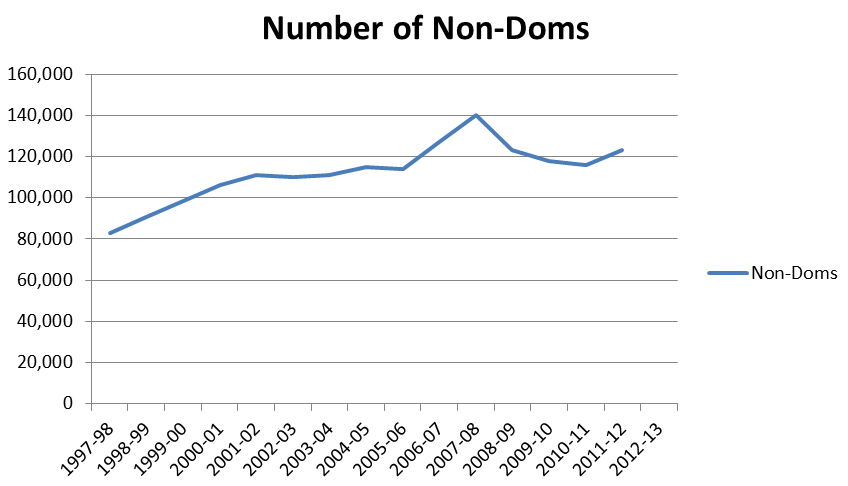
What follows is a table garnered from various ‘official’ sources (to avoid clogging up the post, the sources for all of the data are given in a ‘comment’). The table shows the number of non-doms registered with HMRC over time. Do the Chicken Little arguments of those law firms who advise non-doms – that the effect of the introduction of the non-dom levy has been cataclysmic – stand up?

The non-dom levy was introduced in the tax year 2008-09. The number registered as Non Dom then in the country was 123,000. The number registered as Non Dom for the last available year (2011-12) is… 123,000.

The apparent peak was 140,000 in 2007-08. I say ‘apparent’ because there are very good reasons to be sceptical. It can only be right if there was a huge jump from 2005-06, followed by a matching huge fall to 2008-08 and all against a consistent pattern of gentle increase.

What does this mean? The only argument for tax sweeteners is that we need them to attract or retain the mobile wealthy. If – as the data shows – reducing those sweeteners hasn’t materially affected our ability to attract or retain them, it’s entirely proper to ask whether removing them would.

Capture

Note: I have not found figures for 1997-98, 1998-1999, 1999-00, 2006-07. The table, therefore, assumes a steady progression between the ‘known’ numbers on either side of the missing years.

Why are HMRC not challenging non-dom status?

There’s a surprising dearth of data on non-doms in the UK. In one sense this isn’t a surprise. The overwhelming majority of the perhaps 4.9 million non-doms in the country won’t have substantial assets or income abroad. Their domicile status won’t be of interest to them – and it won’t be of interest to HMRC.

But even in relation to those for whom the status is financially meaningful, data is not routinely published. About 114,000 were registered non-doms 2005-06 (before the introduction of the ‘remittance basis charge’). And about 118,000 were registered in 2009-10 (after its introduction): the latest year for which I have been able to find data. Of those 118,000, the charge was paid by 5,100 people (4.3%). Many of the remainder are likely to be ‘newer’ non-doms: the charge is only payable if you have been resident in the UK for seven out of the preceding nine years. (Putting the matter another way, you can be a resident non-dom for six years and claim the remittance basis without incurring liability to the charge.)

So the figures we have are out of date. But the more important data deficit – for those attempting to understand the tax consequences of our decision to maintain non-dom status – is our ignorance of the amount of tax we forego. As Ed Balls explained back in 2007, information is not held on overseas income and gains that do not give rise to a tax liability in the UK.

The numbers will be substantial, though. Iain Tait, who heads the Private Investment Office of London & Capital, described the £50,000 remittance charge as “largely symbolic.” However you carve it, there will be many billions at stake.

One of the odd things about non-dom status – and there are many (see this piece I wrote last Friday) – is that your possession of it at any given time is a matter of your then present intention as to your future status. I was brought up in New Zealand: do I now intend to return there at some stage in the future? That might not be such an easy thing for HMRC to assess. But judges are well used to such questions. State of mind is a critical element of pretty much every criminal offence. It’s also worth remembering that the burden of proving possession of non-dom status rests on s/he who claims it.

Against that background – vast amounts of tax at stake and so every reason for both sides to fight, a Revenue authority which may not be best placed to assess status, and judges trained to do exactly that – you might expect to find a slew of cases in which HMRC have sought to test entitlement to domicile in the courts. I know I did. But I was wrong.

In the last ten years (which is as far back as I checked), there’s only been one concluded challenge to domicile, nine years ago. There’s also a single indication of a challenge to come.

Many of us in the profession are surprised at HMRC’s seemingly ready acceptance of assertions of UK non-dom status. This morning’s Guardian account of Stuart Gulliver is a good example: it reports he went to University in Oxford, lives in the UK and is married to an Australian. The FT adds that he grew up in Plymouth, and chooses to be based in London. The Independent says he was born in Derby. But he is nevertheless, apparently, accepted to be domiciled in Hong Kong. Now, I’m not saying that conclusion is wrong – but it does raise questions.

What does all of this evidence? A reluctance on the part of HMRC to take on the richest and best-lawyered? A policy decision not to alienate the most mobile? Or merely that us tax professionals are wrong to be surprised. Whatever the answer, it’s a pretty striking state of affairs.

Follow me @jolyonmaugham

A bribe for the wealthy to move to, or remain in, the UK

Late February. How’s your New Year’s Resolution going? Not so well? Congratulations, you possess a necessary (but happily for George, not sufficient) qualification to be the next Chancellor of the Exchequer.

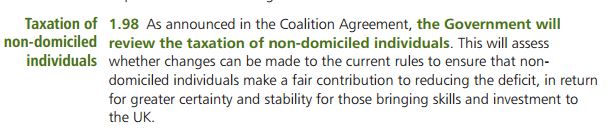
In its first Budget, 22 June 2010, this is what the Coalition said:

Capture

But am I making some party political point? I am not. This is what Labour said in its Pre-Budget report 2002:

Capture

And these are but the last two in a long line of failed resolutions: changes were considered in 1994, 1988 and…

There have been some reforms: Labour introduced a levy for non-doms: a £30,000 annual membership fee to belong to the best tax mitigation club there is. And the Tories have changed the fee structure to reflect the (perfectly sensible) notion that the less deserving you are of club membership, the more you should have to pay to continue to belong. Come April, if you’ve been resident in the UK for 17 of the last 20 years, it will cost you £90,000.

But proper reform? It’s the fiscal equivalent of getting a little more exercise. You know it’s a good thing but it’s just… so… well… Gosh, is that the time? There’s an election coming!

***

What most proper (by which I mean non-tax haven) countries say is: if you live here we’ll charge you to tax on all your income and gains around the world. In the UK, we’ve carved out an exception to that rule: if you are not ‘domiciled’ here we’ll charge you tax only on the income or gains you bring in (or ‘remit’ – hence the remittance basis) to the UK. Your assets and income outside the UK won’t be charged to tax here – and, if you arrange your affairs carefully, might not be charged to tax anywhere. And your country of “domicile”? That’s your ‘home’ country.

I could write tens of thousands of words delineating the operation of these two key concepts: ‘domicile’ and ‘remittance’ basis. But to focus on how they work rather than what they accomplish is to miss the point. And the point is that the remittance basis is a fiscal sweetener – a bribe, if you like – payable to the wealthy with foreign connections to cause them to move to or remain in the United Kingdom.

It’s only having called it by name that we can turn to look at whether we should be paying it and, if we should, what it should look like.

Proponents of the non-dom rule say that it encourages wealthy foreigners to move to (they don’t say but do mean) London and spend their money in (also) London – and that brings benefits including additional tax receipts to the economy. They’re right.

Detractors say, looked at globally, the rule signals our enthusiastic participation in a race to the fiscal bottom which makes winners of the fantastically wealthy and losers of everyone else. They’re also right. Some detractors – a good recent example being the BBC’s recent The Super Rich and Us – also point to the fact that the arrival of wealthy foreigners hasn’t spelled the end for inequality in the UK. Someone, somewhere, possibly in Norfolk, will be flexing his blackboard ruler, but that seems to me a little like arguing that, because I’ve turned on my two-bar electric heater and I’m still cold, it follows that heaters don’t make you warmer.

But just stand back and accept the logic of the (good) points for a second. There are all sorts of ways in which we might entice wealthy foreigners to come and live here. Stable government, a civil service free of corruption, our cultural richness, excellent public infrastructure (someone stop me, please, before I get completely carried away). Do we need a fiscal inducement too? And if we do need a fiscal inducement is this the one?

To answer that question we’d need to model how many would leave, how many would fail to come, and what the loss would be to the economy. Many will tell you they can, or have, performed this exercise. For myself, I like to recall what the Institute of Fiscal Studies, which so often (and often accurately) tilts at fiscal forecasting had to say, back in 2007, about the effects of  rival political proposals for a non-dom levy:

Capture

This is the link for that pleasing flash of intellectual clarity.

But let’s press on, whilst recognising that to do so we’ll need to assume that sensible modelling is possible. Let’s also assume (controversially, but for the sake of argument) that we’d like to continue paying a sweetener.

The question then is, what should that sweetener look like? To answer that, you need to go back to my two key concepts: remittance and domicile.

The concept of domicile has many problems. The question whether X is domiciled in the UK often fails to admit of a clear answer: it is to borrow an attractive phrase (from Ian Jack) “a peculiar mixture of fact and intent”. Perhaps in consequence, legal challenges to domicile status are relatively rare (such that questions might sensibly be asked about whether all of those claiming the status actually have it). But most importantly of all, the line in the sand that the legal test draws is a pretty crappy way of separating out those we might want to give a sweetener to and those we might not. You might think that, after someone has put down roots, they might no longer need (or deserve) an incentive to come or remain here? But the domicile rule all but ignores that critical fact.

As to the remittance basis of taxation, it’s enormously complex to apply. That’s a thing modestly undesirable (to all but tax advisers). But its real failing is that it disincentivises the very thing we want to incentivise. The reason we give a sweetener to get wealthy foreigners to come here is not because we like their company (although often we do). The reason is that we want them to bring their money here and spend it here. Taxing them on the income and gains that they bring into the country discourages them from doing the very thing that the sweetener is designed to encourage them to do.

I don’t want to suggest policy on the hoof (he said, with the inevitable air of a man about to do so anyway). But it doesn’t take much imagination to think of mechanisms that might consistently promote the policy objective of offering a sweetener. If we are to have a tax mitigation club, what about a different one, with equally high annual subs, but that gave you a reduced rate of income tax or capital gains tax for the first, say, five or ten years of residence here? Not desperately politically palatable perhaps, but no less so than the present system properly understood, and likely to deliver far better economic results.

More modest reform might look like a domicile equivalent of the statutory residence test in the Finance Act 2013 – to create bright line tests between resident and non-resident status – coupled with a deemed domicile provision (akin to that in the Inheritance Tax Act 1984) by which you would be deemed to be a UK domiciliary after a number of years residing here.

But I’d love to hear your suggestions – and responses to the above – too.

What we can learn from today’s crackdown in Switzerland

Two events in sequence.

One: international consortium of journalists splashes on successive days on their investigation into tax evasion (many years ago) by clients of Bank X in Switzerland.

Two: a week later, the Swiss authorities raid the offices of Bank X.

Somewhere someone will contend the timing is mere coincidence. But it isn’t.

What can we learn from this sequence?

This: tax havens care about reputational issues.

I wrote in more detail about what business tax havens are really in here. They compete to attract foreigners’ money. If a UK depositor starts to ask himself questions about how HMRC will view his ownership of a Swiss bank account – will it be a red flag? – he will wonder whether to move his money elsewhere. And it’s to avoid that happening – to give the appearance of Switzerland being a respectable player in the global fiscal community – that the Swiss clamp down. And, whatever the reasons for it, that clamp down improves local compliance.

If you want to reduce tax evasion, or money laundering, you need to find ways to bring pressure to bear on how tax havens operate. You need to recognise that they are so often in the business of disrupting sightlines between the money and those who own it. Improve those sightlines and you can meaningfully threaten sanctions. Meaningfully threaten sanctions and you reduce tax evasion and money laundering. Sightlines and sanctions.

What we can learn from today’s crackdown in Switzerland is that reputational issues are an effective lever.

So, well done – in the UK – the Guardian and Panorama. Well done for shining a torch into Swiss vaults. And now, let’s have a little more please.

Hey Politicians! The public are less stupid than you think

Here’s Iain Duncan Smith, on paying tradesmen in cash, speaking yesterday:

Capture

But hang on a second, here’s the Daily Mail responding to observations on the same subject made by the present Financial Secretary to the Treasury, David Gauke, in 2012:

Capture

Those bloody Tories, eh? But wait, wait, wait, wait up. Here’s Ed Miliband speaking on tax avoidance on Saturday:

Capture

And here he is speaking on tax avoidance in 2012:

Capture

What are we to take from all of this? Nothing attractive, although it’s reassuring that the public sees through it. This is YouGov, polled on 12-13 February:

Capture

Credit to the Mail, source of all four of the quotes set out above.

Surely HMRC wouldn’t let you off the hook?

There’s no denying it’s hard to bring successful criminal prosecutions against tax evaders. The complexity of the tax system makes it tough to get a lay jury over the ‘beyond reasonable doubt’ line. And it’s not easy to get the evidence together. Tax havens don’t want to develop a reputation for making enthusiastic disclosures of the affairs of their banks’ clients because, well, those clients might choose to move their money elsewhere.

But having achieved a decent evidential foothold, you’d hope HMRC would take advantage? Wouldn’t you?

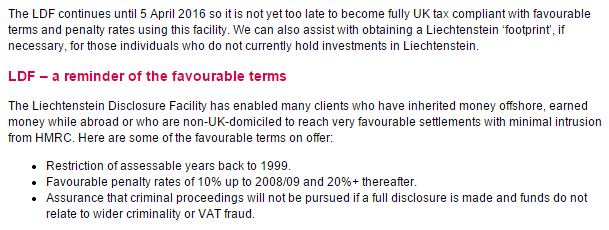
Yesterday Richard Murphy, the well known tax campaigner, pointed to one instance of apparent failure of this principle: you have a tax amnesty to encourage people you might not otherwise find out about to come forward voluntarily and put their tax affairs in order. But why would you offer an amnesty to those you already knew about? In her evidence before the Public Accounts Committee, Lin Homer said that HMRC had “encouraged” 500 taxpayers – whose affairs had been made known to HMRC through information on the Falciani disk – to take advantage of an amnesty (called the “Liechtenstein Disclosure Facility”) offering very low penalties on unpaid tax and immunity from criminal prosecution. These were 500 taxpayers whose affairs were non-compliant, which non-compliance we knew about, and we were offering them an amnesty. Seems odd to me.

But there’s a further puzzle. Forget the Falciani disclosures for a second. Back in 2012 we signed an agreement with Switzerland which presented a satisfying dilemma to non-compliant UK resident taxpayers with accounts there: either (1) agree with the Swiss that you would make a full disclosure of your affairs to HMRC and take your chances with swingeing penalties and/or criminal prosecutions or (2) preserve your anonymity and suffer an initial tax charge of 21-41% of your capital, together with further on-going tax charges and the threat of criminal prosecution in the future. (Although, for reasons unclear to me, if you took option (2) and kept your affairs secret, we promised the Swiss that criminal prosecutions would be “highly unlikely”.)

(Side note: a somewhat unappreciated aspect of the #SwissLeaks disclosures is that, as the Guardian reported, HSBC then set about selling to its individual clients a mechanic involving the interposition of a ‘special purpose vehicle’ between the clients and their accounts which gave to their clients a third option: do nothing.)

So, leaving aside those lucky HSBC clients, HMRC had you where they wanted you: (1) high initial tax charge, future tax charges and continuing risk (albeit for reasons unclear small) of criminal prosecution or (2) face the music at home.

And then? HMRC seem to have let everyone off the hook. They encouraged taxpayers to take advantage of the benefit of the Liechtenstein Disclosure Facility amnesty. This is what HMRC’s own Swiss-UK Tax Co-operation Agreement Factsheet says:

Capture

Here’s how Grant Thornton quite fairly sum up the choice offered to tax non-compliant UK residents with Swiss accounts:

Capture