Autumn Statement Alternatives

Later today you will hear George Osborne say there is no alternative to his plan to slash a further £20bn from lean public services by 2020-21. He will also say that there is no alternative to £9bn of cuts to tax credits, cuts that will hit the poorest hardest, cuts of thousands of pounds per annum to the incomes of millions of households.

But there is.

As I outlined here the Conservatives plan future tax cuts which benefit, disproportionately or exclusively, the wealthy. Suspending those future tax cuts for the wealthy would save, by 2020-21, £9.3bn per annum.

I also explained here that a mere 50 of our 1,156 tax reliefs cost us over £100bn per annum. We don’t know how much the other 1,106 reliefs cost us – because Government doesn’t monitor them. And we don’t know what public benefit they deliver – because Government doesn’t check.

What we do know, as I explained here, is that they disproportionately and regressively benefit the wealthy: an average of £190,400 per annum for the wealthiest.

And we know, too, that they include (amongst the more than 1,000 uncosted reliefs) the £1bn plus ‘Rights for Shares Scheme’ – badged by the Chancellor as for workers but identified by a leading law firm as designed for the wealthiest.

Simply by asking a question that the Chancellor chooses to ignore – do these 1,156 reliefs deliver value for money – it is entirely possible that £10bn or more extra in taxes could be collected without any loss of  public benefit.

To this £19bn, we might add the indiscriminate provision – both direct and indirect – of public money to wealthy pensioners.

Those above basic state pension age enjoy a tax subsidy of up to 12% on earned income.

Moreover, this Office for National Statistics data (see Table 18) reveals that the 10% of wealthiest retired households – some 714,000 households – have gross pre-tax and pre-benefit private income of on average £43,983. Yet still they enjoy average cash benefits from Government of £11,500 per annum.

Means testing benefits to exclude that top 10% of retired households would save £8.2bn per annum. And why, you might wonder aloud, should means testing be thought by the Government appropriate for the working age population, yet a heresy for retired households?

Add in abolition of that unprincipled tax subsidy and you’ll save even more.

So there are alternatives. Clear alternatives. Good alternatives. Alternatives that enable those with the broadest shoulders to bear some share of the pain. Don’t allow yourself to be persuaded otherwise.


Who benefits from tax expenditures?

I’ve banged on about tax expenditure reliefs already. Twice, in fact: here and here.

I made a few points in those posts. We know tax expenditures are hugely expensive. They cost us – through tax revenues we don’t collect – more than £100bn every year. But no one knows quite how much they cost us because Government doesn’t collect the data. And no one knows either whether we get value for money from them because… Government doesn’t ask.

So in governance terms they’re – there’s no putting lipstick on this pig – a disgrace.

I also asked why this state of affairs persists?

Why is Osborne’s Spending Review focusing solely on cutting £20bn from already lean departmental budgets but doing nothing to trim the fat from the revenue side of our profit and loss? Why does he – quite literally – not want to know about the public costs and private benefits of tax expenditures?

What I want to focus on here is a few points about who benefits from tax expenditures. And I’m going to look at income tax expenditures.

There’s no published data – or at least none that I’m aware of – on this. That tells a story all of its own. But I think I’ve been able to reverse engineer some. So as not to clog up the narrative, I’ve set out in detail how I’ve done the calculations at the bottom. Do have a look: if I’ve got them wrong, obviously I’ll hold my hand up.

It is possible to extrapolate from Table 2.5 (with a little help from 2.6) for 2015-16 here something of how the benefit of tax expenditures is spread amongst income tax payers.

This first chart below tells you how much the average income tax payer in certain income brackets has their tax bill cut by (some) income tax expenditures.

The “(some)” is because as I set out at the bottom of this page the data only enables me to infer the distribution of a subset (about £13.5bn of more than £32bn of so-called ‘principal‘) of income tax expenditures. Capture

As you can see, if you earn more than £2m per annum (and the average taxpayer in this earnings bracket earns £4.76m per annum) you benefit (from income tax expenditures alone) to the tune of on average more than £190,000 per annum. But if your income is between £30,000 and £50,000, for example, they benefit you £382 per annum.

It is worth noting that the distribution of the remaining so-called principal income tax expenditures follows the distribution inferred here then you would increase those numbers by 240%. So the average income taxpayer in the £2m plus bracket would derive over £450,000 per year from income tax expenditures.

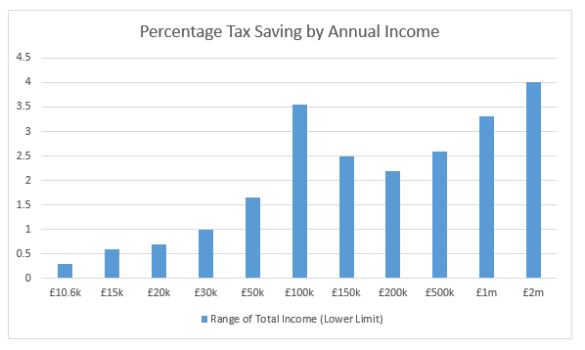
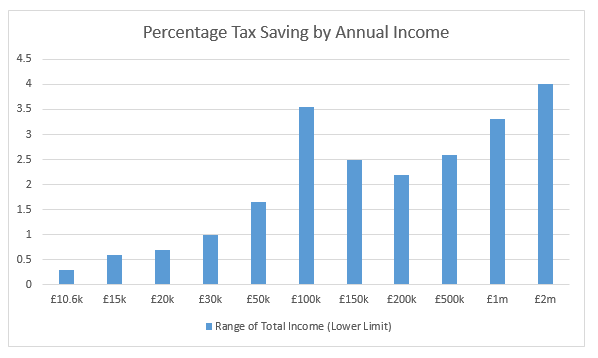
My second table shows that these tax expenditures do not only benefit high earners more in absolute terms. They also benefit high earners more in percentage terms. Put bluntly, they are regressive. This is exactly as you would expect: those paying higher rates of tax are more incentivised to seek out income tax reliefs. And those earning more are better able to engage in the sorts of activity that attract tax reliefs.
Capture

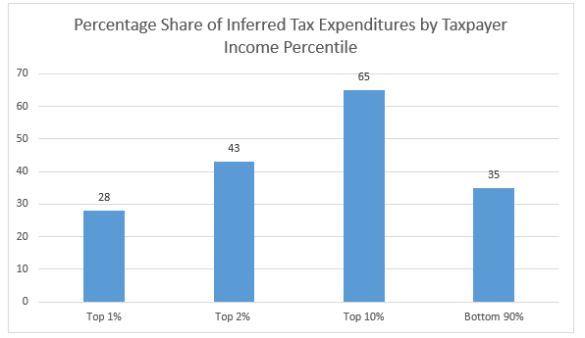
The third table shows you how the benefit of these inferred income tax expenditures is shared amongst some taxpayers.
Capture

As you can see the top 2% of income tax payers (which is broadly the top 1% of earners – because only just over half of over 16s earn enough to pay income tax) receive 43% of all inferred income tax expenditures. And the top 10% of income tax payers (the top 5% of all earners) receive 65% of all inferred income tax expenditures.

Startling though these results are, there is good reason to think them conservative. The (rather puzzling): “Allowances given as tax reductions” line in Table 2.6 here shows 70% of those “allowances given as tax reductions” going to the highest earning 1% of income tax payers.

The Calculations

Table 2.5 sets out for each of the earnings brackets (a) the number of taxpayers in that bracket, (b) the total income of those taxpayers, and (c) the total tax paid by those taxpayers. From (a), (b) and (c) you can calculate (and Table 2.5 does) the average rate of tax paid by those taxpayers.

For any individual taxpayer in that bracket you could identify what tax she would have paid after her personal allowance but before any other reliefs. Tax practitioners call this the ‘blended rate’ (it’s ‘blended’ from the personal allowance, basic, rate, higher rate and additional rate).

Of course we don’t have an individual taxpayer. But if we take (a) and (b) for each of those brackets we can construct what the average individual in that bracket would earn. I have taken that average individual and worked out her ‘blended rate’.

If you deduct the average rate from the blended rate you get a percentage which is accounted for by, I believe, certain types of tax expenditures.

You also need to take into account that not all income is taxed at the same rate. In particular, dividends are taxed at 10%, 32.5% and 37.5% rather than 20%, 40% and 45%. Pro-rated by number, this effect isn’t particularly material for basic rate taxpayers so I’ve ignored it for them. This will mean that the amount of tax reliefs inferred for basic rate taxpayers is overstated.

But for higher rate taxpayers, tax on dividends amounts to 10% of all the tax they pay. And for additional rate taxpayers it amounts to more than 14% of all the tax they pay (you can see this from Table 2.6 for 2015-16). By my calculations this difference will typically account for about 1% of the difference between the blended rate and the average rate for additional rate payers. And 0.75% of the difference for higher rate payers.

So I have deducted this (1%, 0.75%, or 0%) from the difference between the blended percentage rate and the average percentage rate.

If you then apply the resultant percentage to the gross income of that average individual in each tax bracket you can infer a tax reduction which is ‘unexplained’ by other means and which, it seems to me, must be attributed entirely (or virtually entirely) to tax expenditures.

Let me illustrate the calculation.

There are 5,000 taxpayers earning more than £2,000,000 per annum. They earn aggregate income of £23.8 bn. And they pay aggregate tax of £9.43bn. This gives an average rate of tax of 39.7%. The average taxpayer in that bracket has income of £4.76m per annum. Pre-reliefs, that taxpayer would pay income tax of £2,128,143 (a blended rate of 44.7%). 44.7% – 1% (dividend effect) – 39.7% = 4%. 4% of £4,760,000 = £190,400.

If you multiply £190,400 by 5,000 taxpayers you get the aggregate inferred tax expenditures enjoyed by taxpayers with income of more than £4.76m (or £952m). If you do that exercise for every income category you can then work out the figures in my third table. The taxpayer income percentiles come from here.  They are from 2012-13 but the difference will be, in the scheme of things, modest.

The aggregate inferred income tax expenditures is about £13.5bn. By way of comparison the sum of the ‘principal‘ income tax reliefs for 2014/15 is something over £42bn.

For comparison, my results are more conservative than those produced by the (rather puzzling) “Allowances given as tax reductions” line in Table 2.6 here.

However, I can see no reason why the unaccounted for income tax expenditures should follow different distribution curves to those set out above. Indeed the (rather puzzling) “Allowances given as tax reductions” line in Table 2.6 here suggests that my analysis is conservative. It shows 70% of “allowances given as tax reductions” going to the top 1% of income tax payers.

Shrinking the State? It looks like this.

Last year HMRC collected £515bn through the tax system (page 8).

It would have been more but for a number of ‘tax expenditures’ – a particular type of tax relief which you might think of as a substitute for a subsidy (paragraph 7.3.2). Through them we give away by foregoing income “some £100 billion a year” – according to the (Conservative majority) Public Accounts Committee (page 9).

On 25th of November, George Osborne will publish the results of his Spending Review, designed to cut a further £20 billion from public spending by 2019-2020 (table 1.A). His aim – or more accurately his avowed aim – is to “deliver value for money for the taxpayer” (paragraph 1.2).

Value for money is, of course, what good governance in the public sector looks like. It’s why HM Treasury has a so-called Green Book entitled “Appraisal and Evaluation in Central Government.” The 118 pages of that Green Book are one long argument for the need to understand what we get when we spend public money. There is a need to ensure that “Public funds are spent on activities that provide the greatest benefits to society… in the most efficient way.”

No one is pretending that the Spending Review will be easy. The Introductory section to the Spending Review provides that it will “involve difficult decisions” (paragraph 1.3). Not least because it follows on from “£14.3 billion from efficiency compared to 2010” achieved in the last Parliament (paragraph 2.6).

But here’s the thing.

Why are we taking difficult decisions with spending – but deliberately ignoring easy ones around tax reliefs? Why does “value for money” dictate spending cuts when it is absent from Government thinking about reliefs?

And where is the Green Book assessment of the value delivered by that £100bn of tax expenditures?

There isn’t one.

Here’s what the National Audit Office said in November 2014:

“We found little evidence that HMRC evaluates reliefs to see if their objectives are being met.”

(paragraph 17).

And here’s the Public Accounts Committee:

“HM Treasury and HM Revenue and Customs (HMRC) do not keep track of those tax reliefs intended to influence behaviour. They do not adequately report to Parliament or the public on whether reliefs are working as intended and what they cost and whether they represent good value for money.”

(Summary).

And:

“HMRC rarely, if ever, assesses whether a tax relief is an economic, efficient and effective way of meeting its policy objectives.”

(Paragraph 4).

***

Let me try and bring this to life with one example – of the 1,156 reliefs the Office of Tax Simplification says exist.

Entrepreneur’s Relief reduces capital gains tax to 10% for entrepreneurs selling their business. It was forecast to cost £0.475bn in 2007-08 but in 2013-14 cost £2.77bn – an increase of more than 500%. But, says the National Audit Office, there was “No detailed analysis carried out to explain the increase” (Figure 6).

What has this £2.77bn of expenditure delivered? HMRC says that “the relief may have formed a genuine incentive for entrepreneurs based on the finding that the average age of beneficiaries had dropped from 59 to 53. The analysis did not explain or justify the link between age and entrepreneurship” (paragraph 2.15).

It’s not even clear what the purpose of the relief was in the first place.

Giving evidence to the House of Lords Select Committee on Economic Affairs the Oxford University Centre for Business Taxation pointed out that: “The economic rationale for Entrepreneur’s Relief is unclear… an entrepreneur that has already gained the benefit of the relief has a (comparatively) reduced incentive to undertake a new enterprise” (page 124).

***

Let’s return to the Spending Review.

George Osborne, in his Foreword to the HM Treasury paper (“A country that lives within its means: Spending Review 2015”) stresses the need to “eliminate the deficit by 2019-20” to deliver an economy that “offers security for the working people of Britain.”

Of course, you could eliminate the deficit by reducing your spending. But you could also eliminate it by raising your income through cutting back on tax giveaways. Indeed it’s not an either/or. Anyone whose interest genuinely lay in a balanced budget would take a long hard look at both.

You’d look at how much fat there was on the spending side, for sure. You’d recognise that £14bn had already been trimmed – and you’d ask yourself whether more could be done.

But you’d also look at the £100bn cost of those tax giveaways and what public benefit they delivered.

Osborne’s doing the former. But he’s closing his eyes to the latter. There’s compelling evidence of waste on the tax side of the Government’s P&L but Osborne, quite literally, does not want to know.

This is not where you get to if you’re trying to “eliminate the deficit”. It’s not the way to delivery “security for working people”. It’s not what you do if you have a genuine focus on “the best value for money for taxpayers”.

But an ideological exercise in shrinking the State? It looks like this.

So just how good is that Northern Rock transaction?

Here’s what Osborne tweeted out this morning.

It was probably something I ate, because I woke up in a rather sceptical mood: what’s the “gain” he’s referring to, I wondered?

So I looked at the HM Treasury Press Release. It doesn’t tell us much. But it does say that:

The Chancellor has today (13 November 2015) authorised a record-breaking £13 billion sale of mortgages acquired by the government during the financial crisis.

And the word “gain” seems to refer to the fact that the price achieved represented a £280m (or “almost £300m” as the Press Release goes on helpfully to observe. Political rounding, you might call it) surplus over book value.

That’s not especially illuminating because, if I have an asset worth 100, write it down in my books to 10, and then sell it for 30 I can say I’ve made a “gain” on book value of 20 even though actually I’ve lost 70. But because I didn’t know the actual cost to us of the mortgage book – known in the trade as the Granite Portfolio – I left the point alone.

But then I wondered: who purchased it?

Well, it’s something called Cerberus Capital Management LP – “one of the world’s leading private investment firms” – and it’s been on a buying spree of real estate debt from across Europe (as its website helpfully points out) including Germany, France, Britain and Scandinavia. And it seems to be buying this debt through what the Irish Times describes as “a network of Irish companies” Special Purpose Vehicles (SPVs if you’d like to pretend to know what you’re talking about), each of them owning hundreds of millions or billions of pounds of assets but having no Irish employees and paying no Irish corporation tax.

The Irish Times is pretty brassed off about this – well, wouldn’t you be if you were Irish? – but is there a UK angle?

Reader, there is.

The bulk of the loans in the Granite Portfolio pay interest at 4.79% – so says the Financial Times at least. Calculating 4.79% of £13,000,000,000 on an eight digit pocket calculator is a little tricky but I think we get to £623m per annum of interest income. If that income were subject to UK corporation tax (even at our special low low rate of 20%) it would generate UK corporation tax receipts of £125m per annum – less any expenses of course.

But by selling it to Ireland all those prospective tax receipts go to… hang on… the Irish don’t get them either. We don’t and it’s a racing certainty that no-one else will. Typically they disappear off to a Dutch or Luxembourg Company where they’re received as a dividend and are tax exempt.

Cerberus, by the way, is also the name of a “monstrous multi-headed dog who guards the gates of the underworld, preventing the dead from leaving.”

I don’t know that Cerberus have brought the Granite Portfolio through an Irish SPV. But the Irish Times tells us that Cerberus have used this structure to buy other UK property loans – so it’s a reasonable bet. And I’m sure HM Treasury will tell us, if anyone cares to ask them.

We could, of course, have insisted on a UK buyer. That way, we would have kept in the national coffers the contribution made by £623m of annual taxable income. But because a UK buyer would have had a tax liability on that income he wouldn’t have been prepared to pay such a high price. And George Osborne wouldn’t have been able to send out this morning’s tweet trumpeting his “gain”.

I should mention for the sake of completeness that a UK borrower is in principle required to deduct and pay to HMRC 20% tax when he or she pays interest to a foreign lender.  This can be reduced or eliminated if the UK has entered into a so-called ‘double tax treaty’ with the country in which the foreign lender is based.  It will not surprise you to learn that the UK has entered into a treaty with Ireland, and the rate of tax the UK is entitled to deduct under that treaty has been reduced to… zero.

11 November 2015:

Note (1) I now know that the Granite Portfolio was sold to a Dutch Company, Cerberus European Residential Holdings B.V. My understanding – I put it no higher than that – is that this leaves all of the points made above intact.

(2) Friday’s Press Release states the value of the loan book on 30 June 2015 as £12.04bn but information released at the time appears to give a higher value of £12.05bn.

On “shrouds of secrecy” and political will

Here’s an extract from a letter David Cameron sent to the British Overseas Territories – ‘our’ tax havens – in April 2014:

Capture

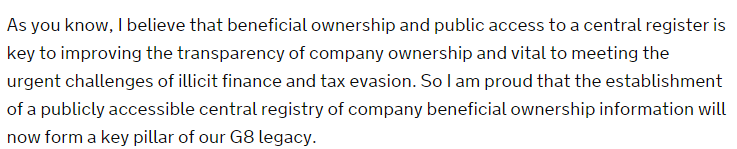
Well put. Sunlight is the best disinfectant. “Tax evasion and illicit finance” are scourges. They need to be addressed, and “urgently”. And transparency is “vital” to meeting to those challenges.

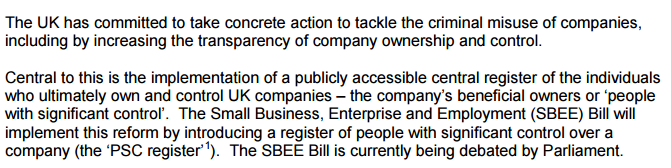
As a BIS paper produced under the Coalition put it (in respect of plans for our own registry):

Capture

And as Cameron reportedly said, speaking in Singapore this July:

Capture

Having made a world-leading commitment to tackle these issues you’d expect the Conservatives to remind us of it in the run up to the General Election. And, amid the febrile atmosphere surrounding the HSBC disclosures of thousands of wealthy tax evaders and one prosecution, they did. Cameron demanded that British Overseas Territories publish plans to create central register revealing companies’ ultimate owners by November. This month.

Of course, the General Election has now come and gone.

So how now press upon the Prime Minister the concerns that so troubled him then?

What’s happened?

In response to a written question from Margaret Hodge, James Duddridge, the Parliamentary Under-Secretary of State for Foreign and Commonwealth Affairs yesterday said this.

Capture

Or, in a word, nothing.

The UK does possess the power to force our tax havens to adopt this measure – at least that’s what an article in the highly respected New Law Journal concluded. It’s just a matter of political will. Which seems to be in rather shorter supply after the General Election than it was before it.

When, back in March, Cameron renewed his demands to the British Overseas Territories, the International Financial Centres Forum – a lobby group for British Overseas Territories – said the demands were “clearly politically driven given the timing.”

Sadly, events have shown it to be right.

Thanks to @davidtpegg for alerting me to the James Duddridge statement.


On EBTs and Rangers – Part 3

A lot of people are interested in the decision of the Court of Session in Advocate General of Scotland v Murray Group Holdings and others. A lot of people.

On the 8th of April, at the height of the 2015 General Election campaign, Ed Balls appeared on the Today programme on Radio 4 to launch Labour’s proposal to ‘abolish’ (as he put it) the non-dom rule. The real question was whether that measure would cost money or raise money. He cited a post on this blog in which I argued that such a measure might well raise £1bn. It was the only evidence he had. I spent the whole day in media studios talking about that £1bn figure.

As I write, that post on the key question around one of the highest profile policies announced in the General Election campaign, a post which has been ‘up’ for over seven months, has been read 6,911 times. And a post about a tax decision of the Court of Session ‘On EBT and Rangers FC – Pt 1‘ has been read 14,246 times. And it’s been up for six days.

Why is that?

***

Clearly, what is perceived to be at stake is the reputation of the club.

Did it “cheat”, as Alex Thompson and others have argued? Did the club’s directors, by trying to reduce its tax bill, imperil its claim to past titles? Did the club do anything ‘wrong’?

I could offer some answers to those questions.

But my views would be ill-informed: I have not followed the story. To offer them would be crass: I know nothing of Glasgow or its football culture. And my expertise is as a tax lawyer: I’m not a moral philosopher.

But what strikes me is this.

You won’t find the answers to those questions in the decision of the Court of the Session. You won’t find them in whether the liquidators decide to appeal that decision. Nor in a decision of the Supreme Court. Not one that overturns the decision of the Court of Session; and not one that upholds it.

You find the moral quality of an action only in its actors. At what they did at the time and why they did it. The man or woman who drafted the tax code knows nothing of morality. The administrator of BDO cares nothing for football titles. The judges in the Supreme Court seek only to apply the law.

And whatever the directors of Rangers FC lost for its fans, and for Scottish football, when they embarked on an attempt to avoid tax won’t be regained by a legal decision that they succeeded in that attempt. And nor will it be lost afresh by a decision that they failed.

Put shortly, the conduct of Rangers’ directors won’t be bad if the liquidators decide not to appeal. And good if the Supreme Court overturns the decision of the Court of Session. It is what is, either way.

***

I have campaigned against tax avoidance at some professional cost to myself: you can read about that here.

And I have taken steps to expose the dishonesty of a small number of my colleagues at the tax bar. You can read about that here.

But I have also recognised that a climate in which tax avoidance goes unchecked – and the use of EBTs was then commonplace – can encourage avoidance amongst those who would not otherwise contemplate it.

And that there are circumstances in which even the best informed can find it impossible to ascertain the likely attitude of HMRC to a transaction they are contemplating.

You’ll all have your views on which side of the moral line the conduct of the directors of Rangers falls. It’s not for me to try and change your minds.

Enough for me to identify the right question. Which has got nothing to do with tax law.

Note: I discussed, on Sportsound, last night many of the issues raised by this post. You can listen to the podcast, for a period of time, here.

Footballers and Film Schemes – today’s Sunday Times story

Today, over six pages, the Sunday Times has shown that a number of professional footballers face financial ruin because they participated in so-called film schemes.

If you were earning a lot of money during the late 90s and early 00s and had an IFA I can almost guarantee you would have been offered the opportunity to participate in a film scheme. They were sold – almost without exception – as opportunities for the wealthy to mitigate (less politely, cut) their tax bill.

It now looks as though film schemes will not deliver that result – although greater clarity will be brought to this question by a forthcoming Supreme Court appeal called Eclipse 35. (Transparency note: I am lead Counsel for Eclipse 35.)

I have a long standing, dual, interest in film schemes. First, I have been involved in litigating almost all – if not all – of them. Second, through a series of posts on this blog, I have written about the many interesting questions that they raise.

Writing here and here I sought to bring a more nuanced perspective to the question whether those who invest in film schemes are getting what they deserve. Writing here I examined the crowd-dynamic that lead so many to embark on tax avoidance schemes. I’ve also written on how you solve these problems here, here, here and elsewhere.

But the most important piece I have written is this one. In it I point the finger at a small group of real villains: some members of my own profession. I invite you to read it.

But the reason I write this morning is this.

I applaud the decision of the Sunday Times to give this story the prominence it deserves. The basic argument is that a number of footballers face financial ruin through no fault of their own. I have no doubt that that argument is right. And the story of working class kids who work hard and succeed as brilliant athlete or musicians but lose it all due to the actions of their advisers is familiar through the ages. But it continues to have a powerful resonance for me – and I suspect for many of you.

I have worked with the Sunday Times on this story, I am quoted in it, and I applaud it. But I do want to add an important postscript.

To focus on two financial advisers – named in the Sunday Times as David McKee and Kevin McMenamin – is to miss the broader story.

Tax barristers got rich through devising these schemes – and are not being held to account. I showed this here.

In that same post, I pointed out the promoters who devised these schemes may have made £100 million from a single idea. And although many of them may have been wound up, the individuals who ran them will have walked away with fortunes. It is very difficult to hold them to account as I pointed out here.

IFAs, too, have wound themselves up – and the individuals involved have walked away wealthy.

And Government too has achieved its policy objectives.

Capture

(that’s an extract from this Decision). The very films Government sought to encourage were made – but Government has (in some cases at least) refused to honour its side of the clear and explicit bargain it struck with investors. I have explored this theme in more detail here.

So it’s not just David McKee and Kevin McMenamin – about whom I know nothing beyond that which is reported in the Sunday Times – whose conduct is amenable of criticism. Everyone involved – those who created the environment for these schemes, those who devised them, advised on them, administered them, and sold them – bears a share of the blame.

And they also share responsibility for the plight of the victims at the bottom.

I’ve tried in leaden-footed legalese to express this sentiment.

But don’t waste your time. Listen instead to Dylan on Who Killed Davey Moore.

On EBTs and Rangers FC – Part 2

Writing here, I explained how Employee Benefits Trust work and why they were used for tax planning.

But I also promised to try and explain why the decision of the Court of Session in the Rangers case seems to me to be wrong. And to look at what happens next.

But first, let me repeat my warning from Part 1:

If you’re a tax specialist you’ll also need to make allowances for the fact that this piece isn’t written for you. I make no apologies for not capturing in these posts the full technical detail around Employee Benefits Trusts.

***

As I said in Part 1, to have a liability to pay income tax you need to have something that is “income” – but you also need to “get” that thing. If you work hard for three years and your employer pays you a bonus in year three because of all of that work do you have a liability to pay income tax in year one? There is income from that year, after all?

I give you this example because what I think the Court of Session has got wrong, in summary, is to focus too much on the income and too little on the getting.

But let me take it a bit more slowly.

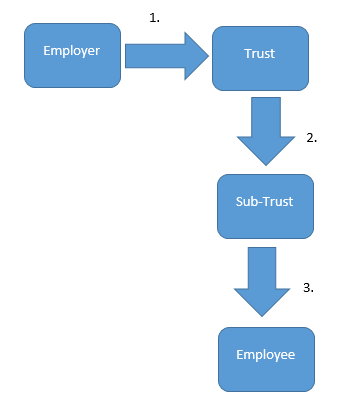
You might think about the Rangers transaction as looking a little like this. (And sorry for my home-made diagram. You need to make allowances for us lawyers.)

Capture

What happens at 1 is that the employer gives money to the trust – think of it as a big pot – for all employees. At 2 the trust gives money to the sub-trust – a smaller pot – for a particular employee and his family. And at 3 the sub-trust lends the money to the employee.

So when does the employee “get” the income? When does he have a liability to pay income tax?

Of course he gets his hands on the cash at 3. But all the courts so far have held that what he has is a loan of the money – which he may need to repay.

And at 2 the money is passed to the sub-trust for the benefit of the employee and his family. But all the courts so far have held that the employee hasn’t got it – because the trust might decide to give it to someone else – for example his daughter – instead.

Now everyone involved kind of knew the money would just flow straight through from employer to trust to sub-trust to employee. And the loans don’t look the same as a loan you might take from a bank – no-one’s been demanding that the loans should be repaid. So you might feel that what the courts have held doesn’t have much reality to it. But as I said on Good Morning Scotland, the law isn’t always about common-sense.

And what’s more important now is that they’re not conclusions a judge can overturn on an appeal.

So what about at 1? Might there be a payment there? Because the new argument HMRC advanced before the Court of Session was that the employees got the income at 1.

But how, you might ask, could they have got it at 1 if they didn’t get it at 2? Isn’t it odd that at 1 it could have been given to any employee but at 2 it could only have been given to the employee or his family? How could it be the employee’s income at 1 if it wasn’t at 2?

Well, the answer the Court of Session gave was this.

You can satisfy the “getting” bit of the test for a liability for income tax in two ways. You can satisfy it if you get the money yourself. Or you can satisfy it if you agree that it should be paid to someone else.

There’s definitely something to this argument as a matter of principle.

Think about it this way. Most of you won’t receive your wages through some complex EBT structure. Most of you will receive them directly from your employer. And you couldn’t avoid income tax on them by agreeing that they should be paid into your daughter’s bank account rather than your own.

And what the Court of Session said had happened here was, in effect, that the employees had agreed that they should be paid into the EBT (at 1) rather than to them. And by agreeing, they had satisfied the requirement that they “get” the income.

But, although that might be right in principle I have some problems with the practice.

The first is that the Court of Session seems to me to see the “getting” requirement as a problem to be solved rather than a key part of the question. And I think this may have led it to the second and third problems.

The second is that the Court of Session is not terribly clear – or not terribly clear to me, at any rate – about where you can find the agreement that someone else should be paid the income.

But I should also make this point. There were two different types of arrangement before the Court of Session: one for footballers and one for managers. And this criticism I have advanced of the Decision may be stronger for managers than for footballers. Because footballers did enter into an agreement (called a side-letter) when they signed with Rangers in which they seem to have agreed that payments should be made to an EBT rather than to them. But Managers didn’t sign an agreement – although they too were found by the Court of Session to have agreed.

The third is that we are taxed on our actual pay – and not on what we might have been paid had we negotiated a different package with our employer. We are free (at least if we do it right) to agree with our employer a package that involves us getting less stuff that does give rise to a tax liability (for example, pay) and more stuff that doesn’t give rise to a tax liability (for example, child-care vouchers or pension contributions). And if we make that choice then we pay (the lower) tax on our actual pay package rather than (the higher) tax on what we might have negotiated. I’m not sure that the Court of Session fully appreciates this.

***

It’s not easy for an outsider – like me – to look at a case and say what the answer should be. The answer is often quite sensitive to the facts. The advocates arguing the case – and the judge or judges hearing it – know those facts better than the outsider does. And that’s a particular problem in this case. I’m not sure why – perhaps it’s because the Court of Session decided the case on an entirely new argument – but the facts relevant to this new argument are not terribly clear from the Decision.

So, although I stand by the problems I have set out above with the Decision, it is perfectly possible that my analysis is wrong. You know this, of course. But it’s important that I say it.

***

But actually my views are not nearly as important as what happens next.

If there is an appeal to the Supreme Court either I will be proved wrong or I will be proved right. And whatever my view is now will be irrelevant.

And if there isn’t an appeal to the Supreme Court then the fact I think the Decision is wrong will also be irrelevant – because it will remain the Decision. And no-one will care if someone somewhere (me, for example) thinks it’s wrong.

So will there be an appeal?

I don’t want to speculate about the financial position of whoever’s running the litigation. There are other people around who are better informed than me on that subject.

But if there is money to fund it I’m pretty sure there will be an appeal. It would be an odd decision to stop at your first loss, having won twice. That’s especially true where you’ve lost on a ‘new’ point. And it’s especially, especially true where that new point is controversial. I can put my hand on my heart and say that all of the tax professionals I have spoken to about the Decision find it difficult to see how it can be right. They might all be wrong – but that sort of sentiment towards the Decision is absolutely going to encourage rather than discourage an appeal.

***

Thanks for sticking with me this far. Even I know that tax is less fun than football.

Capture

I know it now, anyway. So I appreciate you sticking around. And I’ve enjoyed engaging with many of you on twitter.

Please come back for Part 3 where I’m going to talk about what I find particularly interesting about this case. Which is what I think it tells us about who the real winners and the real losers are from this kind of tax avoidance.

On EBTs and Rangers FC – Part 1

A day or so ago, I gave an interview to BBC Radio Scotland.

For a while, at least, you can listen to that interview here (at about one hour and 36 minutes in). It’s not a particularly fluent interview – but it does have one merit. I express a clear view about the decision the Court of Session gave earlier this week in the Rangers case. I say that it was wrong. That’s my view at least and I’m a Queen’s Counsel specialising in the field of tax. Although that fact doesn’t make me right, it does make my view worth listening to.

After I gave that interview, I was asked whether I wanted to write about the Decision. My immediate reaction was that I didn’t. Analysing what cases mean – and whether they are rightly decided – is part of what I do for a living. What I do on this blog I do for other reasons.

But I hadn’t anticipated the level of interest in my views. And the need many Rangers fans have to understand what happened to their club. And the sense of loss that – or so from many hundreds of miles south it seems to me – many feel at having had part of their identity somehow taken away or diminished. And then I remembered that I had started writing this blog because I wanted to improve understanding of the field in which I work. And that the Rangers case was one where there was a huge demand for better understanding.

And so I changed my mind.

In a second I’ll tell you what I’ve decided to do. But before I say anything more, I need to tell you two things.

The first is that I don’t have any connection to Rangers or its equally proud rival, Celtic. I am not Scottish. I am not religious. And although I continue to follow Sunderland AFC – that being the team local to the pit village where my grandfather, Dennis, grew up – I can’t even decently pretend to be a serious football fan.

The second is that, as I point out here, I do work in many of the areas I cover in my blog. And I do work in the field of Employee Benefits Trusts. I think that the only difference this makes is that it gives me a good understanding of the area. I know I’m not the sort of person who would feed you a line because it was convenient to my clients for me to do so. I know that, as I’ve explained here, my record demonstrates that that’s not what I do. But none of that changes the fact that you’re entitled to know when you read what follows that I am doing some – not much but some – work in the field of Employee Benefit Trusts.

***

What I decided I would do is this.

I would write three pieces.

The first on why people use Employee Benefits Trusts; the second on why I think the Decision of the Court of Session is wrong and what happens next; and the third on what we can learn about the effects of tax avoidance from this sad tale.

And I would write them for those who most need them: the fans of Rangers. And because tax is difficult, I’d try and go slowly. I’d like the third piece to get more readers than the first – I think it will be the most interesting – and to do that I’d need not to lose readers along the way.

I haven’t followed the Rangers story especially closely – as I say, I don’t have any connection to the club – so please make allowances for that fact. I don’t think that will affect my ability to carry out the task I’ve set myself – but please bear it in mind if you think I’m getting something wrong.

If you’re a tax specialist you’ll also need to make allowances for the fact that this piece isn’t written for you. I make no apologies for not capturing in these posts the full technical detail around Employee Benefits Trusts.

***

To understand Employee Benefits Trusts you need to start by understanding income tax.

To acquire a liability to pay income tax two things need to happen: the first is that you need to “get” a sum of money and the second is that that sum of money needs to be “income”.

If you do “get” “income” you’ll have to pay income tax on it. And that income tax will reduce the amount of money you have available in your hand to spend.

***

I’m not going to write a long essay on what “income” is here. It’s enough for me to point out that the money that you get from the work you do as an employee is your income.

The interesting bit – for my purposes here at least – is around the “getting”.

Dennis’ wife, my grandmother Joan, had eight grandchildren. As each of us was born, she opened a new savings account and every week she paid money in. Not much: she didn’t work and although Dennis had not followed his brothers down the pit he wasn’t earning a fortune working as an electrician. But something: and as we turned 18 she handed the savings book over to us.

Before I turned 18, the money wasn’t mine. Even though she absolutely knew that she was going to give it to me – and I knew she was too because she’d told me she was saving money for me – it was still hers. But when I turned 18 and she gave me the savings book with the entries all written in in hand (I remember this because the adding up on the final entry was wrong and the handwritten notes showed a new balance rather higher than the amount Joan had paid in and I spent many happy hours wondering whether the bank might hand over that extra. Reader, I was disappointed) and I could take the money out and spend it or give it away… Then it was mine: I’d got it.

***

Employee Benefits Trusts are a bit like that savings account. They are a way that employers earmark money to pay to their employees in the future.

A lawyer will tell you that once the employer has paid the money into the Employee Benefits Trust it doesn’t belong to the employer anymore. But it doesn’t belong to the employee either. It belongs to the trustees who hold on to it until they decide who – which of the beneficiaries of the trust – they are going to give it to.

Accountants take a different view. When they draw up the employer’s accounts they ask who really owns the money. If the employer can use that money to meet its future obligation to pay its employees then they treat it just like Joan’s bank accounts. It’s one of the employer’s assets.

But if control over the money has already been passed over to the employee – if Joan has given me the savings book – then it’s treated just like a payment by the employer of wages. The employer can deduct that money from its income in calculating its profit.

And that’s rather good news for the employer. Because by making that deduction the employer gets to reduce the amount he or she has to pay to the tax man.

***

So the employer wants to hand control of the money over to the employee to reduce the employer’s tax bill.

But what about the employee?

He’d like to – she’d like to – have control of that money too. To spend it. But ideally without having to pay income tax on it. Ideally getting in his or her hand all of the money in the trust.

And because the employer benefits from keeping the employee happy – because a footballer employee who had less in his hand than he wants might otherwise decide he’s going to go play for another club – the employer has a good reason to help the employee get control of that money without having to pay tax on it.

***

So the magic of Employee Benefits Trusts from an employer’s point of view is that they enable the employer to reduce the amount of tax it has to pay to the taxman. And they enable the employer to keep his employees happy.

But only if they work.


How many people has HMRC prosecuted for offshore evasion?

There’s a new report of the Public Accounts Committee out today. You can read it here.

Under its new Chair, Meg Hillier, it continues with many of the themes developed under her predecessor Margaret Hodge. It slams HMRC’s management of tax expenditures (a subject I tackled only a few days ago here and to which I expect to return in the coming days and weeks); it characterises as “unacceptable” HMRC’s customer service; and makes a number of detailed criticisms of how HMRC reports its progress on tackling tax avoidance and evasion.

What I want – briefly, for the point won’t take long – to focus on is some clarity the Report finally delivers on what HMRC has actually done to tackle offshore tax evasion by the wealthy. This has been a particular bug-bear of mine: I wrote a number of times on the issue in the early Spring culminating with this. And the new PAC report very much franks my analysis stating, starkly:

HMRC’s investigations do not lead to sufficient prosecutions to provide an effective deterrent, particularly for wealthy individuals who hide their assets offshore.

It then sets out this startling statistic:

Capture

That’s right, eleven in the last five years.

For scale, we know that the HSBC disclosures led to HMRC becoming aware of the names of 3,600 potential evaders – and in consequence HMRC “encouraged” 500 people to take advantage of the Liechtenstein Amnesty. Offshore tax evasion really has been, as Margaret Hodge put it,  “a risk worth taking” (see Question 102 here).

But worse even than that is what that number – eleven in five years – reveals about HMRC’s attitude to public reporting.

Back at the height of the furore around HMRC’s handling of the HSBC data – and in the run up to a General Election where it was a key political issue – HMRC released this document, entitled: ‘Statement by HMRC on tax evasion and the HSBC Suisse data leak.’

At the time, I was deeply sceptical of some of claims made in that document. I said:

What we know is that in a document designed to defend its record of achieving criminal convictions in tax evasion and the HSBC Suisse tax leaks – that being its title – HMRC is relying on convictions it has achieved in benefit fraud cases.

And that conclusion too is franked by this morning’s PAC report.

Here’s an extract from HMRC’s 2014 annual report on tackling offshore evasion: ‘No Safe Havens.’ And at page 11 it contains this table:

Capture

revealing 2,962 actual and prospective charging decisions.

Did only 11 of those lead to convictions? No. We can now conclude that by including that table – which includes charging decisions for such matters as wrongfully claiming tax credits – HMRC set out to mislead you as to its success in tackling offshore tax evasion. Not lying – because the document does not explicitly state that those are charging decisions in relation to offshore evasion – but an attempt to mislead.

That’s a serious charge – so don’t take my word for it. Have a look at that table and the context in which it appears. Look at the document and at the page. It appears in a document about offshore tax evasion. As the screen-grab above shows, it appears at the end of a paragraph talking about offshore tax evasion. Nowhere I can see in that document is it made clear that that table has nothing to do with offshore evasion.

***

There is some evidence that the Government is at long last taking tax evasion seriously. You can see here a series of consultation papers on new civil and criminal matters. Let’s hope those measures are delivered. Let’s hope they are utilised by HMRC. Let’s hope they work. Because the Coalition Government and HMRC’s response to offshore tax evasion by the wealthy was a disgrace.