Tax in a Cold Fiscal Climate

The following is my contribution to last night’s ICAEW Wyman Symposium.

I am a Queen’s Counsel. You would, therefore, be surprised were I to begin otherwise than with some flamboyant – and on analysis rather tenuous – display of my qualities as Renaissance Man. And not merely surprised. You would leave this evening with that most acute of disappointments: the disappointment of an unmet expectation.

Fear you not.

I take my theme tonight from Orwell’s ‘Keep the Aspidistra Flying’. “There are,” he wrote:

“so many pairs of lovers in London with ‘nowhere to go’: only the streets and the parks, where there is no privacy and it is always cold. It is not easy to make love in a cold climate when you have no money.”

That in a sense is the background against which we all speak before you today: how HMRC should collect tax in a cold fiscal climate.

Some statistics.

In 2005 HMRC had 96,000 FTE staff. By July of last year this had fallen below 60,000.

In 2005-06 the outturn sum spent on HMRC Administration was £3.7bn. In the Annual Report and Accounts for 2013-14 it was expected that £3.1bn would be spent. The cut in real terms will have been larger still. On 4 June 2015 the Chancellor announced a further £80m cut – with more in store.

As a profession we might – indeed we do – complain about this. I could join in that chorus. But the ICAEW has not invited me here to make political points. Nancy Mitford took that line ‘love in a cold climate’ as the title for a novel. In that novel she wrote:

“The worst of being a Communist is the parties you may go to are – well – awfully funny and touching but not very gay… Left-wing people are always sad because they mind dreadfully about their causes, and the causes are always going so badly.”

Let me take her message to heart. I will not ruin the esprit of the evening by minding dreadfully about the cause of better resourcing for HMRC. And let me urge you, too, to eschew that course – at least for the next five minutes. Let me invite you, instead, to consider how HMRC should exercise its powers of care and management in a cold fiscal climate.

You have heard vigorous complaint of legislative measures adopted by successive Governments to tackle avoidance DOTAS, the GAAR, APNs, FNs, POTAS and so on. Let me give you some data. Direct Tax DOTAS disclosures fell from 503 in the first financial year of DOTAS to fewer than 10 in the six months ending September 2014. VAT disclosures fell from 680 to fewer than 5 in the same period.

In a cold fiscal climate these legislative measures have helped stop (disclosable) tax avoidance. “Helped,” because the courts, too, have put their shoulders to the wheel. As I rather shyly put it elsewhere, judges hearing avoidance cases in recent times have “occasionally articulated their instinct to fairness against the grain of the legislation.”

That decline in DOTAS disclosures largely pre-dated the changes in the Finance Act 2014 that so fundamentally altered the economics of tax planning going forward. But those Finance Act measures enabled the collection of a projected £7bn of tax avoidance fruits.

If it is to be said that we might have tackled tax avoidance – and enabled the collection of these enormous sums of money – without those measures and with lower levels of resource then I’d like to hear ‘how’. Because the public, to whom politicians are accountable, have demanded action, and the Coalition Government, on avoidance at least, delivered substantial advances. How else might they have been delivered? Sensible public accountability is much of what a Government exists to provide.

I have touched on avoidance but the challenge going forward will lie in tackling evasion. If you add together in the Tax Gap figures those for criminality, evasion and the shadow economy you get north of £15bn. And the Coalition Government announced shortly before the election that it would consult on and introduce a number of measures to close that gap.

Those measures will include, in particular, a strict liability offence for offshore tax evasion. We have yet to see the detail of that offence but (subject to two provisos) it is something I think we should support. I would like to see a de minimis threshold and a defence of taking advice from an appropriately qualified advisor.

Experiences such as the failed Harry Redknapp prosecution have left HMRC scarred – and institutionally disinclined to prosecute complex tax evasion. It is clearly not in the public interest that there should be effective impunity for well-resourced defendants.

There has been a lot of debate around whether HMRC should target a more vigorous criminal prosecutions policy. HMRC’s job, it is said, is to maximise yield and not to bring prosecutions.

I regard, I have to say, that argument as wrong-headed for a number of reasons.

The argument that chasing criminal prosecutions jeopardises yield draws on the fact that the threat of criminal prosecution will dissuade today’s evaders from coming forward. There is something to that. But what it ignores is that delivering immunity from prosecution to today’s evaders sends a counter-productive signal to today’s compliant taxpayers. “Why should I pay,” they may well ask, “when my neighbour who doesn’t pay suffers no sanction.” The argument for generous amnesties seeks to solve today’s problem – at the price of creating a new one for tomorrow. It just kicks the can down the road.

It is also misleading to say it is HMRC’s job to maximise yield. HMRC’s job is to provide careful stewardship of the tax system. There is no legal authority for the proposition that HMRC would be acting inappropriately if it chose to prioritise criminal prosecutions to encourage future compliance. And – and here I do draw myself up to my full Silken height – there is no conceivable world in which a Judge might criticise HMRC for taking that step.

Finally, of course, there is room for guarded optimism that the world is changing to improve HMRC’s sightlines between tax evaders and their undeclared income. The Common Reporting Standard will further undermine the argument that the UK has no choice but to offer sweetheart deals to tax evaders otherwise we’d never get any of their unpaid taxes. That argument has always struck me as confused: if we really have no prospect of catching the evaders then what could an amnesty deliver? Why would they volunteer?

So I say a combination of better sightlines and meaningful sanctions – a strict liability offence – may restore dignity to civil servants given the difficult job of defending flawed policy choices made by their predecessors. That combination will provide an impetus to disclose.

A few short observations to finish.

First, advocates are inclined to focus on high legal principles. We like to deal in absolutes. But let me tell you a secret. Our sources of constitutional law are alive. Our Judges use them to help mediate between the competing demands of the contemporary body politic and that which we say we hold sacred. But Judges will always interrogate for signs of common sense an advocate’s appeals to that which she says is sacred. And when you make up your minds about what you’ve heard tonight so should you.

Second, I sound a note to judges. Collecting tax in a cold fiscal climate requires an expansion of HMRC powers – that’s been my theme for the evening. But as more executive power flows to HMRC the demands on Tax Judges to moderate that power grow too. Personally, I’d like a strong sense of that from the specialist judiciary.

Third, resources. I promised I wasn’t going to spoil the party by “minding dreadfully about my causes” but there are problems that legislation can’t solve. How will we legislate to stop tobacco smuggling, which costs £1.6bn per annum? The Conservatives promised to bring in a further £5bn from tax avoidance and evasion. Few in this room would advise any client of yours who had ambitious revenue targets to begin by cutting the sales force.

Finally, HMRC. It is critical that the Department maintain or recover something that many people in this room will think has been lost. We will all readily be able to conjure examples of HMRC taking points that it shouldn’t. This stems, in my opinion, from an incipient culture taking hold that HMRC’s job is indiscriminately to maximise revenues. That is fundamentally to misapprehend its job. Whenever HMRC issues an Extra Statutory Concession it recognises that there is some equity in tax. Reigning back that culture is a matter of departmental leadership. I do hope we will now see that leadership.

Age related biases in the tax system

The observation “No good deed goes unpunished” is usually credited to Oscar Wilde. But he took his inspiration from Aeschylus and Prometheus Unbound. Back in 2012 the Chancellor defied them both:

Capture

Budget forecasts revealed that this “simplification” of the tax system stood to raise £3.3bn. (Those few who were, sober, at the CIOT dinner last week will remember the warning to beware Chancellors bearing tax simplification gifts). But, quietly, this tax year the general personal allowance caught up with the age related personal allowance for over 65s (£10,500). Next year, assuming the Conservatives press ahead with their manifesto pledge to raise personal allowances to £12,500 over the life of the Parliament, it will catch up with that for over 75s (£10,660). And that bit of the income tax code that we call “income tax” will discriminate less against the young on the grounds of their age. Less, because we will still have the “married couple’s allowance” – worth between £322 and £835 a year – and one or two other quirks.

But that bit of the income tax code that we call National Insurance Contributions will continue to discriminate. And profoundly. Once you’re over the state pension age, your employer no longer deducts NICs from your earnings. Compare the rate of tax on earned income paid by an employee over state pension age with that paid by a worker under that age (in parentheses) in the present tax year:

0-£8,060 0 (0)

£8,060-£10,600 0% (12%)

£10,600-£42,380 20% (32%)

£42,380-£150,000 40% (42%)

£150,000+ 45% (47%) [1]

So someone above state pension age earning £50,000 per annum would take home £40,596 whereas someone below state pension age would take home £36,325 per annum.

Can this difference be justified?

Certainly not on the ground that National Insurance Contributions are the means by which you pay for your state pension so that once you’ve paid for it you can stop contributing. True it is that to receive the full basic state pension you have to pay NICs for 30 years. But NICs don’t fund the state pension; paying them for more than 30 years doesn’t increase your entitlement; and nor does paying more of them during those 30 years. Moreover, the employed can pay, retrospectively, for missed years for £14.10 a week – and the self-employed for £2.80 a week.

If logic does not dictate that you stop once you’ve qualified, why should it dictate that you stop once you hit state pension age?

It can’t be justified, either, on the grounds that it is necessary to equalise post-tax incomes between generations.

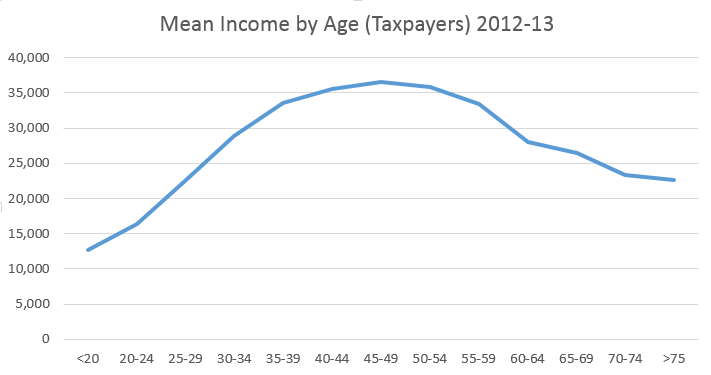
As the chart below reveals (drawn from this data), different levels of taxation merely exacerbate the income advantage enjoyed by the old over the young.

Capture

Moreover growth in pensioners’ incomes has far outstripped that of those of the rest of the population. According to the ONS:

Capture

Other potential justifications? I am fresh out, I am afraid.

Following the Chancellor’s 2012 announcement there was a little pecking at his liver. Ros Altmann, then Director General of Saga but now Baroness Altmann of Tottenham and Pensions Minister, described freezing age-related pensions announcements as an ‘outrageous assault on decent middle-class pensioners’. But, as this chart from Liam Byrne via House of Commons Library/IPSOS MORI shows, the Government escaped meaningful punishment.CaptureA further good deed the Chancellor might do on 8 July would be to abolish the NICs exemption for those above the state pension age. Or he might – as with the married couples allowance – restrict future entitlement to it to those presently entitled to it: if you don’t get it now, you won’t get it in the future.

That would be an undoubted good deed. And, like the Granny Tax, it’s early enough in the electoral cycle for it to go unpunished.

[I have edited this piece to remove a speculation as to the potential cost of such a measure].

My address to the Chartered Institute of Tax

Can I begin by sympathising with the organisers of this evening’s dinner?

They had high hopes of the after dinner speech being delivered by a senior member of the Government. Someone who could speak frankly and with authority about the pressing tax issues of the day. Shortly in advance of the first budget of a new Government. They had those hopes and – if it consoles them – I had those hopes too. I know it’s heresy to blame the electorate – but it is their votes (a mere 2 million of them) that stood between you and a much more interesting after dinner speech.

But the organisers must muddle on. And so must I.

The hysteria around tax towards the end of the election campaign will be fresh in all of our minds. In a rather poor Channel 4 story, the sins of his father were visited upon David Cameron. As, indeed, the sins of her forebears were visited on Margaret Hodge. And Ed Miliband. ‘What is to be done?’ was the question I heard asked time and again by thoughtful professionals – like you. And my answer was invariably that which Jack Nicholson gave at the end of his best film: “Forget it, Jake. It’s Chinatown.”

It was Chinatown then. But is it Chinatown now?

A number of things have changed. Margaret Hodge has gone, for one. More meaningfully, the election campaign is over. And those rather silly stories do seem… rather silly. I was asked a week or so ago to comment on a tax avoidance story by a leading Conservative politician – one of the really big names – and by a leading broadcaster too but I said I didn’t want to be involved.

So things have calmed down. But I don’t think they will return to where they once were. It’s as well to remember that “The more things change the more they remain the same.” That line is often attributed to the 19th French journalist Alphonse Karr. But modern audiences will credit the late 20th century librettist Jon Bon Jovi. But those who fritter away their one and only life rowing with strangers on Twitter – where’s Stephen Herring? Strangers and friends – will know that tax continues to form a central thread in a continuing political narrative around inequality.

That narrative isn’t going away. And so we should expect continuing media interest in our field. Not at the feverish pitch we’ve seen recently. But not absent either.

So how do we, as a profession, participate in the debate? That’s what I want to talk about this evening.

There are a lot of different debates.

There’s a debate about political involvement in our tax system. “Those bloody politicians,” you will hear said, “they’re ignorant and they make bad law. We need to help them get better.” You may hear that said. Some of you will even have said it. And there’s a debate about us as a profession – what moral component is there to our actions in offering tax advice? And should regulatory oversight of our profession increase? There’s a debate about whether there’s any place for morality in tax.

How do we participate in that debate? Let’s start by looking at the first one – about tax and politics.

Let me take an example. Last week the IFS and CIOT ran a joint event to try and identify some tax policy priorities for the new Government. One of the issues – a perennial – that came up was about merging National Insurance Contributions and income tax. The proponent (this time) was Gavin Kelly, he’s the Chief Executive of the Resolution Foundation. If you don’t know it, the Resolution Foundation is a hugely impressive charity that examines the evidence around, in particular, in-work poverty.

Gavin Kelly joined representatives of the Taxpayers Alliance, the Institute of Fiscal Studies, the (Thatcherite) Centre for Policy Studies, PWC, the Centre Forum (a liberal think tank), Judith Freedman, UKIP – I could go on – in making that call. That’s a pretty broad church. And who here thinks it would be a good idea? They are after all both income taxes.

It would mean that (at least) five significant curiosities would be brought to light.

  • It would expose a not terribly progressive tax system: once you include primary and secondary NICs, income tax starts (for the employed) at over 40% on income above £10,600. And it rises to more than 53% – even ignoring the 100-120k anomaly.
  • It would expose the bias in favour of unearned income (which doesn’t suffer NICs).
  • It would expose differing rates of tax for the employed and self-employed: sometimes differing by more than 11%.
  • It would reveal that raising the income tax personal allowance doesn’t actually help the poorest.
  • And it would demonstrate that we pay really quite high rates of income tax.

How would Government address the fall-out from each of these curiosities? Would it live with a single income tax that evidenced them? If not, how would it alleviate them? What would the costs be? Let’s just look at those curiosities in a little more detail.

  • A not terribly progressive tax system? Would the Government reduce the basic rate of tax? (It’s difficult to see it pushing up the higher rate or the additional rate.) What would be the cost of this reduction? Might it be a spur for adopting a flat tax?
  • A bias in favour of unearned income. How would living with this bias play with an electorate that already tagged the Conservatives – unfairly or fairly – as being the party of the rich? Could the Government increase income tax on unearned income without sledge-hammering the five year tax lock? If it could, would this play in the City: how would it be received by the very wealthy who already pay a huge proportion of our aggregate income tax take? Would it drive them to leave the country?
  • What about differing rates of tax for the employed and self-employed? This is an enormously vexed question. There are those who say the difference is not justified – and that it simply leads to people gaming the system by entering into contracts of self-employment in circumstances that look more naturally like employment. And sometimes they are right to say so. There are others who say we need to reward risk taking. And there’s a very compelling school of thought that, but for the flexibility of the UK labour market, the country would not have enjoyed the huge decline in unemployment that we have seen. What would requiring all of those individuals to be treated and taxed as employees do for the labour market? This is a huge question, which Government would need to grapple with before it could contemplate merging the two income taxes.
  • What about the effects of raising the personal allowance? The Government has promised to raise the personal allowance to £12,500 by the end of this Parliament. But tax at a rate of 20% would still be paid on the employment income of those earning around £8,000. This Government wouldn’t be the first to adopt the politically attractive route of cutting the headline rate and recouping the cost of those cuts in the detail. And it won’t be the last. But raising the NICs floor so it matches the income tax floor would be another hugely expensive commitment. Will Government tackle it? It’s not impossible to imagine it might – but certainly not in order to deliver the technical win of unifying the two taxes.
  • And, finally, the very high rates of income tax that we pay. People might be shocked to hear that employment income above £10,600 bears an effective tax rate of over 40%. One can see that shock as being enormously politically helpful to a party that believes in a smaller state. So there is an argument in favour of merging the two taxes. It would absolutely be a helpful stepping stone on that path. But, gosh, this Government has some rather uncomfortable shoes to don before it takes that first step.

So. Look at the world through Government’s eyes. All things being equal, it would undoubtedly prefer to simplify the tax system. No serious doubt about that. But unless we face up to these anomalies. We’re asking it to invest rather a lot of political capital in a tidying up exercise. And that’s even before we look at what a merger would mean for pensioners.

“Ah!” you may say, “But politicians do tidy up the tax system.” But let’s look at the evidence.

Take, by way of example, the Autumn Statement changes to the slab system for SDLT. They were sold to the press as “reforms that aim to address the distortions of the old system” (that’s the Financial Times). Or a “scrapping of the much hated ‘slab’ system in which stamp duty bills rocketed as soon as the price hit a new threshold” (the Daily Mail).

But, of course, if they were really about removing the slab system, why were they structured in such a way that they cost £800m per annum? There’s no reason why reform of the the slab system could not have been accomplished in a revenue neutral manner. £800m is a pretty chunky sum – 2/3rds of what Labour claimed the Mansion Tax would raise. So there were obviously some other policy objectives that were being met at the same time. Policy objectives that it might have been expedient to hide behind a story about merely rationalising a bonkers tax.

When we look at the pure tidying up exercises have been done over the last few years – we have the Tax Law Rewrite project; we have the work of the OTS; but (with great respect to the extremely talented people engaged in each of those projects) they are real tidying up exercises which haven’t really faced these huge political challenges.

So the more interesting question then becomes, how do we as a profession work to achieve that change? If we want this change, how do we de-risk it for Government? Because that’s what has to happen to achieve the technical change that we (as a purely politically neutral profession, of course) want.

And that is where we can come in. Because, so long as the public doesn’t know of these anomalies a merger of the two income taxes carries political risk. So I see a role for us in pointing out these consequences – explaining them to the public through the media. Working to improve transparency.  I should also add that any discussion about what tax changes Government should make that doesn’t condescend to look at the political consequences of making that change runs the risk of being a wasted discussion.

Let me turn to a further debate in the media. About the moral content of our actions as a profession.

Now, we’ve all seen advice about the prospects of some piece of tax planning working. With the benefit of hind-sight, some of the advice we’ve seen might look a little optimistic. Indeed, with the benefit of hindsight, some of the advice we’ve given might seem a little optimistic. But it’s a small group of advisers only who haven’t been interested in the quality of that advice – and who have given unjustifiably positive advice for money. Vanishingly small if you look at the tax profession as a whole. So let’s leave them aside.

What about the work that the rest of us do? Do we have a role to act as moral overseer to our clients? I find that a rather difficult proposition. Here’s some things I can readily accept – and let me make explicit this is my personal view. You may well have – and you are clearly entitled to have – a different view.

We have a duty to help our clients transact at the point on the risk spectrum that works for them. So if an idea works by delivering a result that the draftsman can’t have intended I think we have to tell our client that the transaction is counter-purposive. If a transaction achieves a result that we think the draftsman intended but it achieves this through taking steps that serve no commercial purpose, I think we have to tell our clients that the transaction is artificial.

There are a number of reasons why I think we have to do this. One is that these features will have an impact on the propensity of a court or tribunal to accept that the planning delivers the desired outcome. In my experience, if a transaction has these features it is less likely to work. Another is that I think we have to help our clients make an informed decision: informed with regard to its reputational risk for them, with regard to its relationship with HMRC, its impact on their senior staff, its potential to impact on their pre-tax profitability. And so on.

But I don’t find myself able to go further and say it’s morally wrong of our profession to advise a client who wants to engage in an anti-purposive or artificial transaction, a client who’s properly informed. Just like it’s not morally wrong for a journalist to write a silly story about tax avoidance because that’s what his or her editor has asked for. The moral agent is the client or the editor – it’s his or her moral call.

Nevertheless, it is the profession that gets tarred. So here’s what we do:

  • we don’t deny there’s tax avoidance. If we do then we are taking on the moral taint of our clients. It’s commercially tempting – but it brings the profession into disrepute.
  • we make sure our professional conduct rules are fit for purpose. This is what we’re being encouraged to do by the Government – reasonably so, I think – and I think there’s more to be done here. I’ll come on to talk about what this looks like. If we don’t, we risk having them imposed on us from above.
  • we listen and engage with public concern rather than just badging the public as ignorant. I’ve never been persuaded of anything by being told I’m ignorant. Even if I am. Perhaps especially if I am.

A couple of asides: first, I do understand that some (possibly many) of you won’t accept there’s any morality in tax. In other words that there’s a perfect alignment between tax law and morality: the fact that something is legal makes it moral. You will appreciate I don’t agree. But perhaps more importantly, I don’t think it’s a winnable argument with the public. It’s the equivalent of shouting at the telly – it may make you feel better but you should proceed from the premise you will accomplish no more than short term relief.

Second, I accept that between the plainly anti-purposive (or artificial) and the plainly pro-purposive there is a huge spectrum. That raises an additional layer of complexity that I haven’t addressed.

I just want to finish with some remarks about professional regulatory regimes.

Shortly before the election the Government said this:

HMRC “is asking the regulatory bodies who police professional standards to take on a greater lead and responsibility in setting and enforcing clear professional standards around the facilitation and promotion of avoidance.”

The response from the profession has been mixed.

The ICAEW responded:

“ICAEW already has a Professional Code of Conduct in relation to tax advice, which is revisited and updated on a regular basis. We are keen to work with Government to ensure that the code continues to be fit for purpose and retains public and political confidence.”

And reading between the lines that means: we’re not quite sure what more you want of us. And it might well be that, reading between the lines of the Government statement, they’re not quite sure either.

The CIOT and ATT issued a joint statement saying much the same – but over slightly more paragraphs. I haven’t been able to find any response from the ACCA, the BSB or the SRA.

Roll back the clock a little. With the help of the profession I drafted some Badges of Tax Risk: a series of questions I envisaged clients might ask of their advisers to satisfy themselves that they understood the advice they were getting. It is a very common complaint of individual taxpayers who engage in transactions that don’t work that they didn’t understand the advice they were getting. And sometimes that complaint is justified.

What then happened was that an influential member of one of the professional bodies suggested that it might become a regulatory requirement for members to go through those badges – or a variant on them – with clients before offering tax advice. That was all in the Autumn of last year. I’m not sure what then happened – but it might be an idea worth revisiting.

The reason – a reason – I bring that up in this context is that it then creates a narrative of what our profession does that we can take to the public. Skeletally, the narrative looks like this:

  • the tax system is complex. That complexity sometimes creates opportunities for taxpayers to transact in different ways which involve them paying larger or smaller amounts of tax;
  • it is for taxpayers to choose – and not for us to tell them – how much they want to pursue lower tax bills;
  • it is our job to give our clients clear advice about the risks of pursuing lower tax transactions – and we are professionally obliged to do so;
  • but ultimately it is for them to decide how they want to transact bearing in mind those risks.

Thank you.

Should the tax burden fall exclusively on the wealthy?

In today’s Financial Times, Janan Ganesh contends that for a political party to argue that a broad range of people should pay a little more tax is “tantamount to self-immolation”. More provocatively still, he asserts that “this argument was what it meant to be on the left” and that by “conceding that taxes are a menace that should only sting a few, Labour has become a giant intellectual compliment to the Conservative party.”

He’s wrong to give exclusive credit to the left for the notion that everyone should make a contribution to the common good. Here’s Michael Heseltine in 1990:

Capture

Heseltine was talking, of course, about the Community Charge: aka the Poll Tax.

The logical underpinning for the Thatcher Government’s position was identified in a statement made to both Houses of Parliament:

Capture

The parallel between Local Government accountability then and Central Government accountability now is not perfect. But it does have in common the attractive notion that voters should have a direct stake, through the tax system, in the spending decisions Government makes.

This notion is now (modern) history. The rise in the personal allowance to date has reduced to 56% the number of adults who pay income tax. And that percentage will decline further as the personal allowance continues to rise over the life of this Parliament.

Abstract notions of accountability aside, this narrowing of the tax base carries a raft of undesirable consequences. It creates an environment in which the highest earners, paying as they do the piper, hold unhealthy sway over Government policy. It makes tax revenues highly contingent on the performance of the sectors in which those earners work. It removes from non-tax payers any direct stake in Government’s spending decisions. And, skewed as the tax burden is to productive strivers rather than the wealthy, it fosters discontent amongst many high earners.

These consequences are not antithetical to the values of the Labour Party: they are antithetical to sensible Government.

But what about Janan’s first proposition. Is this damage politically irreversible?

It is tempting to reach, again, for the lessons of the Community Charge. It was said, after all, to be a rigid adherence to the idea that those who use local services should make a contribution to their cost that led to Thatcher’s downfall. As David Mellor is reported to have put the matter: “How could a leader who was wise make 13 million people pay a tax they had never paid before? It just showed that she was no longer thinking in a rational way.”

There are obvious political challenges in the way of any party that would seek to reverse the narrowing of the income tax base. But lessons are not only to be found in history books: a tax on income which is (largely) collected at source has a materially different character to the poll tax. And what is certainly true is that, alongside the risks, there are potential rewards, economic and political, for a party prepared to wrestle with this conundrum.

HMRC: Taking Stock

Back in February Labour announced that it would, if it took power, begin an “immediate and independent review into the culture and practices of HMRC with regard to tax avoidance.”

This politicisation of the question whether HMRC retained public confidence diffused the logic of the demand. But the force of the argument sufficed to overcome this handicap. A broad church of respected industry figures coalesced around a single answer. Paul Aplin, Chair of the ICAEW Tax Faculty Technical Committee, Professor Judith Freedman at Oxford University, Ray McCann and Richard Murphy all joined in the call for a review.

The politics have come and gone. But the issue has not gone away. Paul Aplin has repeated the call. Twice [£]. As has Bill Dodwell, Head of Tax Policy at Deloitte. And so, too, apparently, Grant Thornton. Let me, here, add my voice to theirs.

There is much that we agree on. We each of us identify the need for a review as stemming from a breakdown in public confidence in HMRC: of this, and the threat it poses to social cohesion, there can be no serious doubt.

We all, no doubt, understand the difficulties arising from a constrained funding environment. But even proceeding from this premise, there remains much that might be done to improve the relationship between HMRC and the public it serves.

Political accountability must be enhanced: whilst I have heard the arguments, I still do not understand the case for HMRC remaining a department without a minister.

Transparency goes arm in arm with accountability: the culture of HMRC must change so that it proceeds instead from the assumption that the public has a legitimate interest in understanding the basis on which decisions are made. Whilst plainly there will be hard cases, even under the law as it presently stands there is high level authority for the proposition that HMRC could move some way from the status quo.

Whilst there is disagreement amongst professionals as to whether the recent extensions to HMRC’s powers are justified, there is an emergent consensus that those powers are subject to inadequate internal and external control and supervision. These failings are not only to be found at HMRC – but it is there that rebalancing the culture must begin.

As I and many others have observed, the proper functioning of our tax system is materially contingent upon the public’s voluntary obeisance to it. That obeisance is under strain. Lose it and it won’t be recovered in a dozen Finance Bills.

Some short thoughts on the retirement from the Public Accounts Committee of Margaret Hodge

Those outside the world of tax might not appreciate quite what an influence Margaret Hodge has had on it.

Through her leadership qualities and quiet, behind-the-scenes, consensus building she led a cross-party committee to the heart of one of the most politicised issues of the last Parliamentary term: tax avoidance. To do this whilst maintaining its unity is a remarkable achievement.

Under her leadership, that Committee drove questions of tax and tax avoidance to the top of the political agenda. That achievement kept the political pressure on the Coalition Government to deliver on tax avoidance. And, politically inconvenient to the left though it is, the truth is that, on tax avoidance at least, the Coalition Government responded. It is impossible to know the extent to which responsibility for those legislative changes can be attributed to the work of the Public Accounts Committee. But on any view considerable credit is due to it and to her.

Tax avoidance can’t merely be tackled through changes in the law. It requires public engagement too. Through her acute analysis of the pressure points of, particularly consumer facing, businesses she achieved a number of voluntary changes in corporate behaviour. The effects of this positive drift will continue to be seen.

And we should not forget the important role she played in achieving those (regrettably, still modest) enhancements in HMRC’s public accountability that were delivered during the course of the last Parliament.

And she did all of this whilst finding the time to support and develop the effectiveness of Labour Party activists.

The tax profession, by and large, will be delighted to see the back of her. It’s right to acknowledge that one can’t walk a highwire for five years without occasionally falling off. But, nevertheless, I struggle to see any other serious claimant to the title of most influential Opposition MP of the last Parliamentary term. Who else, after all, can lay claim to have inspired two words: a Hodging and a MarGarotting?

A Personal Tax Roadmap

This tax year the highest earning 5,000 people in the United Kingdom will pay around £9bn of income tax. That amounts to around 5% of the total income tax paid. And it is Labour’s intention, should it be in Government, that this burden on the wealthiest shall increase.

The Party’s manifesto includes measures to raise the so-called additional rate of tax from 45% to 50%; to withdraw the remittance basis of taxation from non-doms; and to tax as income rather than capital performance bonuses – described as ‘carried interest’ – earned by certain types of fund manager.  Whether these measures generate additional tax revenue – or just column inches – will depend upon whether it can persuade those 5,000 people, and others like them, to stay. And on whether it can persuade more to join or replace them.

Labour is absolutely right to believe the wealthy will continue to want to live in the United Kingdom. It is – and will remain – politically stable, an attractive place to invest, with an educational system in international demand, and an unrivalled cultural mix. This has long been – and should remain – London’s real offer to the internationally mobile.

We’ve never sought to go head-to-head on tax with Monaco, or Switzerland, or Belize. We don’t need to compete with the Poundstore nations. Labour’s offer is about quality of life – but that doesn’t mean price can be ignored. It can tip to New York those who might otherwise move to London. It could – critically, if handled poorly – precipitate the departure of those who might otherwise stay. To pretend otherwise is hubris.

How should any new Labour Government face up to that challenge? How can it continue to capitalise on the attractiveness of London to increase the ranks of the wealthy who choose to make the United Kingdom their home?

Roll back the clock to 2010. The then new Government faced challenges of its own: the need to encourage investment – foreign and domestic – in a cold fiscal climate. It did this through a Corporate Tax Road Map in which it set out its stall to the business community: “Come here, invest here,” was the pitch, “and we will deliver to you a stable fiscal mix for the life of the Coalition.”

As a piece of advocacy, it delivered in spades. If you ask – as I have had occasion to do – tax professionals, tax directors, the business community what single tax decision was the best the Coalition made, agreement coalesces around the road map. Businesses like low rates of corporation tax – although a recent KPMG survey revealed they rank a distant third to low interest rates and a flexible labour market as key to our recovery – but what they love is certainty. And that’s what the Road Map provided.

The 2010 challenges are not so very different from those an incoming Labour administration would face: the need to make a case for the wealthy to call London home. A Personal Tax Road Map could, it seems to me, do that job.

Such would undoubtedly be a more ambitious exercise than its Corporate tax equivalent. The Coalition eschewed suggestions it should attempt a Road Map for personal taxes. This is in good part because personal taxes make up a much larger part of the overall tax mix: individual income taxes – including National Insurance Contributions – contribute on their own around half of our overall tax take. Prudent Government does not lightly tie its hands to such important fiscal levers.

But then Coalition policy was to cut the tax burden on the wealthiest – the blended income tax rate paid by the highest earning 5,000 has fallen from just over 43% in 2012-13 to just over 39% in 2014-15. And a new Conservative government has promised that rate would fall more should they be returned to power. It’s not to the wealthy the Conservatives need to make their case.

Labour, on the other hand, needs that piece of advocacy. It needs to renew the promise unambiguously made by Ed Balls not to raise the top rate beyond 50%. It needs to reassure global employers that the replacement for the jettisoned non-dom regime will be shot through with considerations of practicality and yield. That it will be a Government that recognises that for the fruits of success to be shared fairly you first have to grow them. The present Shadow Cabinet absolutely understands this – but it still needs to make the case.

Tax Avoidance and Me

It has been said, and rightly, that I act for tax avoiders. But there is some context.

In the area in which specialist tax barristers work, there are only two types of client. There is HMRC, which is always arguing that someone should pay more tax. And there are those on the other side (let’s call them ‘taxpayers’) who are arguing that they should pay less tax. Those are the only clients there are.

Throughout my career – from the very earliest moments – I have sought work from HMRC. I have sought it because I wanted to appear on both sides of the divide, because I thought it would be interesting, and because I thought I had something to offer to HMRC. In 2013, after many rejected applications to join the Attorney General’s Panels, from which HMRC chooses its advocates, I was accepted onto the A Panel, the most prestigious of those panels. To the best of my knowledge, I was then the only pure specialist tax barrister ever to be appointed onto the A Panel. So I have always sought work from HMRC – despite the fact that the rates of pay have been much lower.

The vast majority of my work has been for taxpayers – and a majority of that work involves acting in courts and tribunals for taxpayers who have engaged in what are called (in the trade) “marketed tax avoidance schemes.” That work is exceptionally technically demanding – and the members of the Bar who are experienced in it are few in number. I am subject (as are all barristers) to the ‘cab rank rule’. That rule obliges me to accept such instructions as I am offered. It exists to protect the principle that everyone is entitled to a fair trial. And although the operation of the cab rank rule is (in practice) easy to escape, it’s an important rule and I have never sought to escape it. These factors have dictated the practice that I have today. I make no apology for it: it is where a professional life properly lived has taken me.

However, during my career at the Bar, I have worn two hats. I have worn a barrister’s hat – as set out above – and I have worn a policy hat.

That has at times been an uncomfortable wardrobe.

Wearing my policy hat I have often and publicly called for measures – some of which have subsequently found their way into law, some of which the Coalition has promised to introduce and some of which are in Labour’s Manifesto – which have made life more difficult for my taxpayer clients. I have on a number of occasions met with Directors at HMRC to advise on how HMRC should tackle tax avoidance. I have (in a formal setting) given advice to teams of Inspectors – and Managers – in HMRC’s Counter Avoidance Unit. I have written publicly about abuses by (a small group of) my colleagues at the tax bar. I have proposed measures to the relevant Conservative Party Treasury Minister – and at least one of those measures has become law. I have done all of this without financial reward, without the desire for personal advancement, and I have done it because I have wanted to see our tax system function better.

My clients are entitled to expect that I observe my professional obligations to them – and that I fearlessly advance their interests in court. I have always sought to do that – and the strength of my taxpayer practice is testimony to my success. My clients have not always appreciated the fact that, wearing my policy hat, I have argued, on occasion, against what I might anticipate to be their interests. I have no doubt that this will have cost me new clients. But that has not weighed in my calculations.

In June 2013 I took the decision to start writing this blog. My very first post was entitled ‘How do we solve a problem like avoidance?’ Colleagues have described it (repeatedly) as the longest suicide note in history of a successful practice, but I continue to write and argue for better understanding of the complex field in which I work. But for the fact I represent in court clients who engage in tax avoidance, I would not be able effectively to do this policy work. This is not why I represent taxpayer clients engaging in avoidance, but it is nevertheless true.

I have always been transparent about the type of work that I do. None of this has – as two newspapers, one on the right and one on the left of the political spectrum have put the matter – “emerged”. You have been able to read it in the “About” page of this blog from the first day I started writing it, and indeed on my personal profile page at Devereux Chambers. It has “emerged” in the same way as it has “emerged” that I am a barrister: it has always been there.

So, yes, I act for tax avoiders. But there is some context.

I believe I can document all of the claims set out above.

What’s the legal content of the Tax Lock?

“Steve Thorburn trades as a greengrocer in Sunderland. In the course of his trade he used weighing machines calibrated in pounds and ounces. On 16 February 2000 he was warned by a properly authorised inspector that these machines did not comply with current legislation. He was served with a 28-day notice requiring that the machines be altered so as to yield measurements in metric units. He did not obey the notice. On 31 March 2000 the inspector obliterated the imperial measure stamps on his machines. He continued to use the now unstamped machines to sell loose fruit and vegetables by pound and ounce. He was prosecuted.” And then convicted.

So began Thorburn v Sunderland City Council [2003] QB 151 which you can read in full here. Whether Mr Thorburn was rightly convicted depended upon the operation of the so-called ‘doctrine of implied repeal’. The doctrine, as stated by Lord Justice Laws (one of many exemplars of nominative determinism to be found in our legal system), is this:

The rule is that if Parliament has enacted successive statutes which on the true construction of each of them make irreducibly inconsistent provisions, the earlier statute is impliedly repealed by the later. The importance of the rule is, on the traditional view, that if it were otherwise the earlier Parliament might bind the later, and this would be repugnant to the principle of Parliamentary sovereignty.

The provision compelling metrification of weights and measures was said to be found in the European Communities Act 1972 (the “ECA”). In a nutshell, Mr Thorburn argued that it had been implied repealed by the Weights and Measures Act 1985 (the “1985 Act”). To the extent that the ECA required Mr Thorburn to use metric measures it had been impliedly repealed by the 1985 Act which permitted the continuing use of imperial measures. The 1985 Act was inconsistent with the 1972 Act and so, he argued, had impliedly repealed it.

He relied upon what Lord Justice Maugham had stated (in a 1934 case):

The Legislature cannot, according to our constitution, bind itself as to the form of subsequent legislation, and it is impossible for Parliament to enact that in a subsequent statute dealing with the same subject-matter there can be no implied repeal. If in a subsequent Act Parliament chooses to make it plain that the earlier statute is being to some extent repealed, effect must be given to that intention just because it is the will of the Legislature.

Giving the only substantive judgment in the Divisional Court Lord Justice Laws held that, in fact, there was no inconsistency between the ECA and the 1972 Act. So one could not read the 1985 Act as impliedly repealing the ECA in any event. However, in case he was wrong, he went on to consider the extent of the doctrine of implied repeal.

He recognised that there were now certain types of legislative provision which cannot be repealed by mere implication. As he put it (at para 60):

The courts may say – have said – that there are certain circumstances in which the legislature may only enact what it desires to enact if it does so by express, or at any rate specific, provision.

Elaborating, he said (at para 62):

We should recognise a hierarchy of Acts of Parliament: as it were “ordinary” statutes and “constitutional” statutes. The two categories must be distinguished on a principled basis. In my opinion a constitutional statute is one which (a) conditions the legal relationship between citizen and State in some general, overarching manner, or (b) enlarges or diminishes the scope of what we would now regard as fundamental constitutional rights. (a) and (b) are of necessity closely related: it is difficult to think of an instance of (a) that is not also an instance of (b). The special status of constitutional statutes follows the special status of constitutional rights. Examples are the Magna Carta, the Bill of Rights 1689, the Act of Union, the Reform Acts which distributed and enlarged the franchise, the [Human Rights Act], the Scotland Act 1998 and the Government of Wales Act 1998.

Ordinary statutes may be impliedly repealed. Constitutional statutes may not be. For the repeal of a provision in a constitutional statute:

the court would apply this test: is it shown that the legislature’s actual – not imputed, constructive or presumed – intention was to effect the repeal or abrogation? I think the test could only be met by express words in the later statute, or by words so specific that the inference of an actual determination to effect the result contended for was irresistible.

So Mr Thorburn’s conviction stood. And the House of Lords refused him permission to appeal.

***

That’s legal history for you. I made it as interesting as I could.

The relevance of it all lies, of course, in the Conservative Party’s pledge this morning. Should they be re-elected they would introduce a new Act – call it the Tax Lock Act – which would bind the Government not to raise taxes. I have written about the pledge in more detail here.

But what is the substantive legal content of the pledge? That, of course, depends on the binding quality of the Tax Lock Act. If Parliament enacted it on Day 1 (pledging not to raise, say, VAT from 20%) and then introduced a Finance Bill on Day 2 (which raised VAT to 25%), what would the pledge do?

The short answer, clear beyond serious doubt, is absolutely nothing.

(1) I do not consider that a Tax Lock Act would be an Act – like Magna Carta or the Bill of Rights – which “conditioned the legal relationship between citizen and State in some general, overarching manner.” It follows that I consider it could be impliedly repealed.

(2) If I’m wrong about (1) it seems to me that the hypothetical provision in the Day 2 Finance Bill raising VAT would give rise to an irresistible inference that Parliament intended to repeal the Day 1 Tax Lock Act (at least insofar as it said there would be no rise in VAT). You can best see why I might say this if you have regard to a recent provision whereby Government has raised a tax rate. Take, for example, this provision from the Finance (No 2) Act 2010:

Capture

It’s not easy to see how anyone could read this otherwise than as intending to introduce the rate of VAT from 17.5% to 20%.

(3) But even if I’m wrong about both (1) and (2), it is worth remembering that any future Conservative Government could simply choose explicitly to repeal the Tax Lock Act. Such is made abundantly clear in paragraph 59 of Lord Justice Laws’ judgment in Thorburn.

So, however you slice and dice the matter, it is abundantly clear that so far as legal content goes – I leave its political content to others – the pledge has none.

The Conservative’s Five Year Tax Lock

Here is David Cameron tweeting out the Conservatives ‘Five Year tax Lock’:

Capture

Others have made the argument that to pledge not to change the law signals a breakdown in trust in politics. No one has made it better than George Osborne did in 2009. Here’s him in Hansard:

Capture

I’m not sure I could have put it better myself.

Leaving aside the fact that Parliament could perfectly well introduce a Finance Act with a tax rise, and that would crack the ‘lock’ by impliedly repealing the legislation introducing it, what does the ‘lock’ actually mean? I’ve seen a few loopholes in my time so let me tell you.

Assuming the above to be the extent of the ‘lock’ the Tories could, consistently with it, do any one of the following things:

  • Subject benefits to income tax.
  • Lower the threshold at which NICs were paid, a measure that would hit the poorest hardest. Note that the Conservatives pledge only that they won’t increase the ceiling not that they won’t reduce the floor.
  • Jettison reliefs from income tax – for example on childcare, or pension contributions – or national insurance contributions. The loss of these reliefs can have a profound impact on your tax bill.
  • Amend the thresholds at which different tax rates were paid. Such an amendment could increase or decrease the tax bill of any individual.
  • There is no pledge in relation to inheritance tax, capital gains tax, corporation tax, stamp duty, air passenger duty, and so on. Increases in all of these taxes remain entirely possible – if not likely.
  • The Conservatives could reduce the VAT registration threshold, compelling hundreds of thousands of small businesses to charge VAT on their sales.

I could go on, and on. But what’s the point: even if you assume the ‘lock’ is adhered to, it’s all but meaningless.

Note: I have amended to add the first bullet point.
