David Cameron and Corporation Tax Receipts

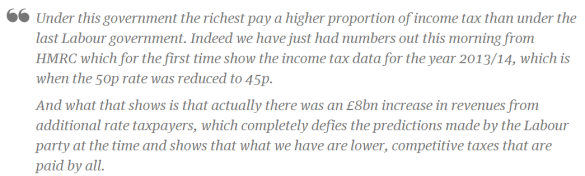
Here’s what David Cameron said at PMQs this afternoon:

Capture

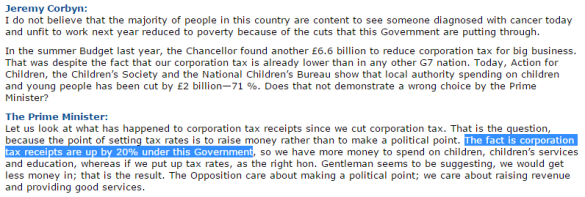
But is this true? Or, like George Osborne’s claim on income tax receipts last week, is its relationship with the truth a fleeting one?

The General Election in 2010 was on 6 May 2010 – a month into the 2010/11 tax year.

Our corporation tax receipts in the 2010/11 tax year – according to HMRC’s own figures (page 8) – were £43.040bn. In the year 2014/15 – the last year for which figures are available – they are £43.005bn.

That’s not a 20% rise. It’s a small fall.

Of course, it’s worse than that because since 2010/11 the economy has grown modestly, tax receipts generally have grown, and there has been modest inflation. Yet corporation tax receipts have still fallen. This is exactly as HM Treasury predicted as it attributed significant costs to these cuts – £2.475bn in the year 2020-21 alone for the cut to 18% made in the Summer Budget.

Perhaps there’s an explanation. But I can’t see it.

Postscript: Iain Campbell points out that in 2009/10 receipts were (at £36.628bn) a sum a 20% increase to which gives you that recorded in 2014/15. If that is the ‘explanation’, Cameron is taking ‘credit’ for policies that Labour introduced: the first cut to Corporation Tax under the Coalition took place with effect from the 2011/12 tax year. It also invites the observation that in 2008/09 corporation tax receipts were £43.927bn: materially higher than now they are even in cash terms.

How much will it cost us to cut the top rate of tax?

Earlier this week, George Osborne came close to suggesting that by cutting the top rate of tax from 50% to 45% he had increased tax revenues by £8bn. The relationship between that suggestion and the truth is a distant one as I explained here.

Its evident falsity does not, however, make it any less convenient to those whose constituencies, or pocket-books, would benefit from further cuts. And so, predictably, it has precipitated a number of calls for those further cuts – perhaps in the coming Budget.

It is, unfortunately, recondite in these times to want to make policy by  reference to the evidence rather than the heroic assertion of that which is convenient. Be that as it may, here’s some evidence: about who it is who pays the top rate of income tax; how much they benefit from cutting it; and how much it costs the public finances to make that cut.

In this tax year, about 332,000 people will pay the 45% “Additional Rate” of income tax. That’s about half a percent of the population. About 83.5% of them are male. More than 332,000 people earn more than £150,000 per annum – the earnings level at which you begin to pay the top rate – but the tax system offers reliefs to reduce your taxable income, and these reliefs are overwhelmingly accessed by higher earners, as I showed here.

The mean average earnings of someone in the Additional Rate category of earner is a bit over £400,000 pa. That means that more than half of the income of that mean earner is taxed at the Additional Rate. If you are one of the 16,000 people earning over £1,000,000 pa, your mean average earnings of £2.43m pa means that virtually all of your income is taxed at the Additional Rate. If you earn £2.43m, a cut of 5% in the top rate of tax will give you an extra £120,000 in your pocket every year.

In total, Additional Rate payers will pay a bit over £30bn in income tax this year. So if you cut the Additional Rate from 45% to 40% you will give them, collectively, a tax break of more than £3.3bn.

This won’t, however, cut what Government receives by £3.3bn.

Most people aren’t keen to pay tax and when we raise income tax rates we increase the incentive to find ways to avoid that increased burden – either by engaging in tax avoidance, or by retiring early, or working less or leaving the country. When people give up work or work less or emigrate they don’t just avoid the increase in the rate of tax, we also lose the rest of the tax that they pay.

So there are reasons to be cautious about raising rates of tax. But, of course, people who are highly motivated by tax rates tend to live in low tax jurisdictions – they are not in the UK in the first place. As the FT put it earlier this week:

Capture

These considerations also act in reverse. When you cut tax rates you can decrease people’s desire to avoid tax, you can increase their inclination to work or work on, and to move to the UK.

We typically call this relationship between the tax take and changes in rates the Laffer Curve. But, as I’ve written here, calling it ‘the’ Laffer Curve is a misnomer because there isn’t only one Laffer Curve – there are different curves for different taxes, at different times and in different economies. And the shape of the curve is affected by a huge number of variables including, in particular, how easy it is to avoid tax.

Back in March 2012, George Osborne announced that he would reverse Labour’s decision to increase the top rate of tax to 50% with effect from 6 April 2013. At the same time as making that announcement HMRC released a paper called ‘The Exchequer Effect of the 50 per cent additional rate of income tax.’ That paper is the only public study of which I am aware into the effects of increasing or decreasing the top rate of income tax in the UK. It concluded that cutting the rate from 50% to 45% would cost around £100m per annum.

However, there is no room for doubt but that cutting the top rate from 45% to 40% would be considerable more expensive.

First, our inclination to alter our behaviour as tax rates change is dynamic. The lower the top rate, the weaker the incentive to change behaviour to avoid it. You can tell this is so because otherwise, by cutting rates to zero, we would raise more than the £163bn we presently receive in income tax. Plainly this is not so. So a cut to a lower top rate (45% to 40%) will cost more money than a cut to a higher one (50% to 45%) – even where exactly the same people are affected.

Second, the Coalition had marked success in tackling personal tax avoidance. One of the arguments as to why cutting rates will not lead to a reduction in tax receipts is that the incentive to avoid tax will weaken. But if it is already extremely difficult for high earners to avoid tax, it cannot sensibly be argued that diminished incentive will have a marked effect.

Third, pay growth in the top percentile of earners – roughly equivalent to those who pay income tax – is strong as this HMRC chart shows:

Capture
The number of those earning above £150,000 is projected to grow by 6.5% from 2014-15 to 2015-16 alone. And the aggregate taxable earnings of that group will grow by over 6% (both calculations from data here). As more income becomes subject to that top rate of tax the cost of cutting it increases.

Writing in the Telegraph last week Fraser Nelson said this:

The top rate of tax is, today, 45p but it was 40p throughout the Labour years. And for good reason: it was the optimal rate, taking the most from the highest-paid. If Osborne were to restore the 40p rate, he’d squeeze far more tax from rich and again demonstrate Conservatism in action.

Now, this is heroic asserting by Fraser. But, if you have regard to the actual evidence, there isn’t room for serious doubt about the effects.

Cutting the top rate of tax will deliver to the top 0.5% of earners a tax cut worth £3.3bn. And it will cost the Exchequer very considerable sums of money. My opinion is that these sums are more likely to be counted in the billions rather than hundreds of millions per annum.

Facebook and UK Corporation Tax (2)

Writing yesterday, I addressed the propensity of certain journalists to ready excitement. I examined what the Facebook deal didn’t mean. Today I want to write a little more on what it does mean. What is the likely thought process that led Facebook to this point? And how much cash is it likely to involve?

First, the thought process.

As David Quentin discusses – in an influential piece of work here – for the sophisticated player tax planning is essentially an exercise in managing tax risk. It involves a choice to seek to reduce your tax liability, which choice carries the the cost of embracing more tax risk. If my assessment of the risk as low is right, I save 100. If my assessment of the risk is wrong, I give back that 100 and I suffer the public embarrassment of fighting and losing a tax case.

I will revisit this equation in future weeks: it doesn’t operate in the public interest. But what I want to cover now is how it affected Facebook’s decision as to where to book UK sales.

Facebook understood – as did Google before it – the diverted profits tax to have backfired. It did not have the consequence of bringing Facebook within the (punitive) 25% diverted profits tax net. What it did do was increase the risk profile attached to Facebook’s tax planning. On the left side of the balance sat the prospective tax savings; on the right sat a now enhanced tax risk. But another factor sat, too, on the right hand side of the balance: the cost attached, especially for a consumer facing business like Facebook’s, to the negative publicity attendant on paying too little tax.

You weigh that tax saving against the increased tax risk and impact of that publicity on your global brand and, ultimately, you make a call as to which side of the balance sits heavier. That would have been the assessment that led Facebook’s to rework part of its UK tax calculation.

But what sat on the left side. What was the actual sum on the left hand side of the balance in my calculation. Can we know?

We would need to know (1) what sales were made by Facebook to UK customers. Of these sales, what subset (2) were effected by UK relationship managers? (You will recall from yesterday’s blog post that only these sales, and not advertising bought by smaller customers online, are affected by the announcement).

Then what profits were generated by selling – as opposed to other parts of Facebook’s value chain (3)? Under existing international tax rules the UK can’t tax what you might think of as ‘manufacturing’ profits here, only ‘retailing’ profits.

Finally, one would apply to those profits (4) our prevailing rate of corporation tax.

As to (1), the latest year of accounts available (for Facebook Ireland Limited’s accounts, where European sales have been booked up to now) gives European sales of €4.8bn in the year to 31.12.14. It doesn’t say what UK sales are, but the relationship of the UK’s GDP to that of the EU (18%) might give you a reasonable proxy for the proportion of sales made in the UK. 18% of €4.8bn would represent €860m. Divide by 1.3 to convert to £ would give you UK sales of £660m.

As to (2), we know that Google generates 60-70% of its sales from 1% of its customers. Let’s assume that the same is true of Facebook: that 1% of customers are serviced by the UK relationship managers, and they generate a (mid-range) 65% of sales in the UK. That would give you 65% of £660m of UK sales, or £430m of sales booked in the UK.

As to (3), worldwide Facebook appears to have a 40% margin (of pre-tax profits/turnover). Attribute, for the sake of argument, 10% of that margin to selling and the remainder to generating and maintaining the technology and intellectual property rights. That would imply a profit on those UK sales of 4%, or £17m.

If you apply to that £17m our 20% rate of corporation tax, you’d arrive at a UK corporation tax bill of £3.4m per annum on those sales. That’s a little less than, but not of a completely different order to, the £4-6m (independently) estimated by Tim Davies, Head of Tax at Mazars, yesterday.

As I explained yesterday, the deal is forward looking. It will apply from April 2016 going. So we won’t see any signs of it in the accounts for the period to 31 December 2015 (which should appear in October 2016). The first sign of it will appear in the accounts for the period to 31 December 2016 (which should appear in October 2017). These will contain 9 months rather than a full year of this new treatment giving rise to an additional corporation tax bill disclosed to us in October 2017 of 75% of £3.4m or £2.55m.

But that’s not all.

We also know – see my post of yesterday – that Facebook UK has approximately £10m of ‘deferred tax assets’ (effectively credits against future tax liabilities, and here comprised of carried forward losses and capital allowances). These would need to be depleted before any cash moves from Facebook UK to HMRC. £2.55m in the year ending 31 December 2016 would leave just about enough to clear the tax bills for the years ending 31 December 2017 and 31 December 2018. So the first cash changing hands in consequence of this deal would be in the year ending 31 December 2019 and we’d find out about it in October 2020.

Of course, this calculation makes a number of assumptions which may or may not be right. If Facebook’s UK revenues grow faster the deferred tax assets would be depleted earlier. Earlier depletion might also result from HMRC’s existing enquiries into Facebook UK’s affairs bearing tax fruit. Or the assumptions made in my calculations might just be off.

But, even bearing these in mind, the BBC’s Businesss Editor Kamal Ahmed’s blog post of yesterday which led with:

Facebook is set to pay millions of pounds more in tax in the UK after a major overhaul of its tax structure.

might look, in the cold light of day, a little excitable. “Set,” perhaps, but not for a good few years to come.


Facebook and UK Corporation Tax

This morning Facebook UK announced – via the BBC’s Kamal Ahmed – that it would start booking sales in the UK. Here’s what they told the BBC:

Capture

What this means in practice is that Facebook UK’s taxable UK profits will cease to be, as previously they were, a simple mark-up of staff costs (a fact I revealed here).

Instead they will be, in part at least, a function of the value that is generated in the UK by those staff. In principle this should mean higher taxable UK profits.

So, welcome news. But (and you knew I was going to say this) let’s not get carried away.

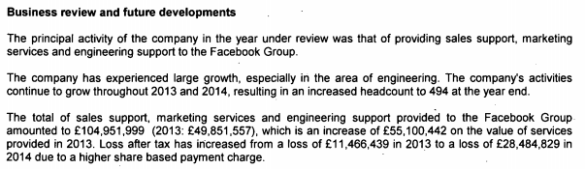
First of all, Facebook UK Limited appears from its accounts to have three activities in the UK:

Capture

being sales support; marketing services; and engineering support.

The “marketing services” and “engineering support” – which you might think of as maintaining the Facebook machine and developing new bits of it – activities will continue to generate UK taxable revenue only on the basis of what the staff cost plus a small mark-up. We should expect these bits to lead to materially no UK tax liability now or in the foreseeable future.

What about what was previously described as sales support? Facebook UK has two types of customer. Those who have UK client managers and those who don’t. It is only in respect of those who have UK client managers that a proportion of the value of those sales will fall within the UK tax net. Sales to those who don’t have UK client managers will continue to be taxed in the Ireland.

So what will now be taxed in the UK is the value added by a sub-set of a sub-set of Facebook UK’s staff.

Second, it’s important to note that, like Google, none of the profits that the Facebook Monolith – i.e. if you assume a world in which what is economically a single entity is taxed like a single entity – makes on UK sales will be subject to UK corporation tax. Unlike Google we can’t know precisely how big those UK sales are – but they are very likely to be billions. What is taxed instead is a combination of fragments of deemed profits on UK costs and deemed profits on deemed value added by a limited number of UK staff. You don’t need me to tell you this ain’t what a sensible corporation tax system looks like.

Third, Facebook has considerable reliefs available to carry forward. You can see that from here:

Capture

Previously Facebook UK didn’t bother to recognise these sums (effectively comprising rights to reduce future tax bills) as assets because they didn’t think they’d ever have any UK corporation tax liability to pay. This might now change – but regardless we should expect it to be a good while before today’s deal results in any real cash moving from Facebook UK to HMRC.

So although this morning’s announcement has been well handled in PR terms, it seems to me that it is unlikely to be especially meaningful in terms either of actual cash passing from Facebook or in terms of its tax liability. Facebook UK’s last published accounts disclosed a payment of £4,327. I wouldn’t bet on today’s announcement resulting in any meaningful change.

***

Another important and related aspect to note is that what Facebook UK have announced today is a forward looking change – effective only from April 2016.

Facebook UK Limited have refused to confirm or deny that they are under revenue enquiry for years up to now – but it’s clear from their accounts that they are.

Capture

Of course we can’t know that these claims relate to how they fragment their sales and engineering businesses to minimise their tax liability. But the Google experience suggests that it’s a pretty decent guess they do.

And nothing in today’s announcement deals with these enquiries. Nor the period after them, from April 2015 to April 2016, when the Coalition’s diverted profits tax applied.

But likely it won’t be until October 2016 at the earliest – when we see Facebook UK’s accounts to 31 December 2015 – that we gain any clarity about past years.

***

What, finally, about the Diverted Profits Tax?

I understand that, like Google, Facebook regards its tax planning as robust enough to withstand a Diverted Profits Tax challenge. But they do accept that it adds tax risk to their business model. And it is a combination of that added tax risk and a response to public perception of them as tax avoiders (despite HMRC’s hugely unhelpful Policy Statement of earlier this week) that is causing them to book at least some real profits in the UK.

This is a real credit to those who have been campaigning for tax justice – through our actions we can achieve  what Government is either unable or unwilling to.


HMRC redefines tax avoidance to exclude Google, Facebook, Amazon

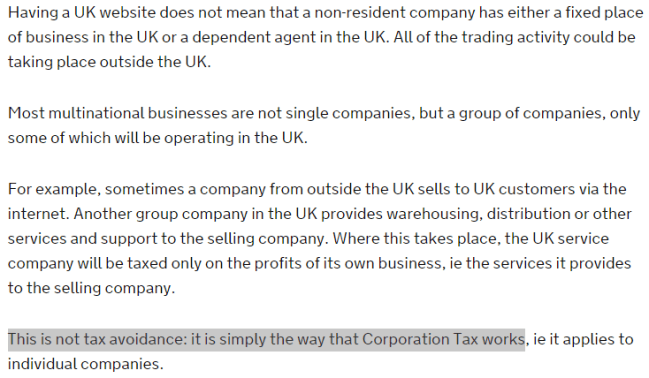
Yesterday HMRC published an “Policy Paper”: ‘Taxing the profits of companies that are not resident in the UK.’ You can read it here.

It contains this extraordinary assertion:

Capture

In effect, say HMRC, if it is “the way that Corporation Tax works” then it is not “avoidance”.

There are a lot of problems with this statement.

The most glaring of them is that it has as its consequence that there is no such thing as tax avoidance. If the structure works it’s not tax avoidance. And if the structure doesn’t work, by definition it doesn’t avoid tax, and so it can’t be tax avoidance either.

Another is that it is contradictory to the definition of avoidance that HMRC itself adopts for the purposes of calculating the Tax Gap.

Capture

For this purposes of calculating the Tax Gap, HMRC say (and this time rightly) that even if a structure does deliver a tax reduction it can still be avoidance – “where it serves little or no purpose other than to produce a tax advantage.”

But the most extraordinary thing of all is that HMRC is going out of its way to provide political cover for businesses which engage in abusive tax practice.

Where is the public interest in HMRC saying, publicly, that it is not avoidance for businesses to establish with a view to minimising their tax liability these highly artificial structures?

Why on earth is HMRC acting as public relations agency for Google, or Facebook, or Amazon?

Did cutting the top rate really raise £8bn?

Speaking in Parliament today, George Osborne said this:

Capture.PNG

(thanks to the Guardian’s Andrew Sparrow for the report).

I don’t have the number to which Osborne refers but it is broadly in line with what was forecast in May 2015 which showed a projected increase in income tax paid by additional rate taxpayers of £7.1bn.

Does this increase vindicate, as Osborne suggests, to the tune of £8bn of extra receipts the decision to cut the 50p rate?

Reader, it does not.

To understand the effects of cutting the rate you’d need to understand what receipts would have been if Osborne hadn’t cut the rate with effect from 2013/14 and compare them to the actual receipts for that year.

No one has done that exercise since the cut but HMRC did some projections beforehand.  It calculated that cutting the 50p rate to 45% would cost money, some £360m over five years.

Capture

So how do we explain that £7bn increase in receipts?

As Osborne well knows, if you tell people in March 2012 that you’re going to cut their tax bill by a tenth (from 50% to 45%) in a year’s time, people will choose to delay payment until April 2013 when their bills will be lower. And they did.

First, we knew they would do this at the time:

Capture

Second, HMRC said in May of last year that it had happened:

Capture

In other words, tax receipts were artificially low in 2012-13 (because people delayed receiving income until rates fell) and were artificially high in 2013-14 (when those delayed receipts were received). Combine those two numbers and you may well explain your £7bn jump.

Third, you can buttress the point if you look at the change in the composition of receipts from Additional Rate Payers in 2012-13 to 2013-14.

  • There was little point to them delaying basic rate employment income: the percentage tax bill on that remains static. And in fact the basic rate employment income receipts actually fall from £1.78bn to £1.73bn.
  • There was little point to them delaying higher rate employment income: the percentage tax bill on that also remains static. And the higher rate employment income receipts rise by a modest 7% from £11.2bn to £12bn.
  • But on additional rate employment income, where their tax bill falls by a tenth, there is an increase of over 19%.

That delaying tactic is likely to explain most or all of that £7bn difference. At paragraph A.26 here HMRC forecast that £6.25bn of income would be moved from 2012-13 to 2013-14. A £6.25bn reduction in 2012-13 receipts plus a £6.25bn increase in 2013-14 receipts would give you a difference in expected tax receipts of 45% of £12.5bn or £5.625bn in tax. (That calculation makes the sensible assumption that only income benefiting from the cut – i.e. taxable at 45% rather than 50% – is pushed forward a year).

But it’s not only that Osborne has been a little economical with the truth. It’s not only that, on all the available evidence, his tax cut actually cost money. It’s that the whole episode signals a terrible indictment of Government policy.

Osborne could have taken measures to prevent these delaying tactics – which remember only benefited those earning over £150,000 per annum – but he didn’t.

And this cost the country £2.4bn in 2012-13: see Table A3. (Although it should be noted this figure will unwind in part in later years.)


On Zac Goldsmith’s Tax Affairs

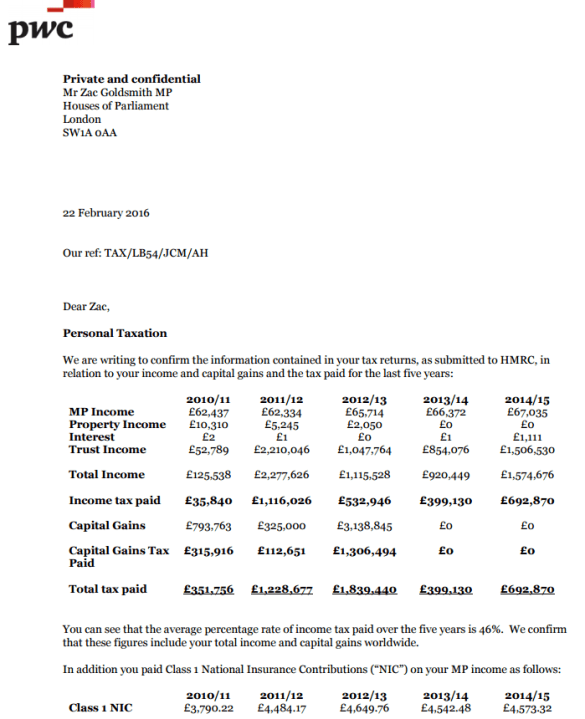
Yesterday Zac Goldsmith issued a Press Release with some details of his tax returns for the past five tax years. I’ve set it out below for those who haven’t seen it. But what do we know about his tax affairs? And what can we learn from the Press Release?

He inherited non-dom status from his father, Sir James Goldsmith. And it is a matter of public record that he benefits from an offshore trust (the “Trust”) established by Sir James to provide Zac and his siblings with an income. Some estimates suggest the Trust has a value of around £300m.

Zac says he relinquished non-dom status with effect from the tax year 2009-10. We don’t know when this happened – but it is likely to have taken place after May 2006 when he was placed onto the so-called A List for the selection of Conservative Party candidates. The decision may have been precipitated by his expectation of his finances becoming a matter of greater public interest. It may also have been affected by changes to the non-dom regime with effect from 2009-10 that rendered it less attractive. In any event in 2010 Parliament enacted the Constitutional Reform and Governance Act which deemed MPs and members of the House of Lords (although not Mayors) to be UK domiciled for income tax, capital gains tax and inheritance tax purposes.

The Tax Consequences

To understand what all of this means in tax terms, it’s best to divide the income and gains made by the Trust into three categories:

(1) those that the trustees who run the trust appoint to Zac and he doesn’t bring into the United Kingdom;

(2) those that the trustees who run the trust appoint to Zac and he does bring into the United Kingdom; and

(3) those that the trustees who run the trust don’t appoint to Zac at all.

The Trustees are likely to have only a minimal liability to tax on these three categories. But what about Zac?

Before Zac became UK domiciled, type (1) income and gains would have escaped liability to UK tax whereas a UK dom would have paid tax on them. Zac hasn’t disclosed his tax records from the period for which he was a non-dom – but even if he did we wouldn’t learn much. Type (1) income and gains wouldn’t appear on his UK tax returns.

But now that he is a UK domiciliary, type (1) income and gains, along with those in type (2), will be subject to UK tax. And we can see from the letter below that he has received between £53,000 and £2.2m per annum from the trust and paid appropriate amounts of tax.

But the interesting category is type (3).

It is highly likely – although I could not say that I know this – that the Trust is a discretionary trust. What that means is that the trustees can choose whether and when to ‘appoint’ income and gains to Zac – and they are likely to have regard (amongst other things) to what is convenient to Zac. Should it be convenient for him to receive income and gains later, the money he might otherwise have taken now will continue to sit abroad, largely or wholly untaxed, and roll up tax free until such time as – perhaps – Zac ceases to be UK resident when the money could be received by him free of UK (or perhaps any) tax.

Indeed, the Trustees taking Zac’s wishes and needs into account is the most likely explanation for the bumpy profile of his receipts from the trust.

It should also be noted that, broadly to such extent as the property in the Trust is not based in the UK, it will escape liability to UK inheritance tax. Ordinarily a discretionary trust is subject to a charge of up to 6% every ten years – but this is not so for a trust established by a non-dom.

What should we make of this?

Let’s assume Zac is leaving money in the Trust until he needs it – which on the basis of very limited information available is possible or probable – is this aggressive tax planning?

I think not.

It wasn’t Zac who set up the Trust. Responsibility for the fact that, in consequence of it being offshore, the Trust does not generate a liability to UK tax  on (most) income and and gains cannot be laid at his door. And the same is true of the fact that the arrangements avoid an inheritance tax liability.

And few would argue that any of us have a positive obligation to maximise the tax we pay. Drawing down money as we need it, and remaining mindful of the tax consequences of doing so, is the sort of decision all of us with pensions are now going to have to make.

Some will think that it is enough that he is receiving very substantial amounts of unearned money. For myself I’d rather judge him on the quality of his policies.

But that’s not a technical question – and it’s one on which we can all form our own view.

What, on any view, Zac should be applauded for is the decision to provide a degree of voluntary disclosure of his tax affairs. But better still would be disclosure of his actual tax returns – rather than merely extracts from them.

Now let’s see what Sadiq Khan provides.

Zac delivers on tax transparency commitment

Zac Goldsmith has today published the details of his tax payments, delivering on the commitment he made to do so last week.

A letter from Zac’s accountant, prepared at his request, confirms the details of his worldwide income, capital gains, and tax payments in each of the years since he first held public office.

Zac Goldsmith said:

‘I have today published my tax return details, prepared and verified by PwC, who have represented me all my adult life.

‘I gave a commitment to do so and today I deliver on that promise. I look forward to all mayoral candidates doing the same so London voters can judge us equally.

‘As was well known to voters in my two elections as an MP, I became ‘non-dom’ automatically because of my father’s international status. It was not a choice, and I relinquished it seven years ago. I was born, grew up and have always lived in London – except for two years travelling abroad in my early 20s. Because of this I derived very little, if any, benefit from this status as my income came to the U.K and was therefore taxed here.

‘It is no secret I was dealt a good hand in life, but I have been determined to play it well. I have stood up for my local community in Parliament for six years, delivering on my promises to them – which is why they returned me with one of the biggest increased majorities at the last election. I am proud of my record and I will stand up and deliver for all of greater London, just like I have for Richmond, should I be elected mayor in May.’

ENDS

And the attached letter provides as follows:

Capture


How now fare Osborne’s windfall billions?

This was the bit of the OBR’s November fiscal outlook (in Table 4.8) that rescued Osborne’s Autumn Statement with tens of windfall billions.

Capture

Capture.PNG

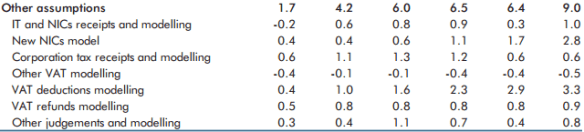
These modelling changes projected substantial increases in in-year and future year tax revenues.  As you can see from the chart above, these projected increases in future revenues were substantially attributable to “modelling” changes to NICs and VAT (explained at, in particular, Box 4.2).

They rescued Osborne by enabling him to kick the tax credits can down the road (and by creating room for further spending), as the Resolution Foundation identified.

On Friday, the OBR released its Monthly Public Finances Release enabling us to see how those November forecasts are bearing up.

In short, not so well.

Capture

For each of NICs and VAT, the 2015-16 out-turn looks unlikely to match the OBR’s upgraded November forecasts.

To hit those forecasts:

  • NICs (or Compulsory social contributions as it is described above) receipts in February and March would have to grow 5.9% from 2014-15 compared with November’s full year forecast growth of 4% and growth so far this year of 3.5%.
  • VAT receipts in February and March would have to grow 5% from 2014-15 compared with November’s full year forecast of 3.9% and growth so far this year of 3.7%.

As I pointed out here (but others have shown far more elegantly) the OBR’s forecasting record is consistent only in its tendency to optimism.

I went on to observe, of that windfall, that:

Capture

Predictably enough, the OBR’s January release evidences only that November marked a continuation of that optimism. And, once again, it seems likely the Chancellor will fail to achieve his windfall growth in tax receipts that were projected only in November.


Why don’t we trust HMRC?

With an annual budget of £3.1bn in 2014/15 HMRC raised £518bn of tax (and paid out £43bn in benefits).

The £3.1bn number is so low in good part because around 98% (237,000 enquiries of 11m returns) of personal self-assessment returns go unchecked. We allow them to go unchecked because we believe the overwhelming majority of taxpayers to be compliant. This is often what we mean when we talk of tax being “voluntary”: by and large, no one checks what we say about what tax we owe.

This state of affairs is not unusual to the UK. It is baked into almost all tax systems. It works well when what the OECD calls ‘tax morale‘ – citizens’ motivation to pay their taxes – is high. But if tax morale declines, the tax gap (the difference between what should be and is paid) is apt to widen, receipts to fall and costs to rise.

But tax morale is affected by (amongst other things) the confidence that we have in our tax authority and our perception of whether others are paying their dues. So, when HMRC faces challenges to its competence or honesty – like that represented by the press coverage of the Google story over the last few weeks – the stakes are very high indeed.

One of the most predictable consequences of these stories is the immediate fracture they effect between tax professionals and the public. The instinct of the former, by and large, is to leap to HMRC’s defence. But I’m less interested in them. What I am interested in is why it is that the public distrusts HMRC  – and how it is that we might address that distrust.

***

The lack of trust centers on a suspicion of sweetheart deals: done for enormous sums of money and behind closed doors.

These days such suspicions fall on fertile ground. Once we talked of the tax net – but today corporation tax is more a slalom course. Shift right, shift left, right again and you arrive at your destination of a tax burden that seems, in the process, somehow to have slipped a zero or two.

We might blame politicians, or taxpayers, or their advisers. We might properly call a curse on all their houses. But not on HMRC’s. Blame does not fall upon the policeman for defects in the law.

Nevertheless, it is public confidence in HMRC that suffers. And it is this that we must address.

Is the process for signing off deals flawed?

Here’s what happens before HMRC signs off a sensitive deal with a big Corporate taxpayer.

  • The Case Team should follow HMRC’s Litigation and Settlement Strategy which states that HMRC is not allowed to haggle or do deals.
  • It then reports to the Tax Disputes Resolution Board which makes recommendations to three Tax Commissioners, including the Tax Assurance Commissioner, who must agree unanimously.
  • Afterwards, decisions are reviewed by HMRC’s internal audit team – its work is overseen by the Tax Assurance Commissioner – and is reported to HMRC’s Audit and Risk Committee who can recommend further action.
  • The Tax Assurance Commissioner publishes an annual report detailing this governance in action.
  • And externally HMRC’s actions are scrutinised by the Public Accounts Committee, the Treasury Select Committee, and the National Audit Office.

In the abstract this looks like a good and rigorous process. Whether, in actuality, it represents proper scrutiny depends on who occupies these roles.

We can generate a dozen different layers of assurance. But if we populate them with individuals with a cookie cutter outlook the result will neither look like – nor represent – good scrutiny. The reality is that few people move into HMRC from the outside world – the traffic is almost all the other way – and the pool of Tax Commissioners is drawn almost exclusively from HMRC and the tax profession. I am aware of no-one who occupies a role of strategic importance in the process of approving deals whose background is such as to reassure the public that they are likely to provide independently minded challenge.

This isn’t a criticism of HMRC: it doesn’t make these appointments. But this state of affairs reflects badly on an appointments strategy that asks outsiders to be reassured by the fact that insiders say things are working properly.

You want to reassure outsiders? Put them at the heart of the approvals process.

Does HMRC get its decisions right?

My criticism of the fact of the homogenity of HMRC’s decision makers goes beyond a procedural one.

We ask for diversity in decision making not merely because it signals that decisions will be made properly – although it does that. We also ask for diversity in decision making because it brings meaningful challenge to decision making – and should bring about better thinking and better decisions.

Writing before the General Election I noted that in the last decade there had only been one tribunal challenge to an assertion of an entitlement to non-dom status. The 3,600 names on the Falciani list led to only one prosecution. And I am aware of only one transfer pricing challenge ever having been brought before a Tax Tribunal.

These statistics do not suggest to me a Department which is sufficiently mindful of the need for it to manage public perceptions of its fairness.

I do not know whether HMRC has struck a good deal with Google UK Limited: I have reason to think HMRC may actually have struck a rather better deal than the £130m headline suggests (I may write more on this). But I do know that against the background of investigations into Google’s French and Italian sister companies, the revolving door between senior Google management and Government positions, and the very modest tax liability attaching to Google’s enormous (and enormously profitable) UK revenues, a high level of public interest was inevitable.

Given the extent to which our overly strict taxpayer confidentiality laws (to which I will turn) inhibit HMRC’s ability to explain or justify its actions to a sceptical public, HMRC should, I think, have taken the view that it was in the public interest that tax justice should be seen to be done. I hope HMRC will do so in the future.

Has HMRC become politicised? 

HMRC is a non-ministerial department. The reasons why it has that status are given as these:

Capture

The debate around tax has become ever more politicised. A consequence has been an increase in the need for a tax department – one which wishes to preserve the confidence of the public – to remain scrupulously neutral.

Regrettably HMRC has done exactly the opposite.

I have heard directly from one Commissioner the pressure he feels himself under to remain on the right side of Ministers. One does not have to look too hard to find instances which suggest HMRC has yielded to this pressure. This document, for example, issued in the run up to the 2015 general election contained, in section 3, a number of future policy commitments. These are not within HMRC’s province and it is unfortunate that the document bears HMRC’s crest. Although I hear repeatedly that the politicisation of the Department began under Gordon Brown, we do not have to cast our minds that far into the past to find a notable example of a Minister taking political credit for what he (then) considered to be the successful conclusion of a deal with a particular taxpayer. And this document (in the “Ministerial Involvement” section) also states that HMRC provided then private information to Ministers, possibly to help with a Press Conference.

When HMRC enters the political fray, when it aligns itself, or allows itself to be aligned, or is aligned by Ministers with party political objectives it must understand that a loss of public confidence is the inevitable corollary.

Transparency

It would be difficult for any department to retain public confidence against the background that I have described. Such an outcome could only be achieved if the workings of that department were transparent. But HMRC’s are not.

This provision imposes strict duties of confidentiality on HMRC. Breaching them is a criminal offence punishable by up to two years in prison. Perhaps unsurprisingly in the circumstances, officers at HMRC tend to take a conservative view of the limitations imposed upon them by the duty of confidentiality.

The consequence is that HMRC regards itself as unable to respond to press coverage which suggests it has struck ‘sweetheart’ deals. This state of affairs is not conducive to public confidence in HMRC. (Nor, one might think, is it necessarily in the interests of individual taxpayers. The fact that HMRC was unable to respond to media briefings by Google made it more difficult for me to get comfortable with the explanations Google provided. I cannot have been alone in this and it may well be that it affected the tone of the media coverage afforded to Google.)

This state of affairs is undesirable. As a judge noted here:

The efficient and effective collection of tax which is due is a matter of obvious public interest and concern. Coverage in the press about such matters is vital as a way of informing public debate about them, which is strongly in the public interest in a well-functioning democracy. HMRC have limited resources to devote to the many aspects of their tax collection work, and it is legitimate and appropriate for them to seek to maintain relations with the press and through them with the public to inform public debate about the tax regime and the use of HMRC’s resources. It is also relevant to the exercise of HMRC’s functions to provide proper and accurate information to correct mis-apprehensions or captious criticism regarding the exercise of their functions (such as any misplaced suggestion that they had engaged in unduly lenient “cosy deals” with certain taxpayers), in order to maintain public confidence in the tax system. If such confidence were undermined, the efficient collection of taxes could be jeopardised, as disaffected taxpayers might withhold co-operation from the tax authorities.

And it is illogical.

Once HMRC takes a dispute before a tax tribunal, the duty of confidentiality (meaningfully) disappears. The rule that tax appeal hearings should be in public is scrupulously observed. Members of the public can sit and hear all the evidence. The documents in that hearing – witness statements, skeleton arguments, appendices to witness statements – become a matter of public record and are available to anyone who makes an application for them. It is difficult to see what coherent principle there might be that could preclude public disclosure of any material until a taxpayer decides to disagree with a HMRC determination but then throw open the doors to public scrutiny. What is it in the act of a taxpayer disagreeing with a HMRC decision that so fundamentally alters the public interest in confidentiality?

Government is handing over to HMRC powers beyond the strict power to determine tax liabilities. Our policy making in the field is increasingly directed towards discouraging taxpayer behaviour which looks to ‘walk the line’. This discouragement often takes the form of increasing the risks attached to such behaviour. These are good and sensible responses to the increased moral opprobrium with which such behaviour is regarded.

A logical further step along this road would be to remove the protection of confidentiality from those taxpayers who cross the boundary. If an enquiry into a self-assessment return reveals a taxpayer to have wrongly declared a materially lower than the correct tax liability, HMRC should be able to make this fact, and the details of it, public.

It is beyond doubt that Google UK Limited, which has a simple business model, engaged in multiple acts of fiscal boundary testing. It is clear (as I explain here) that there are at least two discrete instances of it telling HMRC that the tax it was due to pay was lower by tens of millions of pounds than the tax it was actually liable to pay. I find it difficult to see how the balance of public interest lies in protecting the confidentiality of the author of that behaviour at the cost of a loss of public confidence in HMRC. There is no sensible clear-eyed assessment of the public interest that leads to that outcome.

***

These are serious challenges. The stakes are high. This is no time for the sort of complacent response urged upon Government by several commentators. Assume that they are right to assert – without any better knowledge than you or I – that the public is wrong to believe that sweetheart deals are being done. Where does that take us? The public nevertheless believes it and a loss of confidence in HMRC is the inevitable corollary.

We can avert our eyes from reality; stumble on, and watch as the situation worsens. Or we can recognise that the world has changed and take steps to address the undoubted challenges that HMRC faces.
Will the Trade Union Bill Help or Hinder Industrial Relations?

What follows is a Guest Blog by Bruce Carr QC on the Trade Union Bill 2015-16.

Mr Carr QC was asked by the Secretary of State for Business, Innovation and Skills and the Minister for the Cabinet Office under the Coalition to conduct an Independent Review into the Law Governing Industrial Disputes. The purpose of the review was to:

make recommendations to ensure effective workforce relationships.

THE TRADE UNION BILL – GOOD OR BAD FOR INDUSTRIAL RELATIONS?

With the Trade Union Bill now at select committee stage in the House of Lords and the government facing a major industrial relations problem as it seeks to impose contractual changes on junior doctors, it is a good time at which to consider what impact the proposed trade union legislation will have on relationships between employers, employees and those who represent them.

The Bill has been described in trade union circles as an exercise in ‘settling old scores’. That perception is perhaps understandable given the far reaching range of measures proposed. The Bill covers a number of diverse aspects from strike ballots to picketing to union funding to the role of the Certification Officer. It is not an unreasonable observation that the Bill contains nothing at all that can be viewed as positive from the perspective of those sitting in Congress House, home of the TUC. And all this arises against the background of an extended period of historically low levels of industrial action, even after nearly six years of austerity and much anguish within the ranks of, in particular, public sector workers following an extended period of significant pay restraint. In its briefing on the Bill for its second reading in the House of Commons, Liberty stated that:

“…this relatively short Bill has the potential to cause significant damage to fair and effective industrial relations in this country and would set a dangerous precedent for the wider curtailment of freedom of assembly and association.”

When one looks at the collective effects of the legislation, it is understandable that Liberty should have reached this conclusion.

Changes to balloting and notification

Consider first the changes to industrial action balloting – if a trade union wishes to avoid being sued for inducing a breach of contract by calling industrial action, there will have to be 50% turn-out of voters (clause 2, Trade Union Bill 2015/6) and a total of 40% of the electorate voting in favour of the action (clause 3) where the action relates to “important public services”. However, the government has thus far refused – apparently for reasons relating to security – to take steps aimed at increasing the turnout by allowing the ballot to be conducted with the use of electronic voting. This despite the fact that the balloting process (at least in relation to any ballot of over 50 members) is overseen by an independent scrutineer who is required under existing legislation to certify, amongst other things:

“that the arrangements made with respect to the production, storage, distribution, return or other handling of the voting papers used in the ballot, and the arrangements for the counting of votes, included all such security arrangements as were reasonably practicable for the purpose of minimising the risk that any unfairness or malpractice might occur” (section 231(1)(b) TULRA 1992)

The government has suggested that the threshold/turn out requirements contained in the Bill are justified as a means of ensuring an effective democratic process is undertaken prior to any industrial action. But if the trade unions are correct that electronic voting would increase voter turnout, what could be the objection to it, assuming that any security concerns about the process could be met? Surely this would have the effect of extending the democratic process within the ranks of union members? In the foreword to “Secure Voting – A Guide to secure online voting in elections”, the Conservative MP and Chair of the All-Party Parliamentary Group on Democratic Participation, Chloe Smith, eloquently make the case for electronic voting as follows:

“We shop, we bank, we date, we chat, we organise with ease [on line]. However, we vote entirely on paper. It’s alien to young people, and indeed anyone who appreciates the capability of the internet. It’s also ineffective: we communicate online with people all the time but we lack the final “one-click” to clinch the deal in democracy when the time comes.”

That reasoning would appear to be as applicable to voting in industrial action ballots as it is to voting in Parliamentary elections.

It is also proposed that union members – and the employer – be provided with a ballot paper which sets out what form the industrial action is intended to take and when it is to take place (Clause 4). On the basis that the ballot lasts an average of 3 weeks and the ballot paper is provided at least 3 days in advance of the opening day of the ballot, coupled with the new requirement that 14 days’ notice is given of any industrial action (clause 7), the employer will have a minimum of roughly 5 ½ weeks in which to prepare for what is to come. In addition, it may soon be the case that the employer will no longer be prevented from bringing in agency workers to cover the consequences of the industrial action. (This issue has been the subject of consultation but the government has yet to confirm what its intentions are in relation to it)  All of this will of course mean that the possibility of strike action no longer carries anything like the threat that it once did and the balance of power in industrial relations terms is therefore significantly shifted in the direction of the employer.

Compressed timetable for strike action

Under the Bill, any action will need to be completed within 4 months of the date of the ballot, leaving the union with just 3 ½ months in which to take action, following which it will be required to re-ballot (clause 8).  For a number of reasons, this is likely to have an adverse effect on industrial relations. First, a union, in order to allow itself the maximum room to manoeuvre in relation to proposed industrial action, will have to set its sights as high as possible and identify the extremities of what it plans to do and when. Having done so in the ballot paper, it will then be loath to shift its position for fear that the employer will take legal action on the basis of inaccurate information having been provided at the time of the ballot, and/or on the basis that the particular action no longer has the support of the ballot.

Second, faced with having to complete any industrial action within the effective period of 3 ½ months (allowing for 2 weeks’ notice to be given to the employer), the union is likely to take the view that it should do as much as it can by way of strike action in advance of any re-ballot. Irrespective of the sensitivities of the industrial position, action would take place within the prescribed period where it might not have done had the window of opportunity not been closing. The fact that the union will have to re-ballot – with its attendant costs – if the dispute is not settled will mean that the union will want to maximise its leverage during the period of validity of the first ballot. Conversely, an employer watching the sands of time running out for the union in relation to its first ballot, may well take the view that it will delay, prevaricate or not shift its position, knowing that the union will be forced as a matter of statute to go back to its members after 4 months from the date of the first ballot. From the perspectives of both employer and unions, the industrial strife may not be resolved and may in fact be worsened as a consequence of requiring everything to take place within the prescribed period.

It is also likely to be the case that the requirement to provide a “reasonably detailed indication of the matter or matters in issue in the trade dispute” (clause 4) will prove to be yet another area for litigation as employers seek to argue that the description is either inaccurate or lacks clarity. Furthermore, if during the course of the dispute, one or more of the “matters in issue” is resolved, no doubt employers will seek to argue that the ballot mandate no longer has validity, leading in turn to litigation and/or yet more re-balloting.

Lessons from the Junior Doctors’ dispute

The current junior doctors’ dispute provides a useful template to illustrate of what might happen in the future. The ballot result was announced on 19 November 2015, with 98% voting for strike action based on a high turnout of 76%. A four month time limit would expire on 18 March 2016. There would be no incentive for the union to sit down and negotiate rather than take planned action knowing that as each strike day is cancelled, its opportunities for further action will be fast disappearing. If having conducted some negotiations, it decided to add new dates in substitution for the originally planned dates, it would face the argument that the membership had not voted for this. Equally, employers would be able to comfort themselves with the knowledge that the mandate was soon to expire and the union forced to incur the significant expense of re-balloting its 37,000 junior doctors. Could it seriously be said that the 98% voting in favour of the action in November 2015 could not be regarded as a proper mandate for action beyond that date if, as appears likely to be the case, the dispute is not settled before 18 March? Were the proposed legislation in place, the BMA would already have to be making preparations for a further ballot of its members.

Changes to check off arrangements

Any union operating in the public sector will also be facing the additional prospect of re-balloting in circumstances in which its funding has suffered a steep reduction as clause 14 of the Bill seeks to prevent any employers operating within the public sector from making deductions from salary for trade union subscriptions, irrespective of the wishes of the employer.

Picketing

There are new measures to be introduced in relation to picketing which will result in further costs and administration for unions. They will be required in relation to every location at which picketing is to take place, to provide a “picket supervisor”, complete with badge or arm-band, who must be “familiar with any provisions of a Code of Practice issued under section 203 TULRA 1992 that deal with picketing”. Again, using the doctors’ strike as an example, this will mean that the union has to provide many hundreds of suitably qualified and ‘badged’ supervisors.

Industrial consequences

All of this, it seems to me, is likely to cause trade unions to look to alternative mechanisms in order to advance their case industrially. The Bill does nothing (and could not in any event do anything that would impact on the rights of freedom and expression and association contained within Articles 10 and 11 of the European Convention) about “leverage” campaigns which were at the centre of the rationale for the Review to which I was appointed in 2014. Such campaigns may involve the use of tactics outside the traditional model of industrial action and may include protests, lobbying of third parties in the supply line and forms of direct action involving managers or shareholders. The irony of the present Bill is that if anything, it is likely to increase the use of leverage campaigns as unions seek to avoid what they see as the unfairness of a collection of measures which erode both the lawfulness and the impact of strike action as well as draining off substantial amounts of income through the changes to check off arrangements (at least in the public sector).

Wider implications for trade unions and the Labour Party

The sense of unfairness that pervades the union movement in relation to the current Bill will be reinforced by the concern that the prospects of a change of government at the next election will be reduced should clause 10 of the Bill become law. Under this provision, union members will be required to ‘opt in’ to making contributions to a union’s political fund. The view of the Electoral Reform Society is that “only a small minority are likely to ‘opt in’.” (As set out in their Briefing to the House of Lords Select Committee).

Their view is also that this could result in an annual reduction of £6 million in the Labour Party’s income. Whilst the authors of the Bill may have had the intention of simply modernising current arrangements and improving union democracy and accountability, the fact that the Labour party faces the prospect of such drastic financial consequences as a result of what is proposed, will serve to reinforce the union view that it is intended to be something more. The BBC Parliamentary Correspondent, Mark D’Arcy has recently made this observation:

“The bottom line is that for Labour the loss of millions of pounds in political funding as a result of the changes proposed in this bill could destroy its ability to compete with the Conservative Party; so whatever the rights and wrongs of opting into, rather than out of, a political levy, this will be a bare-knuckle battle for very high stakes.”

The ‘bare knuckle fight’ is likely to be an industrial, as well as a political one. Based on the figures contained in the government’s own impact assessment, the TUC has estimated that the costs to trade unions as a result of the measures in the Bill will amount to £26 million over 5 years, not including any costs incurred as a result of the 4 month re-balloting requirement and not including an up-front implementation cost of £11million. It should therefore come as no surprise that the fight in future may be carried on outside the framework of the 1992 Act. ‘Leverage’ may prove to be a more efficient and cost-effective way of advancing industrial disputes than going through balloting processes which may of themselves, serve only to worsen relationships between workers and employers as set out above.