A short elegy to mark the passing of a prospective improvement to our democracy

He was always rather under-appreciated, Ed Balls, and it looks now as though – at least within TIGMOO – his star has further to fall.

But it shouldn’t. One rather clever insight of his during the last Parliament was to wonder whether the Office for Budget Responsibility might counteract what he then anticipated would be the critical issue for Labour in 2015: whether it could be trusted with the economy. If an independent OBR were to ‘cost’ Manifestos, and Labour’s ‘stood up’ he might gain ammunition to tackle what he anticipated would be a hostile press. And so he secured a Commons Debate on the proposal.

I wrote about the debate here. But let me give you a short extract:

“The Conservatives’ position – not unsupported by Robert Chote’s letter – was that any change in the OBR’s remit was temporally too proximate to the general election to be implemented.  As the then Financial Secretary to the Treasury, Nicky Morgan (who opened the debate for the Coalition) (Column 392) put it:

we are not suggesting that the issues that the shadow Chancellor’s proposals present are insurmountable, but we do believe very firmly that the independence and operation of the OBR is critical. We need to make sure that independence and impartiality is preserved, and as such, Parliament would need time to scrutinise the proposals properly and the OBR still needs time to establish itself fully as an independent fiscal watchdog before being drawn into the political heart of a general election.

So not now, but next time.

Nevertheless, we had the cautious beginnings of a political consensus. And by goodness, the electorate needs it. When the FT, not often Pravda for this sort of agitprop, writes

The deficit policies of both main parties blur into one. Forgetfulness or deceit, it does not matter. When the new government opens the books after the election and the truth comes out, voters will think their new rulers are a bunch of liars who were willing to say anything to get elected. They would be right,

then the hour is surely nigh.

If we are to do more than talk about addressing public cynicism about politics, if politicians are to be incentivised to be straight with the electorate, if we are to fight back against the destructive tribalism that passes for public engagement with Government finances, then it is with measures like this that we must start. Technocratic, apolitical but incredibly important.”

Labour lost the debate.

And – because Balls’ identification of the key battleground appears to have been right – the election. And Ed Balls. And all impetus to continue the push on extending the remit of the OBR.

A pity for Labour and a pity for democracy – the functioning of which could only be enhanced by the electorate having a more acute understanding of what it was being asked to vote for.

Anyway. I mention all of this now because earlier this year George Osborne asked Sir David Ramsden, Chief Economic Adviser to HM Treasury, to conduct a review into the OBR. He looked at a number of issues but, on the costing of manifestos, recommended against an extension.

Perhaps this paragraph of the Report best expressed the core of his reasoning:

Capture

But what about the gains for the functioning of democracy? Why so readily dismiss these? The older reader, at this point, turns wearily to the Appendices and the terms of reference. What is it that Sir David was asked to consider?

Capture

Ah. Nothing on the prospective gains for the functioning of our democracy.

So. A short elegy.

Note: Sir David’s Report was published in September. That publication passed me by; I learned of it from this blog post, by Simon Wren-Lewis.

Balancing the Books – with One Eye Shut

It’s a curious paradox that the delivery of the Conservatives’ desire for a smaller state, a desire born of a belief in the inefficiency of that state, throws up inefficiencies all of its own.

How we laughed at the logic that led us to consider underwriting private sector investment in the nuclear power industry at a cost exceeding that which would be incurred were we to borrow and invest ourselves.

And cried, at the Chancellor’s attempts to wrest from the tax system – one that already exempts the lower earning half of the adult population from liability to income tax – some meaningful amelioration of the swingeing cuts to tax credits that hit hardest that same half.

My own particular cranny of expertise is, of course, neither off-balance sheet financing nor how best to balance the moral imperative to tackle poverty against the desire to run a balanced budget and properly incentivise work. What I know about is the uses that our politicians make of our tax system.

But here too we find inefficiencies – borne of the same desire. And which will have profound consequences for the outcome of the Comprehensive Spending Review.

***

Decisions around the rates at which we pay tax – cutting corporation tax to 18% or the top rate of income tax to 45% – are closely scrutinised. So, too, are decisions around thresholds: raising personal allowances to £12.500, or the point at which you pay higher rate tax to £50,000, or the threshold before a couple must pay Inheritance Tax to £1m. For changes of this type, it is relatively straightforward to identify the cost, the beneficiaries, and the advantages.

But alongside these headline decisions sits a host of further choices made by Government to favour certain types of business activity, or individual, or activity.

This favouriting usually takes the form of a reduction in liability to tax – and sometimes payments made to the chosen subject by HMRC. But from our perspective of course – the ‘our’ here being you and me: society at large – the form makes no difference. Either we incur expenditure by handing over cash or we forego cash by choosing not to collect that which would otherwise be our due.

The technical term for these encouragements is “tax expenditures” – reflecting that through them Government is foregoing or ‘expending’ tax that might otherwise be collected. But unlike the headline decisions around rates and thresholds, the scrutiny of tax expenditures is unsatisfactory – and the evidence of their efficiency weak.

But before I get into how they’re unsatisfactory and weak let me tell you why this matters.

We’re talking staggering sums of money here. An Office for Tax Simplification report identified the existence of over 1,000 reliefs. The 50 tax expenditure reliefs which find their way onto the (somewhat misnamed) “principal” tax expenditure spreadsheet – these 50 alone – cost us collectively £111bn in 2014/15.  That’s about 20% of all the tax of all types we collected that year.

Now that I’ve piqued your interest let me explain how it’s weak and unsatisfactory.

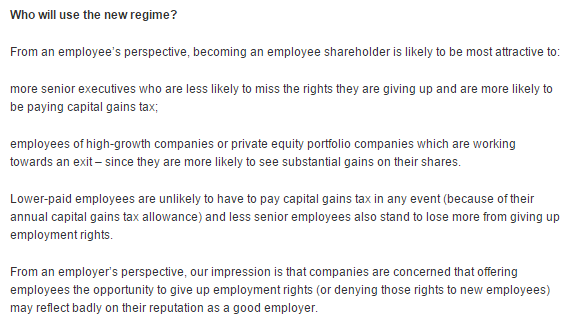
First, what the electorate is told about the purpose of these tax expenditures is often a stranger to the reality of what they actually accomplish. Last week, for example, I wrote about the so-called Shares for Rights scheme. It was heralded by Government as a mechanic to create partnerships between workers and owners of businesses. But the reality was it was little more than a £1bn bung to wealthy private equity buyers. And it appears to have been designed as such.

Second, how the benefits are shared is poorly understood. Richard Murphy has given the example here of how entrepreneur’s relief (which cost a total of £2.77bn in 2013/14) delivered a tax saving of a staggering £600,000 (on average) to each of 3,000 people. True it is that Richard was able to effect that calculation from publicly available information – but the same is not true of most tax expenditures.

Third, their costs – in tax revenues foregone – lack transparency. HMRC publishes three spreadsheets showing the costs attached to tax expenditures. The first – here – sets out what are described (somewhat misleadingly) as the costs of the “principal” tax expenditures. The third – here – describes the costs of “minor” tax expenditure reliefs (i.e. below £50m). But (and this is why I describe the title to the first as misleading) there is also a second – here – with the  title of “cost not known”. And that second includes some punchy items – like the £1bn+ cost of Shares for Rights – which should quite clearly come within the first, “principal” tax expenditures, spreadsheet.

And it’s not easy to avoid the conclusion that that lack of transparency is sometimes deliberate. Let me give some examples:

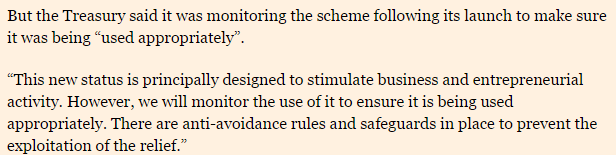
  • The Shares for Rights scheme appears on the “cost not known” spreadsheet – despite the fact that Treasury promised at the time to monitor it. Moreover, as I pointed out in my post last week, the OBR was perfectly well able to estimate the £1bn+ cost. So you might be forgiven for some scepticism about the assertion that Treasury and HMRC are unable to.
  • The second item on the “cost not known” spreadsheet is ‘10% wear and tear allowance.’ But how can that cost not have been known when, in July’s Summer Budget, the Government abolished the allowance, a measure that Treasury was able to estimate carried a forecast yield of £205m in 2017/18 (with more to follow in succeeding years)?
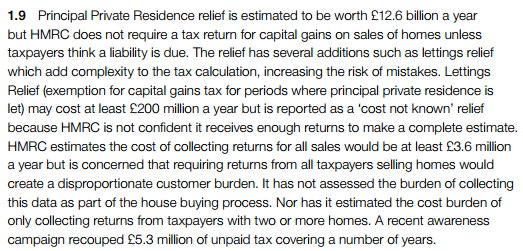
  • The National Audit Office has made similar (and related) points in relation to Lettings Relief:

Capture

But a number of the items on the first spreadsheet – misleadingly marked “principal” tax expenditures – are marked as “particularly tentative and subject to a wide margin of error.” What’s the rationale for including them but excluding lettings relief?

It is temping indeed to conclude that the “costs not known” spreadsheet might better be entitled “costs we’re not going to tell you.”

And even where the costs of tax expenditures are published there are profound doubts about the reliability of those numbers. As the NAO pointed out:

Capture

(and that’s four of only ten reliefs the NAO examined).

And, critically too, fourth, there is no ongoing assessment of whether those reliefs deliver value for money. Even if you make the generous assumption in favour of the Government of the Day that the reliefs do deliver its assessment of value for money at the time they’re introduced, the structure of that relief, its cost and what it delivers, is not routinely reviewed to take account of changes in the economic climate.

Take Agricultural Property Relief from Inheritance Tax, for example. It is expected to cost us £420m in 2014/15 but what value does it now deliver? When I looked at that question here I concluded that whatever had been its original intention, it now acted as a barrier rather than a spur to the productive use of agricultural property.

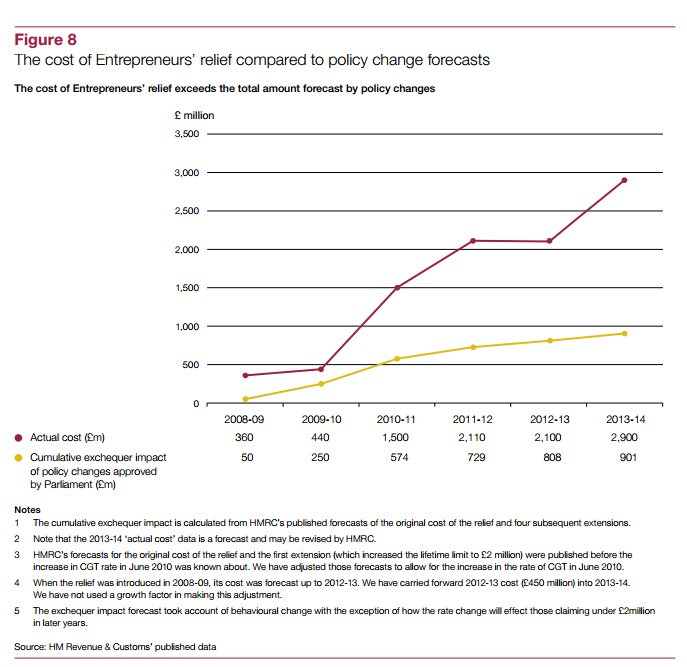
Or Entrepreneurs’ Relief (which I have already referred to). The National Audit Office has calculated that the actual cost is fully three times what was forecast.

Capture

but there is no suggestion that this heightened level of expenditure is necessary to deliver the purpose of “encouraging enterprise”. Or even that Government has seen fit, in light of this much higher level of expenditure than anticipated, even to ask itself the question whether we get value for money from that 300% increase in the originally anticipated cost.

To take another example, a detailed literature review of the effectiveness of tax expenditures on research and development (at a cost in 2014/15 of £1.7bn) presented a very mixed picture. Certainly those reliefs became less effective over time. And we also did not know how effective they were to start with:

Capture

I could go on. But you have the point. For further reading I recommend this Report from the National Audit Office and this one from the Public Accounts Committee.

Given the scale of tax expenditure – over £110bn on 50 tax expenditures alone (HMRC estimate there are may be 150 in total) – these problems of disinformation, poor knowledge of costs and distributional effects, limited understanding of value for money and a lack of monitoring are profoundly troubling.

So Corbyn has been right to highlight it, albeit that his particular focus on corporate reliefs is difficult to understand.

****

But these issues rise above the party political: they ought to be absolutely centre-stage for all of us who care about efficient and well-run Government.

We have been told to expect £20bn of savings in the Government Spending Review, the results of which will be announced with the Autumn Statement on 25 November.

Capture

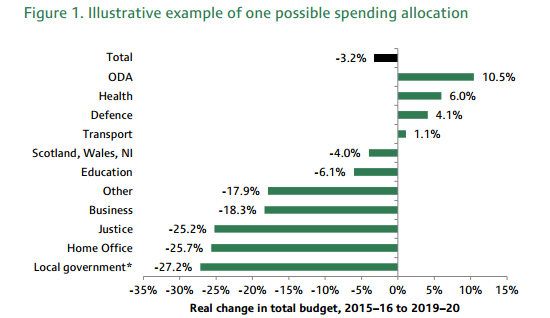
And, as has been well flagged, delivery of this £20bn number whilst meeting the pledge to ‘protect’ substantial parts of public spending, will involve swingeing cuts to some unprotected departments. Departments have been asked to identify prospective cuts of 25% and 40% – here’s one possible scenario the IFS has modeled:

Capture

And these cuts follow, of course, from substantial cuts achieved during the last Parliament.

No one would argue that the Conservatives – initially with the Liberal Democrats and now alone – have failed to look long and hard at how to cut expenditure. But where is the similar detailed focus on revenues foregone?

Because, of course, there is another way to achieve your goal of balancing the budget: you can increase your income. Or do a little of both.

It seems bizarre that you might look to balance the books solely through the mechanic of cutting £20bn of expenditure whilst turning a blind eye to the value for money delivered by your choices to forego income. Especially when there is a tidal wave of evidence that our understanding of that value for money is poor and the sums – in excess of £110bn for fifty tax expenditures alone – are so enormous.

Why would you choose to balance the books with one eye shut?

In another context Government rejected this analogy between revenues foregone and expenditure incurred.

Capture

And this rejection stands, apparently, despite the fact that these tax expenditures can and do take the form of cash payments made by HMRC to beneficiaries.

But whatever the merits of this reasoning – and I personally struggle to identify any – it is surely a truism to say that one can balance the books as easily by increasing your income as cutting your expenditure.

And you would only close your eyes to this truth if you were bent on shrinking the size of the state.

George Osborne: “Workers of the world, unite!”

Remember shares for rights?

I’ll let Osborne jog your memory for you. Here’s an extract from his 2012 Conference Speech:

This idea is particularly suited to new businesses starting up; and small and medium sized firms.
It’s a voluntary three way deal.
You the company: give your employees shares in the business.
You the employee: replace your old rights of unfair dismissal and redundancy with new rights of ownership.
And what will the Government do?
We’ll charge no capital gains tax at all on the profit you make on your shares.
Zero percent capital gains tax for these new employee-owners.
Get shares and become owners of the company you work for.
Owners, workers, and the taxman, all in it together.
Workers of the world unite.

And the deal would be sweetened by tax breaks. The first £2,000 of shares would be free of income tax. And the first £50,000 of shares free of capital gains tax.

It felt, even at the time, rather ugly. Should we be allowing employers to strip fundamental protections from their employees? Here’s the view of Lord (Gus) O’Donnell, speaking in the House of Lords:

Capture

You might think it even worse than that. We weren’t just permitting it. We were, through the tax system, incentivising it. To extend Gus O’Donnell’s metaphor, the rest of us, who fund these reliefs through their tax bills, were encouraging and subsidising the slave trade.

And the amount, and likely beneficiaries, of that subsidy was alarming too. As Paul Johnson of the IFS warned at the time:

it has all the hallmarks of another avoidance opportunity.

And although the cost was said to be fiscal washers:

Capture

The OBR highlighted that this was only because Treasury was looking at it only over a five year time scale (an oft-resorted to piece of trickery as I noted here). Beyond that timescale, the cost would quickly rise towards £1 billion per annum (real money, even in Treasury terms: by way of illustration about what was expected to be raised by the Mansion Tax):

Capture

But nevertheless we shouldn’t worry because:

Capture

Now, I raise this because of a chance remark from a friend at a very grand firm indeed who said that he was spending all of his time constructing shares for rights schemes for private equity and MBO clients. But none, he said, for ‘normal’ people.

Let me explain the swizz, and why it’s so valuable.

Forget about the income tax break. £2,000 might be meaningfully valuable to regular folks. But they’re not (as we shall see) the people for whom Shares for Rights was designed for. And it’s not what the OBR was worried about.

There are two other features that enable – you might almost think encourage – the real swizz.

First, the capital gains tax limit isn’t a cap on the amount of relief. It doesn’t give you the first £50,000 of gains tax free (saving you a mere £14,000 in tax). It’s a cap on the value of the shares when you get them.

Second, the shares don’t need to be ‘normal’ shares. They can be so-called ‘sweet equity’: very special shares for the very special people – the ‘value adders’ at the top.

Now. Assume you’re in private equity and you buy a company for £1m. What value might HMRC attribute to special shares which gave you a right to all of the sale proceeds above £1.25m in five years time? Not very much in a world where the Government can borrow over a five year term at an interest rate of only marginally above 1%. Less than £50,000?

Of course, the invariable logic of private equity deals is that you think you’ll be able to obtain high capital growth. Without that belief you don’t transact. If you’re wrong, then of course the capital gains tax break is worth nothing. But if you’re right?

Assume that in five years time you sell the company on for £1.8m. You’ve now got a capital gains tax break on £550,000 worth £154,000.

I’ve simplified my example – but not relevantly so. Here are some other ones from the law firm Bird & Bird. They conclude, tellingly, by asking: “Is this too good to be true?” (I’ll spare you the suspense. The answer is ‘No’. Or what passes for it if you’re a lawyer).

But don’t just take my word (and Bird & Bird’s) that it’s best used by senior management in private equity deals. Look here. Or here. Or here. Or here. Or… well, you get the picture.

Indeed, of course, as Magic Circle firm Linklaters observed, it was never even designed to be used by lower paid employees.

Capture

So much for workers of the world uniting. (Although there is a sort of uniting: together the rest of us have to make up the lost tax.)

Oh, and how’s that monitoring going by the way?

Not so good. I couldn’t find a figure – although one is given for other types of employee share schemes. And I did find an HMRC document entitled: “Tax allowances and reliefs in force 2013-14 or 2014-15: cost not know” which contains a reference to, yep:

Gains on disposals of exempt employee shareholder shares

So whilst it could be the £1bn predicted by the OBR. It could be more. Much more. It could be the whole amount being saved in 2016-17 by cutting tax credits.

Despite what Treasury promised, we Just. Don’t. Know.

The Tax Gap, Updated

This morning saw the release of new Tax Gap figures for 2013/14. Here are some highlights.

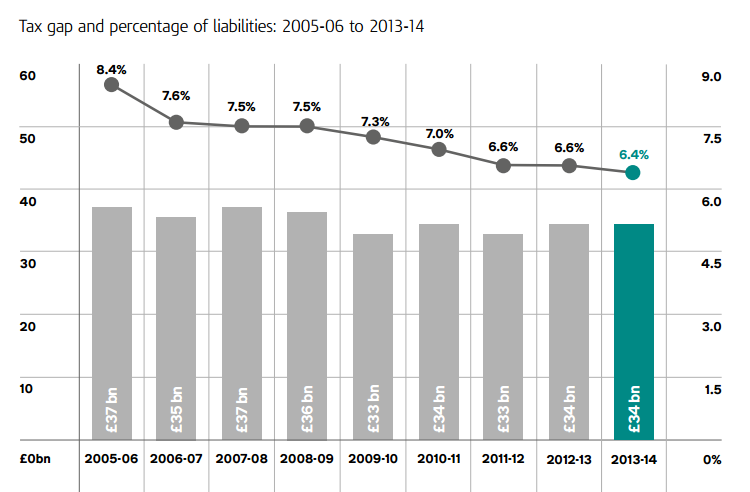
In cash terms the Tax Gap remained static at £34bn but in (the more meaningful) percentage terms it fell from 6.6% to 6.4%.Capture

What can we ascertain from these figures about HMRC’s performance if we dig a little deeper? (This question reflecting, as I observed here, that the Tax Gap is better understood as a performance metric than an anti-austerian’s El Dorado?)

This chart probably sums it up best.

Capture

For me, the stand-out trends are these.

First, we are beginning – for the really radical measures will take effect only in the tax year 2014-15 – to see the fruits of the Coalition’s success in tackling personal tax avoidance. One can also see this trend (more starkly still) in the slump in the disclosure to HMRC of tax avoidance schemes (for those interested, I have discussed that slump here).

Second, we also see (in relation to excise duties) the effects of the very substantial cuts to HMRC’s FTE staff (more on this below) in the excise gap figures. The Summer Budget appears to have recognised the deleterious effects of these cuts:

Capture

(although the cynic in me notes that no figure was there given as to what that additional resource would look like).

But perhaps the most interesting question is what the future will look like. For we are, it seems to me at least, at an inflection point.

As I noted here, HMRC has sustained very substantial cuts in budget and staffing numbers since 2005-6:

Capture

My perception is that the progress – despite these cuts – in closing the tax gap reflects a number of different trends.

First, (see here and here) the Conservative Party is presently culturally better equipped to tackle avoidance and evasion than is Labour. The problems of avoidance and evasion are complex and will not be solved by a purity of moral purpose alone. Likely it is that my colleagues on the left will react to this assertion with outrage. But it is common ground across the left spectrum: see this, for example, which I co-wrote with Richard Murphy. And under Cobyn the problem has become worse not better as I noted here:

Capture

My intention is that Labour should react, not with outrage, but by recognising the issue and moving to address it.

Second, a consequence of their expertise is that the Conservatives have been able to alleviate the effects of cutting resource through some radical legislative steps: the General Anti Avoidance Rule, Follower Notices, Accelerated Payment Notices, Direct Recovery of Tax Debts to name but a few. There is much more to do – as the Conservatives rightly recognise – in particular around offshore evasion by wealthy individuals which, in consequence of campaigning work done largely on the Left (to which I have been a modest contributor), has risen up the political agenda.

But legislative steps are an imperfect solution. They are imperfect because they cannot address the resource heavy areas of smuggling, the shadow economy and so on. Technological advances – see this piece from the Telegraph on HMRC CONNECT – can assist but we also need investigators.

Perhaps more profoundly, they are imperfect because they create imbalances in the system. Over time they will erode – indeed, they are already eroding – the reputation HMRC has previously enjoyed for fair dealing. I hear this frequently from business leaders – and it is borne out by my personal experience too. If this situation goes unalleviated – and my conversations with senior HMRC staff suggest it will accelerate rather than diminish – it will cause serious harm to HMRC’s ability to collect tax and to the investment climate. This is a very real concern.

However, third, in the short and medium term, I expect these figures to improve. The tax avoidance figures next year will show the effects of the adoption in the Finance Act 2014 of a slew of radical legislative measures – and there is more to come from further legislation in subsequent Acts. And at some stage soon – although the current data records no such trend – we will see some modest benefits from a growing focus on evasion. Modest, because unless someone is brave enough really to tackle the shadow economy, our scope for improvement is limited.

Some tentative thoughts on a sugar tax

It’s a tough business trying to structure a sin tax.

Because your purpose is somewhat confused. Although we readily think of alcohol and tobacco we might also include amongst sins discouraged by taxation flying, quarrying, landfill and no doubt others too. Usually we tax exclusively to raise revenue but not so with sin taxes. Speaking of air passenger duty John Healy, in 2003 Economic Secretary to the Treasury, said in a written answer:

Air passenger duty was introduced in 1994 as a measure whose principal purpose was to raise revenue from the aviation industry but with the anticipation that there would be environmental benefits through its effect on air traffic volumes.

Are you trying to maximise revenue? Or dissuade commission of the sin? And if dissuade, how much? A little bit, presumably, because if you really wanted to dissuade, you’d ban it.

It’s tempting to say these considerations plague the design of sin taxes. But that would suggest, falsely, an elevated status for design. You either fudge it – no, you usually fudge it – or you take intellectual dignity from looking to raise a particular sum of money to spend on countervailing measures. Take this example from the 2001 Budget:

Capture

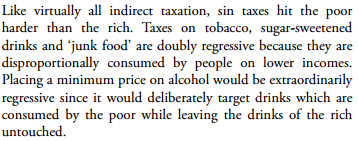
And they can be regressive, sin taxes. Can, because assertions that they invariably are (see, for example, from the Adam Smith Institute):

Capture

should be treated with some caution. It all depends on how they’re structured.

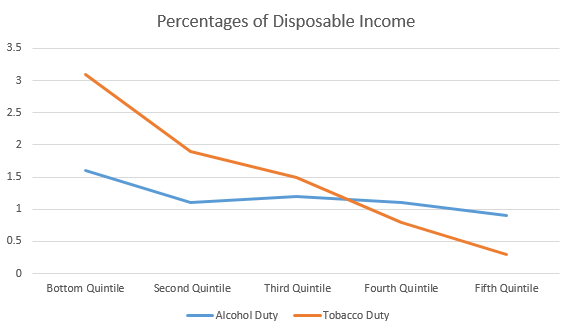
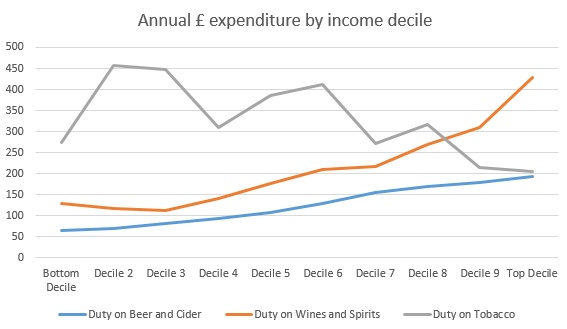
The proportion of your disposable income consumed by tobacco duty, for example, falls sharply as your income rises. But with alcohol, not so much (source: ONS).

Capture

Indeed, the percentage of our expenditure – as opposed to our disposable income – we expend on alcohol duty is absolutely static as we rise up the income scale (see Table 3(c)).

These points emerge even more powerfully if you look in cash terms (see Table 14).

Capture

So the rich smoke less, but drink more, than the poor. I know I do – and I’m pleased I’m not alone.

You’d want to be careful drawing conclusions from this data. But you might tentatively draw a few.

(1) It’s not taxes that discourage the better off from smoking. Although the disincentivising effect of tobacco duty declines as you rise through the income deciles still the rich smoke less. This lower propensity to smoke must derive from something else.

(2) People drink more as they can afford to (Oscar Wilde was wrong: work isn’t the curse of the drinking classes at all). And this suggests that alcohol duty does suppress consumption at its present level – and would suppress consumption more if raised.

(3) If you were inclined to conclude that the rich smoke less because they’re better educated as to the dangers of smoking you’d then have to answer the question why they drink more. This might drive you to conclude that social fashions play a part too.

Are there any implications for a sugar tax? Some tentative ones.

(1) You might start by noting that alcohol and tobacco have no (legal at any rate) substitute goods. The decision you face is to consume or not to consume. But increasing the price of sugary foods and drinks might more readily cause consumers – especially price sensitive ones – to switch to alternatives.

(2) The data on correlations between obesity and income is more complicated than you might think. Whilst for women obesity seems clearly to be correlated with low income the picture is less clear for men. But where there is a relationship, a sugar tax will be regressive – if it’s set at a level where the poor will pay it. The higher the level at which you set it, the more likely the price sensitive consumer will switch to products not covered by the tax. A sugar tax could easily be like alcohol duty – barely regressive at all.

(3) The mixed picture around alcohol and tobacco duties suggest that factors other than affordability are important too. Changing social mores may well rank high amongst them. Perhaps you would earmark revenues – as with the aggregates levy – to fund measures to achieve that change. And to offset the effect on the poor of price rises on sugary foods – by encouraging thrifty and health eating.

On Targeted Anti-Avoidance Rules

[Readers’ Note: I wouldn’t normally publish a piece (reproduced from the Tax Journal, 15 October 2015) written for the technical reader on this blog. But it touches on an important and broader policy issue. If it assists the non-technical reader, a “Targeted Anti-Avoidance Rule” is a (now very common) statutory rule that (relevantly) says a transaction will attract a favourable tax consequence (or fail to attract an unfavourable one) only where achieving a tax saving is not one of the main object or one of the main objects of that transaction.]

We might, rather loosely, divide reliefs in our tax system into two types: those designed to shape our tax system – by improving progressivity, ensuring the ‘correct’ calculation of profits, and so on – and those through which the Government of the day seeks to encourage certain types of behaviour in order to advance its policy objectives. Come to think of it, there’s a third type too: those through which the Government of yesterday sought to deliver its policy objectives, and which no-one has bothered to remove. But I’ll park that whine for another day.

What I want to focus on here is that second type. Government spends – perhaps more accurately it relinquishes in taxable receipts but the result is the same – north of £100bn on tax expenditures.  And it does this because it hopes, though the provision of those reliefs, to change the way in which people behave. It must do, mustn’t it, because otherwise it’s wasting that money.

Now let’s add another element to the mix: Targeted Anti-Avoidance Rules. What function do they perform in relation to tax expenditures? The answer, clearly, is that they switch the relief on or off according to whether the relief is being accessed for good or bad reasons.

So far so good.

But what happens if the TAAR switch gets stuck at ‘off’? That’s no rhetorical question, as the Lloyds Leasing saga (see [2015] UKFTT 0401 for the latest episode) shows.

I’m not going to set out here the backstory. Stripped to its essentials, Lloyds Leasing arose in the context of capital allowances, a form of tax expenditure designed to encourage capital investment, and involved the question whether the main, or one of the main, objects of capital investment undertaken by the taxpayer was to obtain a capital allowance.

Now, even outside a tax expenditure context, main object tests are not amenable of fine analysis. I can understand how a draftsman might sensibly ask a court to identify the main object of a transaction. But “the main, or one of the main, objects”? How do you make sense of a formulation predicated on a three-tiered causative hierarchy (main object, one of the main objects, and not one of the main objects) and how is a court sensibly to distinguish between the second and third tiers?

That’s a rhetorical question, by the way, and a good thing for you, Dear Reader, because although Judges, having no alternative, strive hard for a semblance of sensible analysis what we end up with, is cakes, icing on cakes, cherries on the icing, and now (thank you, Llloyds Leasing) “headroom… above the icing on the cake”.

But profound though these difficulties are when TAARs are used to regulate liabilities to tax they are as nothing compared to the difficulties when TAARS are used to regulate the availability of tax expenditures.

We have tax expenditures type reliefs because we want to alter the way in which taxpayers behave. This must be so; there is no other reason why Government would incur the expenditure. But if a taxpayer responds to the incentive, and changes her behaviour, how does she then contend that obtaining that relief was not one of her main objects?

This was the question in Lloyds Leasing. Before the Court of Appeal, Jonathan Peacock QC contended, unsurprisingly, that you can’t construe the main object test in such a way as to “emasculate” the availability of the relief. You had to read it in light of the fact that the relief was designed to incentivise action. Speaking, obiter, Rimer LJ doubted this: he said it amounted to “an unwarranted suggestion that the ordinary interpretation and application of the inquiry mandated by [the main object test in] s 123(4) must in some manner be diluted.”

Even approached as a matter of pure linguistic construction, I don’t think this can be right. To denude the question posed by subsection (4) (do you have a tax reduction main object?) of its statutory context (behave in this way and you’ll get a tax reduction) is to misapprehend the interpretative exercise facing a judge. But the point emerges even more forcefully if you judge the quality of that reasoning by the outcome it produces.

And, fortunately for us (although unfortunately for Lloyds Leasing), we are able to do that. Because the matter then went back to the First-tier Tribunal, Mr Peacock QC ran the point again, the FTT roundly rejected it, and we were able to see the outcome it produced.

At [84]-[85] the FTT appeared to regard the fact that the transaction would not have been entered into without capital allowances as somehow antithetical to the availability of those allowances. But the very purpose – the only purpose – of having a tax expenditure relief is to cause people to alter their behaviour. Yet applying the main object test in such a way denies them the relief if they do. And if, you might well ask, they would behave in such a manner absent the tax expenditure, what on earth is the general body of taxpayers doing funding the relief? (Don’t worry. That’s a rhetorical question too.)

The point is made again at [87]-[88]. The FTT found that the fact that Lloyds Leasing sought tax advice to ensure that the capital allowances would be available and “structur[ed] the transactions in such a way that (as it thought) they would indeed be available” was somehow inimical to its entitlement to those allowances. But Government has defined the types of behaviour it wishes to encourage and has encouraged people to bring their behaviour within that definition by providing tax reliefs to those that do. Having so behaved, why should they not get the relief?

I could go on.

The problem with this approach is, of course, and even leaving aside the fact that it strips intellectual and moral dignity from witnesses asked to affect before the FTT an indifference to the very tax relief the draftsman used to encourage them, is that it fixes the tax relief switch permanently to the off position. One consequence of this will be a reduction in the cost attached to tax expenditures – but if they are to switched off, that’s properly a decision for the legislator not for the courts.

And that’s the rub: by reasoning thus the courts strip from Parliament a critical tool for shaping behaviour.

The Credit Crunch? Labour’s fault, says Shadow Treasury Minister

Tax expertise runs thin in the Labour Party at the best of times. The Party almost coped under Ed Miliband. But the staffers he brought in have all moved on. And the relationships John Wrathmell (Miliband’s widely admired Head of Economic Policy) worked so hard to develop – have withered or died. Even Richard Murphy – who seemed to many likely to occupy a place at the heart of the Opposition – has no role and appears disenchanted with the project. To my knowledge there is now no one – at all – in the Shadow Team expert in the revenue raising side of Government finances.

So when I learned that Rob Marris, MP for Wolverhampton South West, was to take the tax brief as Shadow Financial Secretary to the Treasury, I was interested to see how he performed.

The Committee stage of the Summer Budget Finance Bill concluded on Thursday. During discussions David Gauke (Marris’ opposite number) pointed out that the position Marris was taking was different to that Ed Balls had previously taken. He then added gently:

I am not sure that Ed Balls is a particular hero of the hon. Member for Wolverhampton South West.

Not gently enough. Marris needed no further invitation:

Capture

Yep. You read that right. Labour was responsible for the credit crunch. To which Gauke responded – well, wouldn’t you have? – with:

Again, I think we can find some consensus.

I suppose it’s too much to expect that Marris might also have mentioned (of many examples) this Cameron speech from 2006:

Capture

which showed that Labour and Ed Balls was on the right side – not right enough, but even so – of the debate around appropriate levels of regulation.

But then, if the real enemy is Labour’s record in Government, why would you?

The Savings from Tax Credits

Is it right to say that closing the deficit requires that we tackle tax credits, a measure which on any view will hit the poorest hardest?

Here’s the section in the Summer Budget Red Book which identified the savings from – freezing, limiting entitlement to, increasing the taper rate of and reducing income thresholds for – tax credits.

Capture

If you add up the final column (which shows the savings for 2020-21) excluding the benefit cap (a separate measure) you reach a figure of £9.735bn. Obviously that number takes in also some measures not connected with tax credits but as the savings are not dis-aggregated between these different measures I’ll assume against myself that everything under these headings relates to tax credits.

How else might that £9.735bn be funded?

Here are some other measures. These are also taken from the same Summer Budget (and again the last column relates to 2020-21). Where necessary, I’ve added a little narrative.

Capture

The Conservatives pledged in their Manifesto to increase the personal allowance to £12,500. Were they to do that the IFS estimated (see page 14) the cost in 2020-21 to be £4bn. Let’s assume they deliver on this Manifesto pledge.

Of this Manifesto Pledge, the IFS observed (although the emphasis is mine):

In part because so many people do not pay income tax, and in part because the biggest gainers are two-earner couples where both can benefit from the higher allowance, increases in the personal allowance benefit those in the middle and upper-middle parts of the income distribution the most.

Capture

Again, the Conservatives pledged in their Manifesto to increase the higher rate threshold to £50,000. Were they to do that the IFS estimated (see page 15) the cost in 2020-21 to be £1.9bn. Let’s assume they deliver on this Manifesto pledge. (And it’s worth noting that this yearthe higher rate of income tax will be paid only by the 5 million highest earners in the country: see table 2.5 for 2015-16).

Capture

This measure hardly requires explanation. But HMRC’s latest inheritance tax release shows that (in 2012-13 the latest year for which the figure is given) Inheritance Tax was paid by only 17,917 estates.

Capture

At 20%, we have the lowest rate of corporation tax in the G20, alongside Russia and Turkey. The case for decreasing it to 18% is not easy to see. More on this for those interested here.

Add those sums together and you arrive at £9.3bn – within fiscal spitting distance of the £9.735bn figure above.

If you’re a stickler, I’ll take you back to the 2014 Autumn Statement (the final column here relates to 2019-20 but, again, ignore this difference).

Capture

As I showed here, the benefits of this measure go disproportionately to buy to let landlords.

And voila. You’re over the top.

Of course there’s an ideological decision being made as to how the deficit should be closed.

A Short Monograph in favour of the Taxation of Dead Cats

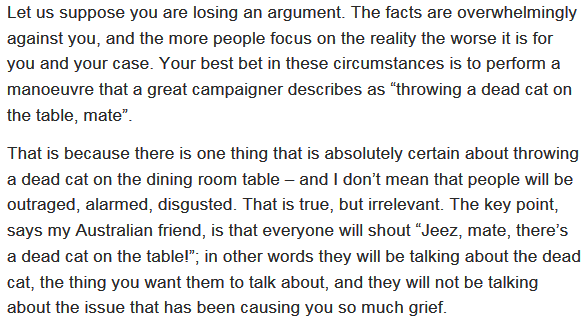
Capture

Copyright: Boris Johnson, 2013.

***

Here are some dead cats frequently cast onto your dining table by misbehaving businesses.

We comply with the law in all jurisdictions in which we operate. Unpacked, this merely means: “because it’s lawful, we do it.” Tax avoidance – even in its most egregious forms – is lawful. If it isn’t lawful, it doesn’t avoid tax. But that doesn’t mean it’s not morally questionable. If I avoid tax, I increase the burden on those who pay theirs. If I am a business and I avoid tax I can undermine those businesses who don’t avoid it. And the allegation that behaviour is not moral is not answered by the response: “it’s lawful”. If you don’t believe me, try it on the spouse you’ve been unfaithful to.

Look at all the other taxes we pay. Yep. You pay them because the law obliges you to. The lipstick applied to this pig is the technical terminology of TTC or Total Tax Contribution. It is absolutely true that businesses are wealth generators and make a critical contribution to our society. Out of economic self interest (it’s called the profit motive, Ladies and Gentleman), they employ staff who also pay tax, generate economic activity for other business who also pay tax, and so on. They also pay other taxes. But none of this stuff – important though it is – gives them a free moral pass when it comes to the moral imperative to pay their share of this tax too.

If MPs don’t like it they should change the law. This ignores the limited scope that our domestic Parliament, bound by a web of international tax treaties and EU law, has unilaterally to improve the law. Think Global Climate Change Summits with whistles. And whatever you’ve read, no Government is a fan of tax avoidance. It reduces its ability to achieve its real political goals: for this Government, for example, perhaps reducing the headline rate of income tax. On a whim (we’re strange creatures us tax lawyers) I traced back as far as a 1959 Manifesto political parties promising to “change the tax system to deal with the tax-dodgers”. Every Government ever has tried: the fact that none of them has succeeded might tell you something.

***

But why do I say we should tax these Dead Cats? And how should we tax them?

They add to the moral failing of tax avoidance a further moral failing of attempting to dissemble the first moral failing away. So when you see it, call it out. Tax it reputationally. #DeadCat

***

I don’t want to kid you.

Not all behaviour that avoids tax has a moral dimension. No one sensible could say that moral obloquy attaches to someone who avoids capital gains tax by buying shares through an ISA. Nor is there any principal – legal or moral – that obliges us to transact in ways that maximise the tax we have to pay. And there are many, many cases where it’s difficult to work out whether what we’re doing is consistent with what Parliament could have intended.

But none of this has as its consequence that – as some assert – there is no moral component to taxation. There is.

***

There is more work to be done in this field.

Recent Government initiatives have looked beyond the hard yards of purely legal solutions to these issues. They have sought to focus on the wide open spaces – identified by a number of thinkers in the field, including me – of risk management: both reputational risks for businesses and financial risks for Government. How can Government raise the reputational risks for businesses that engage in ‘bad’ tax behaviour? How can it keep at Gas Mark 9 the temperature under tax avoiders? How can it increase the pre-tax cost attached to behaviours that focus on improving post-tax returns? And how can it reduce the risks to public finances?

Thankfully, there is more to come.

A further note – on Real Facebook’s Accounts

The release by UK Facebook of its accounts made some media noise. Heather Stewart of the Guardian covered them here, Richard Murphy here, Vanessa Houlder here, Hugo Rifkind here and your present correspondent observed that UK Facebook was unlikely ever to make a, or a material, taxable profit here.

Most – with a couple of honorable exceptions – of the twitter taxperts rallied round UK Facebook. A number of bad points were taken in its defence – and no doubt one or two good ones as well. I would not want to pretend – for it is a long mile from true – that I have any monopoly on insight.

It does surprise me that this is the invariable and knee-jerk reaction to stories asking whether Big Business is misbehaving. Although not quite as much as it surprises me that many taxperts don’t understand that the consequence of their myopia is poor understand of tax issues: journalists don’t feel able to call on experts that they can’t trust to tell the unvarnished truth. This is a real bugbear of mine: I’ve written about it (in two addresses to my colleagues) here and here. As I put it in the first of those two posts:

Here’s a short prescription. Rather than bemoaning the limited understanding of public and media, we should work to improve it. I speak to a lot of journalists – several a day – and I’ve only ever spoken to one who wasn’t interested in the truth.

But we need to be transparent about the premise from which we proceed. When we act in a professional capacity it’s right that we talk our own book. Everyone understands that we sometimes speak as lobbyists. But it’s important to signal when we do. Otherwise we become part of the problem. If we merely stand on the sidelines and criticise, we don’t merely ignore Gandhi’s injunction to ‘Be the change you wish to see in the world.’ We thwart it.

***

Anyway, on to UK Facebook.

One of two points taken in its defence was that you can tell that there is no funny business in its accounts because if you look at the rate of corporation tax paid by Real Facebook on its global profits that rate is really rather high. If true this is a decent point: why would you shift profits out of the UK and into another jurisdiction where you’d pay as high or an even higher rate of corporation tax?

But is it true? Well, at first glance, it looks true. Annex 2A of this document, prepared by the EU Commission, states that Real Facebook paid 45.5% tax on income in 2013. And if you go to Facebook’s own accounts, at Note 13 you find this (and I should note that the accounts refers to income tax which is what our American cousins call corporation tax. For ease of use for my UK readers I am going to call it US corporation tax) :

Capture

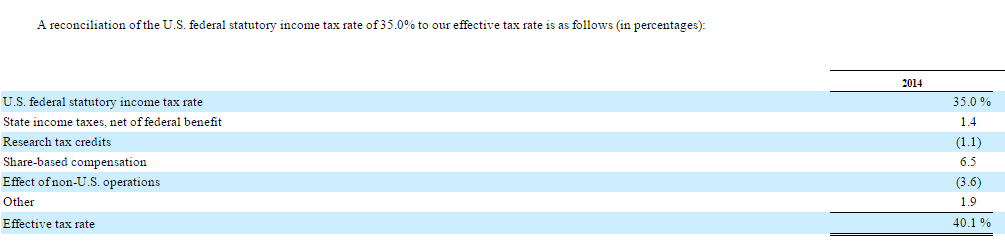
And this:

Capture

They’re probably too small to read on the bus but what they show is that in 2014, Real Facebook made provision for $1.97bn of US corporation tax, an effective tax rate of 40.1% on worldwide income. In 2013, the equivalent rate was 45.5% (hence the Commission figure) and in 2012 it was a remarkable 89.3%!

This surprised me a little because, as the Note itself records, the statutory rate of US corporation tax is 35%. And few of us tax professionals are paid to increase above the statutory rate the amount of tax our clients pay. So I did a little digging.

Not that much, mind. Further down in the very same note you find this:

Excess tax benefits associated with stock option exercises and other equity awards are credited to stockholders’ equity. The income tax benefits resulting from stock awards that were credited to stockholders’ equity were $1.85 billion, $602 million and $1.03 billion for the years ended December 31, 2014, 2013, and 2012, respectively.

So alongside the US corporation tax paid, Real Facebook also received what are shyly described as “income tax benefits” arising from share options (I’ll talk about share options for shorthand although there will be other share based remuneration too) it had granted, of £1.85bn.

Hang on a second: so is the tax provided for by Real Facebook in 2014 $1.97bn (at an effective tax rate of 40.1%) or $1.97bn minus 1.85bn (at an effective tax rate of 6%)?

To find the answer to that question, you need to dig a little deeper.

At page 42 you find this:

2014 Compared to 2013. Our provision for income taxes in 2014 increased $716 million, or 57%, compared to 2013, primarily due to an increase in income before provision for income taxes. Our effective tax rate differs from the statutory rate due to non-deductible share-based compensation, operations in jurisdictions with tax rates lower than the U.S., and tax research credits. Our effective tax rate decreased primarily due to a change in our geographic mix of pre-tax income.

The bit that’s emboldened in that quote was emboldened by me. Now I am not an expert in US Accounting Practice or the US Tax Code. But my understanding is that under US Accounting Practice (and the same is true here) an employer get an accounting deduction when it grants most common types of share option based remuneration to employees to reflect the fact that its incurred expenditure. But under the US Tax Code it doesn’t get a tax deduction when it grants those options; instead it gets that tax deduction later on when the options are exercised. And the amount of the deduction depends on how much the option is then worth.

This timing mismatch has a number of consequences. But in particular, it means that a business with substantial staff costs which costs it chooses to meet in the form of share options will always show a high rate of US corporation tax.

Example. Assume for the sake of example that in 2014 I have income of 100, staff costs of 90 all of which I meet by granting share options of that value, no other costs and the rate of corporation tax is 35%. I will have accounting profits of 10, taxable profits of 100, I will pay tax of 35 and I will have an effective rate of corporation tax of 350%.

But, of course, in the real world, you can’t ignore that, in the future, when those share options are exercised, you will get a tax benefit.

Assume that the options in Example were all exercised on 1 January 2015 at a price which reflected my expectation of their value at the date in 2014 when I granted them. I’d then receive a tax benefit of 35% of 90 or 31.5. That tax benefit would be attributable to my activities in 2014. And if you matched it to 2014 I would have paid tax on my 2014 activities of 35-31.5+ 3.5 and my effective tax rate would be 3.5 on 10 or 35%.

Of course, in practice it’s a little more complicated than this example implies. In 2014 we would show on our balance sheet an expectation of what tax benefit we expect to get in the future (an item called a deferred tax asset) which we would adjust upwards or downwards depending on how closely actuality delivered on our expectations (perfectly in my example, less so in practice). And the tax benefit we got might not be attributable only to our activities in the year in which we got it (it is in my example) but in earlier years too. But these complexities shouldn’t obscure the fact that the tax benefit derives from our activities and reduces the amount we have to pay to the tax authority.

In 2014, Real Facebook made an upward adjustment to its deferred tax assets attributable to stock options of $1.85bn. That figure is not wholly attributable to Facebook’s activities in 2014. But it does reflect share options granted by Real Facebook to its employees – which is a cost of Real Facebook doing business. And it does reflect a 2014 upwards adjustment to Real Facebook’s expectation of tax benefits arising from the grant of those share options. And you can’t ignore it and pretend it has nothing to with Real Facebook’s real US corporation tax liability. And if you match it to Real Facebook’s actual provision for US corporation tax in 2014 it drives Facebook’s effective tax rate down from (an improbably high) 40.1% to (a less surprising, for us cynics at least) 6%.

And the argument that you can tell that there’s no funny business in UK Facebook’s accounts because of the high rate of corporation tax paid by Real Facebook simply evaporates.

***

I said there were two arguments advanced by the taxperts in UK Facebook’s defence. The other is the total tax contribution argument. It is that you shouldn’t focus on the corporation tax paid (or more accurately not paid) by UK Facebook because of all of the other taxes that UK Facebook causes to be paid. In my original piece on UK Facebook’s accounts I said of it this:

In any event, clearly, it’s no defence for X, facing an allegation that it doesn’t pay the appropriate amount of corporation tax, to say: ‘well, I’ve done some other things that the law requires of me.’

The commentariat didn’t think there was any of that going on. Here, by way of example, was one response from a commentator:

I can’t imagine anyone would seek to excuse legal non-compliance in one area by saying ‘but they comply with some other law’…

It’s worth pausing to note that I was making a general observation about how tax avoidance is justified. And that justification certainly is advanced. Speaking yesterday of UK Facebook here Chas Roy-Chowdhury, head of taxation at the Association of Chartered Certified Accountants, said this:

Capture

This is, it seems to me, a diversion. The allegation that someone has avoided corporation tax does not seem to me to be answered by pointing to the fact that they comply with other of their legal obligations.